


What a lotion bar is made of
A lotion bar usually has three building blocks: a wax, a plant butter and one or more liquid oils. The wax gives it its shape. As the bar cools, the wax crystallises and holds the oil in a fine network; scientists call this an oleogel. How firm the result is also depends on the oil: with the same 6% beeswax every time, changing only the oil changed the firmness and how well the oil stayed bound (Frolova et al. 2022). A plant butter such as shea or cocoa butter makes the bar firmer and the skin feel richer.
The wax also explains why the bar softens in your hand: beeswax melts over a range of about 61 to 66 °C and already becomes plastic at around 32 °C (Huanbutta et al. 2026). Vegan lotion bars use plant waxes instead. Candelilla wax, for example, melts at 68.5 to 72.5 °C according to the EU specification, beeswax at 62 to 65 °C (Regulation (EU) No 231/2012); it is harder, so a formula usually needs less of it. More in Candelilla wax or beeswax.
Because there is no water in it, a lotion bar needs no emulsifier. Water-free bases made of waxes, oils and fats form a film on the skin that reduces water loss; they are considered nourishing but also rather greasy (Oliveira and Almeida 2023). The background is explained in Water-free cosmetics, Emulsifiers in cosmetics and Occlusion and TEWL.
Lotion bar vs hand cream, balm and lotion: the terms
Skin care names are not uniformly defined. Even for medicines, lotions, gels, creams and ointments are defined differently depending on the source. A study by the US Food and Drug Administration found that creams and lotions differ mainly in how they flow, while ointments and creams differ mainly in water content and composition (Buhse et al. 2005). For cosmetics, what counts is what is in the ingredient list, not the name on the pack.
| Term | Water | Texture | How it is used |
|---|---|---|---|
| Lotion (body lotion) | yes, usually the main ingredient | pourable | from a bottle or pump, over large areas |
| Cream | usually yes | spreadable | from a tube or jar |
| Lotion bar, body bar | no | solid, softens on warm skin | rubbed directly over the skin, often for the body |
| Solid hand cream | no | solid, often in a tin or stick | rub a small amount over the backs of your hands, massage in |
| Balm, salve | usually no | soft, can be scooped with a finger | targeted on individual spots |
| Body butter | depends on the product | solid or creamy | over large areas, often after showering |
A more detailed explanation, including the line between cosmetics and medicines, is in Ointment, balm, butter, solid cream: the difference. Why solid care feels different from cream in a tube is explained in Solid cream or tube.
How to use a lotion bar
- Warm the bar briefly. Hold it in your hand for a moment or rub it straight over your skin.
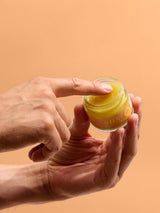
- Use a little. Two or three strokes per arm, leg or back of the hand are enough. Too much stays on the skin as a film.
- Massage in. Spread it with your palm until the skin no longer looks shiny. On your hands, start with the backs, then the fingers.
- Good timing: after a shower or hand wash, when your skin is dry but still warm.
- Store it dry and cool. In a tin the bar stays clean and does not lose its shape in your bag.
More on the right amount in How do I apply a solid cream?, on storing it in the heat in Storing solid cosmetics and on travel in Solid cream in hand luggage.
What to look for when buying
- Ingredient list: it is ordered by weight (Regulation (EC) No 1223/2009, Art. 19). Wax, butter and oils should come first. If “Aqua” appears, it is not a water-free lotion bar.
- Fragrance: many lotion bars are scented with essential oils. If you do not want that, look for a list without “Parfum” and without names such as Limonene or Linalool (Without fragrance and essential oils).
- Vegan or not: Cera Alba is beeswax; vegan bars use candelilla wax, for example.
- Packaging: a bare bar needs a dish at home. A tin protects it on the go; if matching refills exist, you can fill it again (Refillable hand cream).
- Size: small formats are enough for your hands; for the whole body a larger bar is more practical.
A detailed checklist for hands is in Solid hand cream: what to look for.
Frequently asked questions
Is a lotion bar the same as a solid hand cream?
The principle is the same: water-free, made of wax, butter and oil. Lotion bars are often larger and meant for the body; solid hand creams are smaller, often a little firmer and made for hands.
Does a lotion bar feel greasy?
Often a little right after applying, because a film stays on the skin. With a smaller amount and thorough massaging this becomes much less. More in Greasy or cared for?.
Does a lotion bar melt in summer?
It can soften, for example in a car or in the sun. Once it cools down, it sets again. A tin stops it from running out while it is soft.
Can I make a lotion bar myself?
Yes, from wax, butter and oil, measured by weight. Basic recipes and what applies if you sell them are in Making solid cream yourself.
How long does a lotion bar last?
Without water it is less prone to spoiling from germs; its shelf life is limited mainly by how fresh the oils are. Check the date or the open-jar symbol and the smell (Shelf life and the PAO symbol).
At forpeople
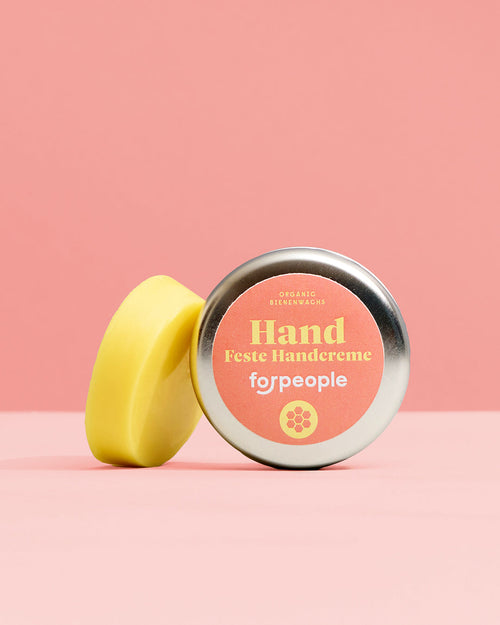
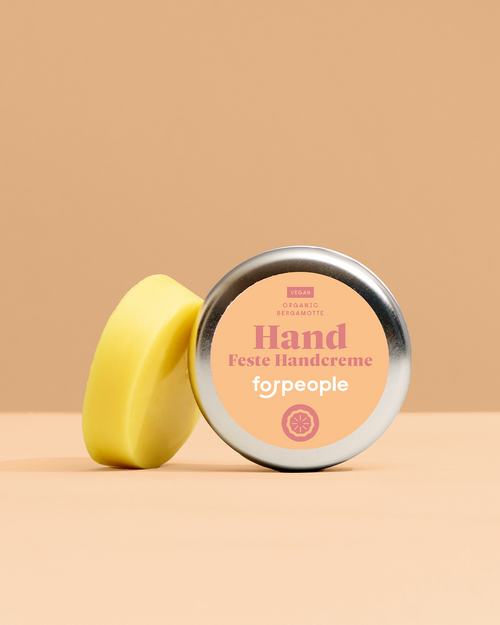
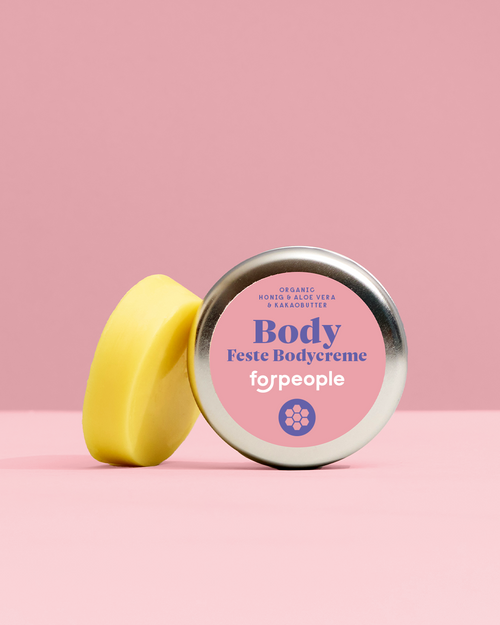
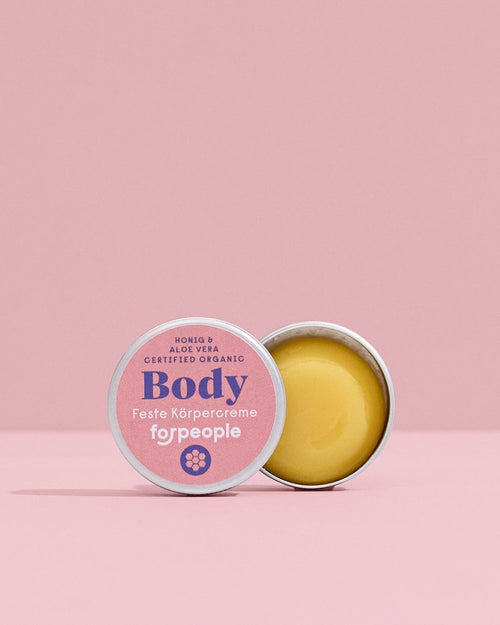
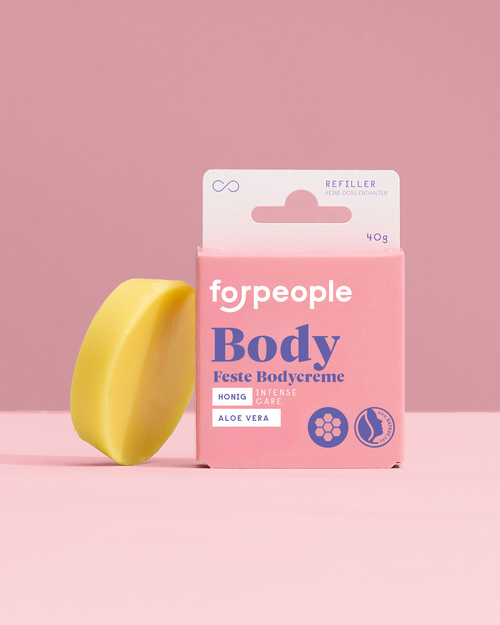
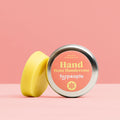
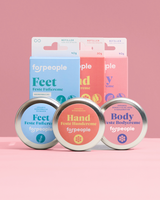
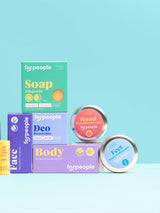
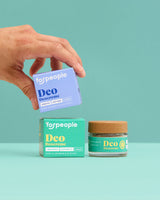
We do not call our products lotion bars but solid hand cream and solid body butter. They follow the same water-free principle, but they come in a metal tin that you can refill. For your hands there is the Solid Hand Cream - Beeswax (30 g, €9.90) with no added fragrance according to its INCI, and the vegan Solid Vegan Hand Cream - Bergamot (30 g, €9.90) with candelilla wax plus lemon and bergamot oil. For your body there is the Solid Body Butter - Beeswax & Aloe Vera (40 g, €9.90) made of cocoa and shea butter, olive and sunflower oil, beeswax and aloe extract. For on the go there is the Solid Body Butter Mini – Beeswax & Aloe Vera (8 g, €5.90), and for refilling the Solid Body Butter Refill - Beeswax & Aloe Vera (€7.90). More on this: Body oil or body butter · Why does solid cream last so long? · Dry skin in winter · Hand cream without mineral oil
Sources
- Frolova Y, Sarkisyan V, Sobolev R, Makarenko M, Semin M, Kochetkova A (2022): The Influence of Edible Oils' Composition on the Properties of Beeswax-Based Oleogels. Gels 8(1): 48. https://doi.org/10.3390/gels8010048
- Huanbutta K, Chuttong B, Danmek K, Sriamornsak P, Suwanpitak K, Sangnim T (2026): Beeswax in Pharmaceutical Sciences: A Comprehensive Review of Its Chemical Composition, Functional Applications, Types, and Formulation Roles. Int J Mol Sci 27(8): 3486. https://doi.org/10.3390/ijms27083486
- European Commission (2012): Commission Regulation (EU) No 231/2012 laying down specifications for food additives, Annex, E 901 beeswax and E 902 candelilla wax. OJ L 83: 1. https://eur-lex.europa.eu/eli/reg/2012/231/oj
- Oliveira R, Almeida IF (2023): Patient-Centric Design of Topical Dermatological Medicines. Pharmaceuticals (Basel) 16(4): 617. https://doi.org/10.3390/ph16040617
- Buhse L, Kolinski R, Westenberger B, Wokovich A, Spencer J, Chen CW et al. (2005): Topical drug classification. Int J Pharm 295(1–2): 101–112. https://doi.org/10.1016/j.ijpharm.2005.01.032
- European Parliament and Council (2009): Regulation (EC) No 1223/2009 on cosmetic products, Art. 19. OJ L 342: 59. https://eur-lex.europa.eu/eli/reg/2009/1223/oj