


Concentrated because no water dilutes it
Most creams from a tube or jar are emulsions: oil and water, combined by an emulsifier. On the packaging you can recognise this by "Aqua" in the ingredient list. This list is sorted by weight, in descending order at the time of addition (Regulation (EC) No 1223/2009, Article 19). If Aqua comes first, water is the largest single ingredient. After you apply the cream, this part evaporates and the oils and waxes remain.
A solid cream consists only of this second part. Scientifically, creams and ointments differ mainly in their content of water and volatile substances and in their composition (Buhse et al. 2005). In this classification, solid cream is closer to an ointment. How the terms differ is explained in Salve, balm, butter, solid cream.
| Feature | Cream from a tube (emulsion) | Solid cream (water-free) |
|---|---|---|
| Largest ingredient | usually water ("Aqua") | oil, plant butter or wax |
| What remains after applying | the oil and active part; the water evaporates | almost the entire amount applied |
| Taking it out | a strip or a dollop, often more than needed | rub the surface, which gives small amounts |
| Content stated as | weight or volume | weight or volume |
| Preservation | needed because it contains water | usually not needed |
The fill quantity must be stated as weight or volume (Regulation (EC) No 1223/2009, Article 19). When comparing two products, this only helps to a limited extent: 30 g of solid cream and 30 ml of emulsion contain very different amounts of oils and waxes. Why the water in emulsions needs an emulsifier and a preservative is explained in Emulsifiers in cosmetics and Preservation and water in cosmetics.
Dosing: the real lever
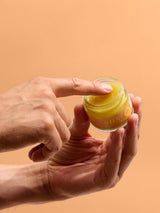
The same tin can last very different lengths of time for two people. What matters is how much is taken per application. From a tube, people like to squeeze out their usual amount. With solid cream, friction decides how much comes off: two to three strokes over the palm are enough for both hands, about a pea-sized amount for both feet. If you hold the tin in your warm hand for a long time or dig deep into it with your finger, you take considerably more. How to find the right amount is explained in How do I apply a solid cream correctly?.
In our own customer reviews (analysis September 2026), yield is praised more often than criticised, but not always. For the solid foot cream, 25 positive mentions face 5 critical ones, for the solid hand cream with beeswax 12 to 3, and for the hand cream with bergamot 16 to 1. The critical voices mostly describe the tin running out faster than expected with daily, generous use. That matches experience: the amount per application decides.
What the yield depends on
- Area: hands and lips are small, legs and back are large. A body butter used daily on the whole body naturally runs out faster than a hand cream.
- Frequency: if you wash your hands often, you reapply more often. How long the film lasts in between is covered in How long does a care film stay on the skin?.
- Temperature: in summer the surface is softer and more comes off when you rub it. In winter it is the other way round.
- Technique: rubbing it directly over the skin usually uses less than taking it out of the tin with your finger.
- Sharing: a tin by the sink is often used by several people.
That is why we deliberately do not give a number of applications per tin on this page. If you want to know your own yield, simply note the date when you open it.
Oxidation: why storage matters
If a tin lasts a long time, its contents have to stay fresh for a long time. Water-free creams rarely spoil because of germs, but their oils can oxidise over time. Oxygen reacts with the fatty acids, producing breakdown products that smell rancid. A review describes two routes: autoxidation, which is accelerated among other things by free fatty acids, metals such as iron and components that have already been oxidised by heat, and light-dependent oxidation. Tocopherols, forms of vitamin E, can act as protective or promoting depending on the system (Choe & Min 2006).
In everyday life this means:
- Close the tin after use so less air and light reach the surface.
- Not on the windowsill, not by the radiator, not in the car in summer. More in Storing solid cosmetics.
- If the cream smells clearly different from when you opened it, for example rancid, stop using it.
- The open-jar symbol shows how long a product can be used after opening. It is required if the minimum durability is more than 30 months (Regulation (EC) No 1223/2009, Article 19). Background: Cosmetics shelf life and the PAO symbol.
Keep water out and it lasts to the end
Microorganisms need water to multiply. That is why water-free products can have a low microbiological risk. How manufacturers assess this is described in a dedicated standard (ISO 29621:2017). But this only applies as long as no water gets into the tin. Take the cream with dry hands and do not leave the tin open next to the shower. More in Hygiene with water-free cosmetics.
When the tin is almost empty, a rim often remains. You can pick it up with a fingertip or push it together after warming the tin in your hand. Then wipe the empty tin dry and insert a refill. How that works is explained in Refillable hand cream.
Frequently asked questions
How many applications does a tin of solid cream have?
That cannot be said in general. The amount per application varies greatly depending on the person, the body area and the season. A small amount per application is the most important factor.
Is solid cream cheaper than cream from a tube?
This is hard to compare per gram, because an emulsion consists largely of water. It makes more sense to compare per application, and that depends mainly on how much you use.
Can solid cream go off?
Yes, the oils can oxidise over time. You notice this by a rancid smell. Stored cool, dry and dark, it stays fresh for longer.
Why is my tin empty faster than expected?
Usually the amount per application was larger than needed, for example with warm cream or when covering large areas. Try fewer strokes and work the cream in for longer.
Is a refill worth it?
If you want to keep the tin, yes. You only buy the contents again and put them into the tin you already have.
At forpeople
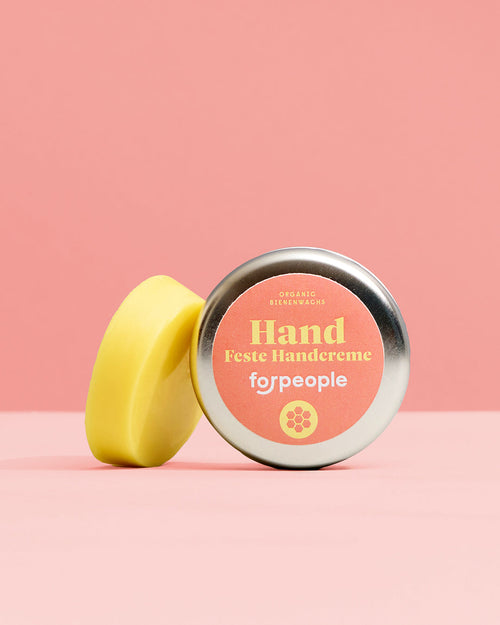
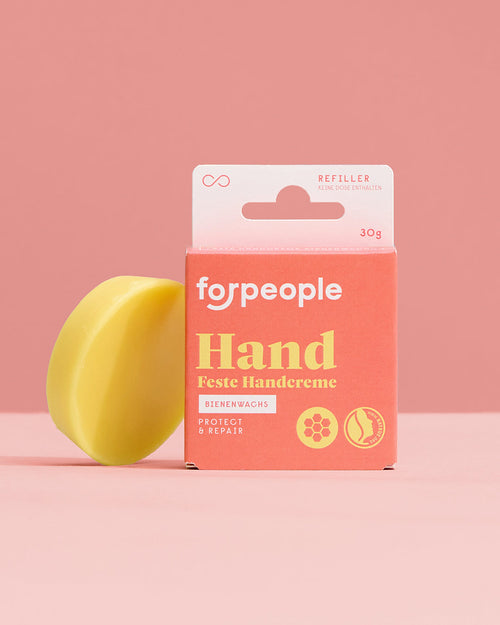
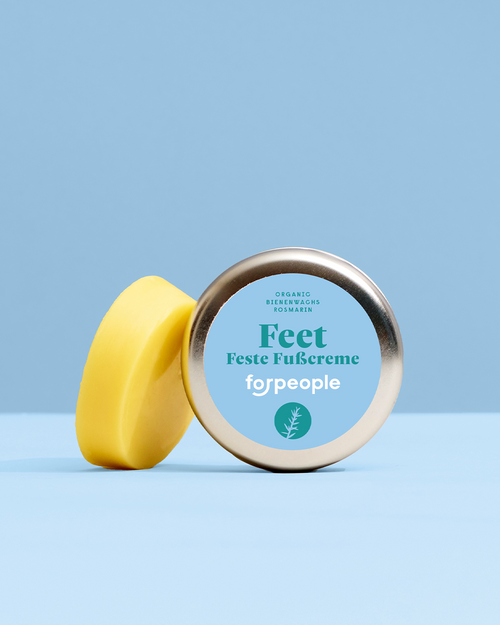
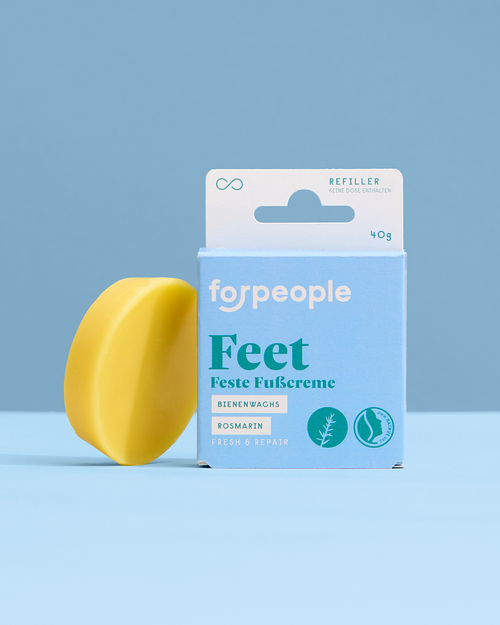
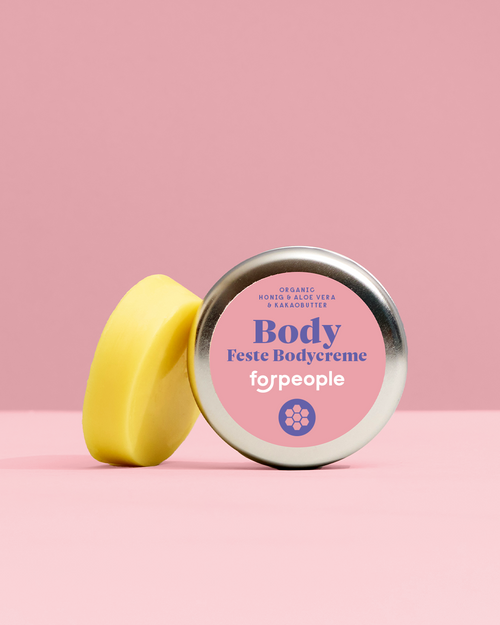
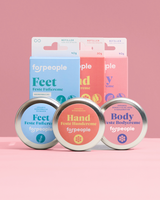
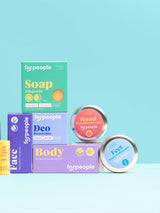
Our solid creams contain no water and no preservatives. The Solid Hand Cream - Beeswax (30 g, €9.90) is also available as the Solid Hand Cream Refill - Beeswax (€7.90), the Solid Foot Cream – Rosemary & Sage (40 g, €9.90) as the Solid Foot Cream Refill - Rosemary & Sage (€7.90). For the body there is the Solid Body Butter - Beeswax & Aloe Vera (40 g, €9.90). Read more: Solid cream or tube · Water-free cosmetics · How to read an INCI list · Water-free, low-water, anhydrous
Sources
- Europäisches Parlament und Rat (2009): Verordnung (EG) Nr. 1223/2009 über kosmetische Mittel, Artikel 19. ABl. L 342: 59. https://eur-lex.europa.eu/eli/reg/2009/1223/oj
- Buhse L, Kolinski R, Westenberger B, Wokovich A, Spencer J, Chen CW et al. (2005): Topical drug classification. Int J Pharm 295(1–2): 101–112. https://doi.org/10.1016/j.ijpharm.2005.01.032
- Choe E, Min DB (2006): Mechanisms and factors for edible oil oxidation. Compr Rev Food Sci Food Saf 5(4): 169–186. https://doi.org/10.1111/j.1541-4337.2006.00009.x
- ISO 29621:2017: Cosmetics – Microbiology – Guidelines for the risk assessment and identification of microbiologically low-risk products. https://www.evs.ee/en/iso-29621-2017