







You've probably got a foot cream in your bathroom. Likely in a plastic tube, likely with a dozen ingredients you can't pronounce — and likely with water as the first ingredient on the list.
Water isn't a bad ingredient. But in a care cream for stressed foot skin it's mainly one thing: a filler. It dilutes the active ingredients, calls for preservatives so nothing turns germy — and ends up in a plastic tube that's in the bin after three months.
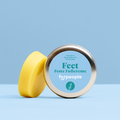
The Solid Foot Cream from forpeople does it differently. And the over 400 reviews with 4.7 stars suggest that's no coincidence.
Why conventional foot creams deliver less than promised
Take a look at the next INCI list on your foot cream. If „Aqua" is right at the top, you already know what you're dealing with: an emulsion. Water and oil are bound together with emulsifiers, preservatives keep the whole thing stable, fragrances provide that pleasant feel when you apply it.
Water (Aqua): Often 60–80% of the product. Dilutes all the other ingredients and provides no care effect of its own.
Mineral oil (Paraffin): Forms a film on the skin but provides no plant fatty acids.
Preservatives: Needed because water encourages germ growth. Some are suspected of disrupting the skin barrier.
Synthetic fragrances: The most common trigger of contact allergies in foot care products.
A solid cream without water needs none of that. What's left are the active ingredients — concentrated, long-lasting, effective.
The 9 active ingredients — what each one does
The Solid Foot Cream from forpeople contains nine plant-based active ingredients that complement each other: deep care, a protective film, revitalisation, cooling and freshness. No coincidence — every ingredient has a job.
„Rosemary, sage and eucalyptus complement each other perfectly in foot care: rosemary stimulates, eucalyptus cools, sage protects. Add shea butter and beeswax for deep care — that's a complete foot care routine in one tin."
— forpeople, on developing the formulaWhen the Solid Foot Cream helps — six uses
Whether after sport, in winter or as a daily routine: the Solid Foot Cream covers more than a classic foot care tube.

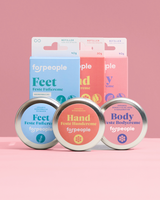
Also available as a set


Solid Foot Cream vs. conventional tube — the direct comparison
What exactly sets a product without water apart from one with it? The table makes it concrete:
| Property | Solid Foot Cream (forpeople) | Standard foot cream (tube) |
|---|---|---|
| Water content | 0% — active ingredients only | 60–80% water |
| Active ingredients | 9 plant-based actives, concentrated | Diluted, stretched with water |
| Preservatives | None needed (no water) | Needed (parabens, phenoxyethanol) |
| Packaging | Tinplate tin, refillable | Plastic tube, hard to recycle |
| Travel-friendliness | Solid, won't leak, no 100ml limit | Liquid, mind the carry-on limit |
| Value | Replaces ~3 conventional tubes | Standard |
| Fragrance allergy | No synthetic fragrance | Common — the biggest allergy trigger |
How to use the Solid Foot Cream properly
-
Clean & pat your feet dry Dry thoroughly, especially between the toes — damp skin takes in care ingredients less well.
-
Warm the cream Rub a little cream between your fingers — your body heat softens the solid texture so it spreads evenly.
-
Massage in Massage into heels, soles and toes. Gentle circular movements spread the cream evenly and boost the fresh feeling.
-
Let it absorb Let it absorb briefly — no greasy residue, no sticky socks. For intensive overnight care on very cracked heels: put on cotton socks after applying.
-
Use regularly Daily, morning or evening. Cracked heels and calluses need consistency — after 1–2 weeks of regular care the difference is clearly noticeable.
Tip for intensive care: Apply a bit more overnight, cotton socks on top — in the morning you'll see the difference.
Frequently asked questions about the Solid Foot Cream
Is the Solid Foot Cream vegan?
The cream contains beeswax (Cera Alba) and so isn't vegan in the strict sense. It is free of animal ingredients apart from the beeswax. The beeswax is functionally indispensable here — it gives the cream its solid consistency and forms the protective film on the skin. Anyone who insists on animal-free products should bear that in mind.
How long does one tin last?
That depends on how often you use it. With daily use on both feet, 40 g typically lasts 2–3 months. Since the cream contains no water, it's stable without preservatives — kept cool and away from light, it lasts at least 24 months. The tinplate tin is refillable — with a refill you save on packaging and cost.
Can I use it on my hands too?
Absolutely — the formula isn't only for feet. Shea butter, olive oil and St. John's Wort work just as well on cracked hands, dry elbows or brittle cuticles. Rosemary and eucalyptus add a pleasantly fresh feel that's clearly different from typical hand creams.
Does the cream really absorb without feeling greasy?
Yes — it's one of the most mentioned points in the reviews. The combination of sunflower oil (light, fast-absorbing) and beeswax (a protective film instead of a heavy oil) makes the cream surprisingly pleasant despite its rich formulation. Important: use only a small amount and massage it in well. Then socks straight after applying are no problem.
Who is the cream for?
The cream is dermatologically tested and free of synthetic preservatives and fragrance — which generally makes it well tolerated, even on sensitive skin. Don't use the cream on open areas of the feet, and seek medical advice.
What makes the cream „solid" — and why is that better?
The solid consistency comes from beeswax and the high proportion of shea butter, which stay solid at room temperature. On the skin the cream melts with your body heat and spreads evenly. The advantage: no emulsion needed, so no water, no emulsifiers, no preservatives. The result is a more concentrated formula with a higher share of active ingredients — and less packaging waste.


