






Why the sole of the foot has no sebaceous glands
Sebaceous glands release an oily secretion onto the skin that keeps the surface supple. They are found almost everywhere on the body, but not on the palms and soles (Smith & Thiboutot 2008). Instead, the sole of the foot has many sweat glands. But sweat brings mainly water and salts to the skin, not fat, and it evaporates again.
Without a film of fat of its own, how supple heel skin stays depends heavily on how much water remains in the stratum corneum. That is why heels react sensitively to dry air, open shoes and walking barefoot on hard, warm floors. The same principle explains why palms also dry out quickly, see Why hands dry out faster.
Pressure and callus formation
Skin protects itself against strain by thickening its stratum corneum. When you step down, a large part of your body weight rests on the heel, again with every step. The skin therefore forms more horny cells there, and the layer gets thicker. This is a normal, useful response. The skin on the sole of the foot differs markedly in its properties from skin on other parts of the body (Hashmi et al. 2015).
Typical causes of particularly thick hard skin on the heel:
- standing or walking for long periods, for example at work
- shoes with an open heel such as sandals, clogs and mules, in which the heel spreads sideways
- hard soles and walking barefoot on hard floors
- a gait that rolls heavily over the heel
- removing hard skin too much or too often, to which the skin responds by forming new hard skin
We explain in detail why calluses come back after a pedicure in Calluses keep coming back.
Why dry hard skin cracks
Healthy hard skin is firm but elastic. Whether it stays that way depends heavily on its water content. In a study of 93 people, calluses, dry heel skin and cracked heels had significantly less moisture and less elasticity than unaffected skin. At hardened sites, the researchers found evidence of a link: the moister the skin, the more elastic it was (Hashmi et al. 2015).
That explains the typical course. The hard skin at the edge of the heel dries out and becomes hard. When you step down, the heel is pressed flat and the edge has to stretch. If it can no longer do that, it cracks, superficially at first and, if the dryness continues, more deeply. In addition, the stratum corneum needs enough moisture for its top cells to shed evenly. If it is too dry, the cells shed less easily and the skin becomes flaky and rough (Rawlings & Harding 2004).
| Stage | What it looks like | What you can do |
|---|---|---|
| dry heels | rough, whitish, slightly flaky | apply cream daily, especially in the evening |
| thick, hard skin | yellowish, firm, raised at the edge | gently remove once a week, then apply cream |
| superficial cracks | fine lines at the edge of the heel, not painful | apply more generously in the evening, cotton socks over it, check your shoes |
| deep cracks | hurt when walking or bleed | do not treat them yourself, have them checked by a podiatrist or doctor |
Care: remove and moisturise
Each has its own job. Removing reduces the thickness; applying cream keeps the remaining hard skin supple.
- Remove gently: about once a week with a pumice stone or foot file, only the top layer. A thin protective layer should remain. Planes and blades are not for use at home.
- Apply cream daily: ideally in the evening. A fat-based cream reduces evaporation and keeps hard skin soft. A film of fat works best on slightly damp skin, for example after showering or a short foot bath (Sethi et al. 2016). We explain the mechanism in Occlusion and transepidermal water loss.
- Socks overnight: cotton socks over the heel after applying cream keep the cream in place.
- Urea for very thick hard skin: High-dose urea (20–30%) can loosen hardened skin (Sethi et al. 2016). How it differs from water-free care and how to combine the two is explained in Urea or water-free cream?
- Check your shoes: closed heels and well-fitting shoes take the strain off the edge of the heel.
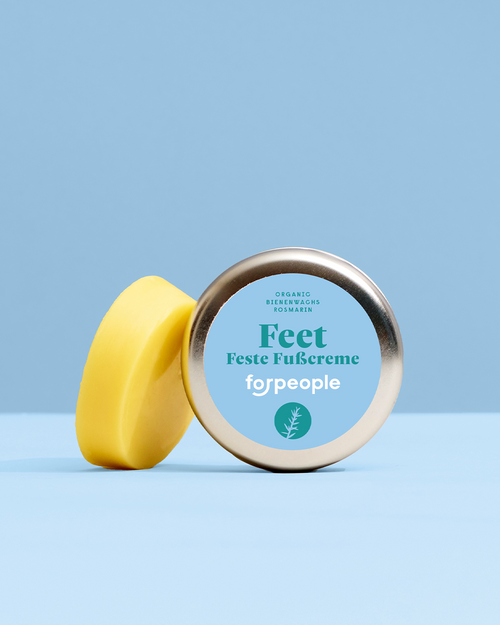
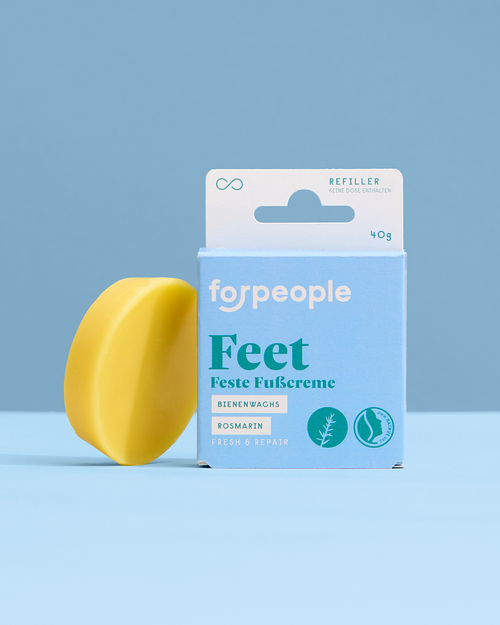
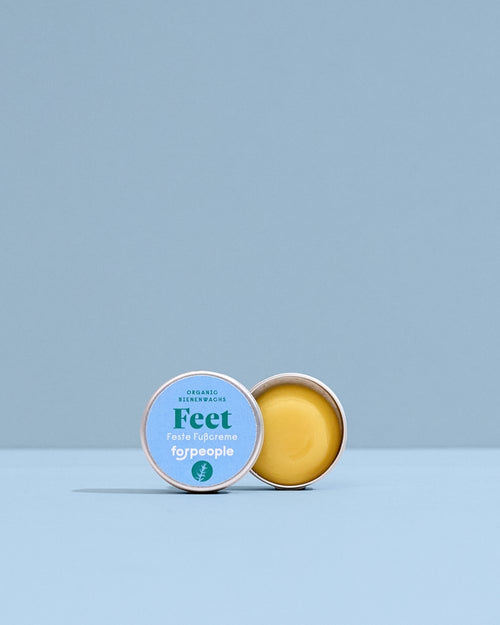
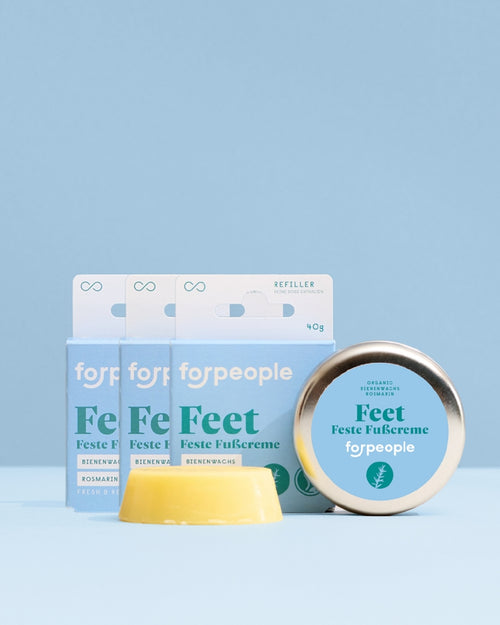
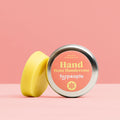
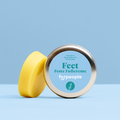
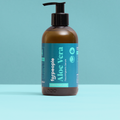
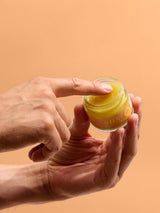
A water-free foot cream such as the Solid Foot Cream – Rosemary & Sage is made of sunflower oil, beeswax, olive oil and shea butter and leaves a film on the heel. When the tin is empty, you top it up with the refill. For on the go there is the travel size in a tin, and as a supply the Foot Care Set XL with tin and three refills. If you want to combine moisture and a film, the Foot Care Set – 3 Steps for Cracked Heels contains the Aloe Vera Serum 99.6%, a beeswax balm and the solid foot cream. How the building blocks of a cream work together is explained in Humectants, occlusives, emollients. In winter, heels dry out particularly quickly in heated indoor air, see Dry skin in winter.
When to see a podiatrist or doctor
Cosmetics care for the skin; they do not treat conditions. Have your feet checked by a podiatrist or doctor if cracks are deep, bleed or hurt when you walk, if the skin turns red, weeps or feels warm, if hard skin grows back unusually fast despite care, or if corns are pressing. If you have diabetes or circulatory problems, you should not remove hard skin yourself; have your foot care done by a podiatrist and get any changes to your feet checked by a doctor.
Frequently asked questions
Why do the heels crack and not the balls of the feet?
At the edge of the heel the hard skin is often especially thick, and when you step down the heel is pressed out sideways. That is where the stretch is greatest.
Should I remove all the hard skin on my heel?
No. A thin layer of hard skin protects the heel. The aim is for it to be smooth and elastic, not for it to disappear.
How quickly do cracked heels become smooth again?
Superficial cracks often improve within a few weeks with daily care, because the stratum corneum renews itself continuously. Deep cracks need professional help.
Why do my heels crack more in summer?
Open shoes, walking barefoot and warm, dry air dry out the hard skin. At the same time, the heel spreads sideways in sandals and is stretched more.
Does a foot cream help against hard skin?
It does not stop hard skin from forming. But it keeps it soft and elastic, so it cracks less often.
At forpeople
- Solid Foot Cream – Rosemary & Sage, 40 g, €9.90: water-free, made of sunflower oil, beeswax, olive oil and shea butter, with essential oils of rosemary, eucalyptus and clary sage.
- Solid Foot Cream Refill - Rosemary & Sage, 40 g, €7.90: refillable, you keep the tin.
- Foot Care Set – 3 Steps for Cracked Heels, €39.90: aloe vera serum, beeswax balm and solid foot cream with refill.
- Foot Care Set XL – for Dry Feet, tin and 3 refills, €29.90.
Sources
- Smith KR, Thiboutot DM (2008): Thematic review series: skin lipids. Sebaceous gland lipids: friend or foe? J Lipid Res 49(2): 271–281. https://doi.org/10.1194/jlr.R700015-JLR200
- Hashmi F, Nester C, Wright C, Newton V, Lam S (2015): Characterising the biophysical properties of normal and hyperkeratotic foot skin. J Foot Ankle Res 8: 35. https://doi.org/10.1186/s13047-015-0092-7
- Rawlings AV, Harding CR (2004): Moisturization and skin barrier function. Dermatol Ther 17 Suppl 1: 43–48. https://doi.org/10.1111/j.1396-0296.2004.04s1005.x
- Sethi A, Kaur T, Malhotra SK, Gambhir ML (2016): Moisturizers: The Slippery Road. Indian J Dermatol 61(3): 279–287. https://doi.org/10.4103/0019-5154.182427