


What transepidermal water loss means
Your skin gives off water all the time, even when you are not sweating. The water moves from the moister, deeper layers outwards and evaporates at the surface. This quiet loss is called transepidermal water loss. It is slowed down mainly by the stratum corneum, the outermost layer of the skin. It consists of dead, flat cells with ordered layers of lipids between them. These lipids and the long, winding path through many cell layers hold the water back (Rawlings & Harding 2004). We explain how this layer is built in The skin barrier explained simply.
When the stratum corneum is stressed by frequent washing, dry indoor heating or cold, water loss increases. Your skin then feels tight, rough and flaky. This is where a protective film comes in: it does not replace the stratum corneum, but it reduces evaporation at its surface.
How TEWL is measured
In studies, transepidermal water loss is measured with a probe placed on the skin. Sensors in the probe detect how the density of water vapour above the skin changes. This shows how much water passes outwards through the stratum corneum per area and time. There are open-chamber, unventilated-chamber and condenser-chamber devices (Alexander et al. 2018).
The measurement is sensitive. Humidity, room temperature and airflow change the result, as do sweat, skin temperature and the body site. That is why measurements are taken under controlled conditions, often after a rest period in an air-conditioned room (Alexander et al. 2018). Cosmetic science has its own guidelines for this, because the method is also used to check claims about skincare products (Rogiers 2001). Individual values from different studies can therefore only be compared with caution.
Which substances form a film
Occlusive substances are fatty ingredients that do not dissolve in water and stay on the skin's surface. In natural cosmetics these are mainly waxes, solid plant butters and oils. Conventional cosmetics also use petroleum jelly, paraffin oil, lanolin and silicones. All of them reduce evaporation, but to different degrees.
| Group | Examples | Texture | Film effect |
|---|---|---|---|
| Waxes | beeswax, candelilla wax | solid, melt only well above skin temperature | form a firm film that adheres well and give creams their firmness |
| Plant butters | shea butter, cocoa butter | firm to soft, melt close to skin temperature | spread as a supple layer over the skin |
| Plant oils | sunflower oil, olive oil, jojoba oil | liquid | form a thin, partly permeable film |
| Mineral fats | petroleum jelly, paraffin oil | ointment-like or liquid | petroleum jelly is considered a particularly dense film, paraffin oil a much weaker one |
How large the differences can be is shown by a study with six healthy volunteers: four plant oils and paraffin oil penetrated only into the uppermost layers of the stratum corneum. The oils reduced water loss to a similar degree, with the exception of jojoba oil, which was less occlusive in this experiment. Petroleum jelly showed the strongest occlusion. The authors describe the effect of the oils as semi-occlusion (Patzelt et al. 2012). A review states that petroleum jelly at a concentration of 5% or more reduces water loss by more than 98% (Sethi et al. 2016).
Petroleum jelly does not simply act like a plastic film, by the way. In an older experiment it spread into the spaces within the stratum corneum instead of just sitting on top, and it did not hinder the recovery of the stratum corneum after an artificial disruption (Ghadially et al. 1992). Which substance suits you is therefore less a question of good or bad than of skin feel, where you use it and personal preference. You can read more about the two waxes in Beeswax in skincare and Candelilla wax or beeswax, and about jojoba oil in Jojoba oil: a liquid wax.
Full or partial occlusion: the difference
With full occlusion, practically no water can escape. This happens under a rubber glove, a film or a plaster that stays on the skin for hours. The water builds up, the stratum corneum swells, and the skin becomes soft and wrinkly, like after a long bath. That is not the goal in everyday life.
With partial occlusion, some water keeps evaporating, just more slowly. This is the typical effect of plant oils, butters and thinly applied wax creams. Your skin can still release water vapour but loses less moisture. That is exactly what you want when your hands, feet or shins tend to be dry.
A film does not bring water into the skin, it only holds back what is already there. That is why it works best on slightly damp skin, for example right after washing your hands or showering (Sethi et al. 2016). Water-based creams therefore often combine humectants with fats. How the three building blocks work together is explained in Humectants, occlusives, emollients.
Why too much film feels greasy
Your skin only takes up a limited amount of fat. Anything applied beyond that stays on the surface. It shines, leaves marks on paper and screens and feels heavy. Dense film formers such as petroleum jelly are therefore considered less pleasant cosmetically; a greasy feel is one of the most common drawbacks of occlusive substances (Sethi et al. 2016).
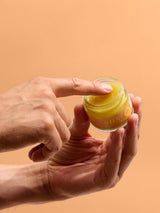
Solid, water-free creams are also highly concentrated. They lack the water that makes up a large part of a conventional cream and evaporates as you rub it in. A small amount is enough. Stroke the solid cream two or three times, warm it between your hands and massage it in. If your skin still shines after a few minutes, it was too much. We describe the difference between a solid cream and a tube in Solid cream or tube? and the water-free principle in Water-free cosmetics.
How to dose the film:
- During the day: apply very thinly, especially on the backs of your hands and knuckles.
- In the evening and overnight: a little more, ideally on feet and heels with cotton socks over them.
- After washing: just pat your hands lightly dry, then apply cream.
- In the cold: apply before going outside, not afterwards. More in Dry skin in winter.
Frequently asked questions
Is occlusion bad for the skin?
No, partial occlusion is the basic mechanism of many skincare products. It only becomes a problem with full occlusion under film or gloves for hours, because the skin then swells.
Can skin still breathe under a wax film?
Skin does not breathe like a lung. But it does release water vapour. A thin film of waxes, butters and oils slows this release down but does not stop it completely.
Is petroleum jelly better than plant oil?
Petroleum jelly forms a denser film than plant oils (Patzelt et al. 2012). But it also feels greasier. Which substance suits you depends on where you use it and on your preference.
Do I need to moisten my skin before using a water-free cream?
It helps. On slightly damp skin, the film holds back the water that is there right now. It also works on completely dry skin, but the skin then feels supple more slowly.
How do I know I have applied too much?
If your skin still shines or feels sticky after five to ten minutes. Then take less next time.
At forpeople
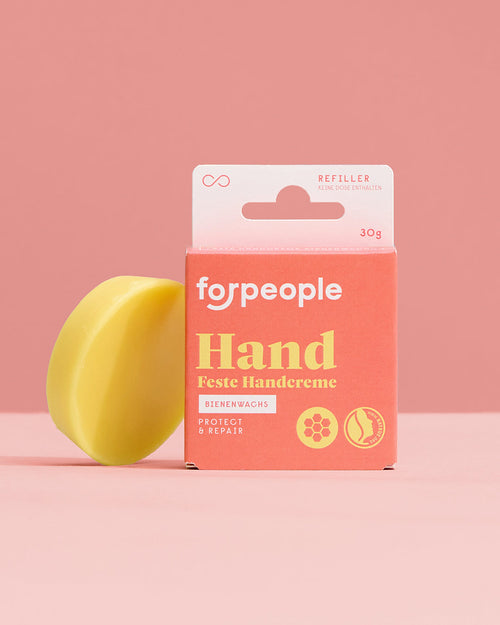
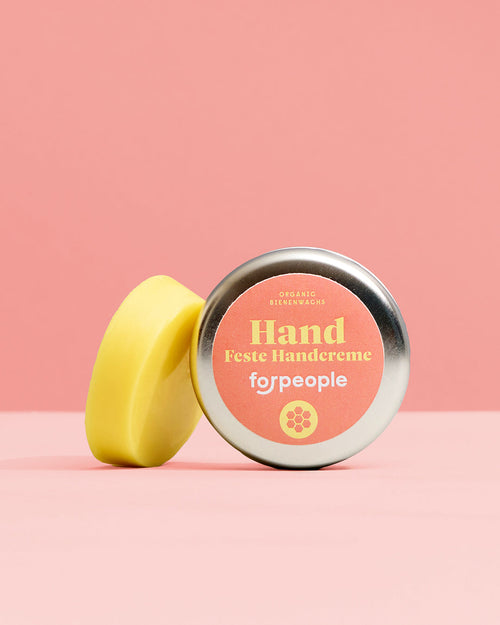
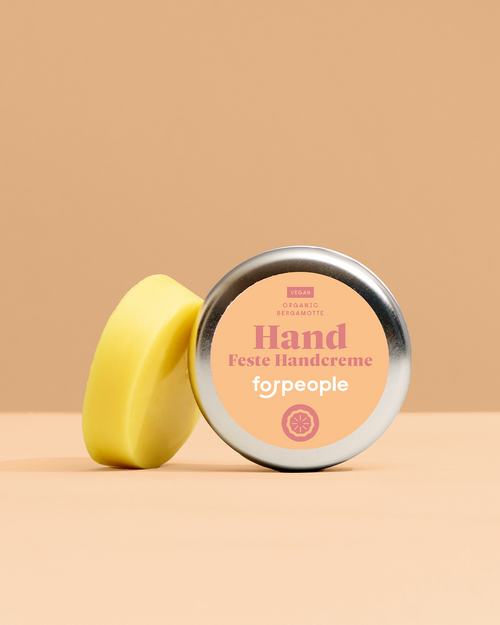
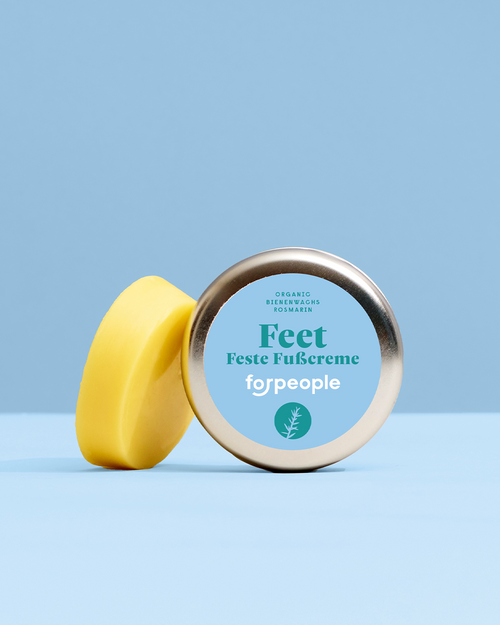
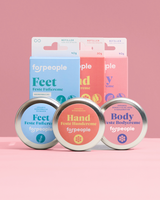
Our solid creams are water-free and made of waxes, butters and oils. They leave a film on the skin that reduces evaporation. With a refill you top up the tin.
- Solid Hand Cream - Beeswax, 30 g, €9.90: made of beeswax, olive oil and sunflower oil, without essential oils.
- Solid Vegan Hand Cream - Bergamot, 30 g, €9.90: vegan, with candelilla wax, jojoba oil and shea butter.
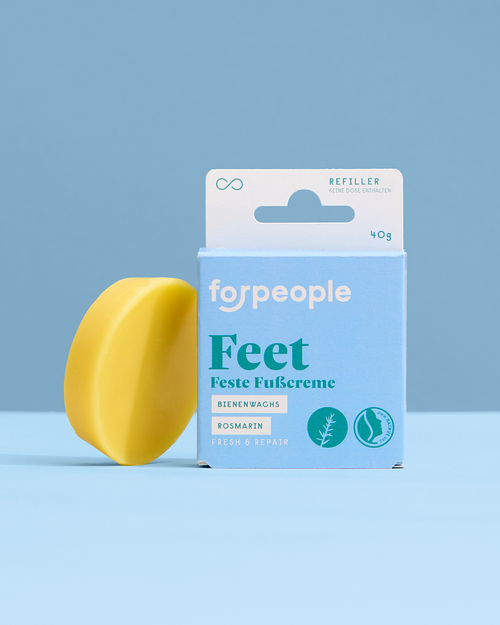
- Solid Foot Cream – Rosemary & Sage, 40 g, €9.90: with sunflower oil, beeswax, olive oil and shea butter; as a refill €7.90.
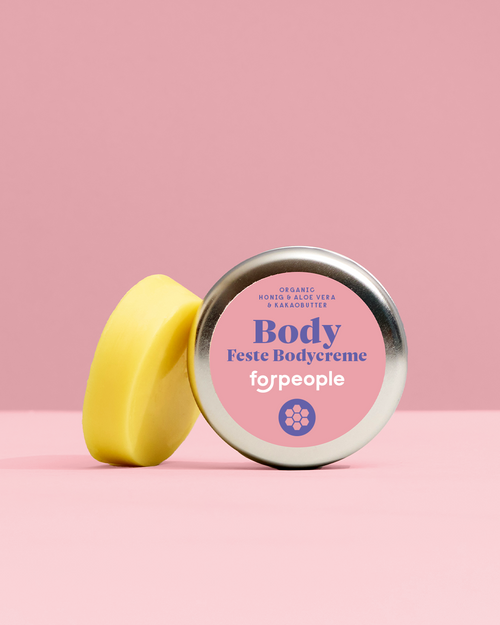
- Solid Body Butter - Beeswax & Aloe Vera, 40 g, €9.90: made of cocoa butter, olive oil, beeswax and shea butter.
Sources
- Rawlings AV, Harding CR (2004): Moisturization and skin barrier function. Dermatol Ther 17 Suppl 1: 43–48. https://doi.org/10.1111/j.1396-0296.2004.04s1005.x
- Alexander H, Brown S, Danby S, Flohr C (2018): Research Techniques Made Simple: Transepidermal Water Loss Measurement as a Research Tool. J Invest Dermatol 138(11): 2295–2300.e1. https://doi.org/10.1016/j.jid.2018.09.001
- Rogiers V, EEMCO Group (2001): EEMCO guidance for the assessment of transepidermal water loss in cosmetic sciences. Skin Pharmacol Appl Skin Physiol 14(2): 117–128. https://doi.org/10.1159/000056341
- Patzelt A, Lademann J, Richter H, Darvin ME, Schanzer S, Thiede G et al. (2012): In vivo investigations on the penetration of various oils and their influence on the skin barrier. Skin Res Technol 18(3): 364–369. https://doi.org/10.1111/j.1600-0846.2011.00578.x
- Ghadially R, Halkier-Sorensen L, Elias PM (1992): Effects of petrolatum on stratum corneum structure and function. J Am Acad Dermatol 26(3 Pt 2): 387–396. https://doi.org/10.1016/0190-9622(92)70060-s
- Sethi A, Kaur T, Malhotra SK, Gambhir ML (2016): Moisturizers: The Slippery Road. Indian J Dermatol 61(3): 279–287. https://doi.org/10.4103/0019-5154.182427