

In winter, dry heated air, long hot showers and slippers without a heel counter add to this. Apply cream after showering or a short foot soak, keep the socks loose, smooth at most once a week, and during the day shoes with a closed heel help. Expect a few weeks, not one night. The foot cream is intended for dry, rough heels with superficial cracks, is water-free, made from plant oils, shea butter and beeswax, and comes in a 40 g tin; according to the product page, about a pea-sized amount is enough for both feet.
In the morning, on the way to the bathroom, a spot on the rim of your heel pulls with every step; in the evening you see white, hard edges with fine lines. This page sums up how far along it is, where the cracks come from, what fissures are, what the evening routine looks like, what to do about a deep crack, whether urea or a water-free cream suits you, and when care is no longer enough.
The problem: how to recognise cracked heels
Cracked heels are cracks in the thickened horny layer, usually on the rim of the heel, where the skin of the sole merges into the skin on the side of the foot (Tucker 2010/2021). Specialists speak of rhagades, in everyday German of “Schrunden”. The thick horny layer of the heel protects against the weight it carries with every step. It becomes a problem when it dries out: in a study of 93 people, dry and cracked heels had markedly less moisture and less elasticity than normal skin (Hashmi et al. 2015).
Thickened callus on the feet is common. In a study of 784 people aged 65 and over, 58 in 100 had corns or calluses (Dunn et al. 2004). In most cases it does not go beyond dry, rough heels that you can care for yourself. Cracks in the heel need to be taken more seriously if you have diabetes. According to IQWiG, about 20 to 30 in 100 people with diabetes develop a diabetic foot in the course of their lives; first signs are dry feet and increased callus formation (IQWiG 2023).
Four stages can be distinguished. First the heel is dry, whitish and rough. Then fine lines appear on the rim that do not hurt; they lie only in the horny layer. If a crack reaches the living skin, it gapes, hurts when walking or bleeds. If redness, warmth or weeping appear as well, it may have become inflamed; in severe cases heel fissures become infected (Tucker 2010/2021). You can care for the first two stages yourself, but not for the last two. Typical times are the heating season and summer in sandals; both are covered in the next section.

Causes: why heels crack, in winter and in summer
The sole of the foot has no sebaceous glands and therefore no oil film of its own. So how supple the heel stays depends on how much water remains in its horny layer.
Why the rim of the heel in particular cracks. Under the heel bone lies a fat pad that is pressed flat when you step down. The skin on the rim of the heel has to stretch every time. If the callus there is thick and dry, it no longer gives and cracks, superficially at first, and deeper if the dryness persists. The stretching is greatest on the rim of the heel, which is why the cracks usually sit there and rarely on the ball of the foot.
Cold and heated air. According to a review article, low humidity and low temperatures weaken the skin's barrier function and make it more susceptible to mechanical stress (Engebretsen et al. 2016). That is exactly what the heel experiences with every step.
Long, hot showers. For cracked heels, the US professional association of dermatologists advises limiting baths and showers to 5 to 10 minutes and applying cream within 5 minutes afterwards (AAD 2022).
Slippers without a heel counter. Open-backed shoes are among the most common causes of cracked heels (Tucker 2010/2021). In summer these are sandals, in winter slippers, clogs and slides at home. Without a heel counter, the heel spreads sideways with every step, and the rim has to stretch. How boots and heating alternately make the skin damp and dry is explained in Dry feet in winter: what causes it, what helps?
In summer. In sandals, clogs and flip-flops the heel is exposed, and without a heel counter the fat pad gives way to the side with every step. If you walk barefoot a lot, you form more callus; sand, stones and patio slabs add friction. After the swimming pool and the sea, the skin often feels tight. Rinse your feet with fresh water afterwards, dry them well and apply cream in the evening. Sandals with a heel strap or a footbed that cups the heel like a shell give more support than flat flip-flops. More about callus from walking barefoot in Does walking barefoot give you more calluses?
| Cause | How you notice it | What you change |
|---|---|---|
| Dry air, cold | heels become rough and flaky from autumn onwards | apply cream every evening, not only once cracks appear |
| Long, hot showers and foot soaks | skin feels tight afterwards | 5 to 10 minutes, lukewarm, apply cream straight afterwards |
| Slippers without a heel counter, barefoot on tiles | bulging, hard edge on the side of the heel | slippers with a closed heel |
| Standing for long periods, higher body weight | thick callus across the whole heel | smooth the callus regularly, well-fitting shoes |
| Too much removed, planed off | callus comes back quickly and thick | only smooth, see Callus on the heels |
| Athlete's foot, eczema, psoriasis | itching, redness, flaking also on the sole or between the toes | have it checked by a doctor |
| Diabetes, underactive thyroid | very dry feet, little sweat, less sensation | medical supervision, foot care by a podiatrist |
The causes follow a specialist article for pharmacies (Tucker 2010/2021). In an analysis of 693 people with diabetes, heels with cracks had less moisture than heels without cracks (14.6 versus 19.1 percent), and athlete's foot was more often associated with very dry heel skin (Oe et al. 2018). How to tell whether dry skin or a fungus is behind it is explained in Dry feet or athlete's foot? Signs and when to see a doctor.
Fissures (Schrunden): the same as cracked heels?
Yes. “Schrunde” is an old German word for a crack or split; in medicine it is called a rhagade. It refers to cracks in dry, thickened skin, on the feet almost always on the rim of the heel. Callus is the protective layer, the fissure is the crack in it. For care, depth is therefore what counts most. Fine fissures that do not hurt lie only in the horny layer and can be cared for with the routine below. If a crack hurts, bleeds or weeps, it belongs in professional hands.
“Fissure balm” (Schrundensalbe) is not a defined term. In the ingredient lists we read for this, water and urea were usually at the top, often with glycerin, panthenol, petroleum jelly or lanolin. What is in such products is explained in Fissures: what the word means and what is in fissure balm. Whether urea or a water-free cream suits you better is covered in the section further down.
The evening routine: apply cream, smooth, protect
The plan works if you keep it up for a few weeks; according to Stiftung Warentest, even creams for callus usually need a few weeks (Stiftung Warentest 2025).
| Step | What you do | Why |
|---|---|---|
| Evening: wash | take a short lukewarm shower or bathe for 5 to 10 minutes, dry off, also between the toes; details in Foot soak before applying cream | Water softens the horny layer, long hot baths dry it out (AAD 2022) |
| Evening: apply cream | apply cream to the still slightly damp heel; according to the product page, you stroke the solid foot cream once or twice over the heel and the ball of the foot or warm it in your hand; not between the toes | The film of fat keeps the water from evaporating again straight away |
| Evening: socks | loose cotton socks over it, see Foot cream overnight with socks | The cream stays on the skin instead of on the bedding (AAD 2022) |
| For very dry heels | a little aloe vera serum first, the foot cream on top; in the evening, also a thin layer of beeswax salve on hard edges. All three are in the Foot Care Set – 3 Steps for Cracked Heels (€39.90, €40.60 individually) | water-based under fat-based; according to the product page, the beeswax salve is intended for rough patches on heels |
| Once a week: smooth | after the foot soak, go over the hard edge with a wet pumice stone until it no longer bulges; no planes or blades | Removing too much stimulates new callus formation (Stiftung Warentest 2025) |
| During the day: shoes | shoes and slippers with a closed heel | The heel spreads less |
| After 2 to 4 weeks | Are the edges softer, the lines shallower? If not: make an appointment with a podiatrist | If there is no improvement, the AAD advises seeing a doctor (AAD 2022) |
Deep crack in the heel: what to do, when to see a podiatrist or doctor?
A crack counts as deep when it no longer lies only in the callus but reaches the living skin. It then gapes, hurts when you step down, bleeds or weeps; people then often speak of open heels. A fine crack that does not bleed and does not hurt lies in the horny layer; here the routine above applies.
What to do straight away. An open crack is a small wound. No cream, no oil and no home remedy goes into it; our product pages state explicitly that they do not belong on broken skin. Rinse the area with lukewarm water, pat it dry and cover it with a plaster. For daytime, the AAD mentions a liquid bandage that lies as a film over the crack (AAD 2022); at the pharmacy this is called liquid plaster. Keep caring for the intact skin around it and leave the crack out.
| Sign | Where to go | How urgent |
|---|---|---|
| thick callus that you can no longer smooth yourself | podiatrist | make an appointment without rushing |
| deep crack, pain when walking | podiatrist; if the crack is open, a doctor | soon |
| crack bleeds, stays open or does not improve despite care | GP or dermatologist | within the next few days |
| redness that spreads, swelling, warmth, pus or fever | doctor or out-of-hours medical service | the same day |
| diabetes, numbness or tingling in the feet, circulation problems | doctor and podiatrist; do not remove callus yourself | with any change |
The table is a guide and does not replace an examination. Cracked heels can also be linked to a skin condition or another underlying condition; only a doctor can clarify this.
Until the appointment. Do not cut, plane or pull off the callus at the crack, and do not use callus-removing plasters or acid preparations on cracked skin. Wear closed, well-fitting shoes with a heel counter instead of slippers or sandals. Note down how long the crack has been there and take a photo so that you can compare how it develops. Bring a list of your medication to the appointment, especially blood thinners, and the shoes you wear most often.
A study of 167 people with diabetes and a deep, open heel crack shows how long deep cracks take. After four weeks of daily use, the crack had fully closed in 46 percent with a cream of urea, glycerin and petroleum jelly, and in 33 percent with a base without these active ingredients; the difference was not statistically significant. Afterwards, 6 and 24 percent of the cracks respectively were still deep and open (Gin et al. 2017). The participants were under medical supervision, as should be the case with such cracks.
Urea or water-free cream?
Each has its own job. Urea binds water in the horny layer; from about 10 percent it also dissolves hardened skin (Piquero-Casals et al. 2021). A water-free cream made of oils, butter and wax brings hardly any moisture of its own. It lays a film on the skin and slows the evaporation of the water. For cracked heels, the AAD mentions both: a cream with 10 to 25 percent urea after bathing and pure petroleum jelly before going to bed (AAD 2022).
| Your heels | What suits them | What to watch out for |
|---|---|---|
| dry, rough, feel tight, little callus | water-free cream in the evening on slightly damp skin, socks over it | use a little, spread thinly |
| thick, hard callus with fine cracks | urea cream from about 10 percent, plus the pumice stone once a week | urea can sting on cracked skin |
| both | combine, for example the urea cream in the morning and the water-free cream with socks in the evening | none of it in open cracks |
| diabetes | according to IQWiG, creams or lotions with 5 to 10 percent urea, no greasy ointments or oils (IQWiG 2023) | discuss care with your doctor or podiatrist |
Our solid foot cream belongs in the first row; it contains no urea. The detailed comparison, also for dry hands, is in Urea or water-free cream? Rough heels and dry hands.

What helps – and what tends not to
What works is whatever keeps the horny layer moist and leaves a film of fat. Many home remedies have no evidence behind them or irritate open areas.
| Remedy | What it does | Assessment |
|---|---|---|
| Solid, water-free foot cream made of oils, butter and wax | lays a film on the skin that protects against drying out | in the evening on slightly damp skin; without urea, does not remove callus |
| Cream with 10 to 25% urea | binds water, from about 10% it dissolves hardened skin (Piquero-Casals et al. 2021) | named by the AAD for cracked heels (AAD 2022); higher concentrations are more likely to irritate; comparison in Urea or water-free cream? |
| Pure petroleum jelly | dense film of mineral oil | the AAD mentions it for the evening with socks (AAD 2022); feels greasy |
| Olive or coconut oil, udder balm | add fat to the skin | same principle; liquid oil quickly ends up in the sock |
| Milk and honey foot soak | mainly water | there is no evidence for milk or honey on heels; the water softens |
| Vinegar, lemon, baking soda, foot peel socks | acid or alkali | sting in cracks, not with diabetes; more in Vinegar, baking soda, lemon: what are home remedies for callus worth? |
| Callus plane, blade, rasp | cut instead of smoothing | high risk of injury (Stiftung Warentest 2025) |
| Liquid plaster from the pharmacy | protective film over a crack | named by the AAD for daytime; superglue from the toolbox is not made for skin |
| Vitamin tablets | – | there is no evidence that they improve cracked heels; dryness, pressure and shoes are usually behind them |
Common mistakes
Planing off the callus radically. Thick callus is the protection, not the cause. Removing a lot stimulates new callus formation (Stiftung Warentest 2025) and can cut into the living skin.
Only applying cream when it hurts. In a study of 150 women, very dry heels reached about the moisture level of normal heels three hours after cream was applied; the researchers therefore recommend daily, repeated application (Choi et al. 2018). A fixed slot in the evening does more than a thick layer at the weekend.
Water-free cream on completely dry skin. A cream without water brings hardly any moisture of its own; it keeps moisture in the skin. That is why it belongs on slightly damp skin; that is also what the product page of our foot cream says.
Backless slippers at home. The rim is stretched with every step and cracks further.
When to seek medical advice? Diabetes and warning signs
With diabetes, the nerves and blood flow in the feet can decline; small cracks are noticed late and close more slowly. In a screening of 33,259 people with diabetes in India, cracked heels were more strongly linked to a high risk of foot damage than callus or corns (Viswanathan et al. 2024). The Institute for Quality and Efficiency in Health Care advises looking at your feet daily, washing them in lukewarm water and drying them well, using creams or lotions with 5 to 10 percent urea and no greasy ointments, oils or zinc pastes; hot foot baths, hot-water bottles and electric blankets should be avoided. Callus, cracks and nails then belong with a podiatrist; if there is an increased risk of chronic wounds, statutory health insurance pays for medical foot care (IQWiG 2023). Our foot cream and the beeswax salve are fat-based and contain essential oils; we therefore do not recommend them if you have diabetes. More in Foot care with diabetes: what to check every day.
These signs belong in the hands of a podiatrist or doctor:
- A crack is deep, gapes, bleeds, weeps or hurts when walking.
- The skin around a crack is red, swollen or warm, or there is pus, or you have a fever: see a doctor or the out-of-hours medical service the same day.
- You have diabetes or circulation problems, or you feel little in your feet: even with small changes.
- After two to four weeks of regular care, nothing has improved.
- The skin itches, also flakes on the sole or is whitish and softened between the toes.
- You take medication that affects blood clotting or the immune system: ask at your doctor's practice before you remove callus.
What customers say
One voice from a verified review in our shop, translated from German and shortened.
“[…] By now it has become a nice evening ritual to apply cream to my feet before going to bed. On top of that, it smells great.”
Customer review of Foot Care Set – For Dry, Rough Feet (2× Rosemary Cream), 5 out of 5 stars, July 2026, verified purchase
Is it mainly your feet or soles that itch? Causes and what helps: Itchy soles and feet.
Frequently asked questions
What helps quickly with cracked heels?
Your heels become softer overnight if you apply cream to slightly damp skin after showering and pull cotton socks over them. The cracks themselves take weeks, because the horny layer has to renew itself.
Which home remedies help with cracked heels?
What helps most is a short, lukewarm foot soak followed by a film of fat, for example from a fat-based cream or pure petroleum jelly with socks over it (AAD 2022). Vinegar, lemon and baking soda sting in cracks; there is no evidence for milk and honey.
Why do my heels crack in winter?
Cold and dry heated air weaken the skin barrier (Engebretsen et al. 2016), hot showers dry it out further, and in slippers without a heel counter the heel spreads with every step.
Urea or a fatty cream: what suits cracked heels?
With thick, hard callus, urea from about 10 percent helps to dissolve it; with dry heels, a film of fat keeps the moisture in the skin. Both can be combined. With diabetes, IQWiG advises 5 to 10 percent urea and advises against greasy ointments (IQWiG 2023).
Can the solid foot cream go on cracked heels?
On superficial cracks that do not bleed and do not hurt, yes; according to the product page, that is what it is intended for. Not on open, bleeding or weeping areas, because the product page says: “Do not apply to broken skin.”
Open heels: what to do?
Neither a pumice stone nor a file nor cream belongs in an open crack. Rinse it with lukewarm water, pat it dry, cover it with a plaster and wear closed shoes. Have deep, bleeding or painful cracks looked at by a podiatrist or doctor, and with diabetes any open area promptly. Apply cream again once the skin has closed.
Why do the heels crack and not the balls of the feet?
On the rim of the heel the callus is often especially thick, and when you step down the heel spreads sideways. That is where the stretching is greatest.
Are fissures (Schrunden) and cracked heels the same thing?
Yes. “Schrunde” is the old German word for a crack in the skin, rhagade the medical one. “Fissure balm” (Schrundensalbe) is not a defined term; usually it is a cream with urea.
Can I also use the solid foot cream in the morning?
Yes, but only a little. A water-free cream leaves a thin film, and a freshly creamed sole slips in sandals and on smooth floors. The larger amount belongs in the evening.
When should I see a podiatrist about cracked heels?
If cracks are deep, bleed or hurt, if you can no longer smooth the callus yourself, if nothing improves after a few weeks, and always if you have diabetes. Your doctor can then prescribe podiatry.
At forpeople
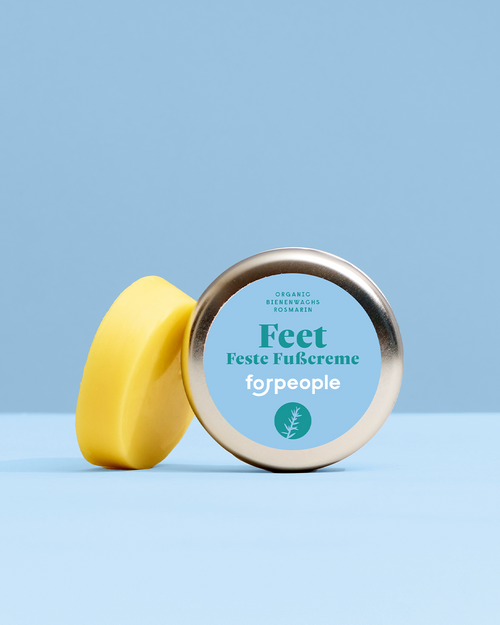
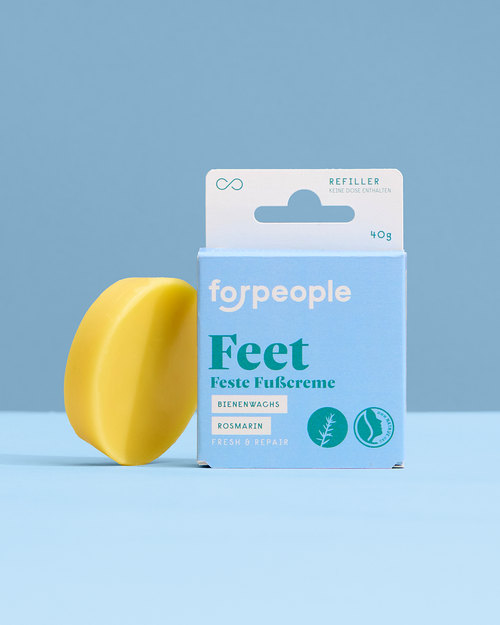
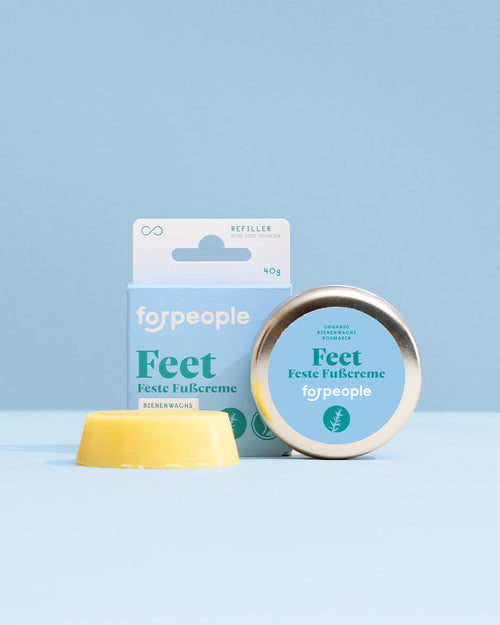
What the foot cream is. According to the ingredient list, the Solid Foot Cream – Rosemary & Sage consists of sunflower and olive oil, beeswax, shea butter, extracts of St. John's wort and aloe vera, and essential oils of rosemary, eucalyptus and clary sage; no water is added. According to the product page, it lays a thin film on the skin that protects against drying out and keeps rough heels and balls of the feet supple. 40 g in a metal tin costs €9.90, three tins €27.90. According to the product page, one tin is enough for approx. 90 to 120 applications; after that you refill it with the Solid Foot Cream Refill – Rosemary & Sage (40 g, €7.90). In the cold it becomes firmer; then warm the bar briefly in your hand.
You can find the tin, refill and sets under Foot cream for dry, cracked heels.
What it is not. It contains no urea and does not remove thick callus; that is still the job of the pumice stone. It is not intended for open cracks, and with deep cracks it does not replace an appointment.
The set, honestly calculated. The Foot Care Set – 3 Steps for Cracked Heels costs €39.90 and contains the foot cream in the tin (40 g), a refill (40 g), the Beeswax Salve – Larch & Mandarin in a Glass Jar (50 g, €12.90 individually) and the Aloe Vera Serum 99.6% (50 ml, €9.90 individually). Bought individually, the four items cost €40.60; the price advantage is 70 cents. The set is worth it if you want to use all three steps; for basic care, the foot cream is enough.
Who it is less suited to. Because of the essential oils, the foot cream contains Linalool, Limonene and Geraniol; if you react to fragrances, check the list before buying. According to the product page, it is not suitable for children under 7 because it contains eucalyptol and camphor. The beeswax salve contains larch resin, propolis and essential oils; if you are allergic to colophony, tree resin or propolis, read Colophony allergy, propolis, beeswax: symptoms and advice first. During pregnancy and breastfeeding we recommend care without essential oils. Neither of the two is vegan.
More on this: Foot care at home: the routine for well-cared-for feet in winter · Callus on the heels: keep it soft instead of planing it off · Pedicure at home: step by step to well-cared-for feet · Foot care for men: callus, cracks and odour under control · Foot cream tested: how to recognise a good foot cream for winter · Foot mask, foot peel socks or cream overnight: what helps when
From the blog: Hands and feet through winter: a routine for morning and evening
Sources
- American Academy of Dermatology (AAD): How to care for dry, cracked heels. aad.org, last updated 31.01.2022, accessed 10.11.2026. aad.org/public/everyday-care/skin-care-basics/dry/dry-heels
- Engebretsen KA, Johansen JD, Kezic S, Linneberg A, Thyssen JP (2016): The effect of environmental humidity and temperature on skin barrier function and dermatitis. Journal of the European Academy of Dermatology and Venereology 30(2): 223–249. https://doi.org/10.1111/jdv.13301
- Hashmi F, Nester C, Wright C, Newton V, Lam S (2015): Characterising the biophysical properties of normal and hyperkeratotic foot skin. Journal of Foot and Ankle Research 8: 35. https://doi.org/10.1186/s13047-015-0092-7
- Tucker R: Heel fissures. The Pharmaceutical Journal, published 01.06.2010, updated 28.04.2021, accessed 10.11.2026. pharmaceutical-journal.com/article/ld/heel-fissures
- Stiftung Warentest: Fußpflege: Raue Zonen gezielt behandeln. test.de, 13.06.2025, accessed 10.11.2026. test.de/Fusspflege-Raue-Zonen-gezielt-behandeln-1694828-0
- Piquero-Casals J, Morgado-Carrasco D, Granger C, Trullàs C, Jesús-Silva A, Krutmann J (2021): Urea in Dermatology: A Review of its Emollient, Moisturizing, Keratolytic, Skin Barrier Enhancing and Antimicrobial Properties. Dermatology and Therapy 11(6): 1905–1915. https://doi.org/10.1007/s13555-021-00611-y
- Gin H, Rorive M, Gautier S, Condomines M, Saint Aroman M, Garrigue E (2017): Treatment by a moisturizer of xerosis and cracks of the feet in men and women with diabetes: a randomized, double-blind, placebo-controlled study. Diabetic Medicine 34(9): 1309–1317. https://doi.org/10.1111/dme.13402
- Choi JY, Kim EJ, Jang SI, Kim AR, Lee TJ, Lee HK (2018): A new technique for evaluating heel xerosis grade and the effects of moisturizer on heel skin dryness. Skin Research and Technology 24(4): 557–561. https://doi.org/10.1111/srt.12466
- Institut für Qualität und Wirtschaftlichkeit im Gesundheitswesen (IQWiG): Diabetischer Fuß: Wie beugt man Wunden vor? gesundheitsinformation.de, updated 18.10.2023, accessed 19.11.2026. gesundheitsinformation.de/diabetischer-fuss-wie-beugt-man-wunden-vor.html
- Oe M, Takehara K, Noguchi H, Ohashi Y, Fukuda M, Kadowaki T, Sanada H (2018): Skin hydration of the heel with fissure in patients with diabetes: a cross-sectional observational study. Chronic Wound Care Management and Research 5: 11–16. https://doi.org/10.2147/CWCMR.S158139
- Dunn JE, Link CL, Felson DT, Crincoli MG, Keysor JJ, McKinlay JB (2004): Prevalence of foot and ankle conditions in a multiethnic community sample of older adults. American Journal of Epidemiology 159(5): 491–498. https://doi.org/10.1093/aje/kwh071
- Viswanathan V, Gupta A, Devarajan A, Kumpatla S, Shukla S, Agarwal S, Makkar BM, Saboo B, Kumar V, Sahay RK (2024): Early screening for foot problems in people with diabetes is the need of the hour: ‘Save the Feet and Keep Walking Campaign’ in India. BMJ Open Diabetes Research & Care 12(4): e004064. https://doi.org/10.1136/bmjdrc-2024-004064