




Which substances are involved
Salves containing resin can include several ingredients that matter for people with contact allergies:
- Colophony (rosin) is the solid part of pine resin. It is found in many everyday products, from plasters and medical devices to cosmetics (Karimian et al. 2026).
- Turpentine is the volatile part of pine resin. Since 2023, the EU has classed it as an allergenic fragrance that must be named in the ingredient list (Regulation (EU) 2023/1545).
- Larch resin (“Venice turpentine”) is a resin of its own. In an older study on colophony allergy, it proved to be a useful additional test substance (Karlberg & Lidén 1985). This suggests that people with a colophony allergy should also be careful with larch resin.
- Propolis is the resinous “bee glue” that bees collect from plants and use in the hive (de Groot 2013).
- Beeswax can contain traces of propolis. Whether this matters for people with a propolis allergy has not been clearly established; reactions appear to be rare (de Groot et al. 2026).
- Terpenes and essential oils such as pinene, limonene or linalool occur naturally in resins and plant oils. Many of them must be declared individually above certain amounts.
How resin, colophony, turpentine and wood tar are related is explained on Larch resin, pine pitch, pine tar: the difference.
How common are reactions?
The figures come from patch tests, i.e. allergy tests on the back, in people who were tested because of skin complaints. They say nothing about how often the general population reacts.
Colophony: a meta-analysis of 73 studies with 459,757 people tested arrives at a pooled frequency of 3.54 per cent. For about 39 per cent of these positive tests, a link to the tested person’s complaints was seen. The rate has remained stable for decades (Karimian et al. 2026).
Propolis: propolis has been part of the European baseline series for patch testing since 2019. In an evaluation from Amsterdam, 9.5 per cent of 3,134 people tested reacted positively, but only 3 per cent of these reactions were judged clinically relevant. Many positive tests occurred together with reactions to balsam of Peru, colophony, fragrance mixes and oxidised limonene and linalool (Kocabas et al. 2024). How often propolis causes reactions also depends on where it comes from.
Beeswax: a recent review concludes that people with a positive propolis test do not need to avoid all cosmetics containing beeswax. Reactions to propolis residues in wax cannot be ruled out, but they are rare and mainly involve lip balms (de Groot et al. 2026).
What the label tells you
The ingredient list is your most important tool. Ingredients are listed in descending order of weight, using their INCI names. How to read the list is explained on Reading an INCI list.
| Substance | How it appears in the INCI list | Note |
|---|---|---|
| Colophony | Colophonium | one of the more common contact allergens |
| Turpentine from pines | Turpentine | must be declared above 0.001 % in products that stay on the skin |
| Larch resin | Larix Decidua Resin | be careful if you have a colophony allergy |
| Propolis | Propolis Extract, Propolis Wax | frequent joint reactions with balsam of Peru, colophony, fragrances |
| Beeswax | Cera Alba, Beeswax | rarely a trigger; propolis residues possible |
| Terpenes from resin and essential oils | e.g. Pinene, Terpinolene, Alpha-Terpinene, Terpineol, Limonene, Linalool | declared individually above 0.001 % in products that stay on the skin |
The requirement to list turpentine, pinene, terpinolene, alpha-terpinene and terpineol individually was introduced by Regulation (EU) 2023/1545. Limonene and linalool already had to be declared before. Products that do not yet meet the new rules could be placed on the market until 31 July 2026 (Regulation (EU) 2023/1545). More on fragrances on Essential oils and fragrance allergens.
What you can do if you have or suspect an allergy
- Known allergy: if you know that you react to colophony, balsam of Peru, propolis or fragrances, talk to your dermatologist or allergist before using a resin or propolis salve. Ideally, take the ingredient list with you.
- Suspected allergy: a patch test at a dermatology practice shows whether you have a contact allergy. Self-diagnosis is unreliable.
- Testing a new product: dermatology uses the repeated open application test for this. A product is applied twice a day for seven days to the inside of the forearm near the crook of the elbow (Hannuksela & Salo 1986). This does not replace an allergy test, but it shows you whether your skin tolerates a product in everyday use.
- If you react: stop using the product immediately. If redness, burning or blisters appear or do not go away, seek medical advice.
“Natural” does not automatically mean “well tolerated”: resins and propolis are natural substances and still known allergens.
Frequently asked questions
Can I use pitch salve if I am allergic to colophony?
Better not without asking a doctor first. Larch resin is not colophony, but it has been used as an additional test substance in studies on colophony allergy.
If I am allergic to propolis, am I also allergic to beeswax?
Not necessarily. A recent review sees no reason to avoid all cosmetics with beeswax. Reactions caused by propolis residues in the wax are possible, however, especially with lip balms.
Why are pinene and terpineol listed on my salve?
These terpenes occur naturally in resins and essential oils. Since Regulation (EU) 2023/1545, they must be named individually above certain amounts so that people with fragrance allergies can recognise them.
Does a positive allergy test mean I have to avoid every resin salve?
Not every positive test is relevant in everyday life. The best place to discuss what you should avoid is the practice that did the test.
Are there salves without resin and without bee products?
Yes. Plant waxes such as candelilla wax replace beeswax. Many solid creams contain no resin or propolis at all. A look at the INCI list tells you.
At forpeople
To make comparing easier, here are our salves and solid creams according to their ingredient lists. We make no statement about suitability for allergies for any of them; what matters is how your skin reacts.
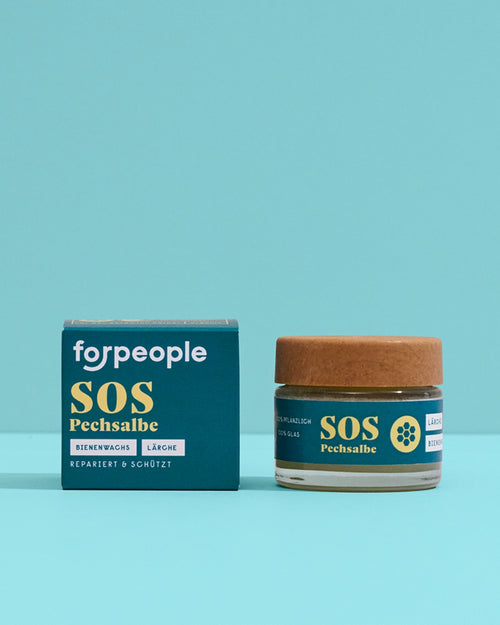
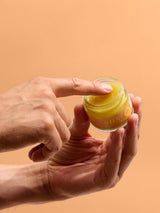
- SOS Pitch Salve - Larch Resin in a Glass Jar (50 g, €16.90): larch resin, beeswax, olive oil; pinene, terpinolene, alpha-terpinene, terpineol. No propolis, no added essential oils.
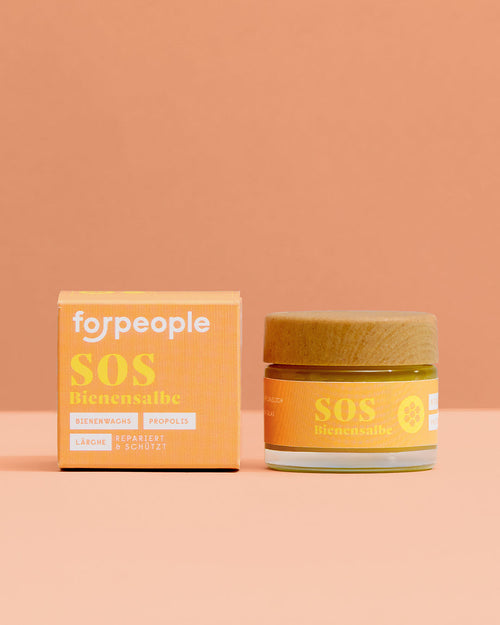
- Beeswax Salve Larch & Mandarin in a Glass Jar (50 g, €12.90): larch resin, propolis, beeswax, olive, almond and castor oil, alcohol, essential oils of mandarin, rosemary and fir; limonene, linalool and the terpenes from the resin.
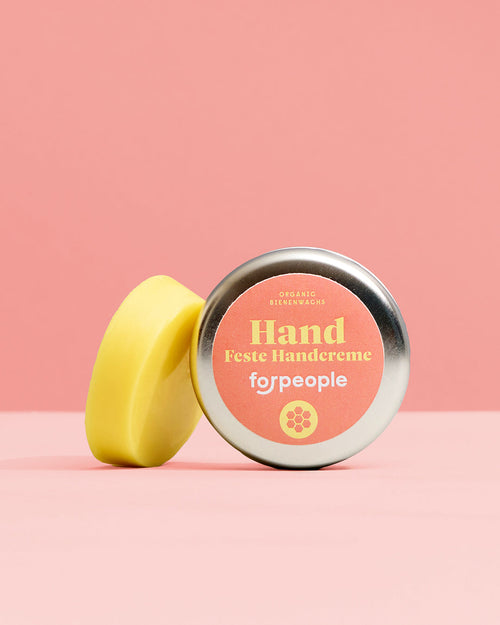
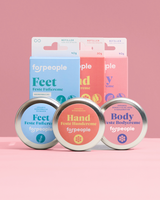
- Solid Hand Cream - Beeswax (30 g, €9.90): beeswax, olive and sunflower oil, St. John’s wort and aloe extract. No resin, no propolis, no essential oils.
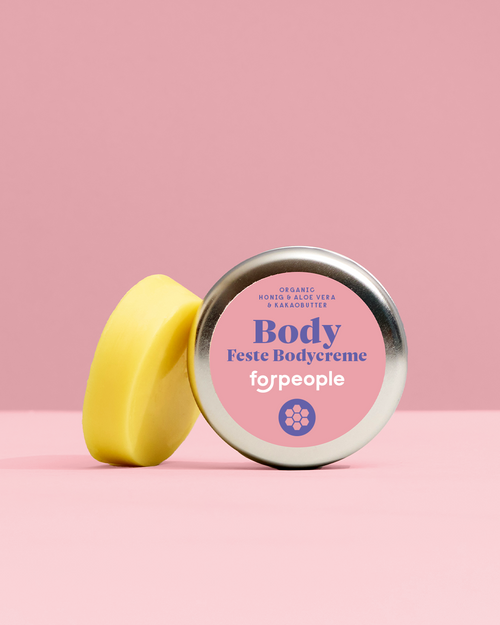
- Solid Body Butter - Beeswax & Aloe Vera (40 g, €9.90): cocoa butter, olive oil, beeswax, sunflower oil, shea butter, aloe extract. No resin, no propolis, no essential oils.
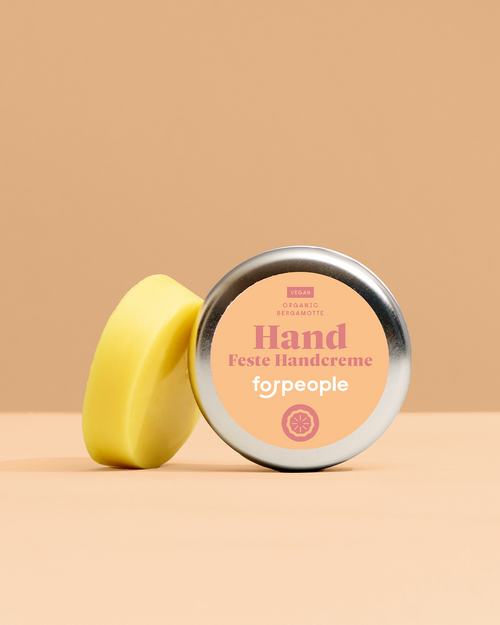
- Solid Vegan Hand Cream - Bergamot (30 g, €9.90): vegan with candelilla wax, without beeswax, resin or propolis; it does, however, contain lemon and bergamot oil with limonene, geraniol, citral and linalool.
More on this: Without fragrance and essential oils · Candelilla wax or beeswax · Pitch salve or drawing salve · Baking soda in deodorant: when the skin reacts
Sources
- Karimian K, Isufi D, Jensen MB, Johansen JD, Schwensen JFB (2026): Prevalence of Contact Allergy to Colophonium in Dermatitis Patients: A Systematic Review and Meta-Analysis. Contact Dermatitis 95(1): 1–16. https://doi.org/10.1111/cod.70153
- de Groot AC (2013): Propolis: a review of properties, applications, chemical composition, contact allergy, and other adverse effects. Dermatitis 24(6): 263–282. https://doi.org/10.1097/DER.0000000000000011
- de Groot AC, Ipenburg NA, Rustemeyer T (2026): Propolis and Beeswax in Cosmetics: A Market Survey and Literature Review on Their Relationship and Role in Allergic Contact Dermatitis. Contact Dermatitis 94(5): 494–503. https://doi.org/10.1111/cod.70108
- Kocabas G, Ipenburg NA, de Groot A, Rustemeyer T (2024): Results of patch testing propolis in the European baseline series: A 4-year retrospective study. Contact Dermatitis 91(5): 375–378. https://doi.org/10.1111/cod.14678
- Karlberg AT, Lidén C (1985): Clinical experience and patch testing using colophony (rosin) from different sources. Br J Dermatol 113(4): 475–481. https://doi.org/10.1111/j.1365-2133.1985.tb02363.x
- Hannuksela M, Salo H (1986): The repeated open application test (ROAT). Contact Dermatitis 14(4): 221–227. https://doi.org/10.1111/j.1600-0536.1986.tb01229.x
- Europäische Kommission (2023): Verordnung (EU) 2023/1545 zur Änderung der Verordnung (EG) Nr. 1223/2009 hinsichtlich der Kennzeichnung allergieauslösender Duftstoffe in kosmetischen Mitteln. ABl. L 188: 1. https://eur-lex.europa.eu/eli/reg/2023/1545/oj