









Where the name comes from
The word Pech goes back to the Latin “pix”, in Old High German “peh”, in Middle High German “bech”. This is how it is described in the application that brought resin tapping in Lower Austria into the Austrian inventory of intangible cultural heritage (ARGE NÖ Pecherstraße 2010). There, the word means the fresh resin of the black pine. The people who harvested it were called Pecher (resin tappers); the area in southern Lower Austria is still known as Pecherland.
In today’s language, “pitch” is ambiguous. It can mean raw tree resin, but also tough, dark residues from processing wood or coal. The differences between resin, rosin, turpentine and wood tar are explained on Larch resin, pine pitch, pine tar: the difference. A pitch salve in the sense of this page contains resin, not tar.
Resin tapping: a craft with a fixed yearly rhythm
In the districts of Mödling, Baden, Wiener Neustadt and Neunkirchen, resin harvesting has been documented since the Middle Ages, for example through field names, and was actively promoted from the 18th century (Austrian Commission for UNESCO; Bockhorn 2010). The main tree was the black pine (Pinus nigra). The application describes a yield of 2.5 to 4 kilograms of resin per trunk per year; warmth and moisture encourage the flow of resin, cool and dry weather slow it down (ARGE NÖ Pecherstraße 2010).
The working year followed a set pattern:
- Winter: preparing tools, carving resin gutters, building ladders.
- February/March: starting new trees. Bark was removed at the bottom of the trunk and a resin pot attached.
- April to autumn: every few days, “Plätzen” or “Hobeln”: a narrow strip of inner bark is taken off so that fresh resin flows. The pots were emptied three to four times a year.
- October: “Pechscherrn”: the resin that had hardened on the trunk surface is scraped off.
From the 1960s onwards, the craft declined sharply because of cheaper imports and substitutes made from mineral oil. According to the inventory entry, there are still eight resin tappers in Austria today and a single processing business, the Pecherhof in Hernstein (Austrian Commission for UNESCO).
Larch resin: drilled, not planed
Larch is worked differently. In the “Tyrolean method”, the harvester drills downwards at an angle into the foot of the trunk, closes the hole with a wooden plug and later scoops out the collected resin with a resin spoon (BOKU). The Bavarian State Institute of Forestry describes a borehole about 50 to 80 centimetres long and around 30 millimetres wide; depending on the region, one tree yields about 200 to 370 grams of resin per harvest year and is used for 10 to 15 years (Lagoni 2012).
Larch resin comes mainly from Carinthia, South Tyrol and south-western Switzerland. Until the late 19th century, Venice was the most important trading place, hence the name “Venice turpentine” for purified larch resin (Lagoni 2012).
From raw resin to salve
Raw resin is not clean. Larch resin is therefore purified, filtered several times, gently warmed and clarified by decanting (Lagoni 2012). Pine resin used to go mostly to resin refineries and pitch boilers. There it was distilled into liquid turpentine oil and solid rosin, raw materials for paper, varnishes, soaps and much more (ARGE NÖ Pecherstraße 2010). Because of its low-volatility components, larch resin cannot be separated into these two fractions as easily (BOKU).
| Step | Pine (black pine) | Larch |
|---|---|---|
| Harvesting | bark removed strip by strip (“Plätzen”, “Hobeln”), resin collected in a pot | borehole at the foot of the trunk, closed with a wooden plug |
| Collection | pots emptied three to four times a year, hardened resin scraped off in autumn | resin scooped out of the borehole with a resin spoon |
| Cleaning | boiling and filtering in the pitch works | filtering, gentle warming, decanting |
| Further processing | distillation into turpentine oil and rosin | mostly used as purified resin (“Venice turpentine”) |
| Typical consistency | crystallises in air and hardens | stays viscous, crystallises little |
For a salve, the purified resin is dissolved in warm oil and bound with wax. The principle is the same as for any water-free salve: oil and wax form the base, and the resin adds scent, colour and a slightly sticky, viscous texture. How salve, balm and solid cream differ is explained on Salve, balm, butter, solid cream. If you would like to make your own, you will find basic wax-to-oil ratios on Making solid cream yourself.
Pitch salve today: cosmetic or medicine?
The word pitch salve is not protected. There are cosmetic pitch salves and medicinal products with resin ingredients. Under EU law, a cosmetic product is intended to clean the skin, protect it, keep it in good condition or change its appearance (Regulation (EC) No 1223/2009, Article 2). Medicinal products, by contrast, carry an authorisation number and come with a package leaflet. What this means in detail is explained on Is pitch salve the same as drawing salve?.
A cosmetic pitch salve cares for dry, rough and stressed skin and leaves a protective film of oil, wax and resin. How this film reduces evaporation is described on Occlusion and TEWL. It is not meant for injured or irritated skin.
Collecting resin yourself?
Many recipes start with “collect resin in the forest”. Keep in mind: forests and their trees belong to someone. Ask the forest owner or the forestry office before you take anything, and never cut into trees. Tapping sites make trees more vulnerable to pests and can reduce the value of the timber (BOKU). Take at most small amounts of resin that has already come out and hardened, and only with permission.
Tree resin can also cause contact allergies. Before you put resin on your skin, read Allergic to tree resin, colophony or propolis?. Homemade products are for your own use only; anyone who passes on or sells a salve needs, among other things, a safety assessment under the Cosmetics Regulation (Regulation (EC) No 1223/2009, Article 10).
Frequently asked questions
Why is it called pitch salve?
Because it contains tree resin, which in the Alpine region and Lower Austria has traditionally been called “Pech” (pitch). The word comes from the Latin “pix”.
Does pitch salve contain tar?
A resin salve does not. Resin comes out of the living tree. Tar only forms when wood is heated strongly without air. They are two different substances.
Which resin is pitch salve made from?
Traditionally from pine or larch resin, sometimes from spruce resin. Which resin is used is shown in the ingredient list, for example “Larix Decidua Resin” for larch resin.
Is resin still harvested by hand today?
Yes, but rarely. According to the inventory of intangible cultural heritage, eight resin tappers still work in Lower Austria, and larches are tapped in Carinthia, South Tyrol and Switzerland.
Does pitch salve always smell strong?
Resin has its own spicy, woody scent. How strong it is depends on the type and amount of resin.
At forpeople
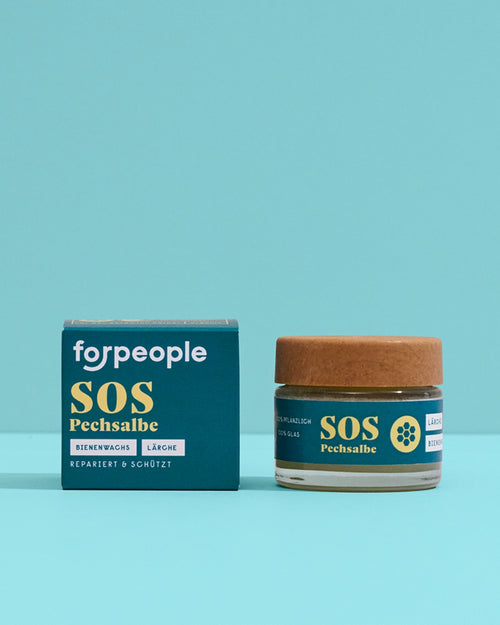
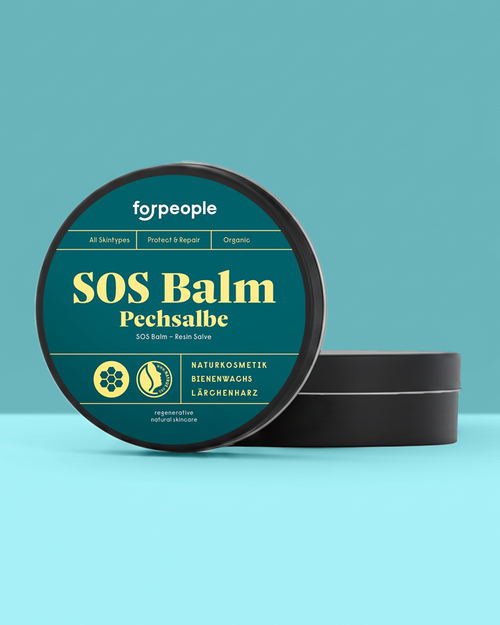
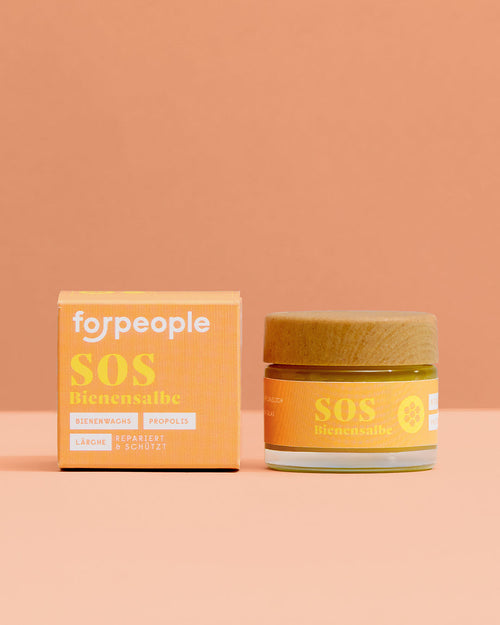
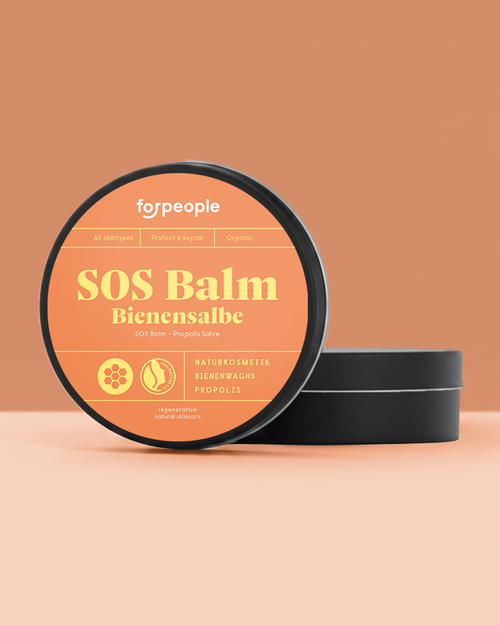
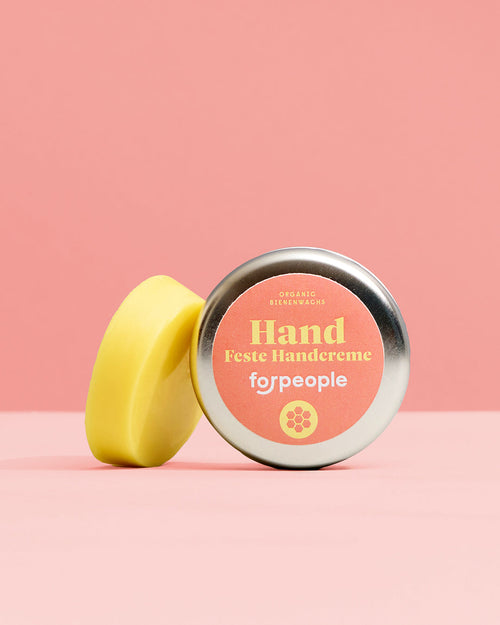
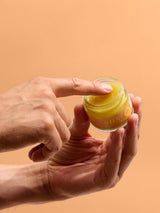
Our SOS Pitch Salve - Larch Resin in a Glass Jar (50 g, €16.90) consists of olive oil, larch resin and beeswax according to its ingredient list. The list also names the terpenes pinene, terpinolene, alpha-terpinene and terpineol individually. It is a cosmetic product and contains no water. For larger needs there is the SOS Pitch Salve - Larch Resin in a Tin (150 g, €39.90). The Beeswax Salve Larch & Mandarin in a Glass Jar (50 g, €12.90) contains propolis and essential oils of mandarin, rosemary and fir in addition to larch resin and beeswax; it is also available as Bee Salve Larch & Mandarin in a Tin (€34.90). If you prefer to avoid resin, choose the Solid Hand Cream - Beeswax (30 g, €9.90). More on this: Pitch salve or drawing salve · Resin, pitch, wood tar · Allergy to resin and propolis · Water-free cosmetics · Reading an INCI list
Sources
- Österreichische UNESCO-Kommission: Pecherei in Niederösterreich. Österreichisches Verzeichnis des immateriellen Kulturerbes (abgerufen 30.09.2026). https://www.unesco.at/kultur/immaterielles-kulturerbe/verzeichnis/element/pecherei-in-niederoesterreich
- ARGE NÖ Pecherstraße (2010): Bewerbungsformular „Pecherei in Niederösterreich, Harzgewinnung und Verarbeitung“ für das österreichische Verzeichnis des immateriellen Kulturerbes. Österreichische UNESCO-Kommission. https://www.unesco.at/fileadmin/Redaktion/Kultur/IKE/IKE-DB/files/337.doc
- Bockhorn O (2010): Gutachten zu „Pecherei in Niederösterreich“ (Antrag auf Aufnahme in das österreichische Verzeichnis des immateriellen Kulturerbes), Wien, 6. November 2010. https://www.unesco.at/fileadmin/Redaktion/Kultur/IKE/IKE-DB/files/338.pdf
- Universität für Bodenkultur Wien (BOKU) (o. J.): Steckbrief Harz, Pech, Balsam. https://boku.ac.at/fileadmin/data/H03000/H91000/H91300/Forschung/Steckbrief_Harz.pdf
- Lagoni N (2012): Vom Lärchenharz zum Terpentin bis Lärchenöl. LWF Wissen 69: 79–81. Bayerische Landesanstalt für Wald und Forstwirtschaft. https://www.lwf.bayern.de/mam/cms04/biodiversitaet/dateien/vom_laerchenharz_w69.pdf
- Europäisches Parlament und Rat (2009): Verordnung (EG) Nr. 1223/2009 über kosmetische Mittel, Artikel 2 und 10. ABl. L 342: 59. https://eur-lex.europa.eu/eli/reg/2009/1223/oj