


Two legal categories: cosmetics and medicinal products
In the EU, cosmetic products and medicinal products are governed by separate rules. The Cosmetics Regulation states explicitly that it applies only to cosmetic products and not to medicinal products, medical devices or biocides. The distinction follows from where the product is applied and what it is intended for (Regulation (EC) No 1223/2009, recital 6).
- Cosmetic product: it comes into external contact with the skin, hair, nails or lips, exclusively or mainly in order to clean them, perfume them, change their appearance, protect them, keep them in good condition or correct body odour (Regulation (EC) No 1223/2009, Article 2).
- Medicinal product: under the German Medicinal Products Act, this is, among other things, a substance intended as a remedy for illnesses or pathological complaints, or intended to influence body functions pharmacologically. Cosmetic products are explicitly excluded (Section 2 AMG, paragraph 1 and paragraph 3 no. 3). The EU directive on medicinal products for human use defines the term in a similar way (Directive 2001/83/EC, Article 1).
In Germany, a finished medicinal product may only be sold once it has been authorised (Section 21 AMG). A cosmetic product needs no authorisation. However, before it is sold, the responsible person must have a safety assessment carried out and notify the product to the European Commission (Regulation (EC) No 1223/2009, Articles 10 and 13).
What is in the two salves
The raw material of a pitch salve is tree resin, usually from larch or pine, harvested from the living tree. How this used to be done is described on Pitch salve: origin, name and how it was made. The salve base consists of plant oil and wax.
Ammonium bituminosulfonate, also called ichthammol, comes from shale oil, i.e. from rock. A chemical analysis shows that the substance complying with the European Pharmacopoeia consists mainly of sulfonated sulphur-containing ring compounds from shale oil. It is made by treating the oil with sulphuric acid and then neutralising it with ammonia (Tiemann et al. 2026). Chemically, it has nothing to do with tree resin.
| Feature | Cosmetic pitch salve | Drawing salve (medicinal product) |
|---|---|---|
| Legal category | cosmetic product under Regulation (EC) No 1223/2009 | medicinal product under the Medicinal Products Act |
| Typical raw material | tree resin (e.g. larch resin), plant oil, wax | ammonium bituminosulfonate from shale oil |
| Requirement for sale | safety assessment, notification, responsible person | authorisation by the authority |
| Labelling | ingredient list (INCI), name and address of the responsible person | authorisation number “Zul.-Nr.”, active substance and strength, package leaflet “Gebrauchsinformation” |
| Intended for | caring for the skin, protecting it, keeping it in good condition | indications according to the authorisation and package leaflet |
| Permitted statements | only properties the product actually has; no references to illness | only the authorised indications |
Sources for the table: Regulation (EC) No 1223/2009, Articles 2, 10, 13, 19 and 20; AMG, Sections 2, 10, 11 and 21; Tiemann et al. 2026.
Why the names get mixed up
Both names sound like an old-fashioned home medicine cabinet. On some websites, resin salve is therefore also called “drawing salve”. Legally, they are not the same, and for a cosmetic product the term would be misleading: cosmetics must not claim properties or functions they do not have (Regulation (EC) No 1223/2009, Article 20).
On top of that, the word “pitch” is ambiguous. In the Alpine region it means raw resin; in industry it also means dark residues from tar. The difference is explained on Larch resin, pine pitch, pine tar.
How to tell from the pack what you are buying
The labelling shows the category at a glance (the rules below apply in Germany):
- Medicinal products show on the container and outer packaging the name with strength and pharmaceutical form, an authorisation number with the abbreviation “Zul.-Nr.” and a batch number “Ch.-B.” (Section 10 AMG). They come with a package leaflet headed “Gebrauchsinformation” (Section 11 AMG).
- Cosmetic products carry a list of ingredients in descending order of weight, using the internationally uniform INCI names, plus the name and address of the responsible person (Regulation (EC) No 1223/2009, Article 19). How to read this list is explained on Reading an INCI list.
So if a pitch salve lists “Larix Decidua Resin” in its ingredients and there is no authorisation number on the tin, you are holding a cosmetic product.
When a care salve is not the right choice
A cosmetic salve is meant for dry, rough and stressed skin that is otherwise intact. If an area of skin hurts, swells, turns very red or does not get better after a few days, have it looked at by a doctor. A cosmetic salve is not meant for that. This is why the safety notes on our salves say: “Do not use on injured or irritated skin” and “In case of skin irritation or allergic reactions, stop use immediately and seek medical advice”.
If you react to tree resin, colophony or propolis, you should avoid resin salves altogether. You will find notes on this on Allergic to tree resin, colophony or propolis?.
Frequently asked questions
Is pitch salve a medicinal product?
That depends on the product. Our pitch salve is a cosmetic product. There are also medicinal products with resin ingredients; you can recognise them by the authorisation number and the package leaflet.
Does pitch salve contain ichthammol?
A resin-based pitch salve does not. Ammonium bituminosulfonate comes from shale oil and is a pharmaceutical substance. The ingredient list of a resin salve names resin, oil and wax instead.
Can I use pitch salve instead of a drawing salve?
No. A cosmetic salve is no substitute for a medicinal product. For skin problems that go beyond dry skin, ask at a pharmacy or doctor’s practice.
What should I keep in mind with a cosmetic pitch salve?
Only apply it to intact skin, not to injured or irritated areas. If you are allergic to tree resin, colophony or propolis, it is better to avoid it.
What is a cosmetic pitch salve for?
For dry, rough and stressed skin, for example on the hands, elbows or heels. It leaves a care film of oil, wax and resin.
At forpeople
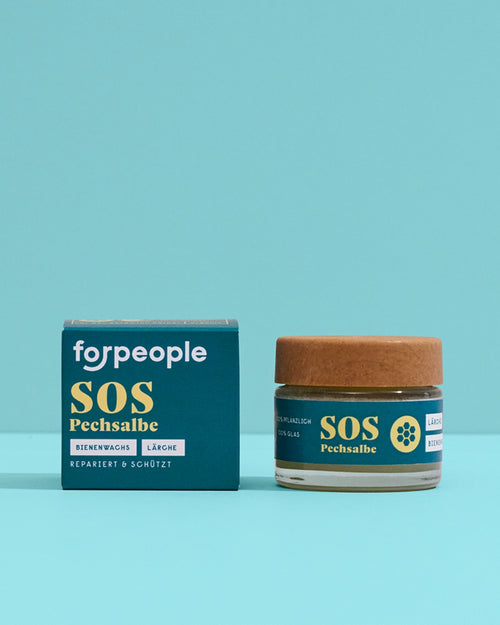
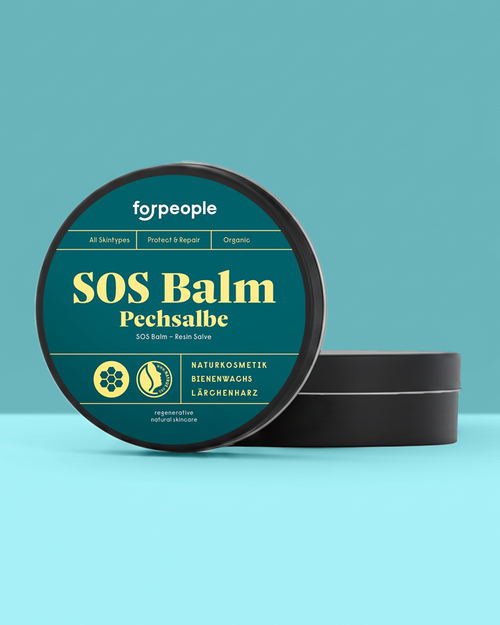
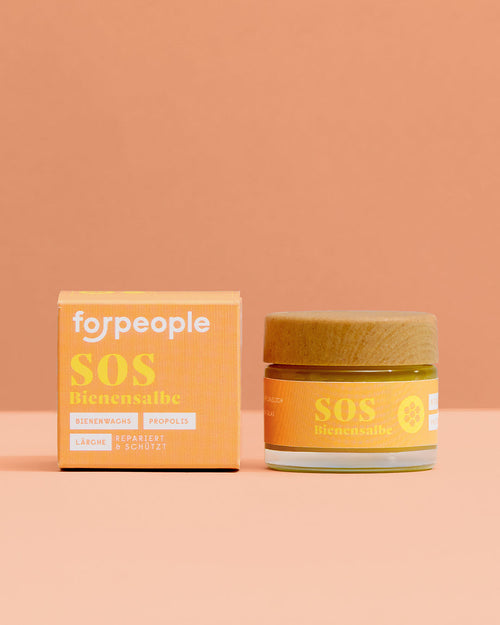
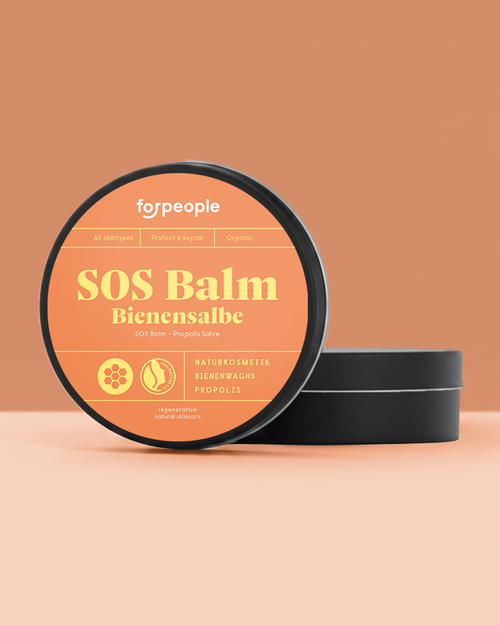
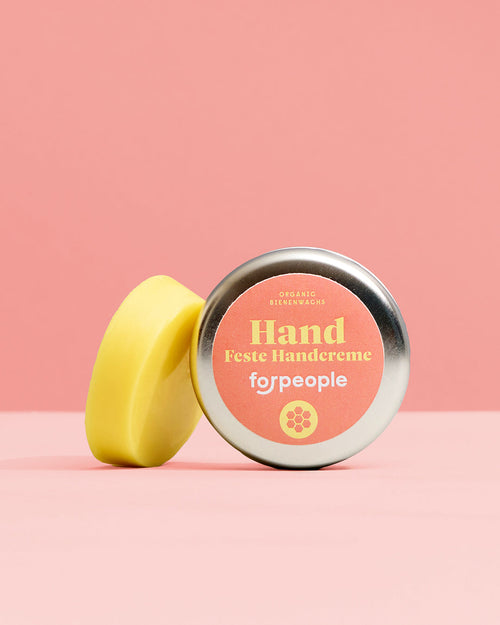
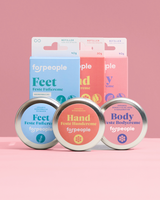
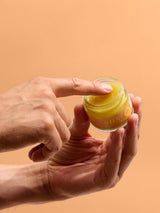
The SOS Pitch Salve - Larch Resin in a Glass Jar (50 g, €16.90) and the SOS Pitch Salve - Larch Resin in a Tin (150 g, €39.90) are cosmetic products under the EU Cosmetics Regulation and are notified in the EU notification portal. Their ingredient list names olive oil, larch resin and beeswax as well as the terpenes pinene, terpinolene, alpha-terpinene and terpineol. The Beeswax Salve Larch & Mandarin in a Glass Jar (50 g, €12.90) also contains propolis and essential oils; it is also available as Bee Salve Larch & Mandarin in a Tin (€34.90). Without resin: the Solid Hand Cream - Beeswax (30 g, €9.90). None of these products is a medicinal product. More on this: Salve, balm, butter, solid cream · Water-free cosmetics · Pitch salve: origin and how it was made · Petroleum jelly or beeswax salve
Sources
- Europäisches Parlament und Rat (2009): Verordnung (EG) Nr. 1223/2009 über kosmetische Mittel, Erwägungsgrund 6, Artikel 2, 10, 13, 19 und 20. ABl. L 342: 59. https://eur-lex.europa.eu/eli/reg/2009/1223/oj
- Gesetz über den Verkehr mit Arzneimitteln (Arzneimittelgesetz – AMG), §§ 2, 10, 11 und 21, in der geltenden Fassung. https://www.gesetze-im-internet.de/amg_1976/
- Europäisches Parlament und Rat (2001): Richtlinie 2001/83/EG zur Schaffung eines Gemeinschaftskodexes für Humanarzneimittel, Artikel 1. ABl. L 311: 67. https://eur-lex.europa.eu/eli/dir/2001/83/oj
- Tiemann O, Schwalb L, Hansen HJ, Aguilera ML, Gröger T, Huy P et al. (2026): Regulatory Challenges for Look-Alike and Sound-Alike Non-Biological Complex Drugs: Molecular Fingerprint Discrimination of Ichthammol Formulations. Mol Pharm 23(1): 139–150. https://doi.org/10.1021/acs.molpharmaceut.5c00679