











Where the procedure comes from
In the specialist literature the procedure is called the repeated open application test, ROAT for short. In the original description, the substances were applied twice a day for seven days to the flexor side of the forearm near the crook of the elbow, unless a reaction appeared earlier (Hannuksela & Salo 1986). The current European guideline gives twice-daily application for up to ten days to two weeks, in some cases up to four weeks. The test area is usually 3 × 3 to 5 × 5 cm, and the amount should cover the area (Uter et al. 2026).
In medical practice the test is used to clarify how relevant the results of a patch test are, and it is assessed by a doctor (Uter et al. 2026). At home you only take over the procedure, not the assessment.
How to go about it
- Choose the time: The skin at the test spot is unremarkable, not freshly shaved and not broken.
- Fix the spot: The inside of the forearm near the crook of the elbow, an area of about 3 × 3 to 5 × 5 cm. Always use the same spot.
- Apply: In the morning and evening, enough to cover the area thinly. Do not wipe the product off, and do not cover the spot with a plaster or film.
- Change nothing else: No second new product, no new shower gel or laundry detergent. Only then can you attribute a reaction.
- Look every day: In good light, before the next application, comparing with the other arm.
- Keep going: At least seven days, preferably up to two weeks.
- Second step where you will use it: If the arm stays unremarkable, use the product for a few days on a small area where you want to use it, for example on one hand, under one arm or on a spot along the jawline.
Duration and location follow the specialist procedure; the notes on the condition of the skin, the comparison and the second step are common practice.
| What you observe | What you do |
|---|---|
| Nothing: the spot looks and feels like the other arm. | Carry on to the end, then take the second step where you will use the product. |
| Burning, stinging or tingling shortly after application | Remove the product with a soft cloth and lukewarm water and stop. |
| Redness, itching, small bumps or flaking at the spot, possibly only after several days | Stop and do not put anything else on the spot. Note the product and the day. |
| The reaction does not subside after you stop, spreads, weeps or forms small blisters. | Seek medical advice and take the ingredient list with you. |
Slightly different depending on the product
The specialist procedure is intended mainly for products that stay on the skin (Uter et al. 2026). The following notes are common practice.
- Creams, oils, salves: as described. With a solid cream, a very small amount is enough; how to warm it up is explained under How do I apply a solid cream correctly?
- Soap: Test it the way you use it: lather, wash the spot briefly, rinse. Do not leave the lather on. This also applies to a soap with essential oils such as the Aloe Vera Soap – Lavender. Whether soap is an option for your face is covered on the page Can I use bar soap on my face?
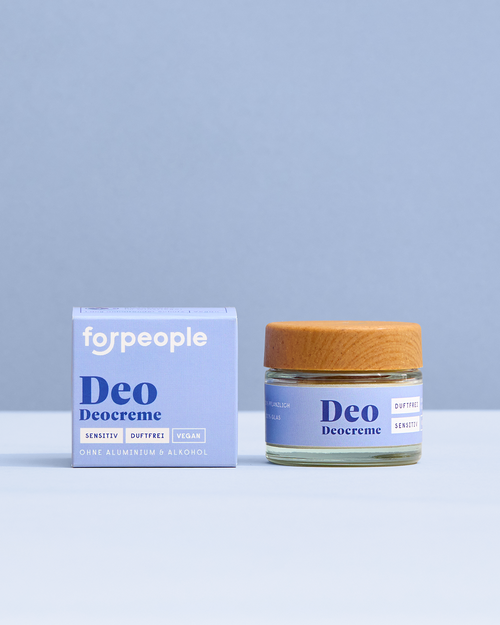
- Deodorant: after the arm, use it under one arm only for a few days and not straight after shaving, see Deodorant after shaving: why does it sting, and what helps? According to its INCI list, the Sensitive Deodorant Cream contains no essential oils, but it does contain baking soda. The Deodorant Cream - Lemon contains essential oils and baking soda; its product page advises people with sensitive skin to test it on a small area first.
- Sunscreen: Try it in good time before your holiday and not on the first day in the sun.
- Products with essential oils, resin or propolis: The test is especially worthwhile here, because these raw materials consist of many individual substances. More on this under Essential Oils and Fragrance Allergens and Allergic to tree resin, colophony or propolis?
Why some reactions only appear after days
Applying once and checking the next morning is not enough. The European guideline gives several reasons for this (Uter et al. 2026):
- Substances accumulate: Some substances are present in such small amounts that they first have to build up in the skin with repeated application before the threshold for a reaction is reached.
- The immune system responds with a delay: Delayed-type reactions typically appear only one to a few days after contact. Patch tests are therefore read several times, ideally after two days, after three to four days and once more around day seven.
- Accompanying factors count: Friction, sweating, covering and already damaged skin can mean that an otherwise unremarkable amount does trigger a reaction.
- A sensitivity can develop anew: This phase goes unnoticed. A product you have tolerated well for a long time can therefore cause problems later.
What the test does not show
- No cause: A skin reaction to a product can be an irritation, an allergy or both (Uter et al. 2026). On the arm you cannot tell these apart, and the test does not show which substance it was either. How to narrow down the candidates is explained on the page How to Read an INCI List.
- No all-clear: Even under medical supervision, an unremarkable test after one to two weeks does not rule out an allergy (Uter et al. 2026).
- Other parts of the body: The forearm reacts less readily than the upper arm or the back (Uter et al. 2026). On the face, the horny layer is thinner and its barrier weaker than on the trunk, arms and legs; eyelids and lips are special cases again (Tagami 2008). More on the horny layer: The skin barrier explained simply.
- A different skin condition: What stays without findings on unremarkable skin can turn out differently on already damaged skin (Nakada et al. 2000).
- No finding: In medical practice the result is assessed on a fixed scale covering area, redness, bumps and blisters (Uter et al. 2026). Your impression at home is an observation.
When to seek medical advice?
Seek medical advice if a reaction does not subside after you stop using the product, spreads, weeps, forms small blisters or swells markedly, and if your skin keeps reacting to different products. In case of swelling of the face, hives on the body or shortness of breath, call the emergency number 112 immediately. If you have a known contact allergy, atopic dermatitis or another skin condition, discuss new products with your doctor beforehand. Whether there is a contact allergy, and to which substance, is clarified by a patch test carried out by a skin specialist. It is regarded as the diagnostic standard (Mahler et al. 2019) and cannot be replaced by the test at home. Take along the products you reacted to, or their ingredient lists.
Frequently asked questions
Is it enough to apply the product once and wait 24 hours?
No. Some reactions only appear after several days or only after repeated application. That is why the specialist procedure calls for application twice a day for at least a week.
Is the test near the crook of the elbow an allergy test?
No. It only shows whether anything is noticeable at this spot during this period. An allergy test is carried out by a skin specialist.
Nothing was noticeable for two weeks. Does that mean I will tolerate the product in the long run?
That cannot be promised. The test only shows that nothing was noticeable at this spot during this time. Skin elsewhere can react differently, and a sensitivity can also develop later. Keep watching your skin and stop if it reacts.
Can I try a face oil straight on my face?
Better on the arm first and then for a few days on a small spot along the jawline. The horny layer of the face is thinner than on the arms and legs, and its barrier is weak on the eyelids too. On the amount: Face oil on oily skin: does that work?
I have a set with several products. How do I start?
With one product. Add the next one only when the first has been unremarkable for one to two weeks. If you test everything at once, you will not know what caused a reaction.
At forpeople
The pages of the individual products show the full INCI list and the safety notes: do not use on broken or irritated skin; in case of skin irritation or allergic reactions, stop using the product immediately and seek medical advice. Four examples of what the list shows before the test:
- Solid Hand Cream - Beeswax, 30 g, €9.90: five entries in the INCI list, no essential oil
- Solid Foot Cream – Rosemary & Sage, 40 g, €9.90: with essential oils of rosemary, eucalyptus and clary sage
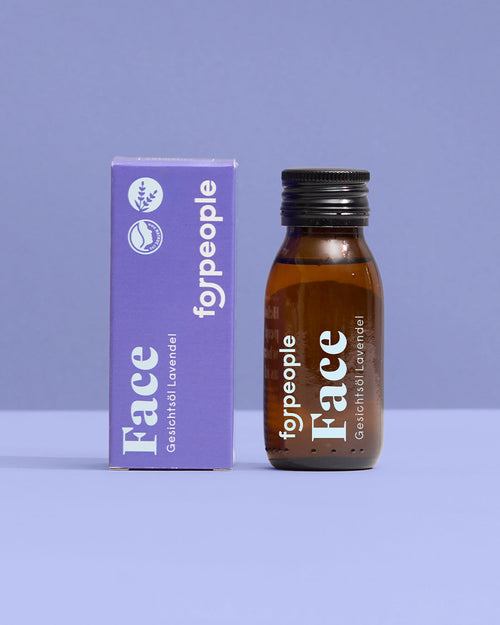
- Face Oil - Lavender, 50 ml, €21.90: with lavender oil; the INCI list names Linalool and Limonene
- Beeswax Salve Larch & Mandarin in a Glass Jar, 50 g, €12.90: with larch resin, propolis and essential oils
More on this: Cream with few ingredients: what does a short list give you? · Without fragrance and essential oils: ingredients at a glance · Allergic to tree resin, colophony or propolis? · Baking soda in deodorant: why it's there and skin reactions
From the blog: Switching to solid skincare: what is different in the first weeks
Sources
- Hannuksela M, Salo H (1986): The repeated open application test (ROAT). Contact Dermatitis 14(4): 221–227. https://doi.org/10.1111/j.1600-0536.1986.tb01229.x
- Uter W, Aerts O, Agner T et al. (2026): European Society of Contact Dermatitis Guideline for Diagnostic Patch Testing – Recommendations on Best Practice (Update 2026). Contact Dermatitis 95(3): 237–275. https://doi.org/10.1111/cod.70195
- Nakada T, Hostynek JJ, Maibach HI (2000): Use tests: ROAT (repeated open application test)/PUT (provocative use test): an overview. Contact Dermatitis 43(1): 1–3. https://doi.org/10.1034/j.1600-0536.2000.043001001.x
- Tagami H (2008): Location-related differences in structure and function of the stratum corneum with special emphasis on those of the facial skin. Int J Cosmet Sci 30(6): 413–434. https://doi.org/10.1111/j.1468-2494.2008.00459.x
- Mahler V, Nast A, Bauer A et al. (2019): S3 guidelines: Epicutaneous patch testing with contact allergens and drugs – Short version, Part 1. J Dtsch Dermatol Ges 17(10): 1076–1093. https://doi.org/10.1111/ddg.13956