





What sets soap apart from other cleansers
Soap in the strict sense is a salt of fatty acids. It forms when oils or fats react with a strong base such as sodium hydroxide; how this works is explained in Is there still lye in natural soap? Saponification explained. The result is always alkaline. A review gives pH values of 8.5 to 11 for soap and 5.5 to 7 for syndets, that is, cleansers made from synthetic surfactants (Mijaljica et al. 2022). In a series of measurements on commercially available soaps, the majority had a pH of 9 to 10 (Tarun et al. 2014).
The form tells you nothing about this: there are solid syndets too. Whether a bar is a soap shows in the ingredient list. It names oils together with Sodium Hydroxide, or the finished salts such as Sodium Olivate. More on this under Bar soap or liquid soap: which is better for your hands?
Both types dissolve fat. Much of what collects on the skin is not water-soluble; water alone removes it only incompletely (Mijaljica et al. 2022).
What pH does to the skin
The surface of the skin is acidic. A series of measurements on 330 people found a natural pH of about 4.7 on average on the forearm. Even tap water, which in Europe usually has a pH of around 8, raised it for up to six hours (Lambers et al. 2006). Soap raises it too. Three studies show what that means over time:
- Forehead, four weeks: Ten healthy people washed their forehead and forearm twice a day, for four weeks each with soap and with a syndet. With soap, the skin's pH was 0.3 units higher on average, and markedly more propionibacteria were found, which are part of the normal skin flora (Korting et al. 1987).
- Ten weeks of everyday use: Two groups of 25 healthy women used either an alkaline soap or a syndet bar at home. The skin measurements did not change significantly, apart from a small rise in pH with soap. However, the soap tended to be perceived as more irritating (Barel et al. 2001).
- Over years: People who had used soap for more than five years had the same skin pH as people who had used a slightly acidic cleanser for just as long. After washing with soap, the pH recovered equally fast in both groups, measured on the forearm over six hours (Takagi et al. 2015).
Healthy skin evens out the rise. Even so, soap shifts the pH more than a cleanser adjusted to an acidic pH, and some skin responds with tightness and dryness. Only one of the three studies measured on the forehead. On the face, the forehead, nose and chin also tend to produce more sebum than the cheeks; the same soap can go unnoticed on the forehead and leave the cheeks feeling tight.
Who soap on the face suits, and who it tends not to suit
This overview is practical guidance, not a diagnosis. The measure is how your skin feels in the hour after washing.
| Your skin | Soap on the face? | What you can do |
|---|---|---|
| feels clean after washing and does not feel tight | possible | once a day, ideally in the evening; then moisture and a little oil |
| feels tight now and then, especially in winter | with limits | evenings only and not every day; lukewarm water is enough in the morning |
| is dry, flakes or regularly feels tight | rather not | lukewarm water or a cleanser with a pH of around 5.5; then apply cream or oil |
| reacts to fragrances or essential oils | not with scented soap | choose an unscented cleanser |
| is wearing water-resistant sunscreen or make-up | as a second step | loosen it with oil first, then wash with a little soap |
How to remove water-resistant sunscreen in two steps is described in How do I wash off mineral sunscreen? Which fragrance components have to be listed individually on the label is explained in Essential Oils and Fragrance Allergens.
Superfatting: what it does and what it does not do
Handmade soaps are usually superfatted. This means slightly less lye is used than would be needed on paper to saponify all the oils. A small share of the oils therefore stays in the bar unsaponified. In handmade soap, the glycerin from saponification generally stays in the bar as well; according to the manufacturer, the forpeople soaps are free from glycerin. More on this under Does glycerin dry out the skin?
There are three things superfatting does not do:
- It does not change the pH. Soap salts are only stable in the alkaline range. A superfatted soap stays alkaline too.
- It does not replace skincare. Soap is rinsed off. How much oil stays on the skin afterwards is not stated on the label, nor is the degree of superfatting.
- It says nothing about how your skin will react. Only trying it will show.
How to wash your face with soap
- Lather: Work the soap into a lather between your wet hands. Do not rub the bar itself over your face.
- Wash with lukewarm water: Spread the lather over forehead, nose, chin and cheeks with your fingertips. Leave out the eye area.
- Rinse thoroughly: No soap residue should stay on the skin. Then pat your face dry.
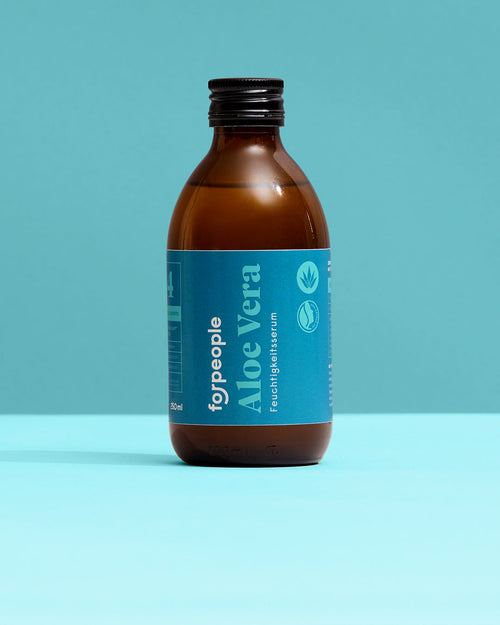
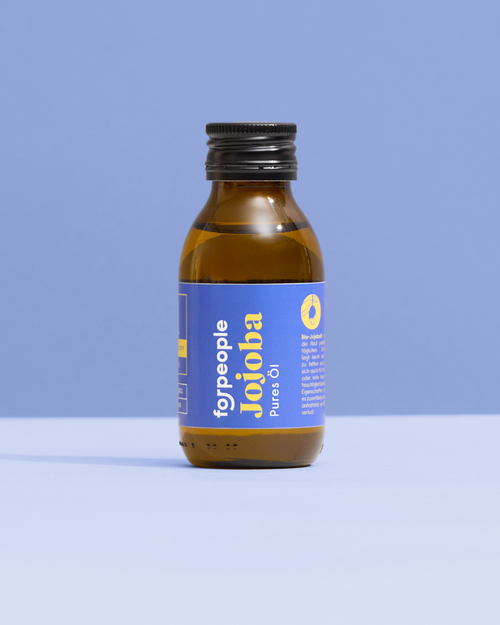
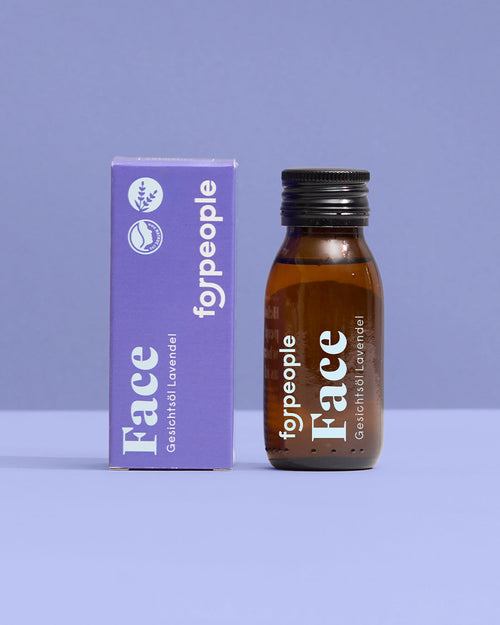
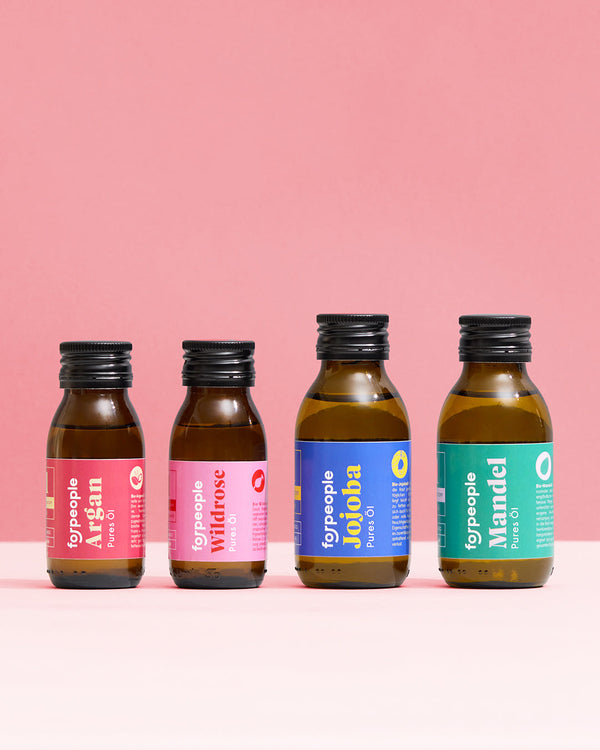
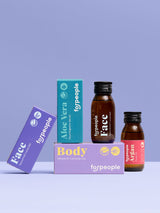
- Apply skincare straight away: On skin that is still slightly damp, first apply something water-based, for example the Aloe Vera Serum 99.6%, then one or two drops of oil. A pure oil without essential oils such as the Jojoba Oil - pure works for this, or the Face Oil - Lavender, which contains lavender essential oil. The order is explained in Combining aloe vera serum with oil or solid cream.
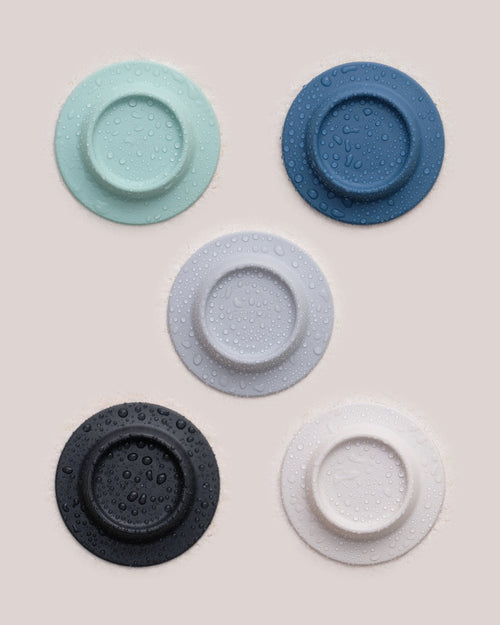
- Let the soap dry: Put the bar down so that it can dry all round, for example on a Soapi Magnetic Soap Holder for Bar Soap.
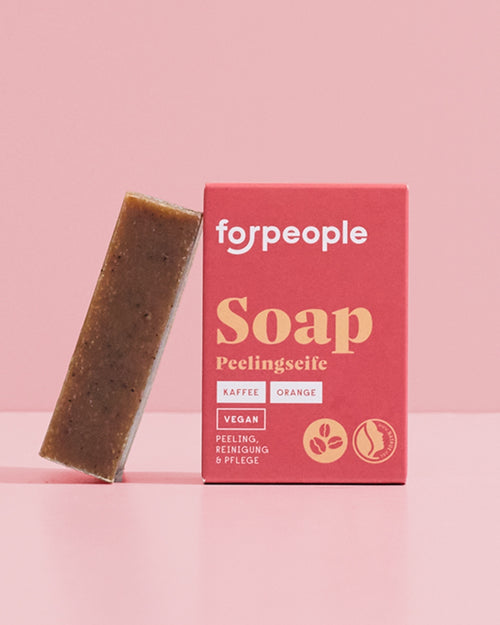
Once a day, in the evening, is enough for most people; that is practical experience, not a measured limit. For the face, use a soap without scrub particles: the Aloe Vera Soap with Scrub - Coffee & Orange contains coffee powder and is meant for hands and body. More on the oil afterwards: Face oil on oily skin: does that work?
When to seek medical advice
Cosmetics cleanse and care for the skin; they do not treat medical conditions. If you have acne, rosacea, atopic dermatitis, eczema or another skin condition on the face, agree your cleansing routine with your doctor. Also seek advice if your skin burns, itches, weeps or stays red for days after washing, and leave out the soap until then. If soap gets into your eye, rinse thoroughly with water. If the stinging persists, have the eye looked at.
Frequently asked questions
Is natural soap better for the face than other soap?
Chemically, both are soaps and therefore alkaline. Handmade natural soap is often superfatted and frequently scented with essential oils. Whether it suits your skin better cannot be predicted.
Is there bar soap with a skin-neutral pH?
Not true soap; it is always alkaline. Solid bars with a pH of around 5.5 are syndets; their ingredient list shows synthetic surfactants instead of saponified oils.
Does the scent of the soap stay on the face?
It is noticeable while washing and lingers only briefly after rinsing. The fragrance components of essential oils, such as Linalool or Limonene, are named individually in the ingredient list.
Can I use the same soap for face, body and hair?
For hands and body, yes; for the face, with the limits described above. With hair, water hardness comes into play; this is explained in Washing hair with soap: hard water, acid rinse and the switch.
Will the soap go mushy if I use it every day?
Only if it cannot dry in between. More on this under Mushy bar soap: causes and proper storage.
At forpeople
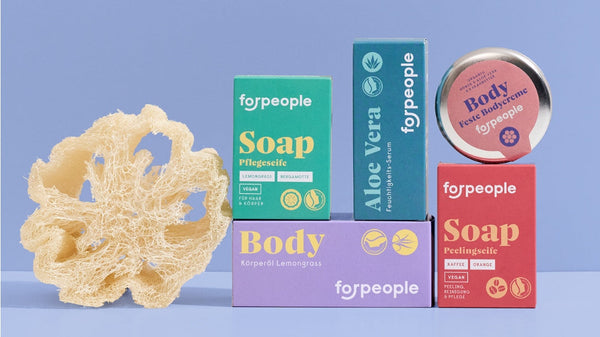
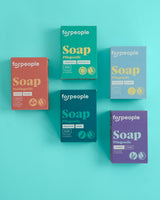
Our soaps are classic, alkaline soaps made from saponified plant oils. All five varieties contain essential oils. We do not offer a dedicated facial soap or a soap without essential oils.
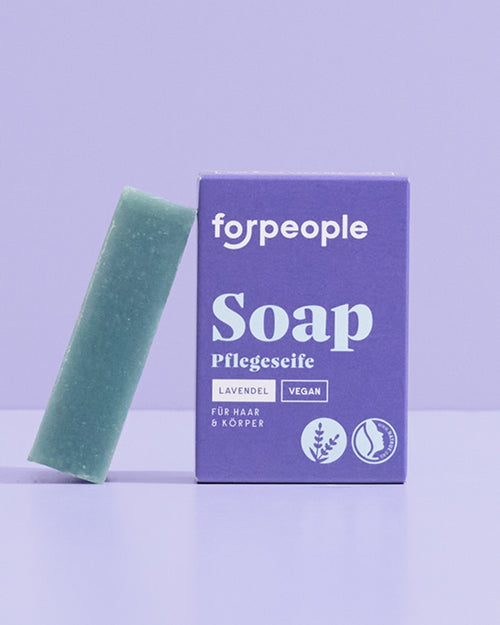
- Aloe Vera Soap – Lavender, 75 g, €8.90: according to its INCI list made from olive and coconut oil, shea butter, castor, sunflower and argan oil, with lavandin and lavender oil.
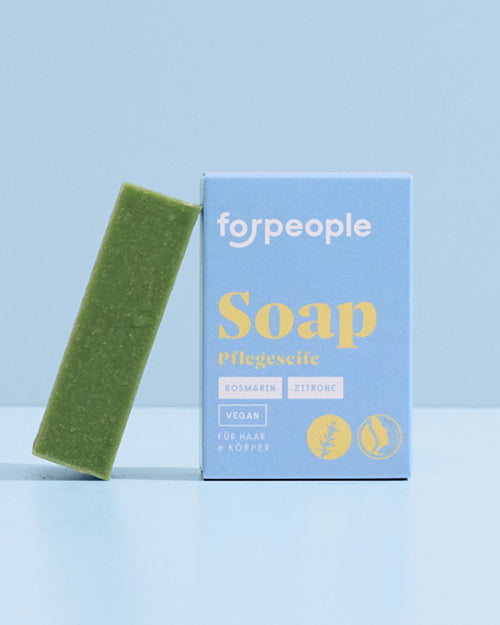
- Aloe Vera Soap – Rosemary & Lemon, 75 g, €8.90: the same oil base, with rosemary and lemon oil.
- Aloe Vera Serum 99.6%, 250 ml, €24.90: water-based, preserved with potassium sorbate and sodium benzoate.
- Jojoba Oil - pure, 100 ml, €16.90: a single ingredient, without essential oils.
More on this: Is there still lye in natural soap? Saponification explained · Bar soap or liquid soap · Mushy bar soap
From the blog: Less in the bathroom: a skincare routine with three products · Face & Body Oils: Which Oil Suits Which Skin Type?
Sources
- Lambers H, Piessens S, Bloem A, Pronk H, Finkel P (2006): Natural skin surface pH is on average below 5, which is beneficial for its resident flora. Int J Cosmet Sci 28(5): 359–370. https://doi.org/10.1111/j.1467-2494.2006.00344.x
- Mijaljica D, Spada F, Harrison IP (2022): Skin Cleansing without or with Compromise: Soaps and Syndets. Molecules 27(6): 2010. https://doi.org/10.3390/molecules27062010
- Tarun J, Susan J, Suria J, Susan VJ, Criton S (2014): Evaluation of pH of Bathing Soaps and Shampoos for Skin and Hair Care. Indian J Dermatol 59(5): 442–444. https://doi.org/10.4103/0019-5154.139861
- Korting HC, Kober M, Mueller M, Braun-Falco O (1987): Influence of repeated washings with soap and synthetic detergents on pH and resident flora of the skin of forehead and forearm. Results of a cross-over trial in health probationers. Acta Derm Venereol 67(1): 41–47. https://pubmed.ncbi.nlm.nih.gov/2436413/
- Barel AO, Lambrecht R, Clarys P, Morrison BM Jr, Paye M (2001): A comparative study of the effects on the skin of a classical bar soap and a syndet cleansing bar in normal use conditions and in the soap chamber test. Skin Res Technol 7(2): 98–104. https://doi.org/10.1034/j.1600-0846.2001.70208.x
- Takagi Y, Kaneda K, Miyaki M, Matsuo K, Kawada H, Hosokawa H (2015): The long-term use of soap does not affect the pH-maintenance mechanism of human skin. Skin Res Technol 21(2): 144–148. https://doi.org/10.1111/srt.12170