





What happens under the sock
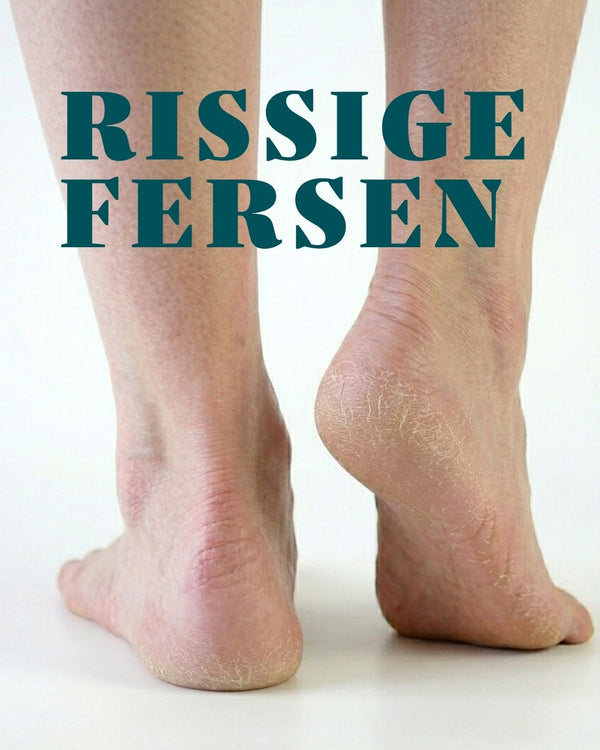
There are no sebaceous glands on the sole of the foot, see Why heel skin gets so thick and cracks. The skin there has no film of fat of its own, and how supple it stays depends on the water in the stratum corneum. In a study of 93 people, calluses and dry heel skin had significantly less moisture and less elasticity than unaffected skin (Hashmi et al. 2015).
When you apply cream and put on socks, three things come together:
- The film of the cream: Fats and waxes lay a water-repellent layer on the skin and reduce water loss (Sethi et al. 2016). The mechanism is described in Occlusion and TEWL.
- The cover: Covered skin is less ventilated, and the water content of the stratum corneum rises (Zhai & Maibach 2002). A fabric sock covers only lightly: it keeps a little warmth and moisture at the foot but lets air through.
- The time: Care that has been applied disappears, among other things, through contact with other materials (Lodén 2003). Without a sock, that is the bed linen at night. With a sock, more of it stays on the heel.
How much the sock contributes on its own has hardly been studied. In a small Japanese study, ten healthy volunteers wore special heel socks and comparison socks for two weeks each. With the heel socks, the stratum corneum at the back of the heel was better hydrated, and a dermatologist rated flaking and cracking lower (Kamo et al. 2020). The study looked at one particular sock model, not at applying cream, and cannot be transferred one-to-one to cotton socks.
Step by step: applying cream in the evening
- Wash: Wash your feet briefly with lukewarm water. A long soak is not necessary, see Foot soak before moisturising: worth it or not?
- Dry: Dry thoroughly between the toes. Only pat your heels and soles dry, because a film of fat works best on slightly damp skin (Sethi et al. 2016).
- Apply thinly: heels, the edge of the heel, the balls of the feet and the outer edges. Leave out the spaces between the toes. The skin there should stay dry.
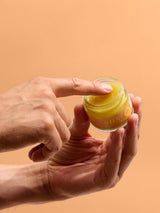
- Massage in: one to two minutes. You rub a solid cream directly over the heel and spread it with your hands, see How do I apply a solid cream correctly?
- Socks on: clean, loose cotton socks. Put them on sitting down, because freshly creamed soles are slippery.
- In the morning: Socks off, briefly massage in any residue. The socks go in the wash, because they take up fat.
With a sock, without a sock or with cling film?
| Option | What happens | For the night |
|---|---|---|
| Loose cotton sock | The cream stays on the foot. The fabric takes up sweat and excess fat and lets air through. | first choice |
| No sock | Some of the cream rubs off on the bed linen. | possible: apply more sparingly, wait a few minutes |
| Thick or tight sock | Your feet get warm and sweat more easily; tight cuffs dig in. | only if you do not sweat in them |
| Cling film or plastic bag | Airtight: sweat cannot escape, the stratum corneum swells. | not recommended |
Tighter is not better. An airtight cover raises the water content of the stratum corneum to the point where its barrier function suffers (Zhai & Maibach 2002). In an experiment with twelve people, the skin's water loss on the forearm rose after 24 to 96 hours of continuous covering; the authors interpret this as damage to the barrier (Fluhr et al. 1999). One night is shorter. Cling film is still not needed: the film of the cream and a fabric sock are enough. If your skin is whitish and swollen in the morning, use less cream or a thinner sock. The same applies to hands, see Overnight hand mask.
Which cream goes under the sock?
Fats and waxes form the film. Humectants such as urea or glycerin bind water in the stratum corneum. The two can be combined; which suits when is explained in Urea or water-free cream?
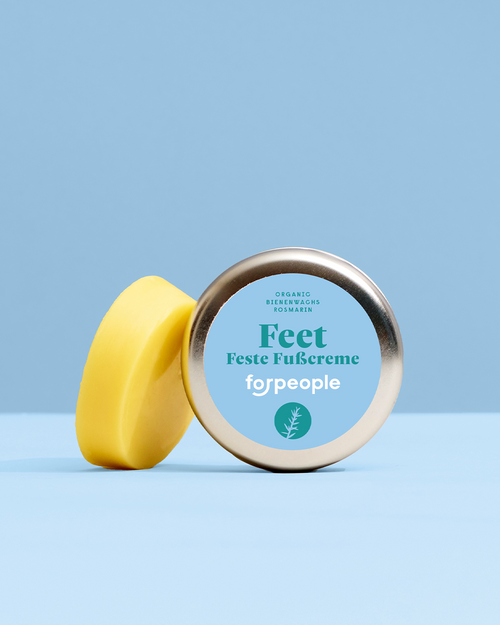
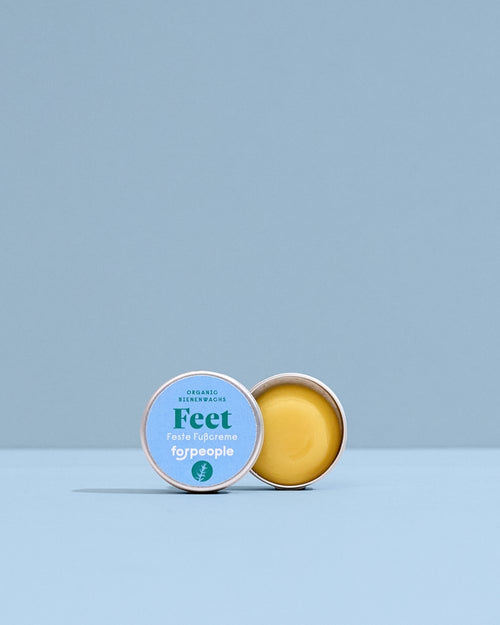
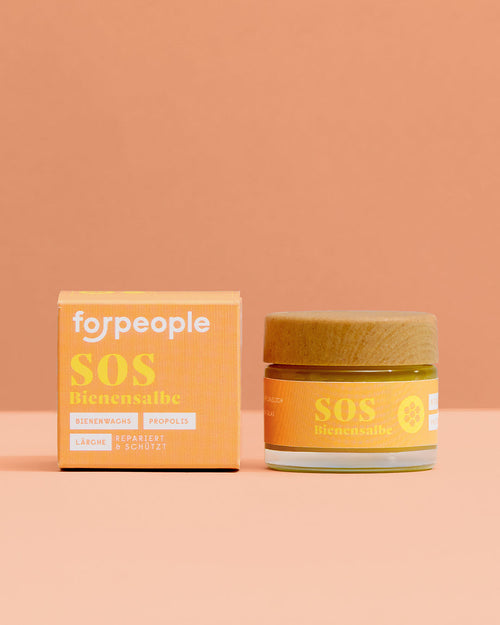
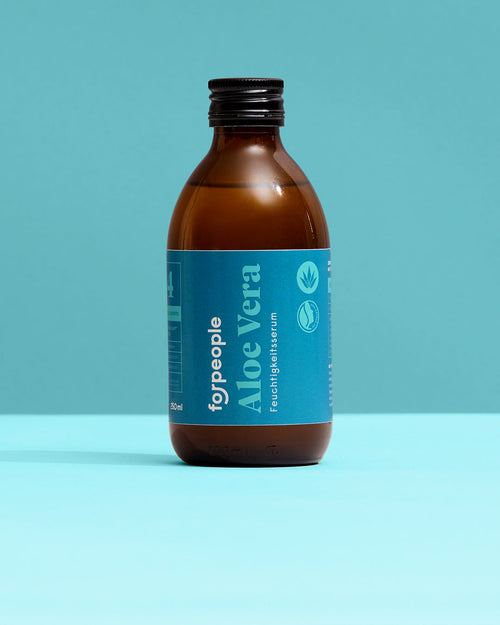
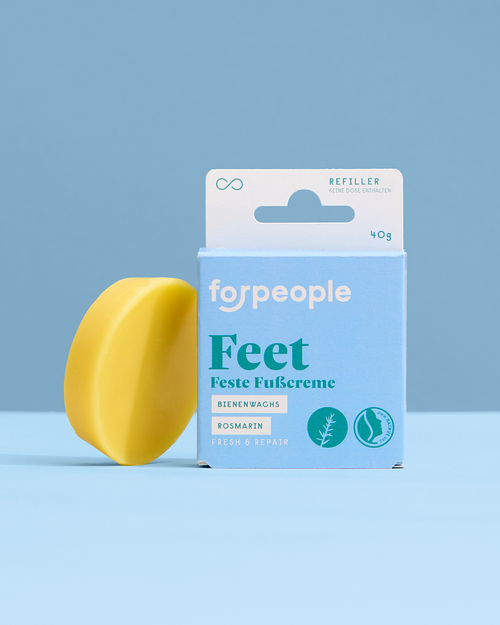
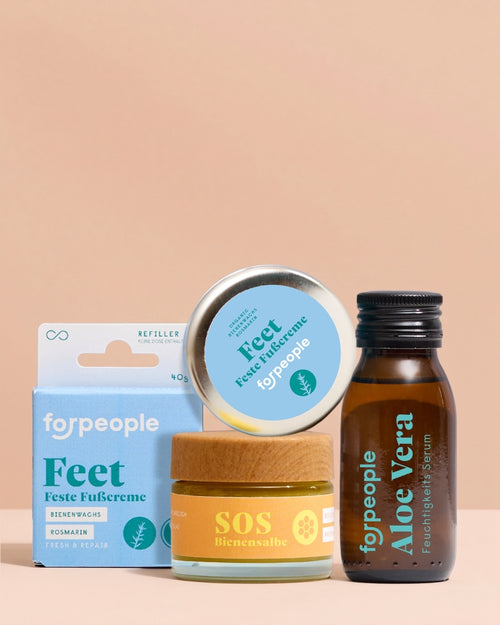
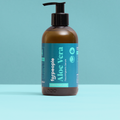
A water-free foot cream such as the Solid Foot Cream – Rosemary & Sage consists, according to its INCI list, of sunflower oil, beeswax, olive oil and shea butter, plus St. John's wort and aloe extract and essential oils of rosemary, eucalyptus and clary sage. So it is not unscented. For travel it comes as the Solid Foot Cream Travel Size – Rosemary & Sage in a Tin with 8 g. Softer and easier to apply thickly is the Beeswax Salve Larch & Mandarin in a Glass Jar. It contains larch resin and propolis, so read the allergy notes first. If you want to combine moisture and a film, apply a water-based product such as the Aloe Vera Serum 99.6% first and put the cream on top.
How often, and when not to?
There is no fixed rule. For moisturisers in general, the literature gives one to three times a day depending on dryness, especially after bathing (Sethi et al. 2016). For feet, this has proved practical:
- Very dry, rough heels: every evening until the skin feels supple.
- After that: two to three times a week, more often during the heating season and in sandal weather.
Think in weeks, not days. Leave the socks off if you sweat a lot in them or if your skin looks swollen in the morning. If your skin reacts to a product with redness or stinging, stop using it.
When to see a podiatrist or doctor
Cosmetics care for the skin; they do not treat conditions. Open areas do not belong under cream and a sock. Have your feet checked by a podiatrist or doctor if cracks are deep, bleed or hurt when you walk, if the skin is red, swollen or warm or weeps, or if the skin between your toes changes. If you have diabetes, circulatory problems or reduced sensation in your feet, discuss your foot care with your practice beforehand. More in Cracked heels: when to see a podiatrist or doctor
What customers say
A selection of verified reviews from our shop (collected via Judge.me), translated from German and partly shortened.
“I have been using the foot cream for 2 years before going to sleep. It is especially easy to apply when temperatures are warm. My feet feel cared for and I like the smell. At some point the solid cream breaks. […]”
Customer review of Solid Foot Cream Refill - Rosemary & Sage, 4 out of 5 stars, August 2026, verified purchase
Frequently asked questions
Does putting on socks after applying cream really do anything?
Yes. The cream stays on your foot instead of on the bed linen, and the fabric keeps a little moisture at the skin. Cracks do not disappear overnight.
Which socks are suitable for the night?
Clean, loose cotton socks. They take up sweat and fat and do not dig in. Keep one pair just for this and wash it regularly.
Does the cream have to sink in before I put the socks on?
No. A water-free cream forms a film that is meant to stay on the skin. One to two minutes of massaging in is enough. In reviews, some customers describe the solid foot cream as sinking in well; others wear socks afterwards because of the film.
Does the scent of rosemary and sage bother you when falling asleep?
That is a matter of taste. The scent comes from essential oils of rosemary, eucalyptus and clary sage and is often mentioned in reviews. If you avoid fragrances, the overview Without fragrance and essential oils will help.
The solid cream is hard in the evening or breaks. What do I do?
A solid cream is harder at cool room temperature. Warm the piece briefly in your hand. Towards the end it gets thin and can break; warm the pieces between your palms and massage them in as usual. With the refill you top up the tin.
At forpeople
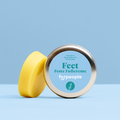
- Solid Foot Cream – Rosemary & Sage, 40 g, €9.90: water-free, in a metal tin, with essential oils of rosemary, eucalyptus and clary sage.
- Solid Foot Cream Refill - Rosemary & Sage, 40 g, €7.90: the refill for the tin.
- Beeswax Salve Larch & Mandarin in a Glass Jar, 50 g, €12.90: a soft salve with beeswax, larch resin, propolis and essential oils.
- Foot Care Set – 3 Steps for Cracked Heels, €39.90: aloe vera serum, beeswax salve and solid foot cream with refill.
More on this: Why heel skin gets so thick and cracks · Foot soak before moisturising · Calluses keep coming back · Urea or water-free cream? · Overnight hand mask
From the blog: Cracked Heels, Dry Feet: What Really Helps – and What Doesn't · Well-cared-for feet for spring: care tips
Sources
- Zhai H, Maibach HI (2002): Occlusion vs. skin barrier function. Skin Res Technol 8(1): 1–6. https://doi.org/10.1046/j.0909-752x.2001.10311.x
- Sethi A, Kaur T, Malhotra SK, Gambhir ML (2016): Moisturizers: The Slippery Road. Indian J Dermatol 61(3): 279–287. https://doi.org/10.4103/0019-5154.182427
- Hashmi F, Nester C, Wright C, Newton V, Lam S (2015): Characterising the biophysical properties of normal and hyperkeratotic foot skin. J Foot Ankle Res 8: 35. https://doi.org/10.1186/s13047-015-0092-7
- Kamo A, Umehara Y, Negi O, Iwata M, Kamata Y, Suga Y et al. (2020): Effects of Kakato-tsurutsuru socks on dry heels in healthy volunteer subjects. J Dermatol 47(4): 413–417. https://doi.org/10.1111/1346-8138.15235
- Fluhr JW, Lazzerini S, Distante F, Gloor M, Berardesca E (1999): Effects of prolonged occlusion on stratum corneum barrier function and water holding capacity. Skin Pharmacol Appl Skin Physiol 12(4): 193–198. https://doi.org/10.1159/000066243
- Lodén M (2003): Role of topical emollients and moisturizers in the treatment of dry skin barrier disorders. Am J Clin Dermatol 4(11): 771–788. https://doi.org/10.2165/00128071-200304110-00005