






What water does to hard skin
The horny cells of the stratum corneum take up water and swell. An electron microscopy study shows how much: after four hours of contact with water the stratum corneum was about three times as thick as before, after 24 hours about four times. Pools of water formed between the cells, and the ordered layers of fat there were disrupted (Warner et al. 2003). These are extreme values, not a foot soak. But they show this: water makes the stratum corneum soft, and too much of it disturbs its structure.
On the sole of the foot the stratum corneum is especially thick, see Why heel skin gets so thick and cracks. After a few minutes in water, hard skin gives way and is easier to smooth with a pumice stone. Which tool works wet and which works dry is explained in Pumice stone, file or plane: what should I use to remove hard skin? But soft does not mean cared for: once the water has evaporated, the hard skin becomes firm again.
Why too much water makes the skin drier
Why water can dry out the skin has not been fully clarified. A review names several possible reasons: the salt content, pH, hardness and temperature of the water, as well as the extraction or dilution of the natural moisturising factors, that is, the water-binding substances in the stratum corneum (Tsai & Maibach 1999).
Two experiments with healthy volunteers:
- In eleven people, areas of skin on the forearm were soaked for ten minutes. Afterwards the stratum corneum there accumulated moisture markedly more slowly, and this lasted for five hours. The researchers attribute this to water-binding substances being washed out (Visscher et al. 2003).
- 50 people immersed their hands in water for ten minutes. At around 41 °C, the skin's water loss on the palm rose from 25.75 to 58.58 g/m² per hour, at around 11 °C to 34.96. For hand washing, the authors advise cold or lukewarm water rather than hot (Herrero-Fernandez et al. 2022).
Both experiments concern the forearm and hands, not the feet. As a direction for foot care, this remains: short rather than long, lukewarm rather than hot, cream afterwards. How the stratum corneum holds water is explained in The skin barrier explained simply.
Duration and temperature at a glance
| Foot soak | What happens to the skin | Assessment |
|---|---|---|
| 5 to 10 minutes, lukewarm | Hard skin swells and becomes soft. The skin is slightly damp afterwards. | useful before smoothing and applying cream |
| much longer | The stratum corneum swells a lot; water-binding substances can be washed out. | not necessary; the skin can be drier afterwards |
| hot | In the experiment, the skin's water loss rose more at around 41 °C than in cold water. | avoid |
| with soap or bubble bath | Surfactants also act on the fats and proteins of the stratum corneum. | use soap for washing, not for soaking |
| no foot soak, just washing or showering | The skin is likewise clean and slightly damp. | enough for daily care |
Sources for the table: Visscher et al. 2003, Herrero-Fernandez et al. 2022, Ananthapadmanabhan et al. 2004. At what point a foot soak is too long has not been studied precisely. In foot care, five to ten minutes are usual. “Lukewarm” means pleasantly warm and well below the roughly 41 °C that counted as hot in the experiment.
Salt, soap, oil: what belongs in the water
- Salt: It changes the salt content of the water, one of the properties that can influence how skin reacts to water (Tsai & Maibach 1999). We know of no evidence that salt cares for dry heels better than plain water. It is not necessary.
- Soap and bubble bath: Surfactants loosen dirt, but they also react with the fats and proteins of the stratum corneum. That can lead to a feeling of tightness and to dryness. In experiments, alkaline solutions with pH 10 made the stratum corneum swell additionally (Ananthapadmanabhan et al. 2004). Classic soap is alkaline, see Is there still lye in natural soap? So wash your feet briefly with soap and soak them in plain water.
- Oil: It floats on the water and makes the tub and your soles slippery. Applying cream afterwards is more targeted.
After the soak: dry and apply cream straight away
- Soak: five to ten minutes in lukewarm, plain water.
- Smooth, if needed: about once a week with a pumice stone, only the top layer. A thin layer of hard skin stays as protection, see Calluses keep coming back.
- Dry: thoroughly between the toes. Only pat your heels and soles dry; they may stay slightly damp.
- Apply cream straight away: within a few minutes, before the skin is dry again. Leave out the spaces between the toes.
- In the evening: cotton socks on top, see Foot cream overnight with socks: does it help?
Behind this is a simple principle that is often called “soak and seal”: first bring water into the stratum corneum, then lay a film over it that slows evaporation. Fats and waxes work best on slightly damp skin; for this the skin is only patted dry after bathing (Sethi et al. 2016). More on this: Occlusion and TEWL.
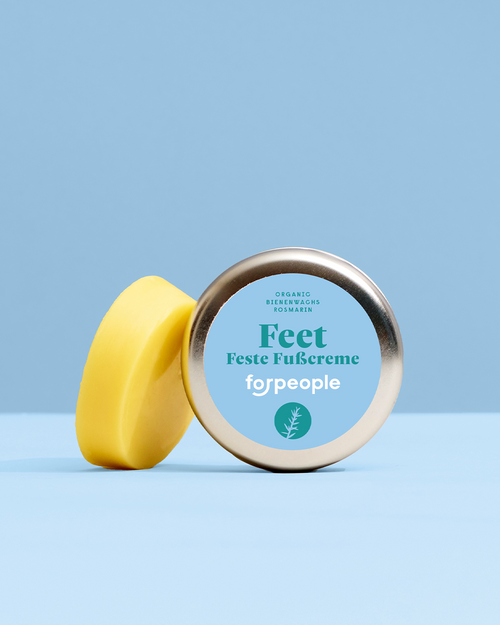
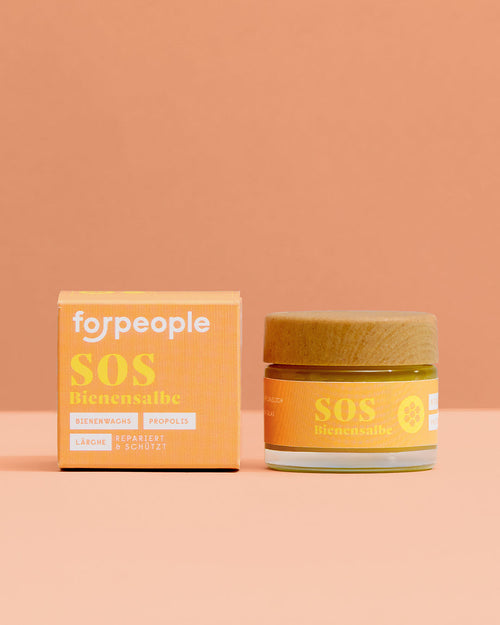
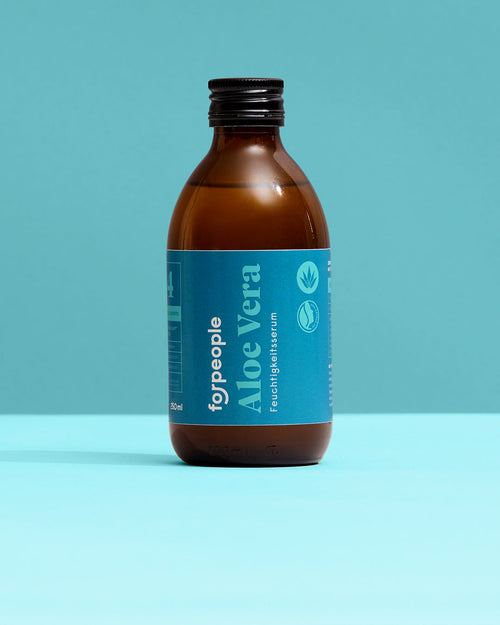
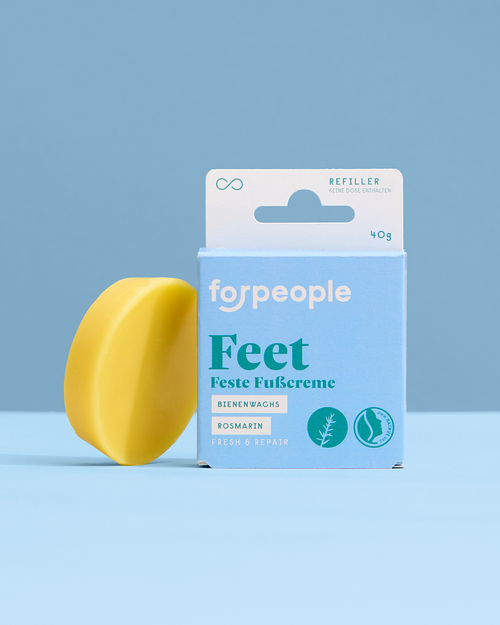
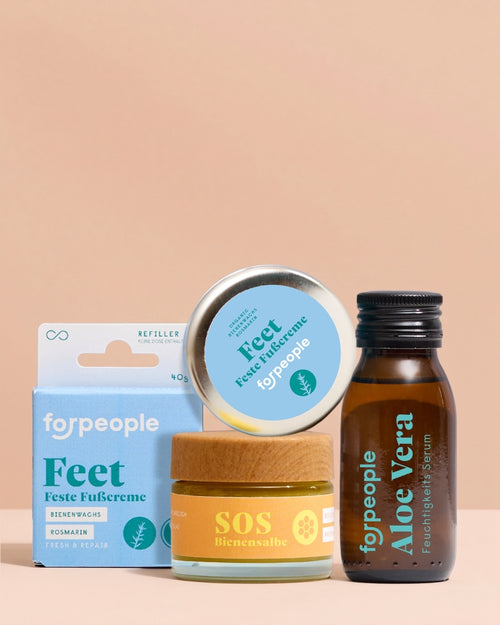
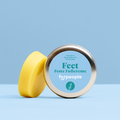
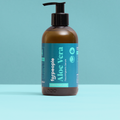
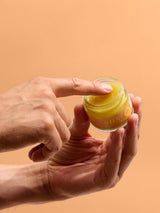
A water-free cream such as the Solid Foot Cream – Rosemary & Sage brings no water of its own. According to its INCI list it consists of sunflower oil, beeswax, olive oil and shea butter and lays down the film; it also contains essential oils of rosemary, eucalyptus and clary sage. For particularly rough areas at the edge of the heel, the softer Beeswax Salve Larch & Mandarin in a Glass Jar is also suitable. It contains larch resin and propolis, so read the allergy notes first. Without a foot soak, the slightly damp skin after showering is enough, or you first apply a water-based product such as the Aloe Vera Serum 99.6% and put the cream on top.
When to see a podiatrist or doctor
Cosmetics care for the skin; they do not treat conditions. If you have diabetes, circulatory problems or reduced sensation in your feet, check with a doctor or podiatrist beforehand whether and how foot soaks are suitable for you. If you do not feel warmth well, you will not notice water that is too hot. Skip the foot soak and have your feet checked if areas are open, if cracks are deep, bleed or hurt, or if the skin is red, swollen or warm or weeps. More in Cracked heels: when to see a podiatrist or doctor
What customers say
A selection of verified reviews from our shop (collected via Judge.me), translated from German and partly shortened.
“I have already ordered the foot cream several times. The cream is very pleasant and cares well.”
Customer review of Solid Foot Cream Refill - Rosemary & Sage, 5 out of 5 stars, January 2026, verified purchase
Frequently asked questions
Do I have to soak my feet before applying cream?
No. For daily care it is enough to wash your feet or shower and apply cream while they are slightly damp. A foot soak is worthwhile if you want to smooth hard skin with a pumice stone.
How long and how warm should a foot soak be?
Five to ten minutes in lukewarm water are usual. Hot water and long soaking can leave the skin drier.
Do I apply cream to damp or dry feet?
Slightly damp on the heels and soles, dry between the toes. The skin should not be dripping wet, because a solid cream does not adhere well to it. Patting dry is enough.
Is a solid cream easier to apply after a foot soak?
Usually yes. The skin is warm, and a solid cream melts faster on warm skin. In reviews, customers describe using the solid foot cream after showering. Whether a cream also sinks in faster after a soak has not been studied.
Is it all right for water to get into the tin of the solid cream?
Better not. The solid foot cream is water-free and, according to its INCI list, contains no preservatives. Take it out of the tin with dry hands. The background is explained in Hygiene and water-free cosmetics. When the tin is empty, you put in the refill.
At forpeople
- Solid Foot Cream – Rosemary & Sage, 40 g, €9.90: water-free, in a metal tin, with essential oils.
- Solid Foot Cream Refill - Rosemary & Sage, 40 g, €7.90: the refill for the tin.
- Aloe Vera Serum 99.6%, 250 ml, €24.90: water-based, preserved with potassium sorbate and sodium benzoate.
- Foot Care Set – 3 Steps for Cracked Heels, €39.90: aloe vera serum, beeswax salve and solid foot cream with refill.
More on this: Foot cream overnight with socks · Pumice stone, file or plane · Calluses keep coming back · Why heel skin gets so thick and cracks
From the blog: Well-cared-for feet for spring: care tips · Cracked Heels, Dry Feet: What Really Helps – and What Doesn't
Sources
- Warner RR, Stone KJ, Boissy YL (2003): Hydration disrupts human stratum corneum ultrastructure. J Invest Dermatol 120(2): 275–284. https://doi.org/10.1046/j.1523-1747.2003.12046.x
- Tsai TF, Maibach HI (1999): How irritant is water? An overview. Contact Dermatitis 41(6): 311–314. https://doi.org/10.1111/j.1600-0536.1999.tb06990.x
- Visscher MO, Tolia GT, Wickett RR, Hoath SB (2003): Effect of soaking and natural moisturizing factor on stratum corneum water-handling properties. J Cosmet Sci 54(3): 289–300. https://pubmed.ncbi.nlm.nih.gov/12858228/
- Herrero-Fernandez M, Montero-Vilchez T, Diaz-Calvillo P, Romera-Vilchez M, Buendia-Eisman A, Arias-Santiago S (2022): Impact of Water Exposure and Temperature Changes on Skin Barrier Function. J Clin Med 11(2): 298. https://doi.org/10.3390/jcm11020298
- Ananthapadmanabhan KP, Moore DJ, Subramanyan K, Misra M, Meyer F (2004): Cleansing without compromise: the impact of cleansers on the skin barrier and the technology of mild cleansing. Dermatol Ther 17 Suppl 1: 16–25. https://doi.org/10.1111/j.1396-0296.2004.04s1002.x
- Sethi A, Kaur T, Malhotra SK, Gambhir ML (2016): Moisturizers: The Slippery Road. Indian J Dermatol 61(3): 279–287. https://doi.org/10.4103/0019-5154.182427