







What cold and heated air do to the skin
Cold air holds little water vapour. When it is heated indoors, its relative humidity drops further, and the skin gives off more water to the air. A review that evaluated studies on humidity, temperature and season concludes: low humidity and low temperatures lead to a general decrease in skin barrier function and make the skin more susceptible to mechanical stress (Engebretsen et al. 2016).
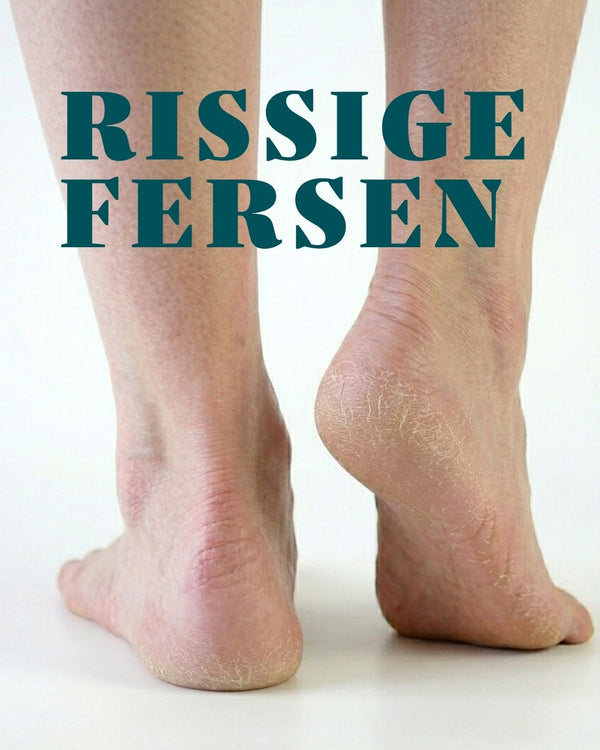
A study of stratum corneum lipids fits this. At all three body sites measured – face, hand and leg – the stratum corneum contained clearly fewer lipids in winter than in spring and summer (Rogers et al. 1996). The sole of the foot was not measured in this study. It has one special feature: it has no sebaceous glands and therefore no oily film of its own, as the page Why heel skin gets so thick and cracks explains. Its thick stratum corneum only stays supple as long as it holds enough water. What winter air does to the whole body is covered under Dry skin in winter.
Warm shoes, thick socks: first damp, then dry
Feet give off a lot of water, even without exertion. In older series of measurements summarised in a review, water loss from the hands and feet was two to four times that from other body sites; the palms and soles also have the highest density of sweat glands (Taylor & Machado-Moreira 2013).
In a lined winter boot this moisture can hardly escape. The stratum corneum takes up water and swells. Electron microscope images show how much water changes it: after four hours of contact with water the stratum corneum was about three times as thick, after 24 hours about four times, and the lipid layers between the cells were disrupted (Warner et al. 2003). A damp boot is not a water bath; but the direction is plausible: skin that has been damp for a long time is not better protected against drying out afterwards.
At home comes the change. The feet are in dry heated air, and the stratum corneum gives off its water again.
Hot showers and baths
In winter many people shower and bathe for longer and with hotter water. In one study, 50 healthy volunteers immersed one hand in water at about 41 °C and the other in water at about 11 °C for ten minutes. Water loss through the skin rose from 25.75 to 34.96 g/m² per hour after the cold water, and to 58.58 after the hot water. The authors advise cold or lukewarm water for handwashing (Herrero-Fernandez et al. 2022). The measurements were taken on the palms, not on the feet.
Dry heat counts too: after five minutes of contact with a surface at 44 °C, water loss on the forearm was slightly raised (Herrero-Fernandez et al. 2022). Warming your feet directly on a radiator or a hot-water bottle is therefore unfavourable for dry skin. How long a foot bath may last is covered under A foot bath before applying cream: useful or not?
Causes at a glance
| Cause | What is behind it | What you can do |
|---|---|---|
| Cold outdoor air, dry heated air | Low humidity reduces the barrier function of the skin | Do not overheat rooms, air them briefly and often, apply cream in the evening |
| Season | The stratum corneum contains fewer lipids in winter | Rich care instead of a light lotion |
| Lined shoes, thick socks | Moisture builds up, the stratum corneum swells and then dries out again | Alternate shoes and air them, change damp socks |
| Hot, long showers and baths | Hot water raises the skin's water loss more than cold water | Brief and lukewarm, then dry and apply cream |
| Radiator, hot-water bottle | Dry heat also raises water loss | Warm your feet with socks and movement |
| Less attention | In winter you rarely see your feet | Link applying cream to a fixed habit |
A routine for winter
- Wash briefly with lukewarm water. Soap only where it is needed.
- Dry thoroughly. Pat rather than rub, between the toes too.
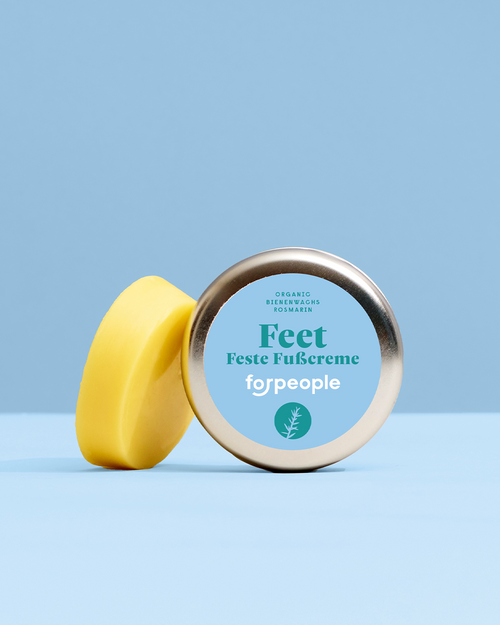
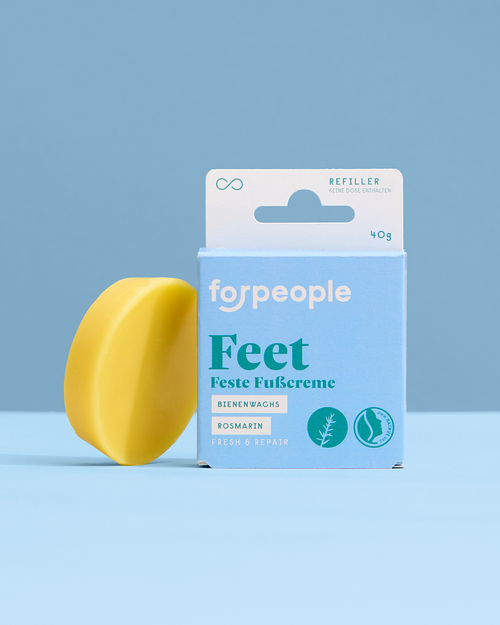
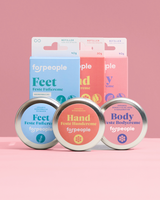
- Apply cream in the evening. A rich cream lays a film on the skin that reduces evaporation; the mechanism is explained under Occlusion and transepidermal water loss. A review recommends applying such oils to skin that is still slightly damp (Sethi et al. 2016). Apply cream to the heels, the balls of the feet and the outer edges, not between the toes. A water-free cream such as the Solid Foot Cream – Rosemary & Sage is rubbed directly over the skin and then spread with your hands. When the tin is empty, you insert the refill.
- Socks on top. Cotton socks keep the cream on the skin and off the bed sheets. More: Foot cream overnight with socks: what does it do?
- Let shoes dry. Do not wear a pair two days in a row, take out the insole and change damp socks.
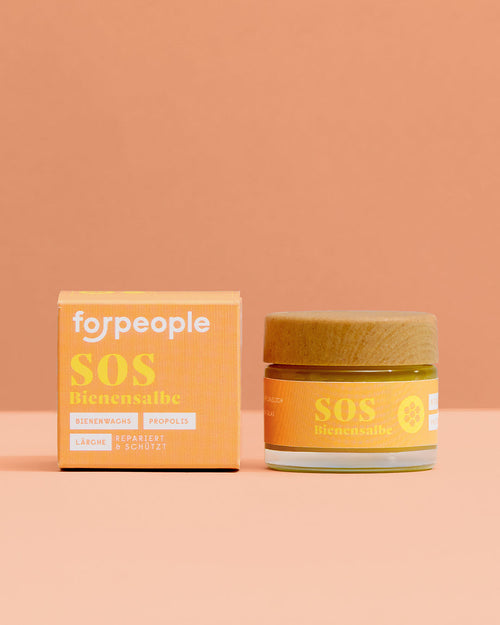
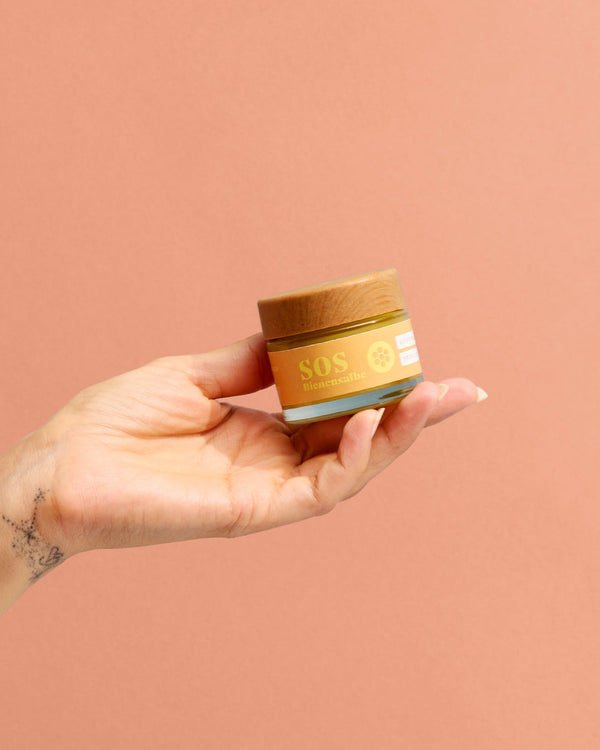
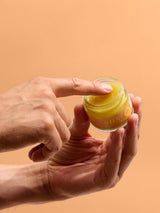
- Give rough areas extra care. On the edge of the heel and the ball of the foot the layer can be thicker. A soft salve such as the Beeswax Salve Larch & Mandarin in a Glass Jar is also suitable for this.
When to see a podiatrist or doctor?
Cosmetics care for the skin; they do not treat medical conditions. See a doctor if your toes turn white or blue in the cold, stay numb, or hurt, swell or form blisters after warming up. You should also have deep, bleeding or painful cracks, red, weeping or warm areas, and dry skin that does not improve despite a few weeks of regular care checked by a podiatrist or doctor. If you have diabetes, circulation problems or reduced sensation in your feet, discuss foot baths, hot-water bottles and the removal of hard skin with your practice beforehand. More: Cracked heels: when to see a podiatrist or a doctor?
What customers say
A selection of verified reviews from our shop (collected via Judge.me), translated from German and partly shortened.
“My feet don't have problem skin. After showering they are very happy about their extra care with the solid foot cream, and I notice it. […]”
Customer review of Solid Foot Cream – Rosemary & Sage, 5 out of 5 stars, January 2026, verified purchase
“I'm very enthusiastic about the cream, it is easy to apply and smells good”
Customer review of Solid Foot Cream Refill - Rosemary & Sage, 5 out of 5 stars, March 2026, verified purchase
Frequently asked questions
Why are my feet drier in winter than in summer?
The air is drier, the stratum corneum contains fewer lipids, and hot showers add to it. In warm shoes the skin first gets damp and then dries out again in heated air.
Does applying cream help against cold feet?
No. A cream cares for dry skin; it does not warm and does not protect against cold injuries. What has been studied on this is covered under Cold cream: water-free, but no protection from frost. Dry socks, sufficiently roomy shoes and movement help against cold feet.
Does the solid foot cream get harder in the cold?
Yes. Waxes become firmer at low temperatures; in a cool room the cream takes longer to soften. If your feet themselves are cold, the cream hardly melts on them. In that case warm it briefly between your hands and spread it from there; reviews describe this too. The technique is shown under How do I apply a solid cream correctly?
Should I put socks on after applying cream?
Yes, especially in the evening. The sock keeps the cream on the heel, and you do not slip on smooth floors with freshly creamed soles. Use cotton, not plastic film.
What does the solid foot cream smell of?
Of herbs. The scent comes from essential oils of rosemary, eucalyptus and clary sage; linalool, limonene and geraniol are listed in the INCI as their constituents. If you want to avoid fragrance, you will find alternatives under Without fragrance and essential oils: ingredients at a glance.
At forpeople
- Solid Foot Cream – Rosemary & Sage, 40 g, €9.90: water-free; according to the INCI made from sunflower oil, beeswax, olive oil and shea butter, with essential oils of rosemary, eucalyptus and clary sage; in a metal tin.
- Solid Foot Cream Refill - Rosemary & Sage, 40 g, €7.90: the refill for the tin, same formula.
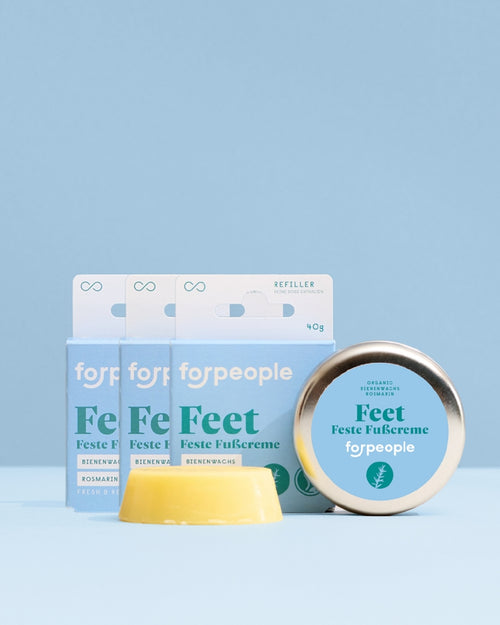
- Foot Care Set XL – for Dry Feet, €29.90: one tin and three refills.
- Beeswax Salve Larch & Mandarin in a Glass Jar, 50 g, €12.90: soft salve made from olive, almond and castor oil with beeswax; contains larch resin, propolis and essential oils.
The foot cream and the beeswax salve contain essential oils. Do not use them on injured skin.
More: Why do heels crack in summer? · Why do feet get drier with age? · Dry skin in winter
From the blog: Cracked heels, dry feet: what really helps – and what doesn't · Bee Salve: Beeswax & Propolis for Dry, Stressed Skin
Sources
- Engebretsen KA, Johansen JD, Kezic S, Linneberg A, Thyssen JP (2016): The effect of environmental humidity and temperature on skin barrier function and dermatitis. J Eur Acad Dermatol Venereol 30(2): 223–249. https://doi.org/10.1111/jdv.13301
- Rogers J, Harding C, Mayo A, Banks J, Rawlings A (1996): Stratum corneum lipids: the effect of ageing and the seasons. Arch Dermatol Res 288(12): 765–770. https://doi.org/10.1007/BF02505294
- Taylor NA, Machado-Moreira CA (2013): Regional variations in transepidermal water loss, eccrine sweat gland density, sweat secretion rates and electrolyte composition in resting and exercising humans. Extrem Physiol Med 2(1): 4. https://doi.org/10.1186/2046-7648-2-4
- Warner RR, Stone KJ, Boissy YL (2003): Hydration disrupts human stratum corneum ultrastructure. J Invest Dermatol 120(2): 275–284. https://doi.org/10.1046/j.1523-1747.2003.12046.x
- Herrero-Fernandez M, Montero-Vilchez T, Diaz-Calvillo P, Romera-Vilchez M, Buendia-Eisman A, Arias-Santiago S (2022): Impact of Water Exposure and Temperature Changes on Skin Barrier Function. J Clin Med 11(2): 298. https://doi.org/10.3390/jcm11020298
- Sethi A, Kaur T, Malhotra SK, Gambhir ML (2016): Moisturizers: The Slippery Road. Indian J Dermatol 61(3): 279–287. https://doi.org/10.4103/0019-5154.182427