








What changes in the skin over the years
A review of skin ageing sums it up: the epidermis renews itself more slowly, and the skin produces less sweat and less sebum. Touch sensitivity and pain perception also decline (Balin & Pratt 1989). A review of dry skin in older adults names changes in keratinisation and in the lipid content of the skin as internal causes and stresses: dry skin is common in older people, but it is not a normal part of ageing (White-Chu & Reddy 2011).
The sole of the foot has no sebaceous glands; how supple it stays depends on the water in the outer skin layer and on sweat. If sweating declines, it stands to reason that the sole dries out faster. More on this under Why heel skin gets so thick and cracks.
In a survey of 1,710 people in 14 nursing homes and 6 hospitals in Germany, just under half had dry skin (48.8 per cent), most often on the feet and legs (42.9 per cent) (Lichterfeld et al. 2016). The figures apply to people in nursing homes and hospitals, not to all older people.
The padding under the heel gets stiffer, not thinner
It is often said that the fat pad under the sole gets thinner with age. An ultrasound measurement in 60 healthy people aged 41 to 83 found something different: the soft tissue under the big toe, the ball of the foot and the heel was markedly stiffer with increasing age; it was not thinner (Kwan et al. 2010).
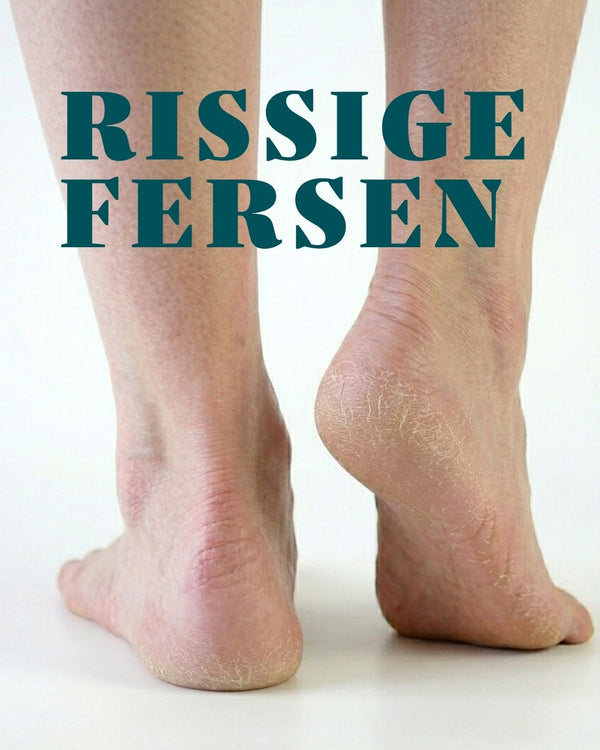
One consequence is plausible, even though the study did not measure it: stiffer padding cushions less, the skin takes more pressure and responds with callus. Thick, dry callus stretches poorly when you step down and cracks at the edge of the heel. Why callus returns after it has been removed is explained in Calluses keep coming back: why, and what helps.
What adds to it from outside: care, medication, indoor air
In a Finnish focus-group study with 17 older people, participants reported that a stiff back, age and added weight made even the position for cutting toenails difficult. They rarely used foot cream, and only a few did so daily. Asking relatives for help was not an option for them (Miikkola et al. 2019).
As external causes of dry skin, the review names diuretics and similar medication as well as a lot of heated or air-conditioned air (White-Chu & Reddy 2011). If your skin has been drier since you started a new medicine, raise it with your doctor and do not stop taking anything on your own.
Changes and what helps in everyday life
| Change | Effect on the feet | What helps in everyday life |
|---|---|---|
| less sweat and sebum | sole, top of the foot and ankles dry out faster | apply a rich, fat-based product once a day, ideally in the evening |
| fewer lipids in the outer skin layer | hot water and a lot of soap dry the skin more | wash briefly with lukewarm water, little soap |
| weaker sense of touch, less pain perception | pressure points and water that is too hot are noticed later | check the water temperature with a thermometer; feel inside your shoes |
| stiffer padding under heel and ball | more pressure on the skin, more callus | well-fitting, well-cushioned shoes; smooth callus only moderately |
| less mobility, weaker eyesight | feet are cared for and looked at less often | care for them sitting down, use aids, accept help |
Left column based on sources 1, 2, 4 and 5; the right column is common care practice.
A routine that works even with a stiff back
- Wash: daily, briefly and with lukewarm water. Whether a foot bath beforehand makes sense is covered in Foot bath before moisturising.
- Dry: thoroughly, including between the toes.
- Apply cream: in the evening, sitting down, with your foot on a stool or on your other knee. Cover the heel, sole, top of the foot and ankles, but not the spaces between the toes. A long-handled cream applicator from a medical supply shop saves you bending down.
- Put on socks before you stand up: freshly creamed soles slip on tiles and wooden floors. In detail: Foot cream overnight with socks.
- Look: once a week at heels, soles and the spaces between the toes, with a hand mirror or with the help of a second person.
- Callus: smooth at most once a week with a pumice stone or file, never with blades. More in Pumice stone, file or callus plane?.
The review names three starting points: raise the humidity in the room, adjust bathing and washing habits, and use emollient care that replaces skin lipids (White-Chu & Reddy 2011). What is added in the heating season is covered in Dry feet in winter.
Which care fits: solid, soft or with urea?
A fat-based, water-free product lays a film on the skin that reduces evaporation (Occlusion and TEWL). Creams with urea, by contrast, bind water in the outer skin layer. A systematic review of moisturisers for dry skin on the feet evaluated 22 studies. Urea was the most frequently studied active ingredient (14 studies); because of the weak quality of the studies, however, the authors did not recommend any one active ingredient over another (Parker et al. 2017). How the two complement each other is explained in Urea or water-free cream?.
The review of dry skin in older adults advises watching out for known contact allergens in care products and names lanolin, aloe vera and parabens (White-Chu & Reddy 2011). Essential oils can also trigger reactions. Try anything new on a small area first, and stop using it if your skin turns red or stings.
When to see a podiatrist or doctor
Cosmetics care for intact skin; they do not treat medical conditions. Have your feet looked at by a podiatrist or doctor if cracks are deep, bleed or hurt when you walk, if the skin is red, swollen, warm or weeping, if toes are cold, discoloured or numb, or if nothing improves after a few weeks of care. If you have diabetes, circulation problems or reduced sensation in your feet, do not remove callus yourself and have every change checked. Where to go in each case: Cracked heels: when to see a podiatrist or doctor.
What customers say
A selection of verified reviews from our shop (collected via Judge.me), translated from German and partly shortened.
“I buy this foot cream for my mother. It is a great product and a real help with her foot problems.”
Customer review of Solid Foot Cream – Rosemary & Sage, 5 out of 5 stars, December 2025, verified purchase
“Smells good. Very pleasant to apply. Absorbs well. Great that it comes as a refill pack!”
Customer review of Solid Foot Cream Refill - Rosemary & Sage, 5 out of 5 stars, February 2026, verified purchase
Frequently asked questions
How often should I apply cream to my feet in older age?
Once a day, ideally in the evening after washing. Regularity matters more than the amount. If your skin is very dry, you can apply a second thin layer in the morning.
Is a solid foot cream too hard for stiff fingers?
It is solid and only begins to melt with the warmth of your skin; that takes some getting used to. Hold the tin in your hand for a moment, or stroke the surface of the cream directly over your heel. If you prefer to work without pressure, choose a soft salve in a jar. On the amount: How do I apply a solid cream correctly?
Should I put on socks after applying cream?
Yes, and before you stand up. Creamed soles slip on smooth floors, and the sock keeps the product on your skin. Choose cotton socks with a wide cuff that do not constrict.
What does the solid foot cream smell of, and what if I want to avoid fragrance?
Our solid foot cream has a herbal scent. It comes from essential oils of rosemary, eucalyptus and clary sage, so the cream is not free from fragrance. Which products do without essential oils is shown in the overview Ingredients at a glance.
Can I apply cream to a relative's feet?
Yes. It is easiest sitting down, with the foot on a towel on your lap. Keep the spaces between the toes dry and put socks on afterwards. Look at the skin as you go; show cracks, redness or open areas to the GP practice or a podiatry practice.
At forpeople
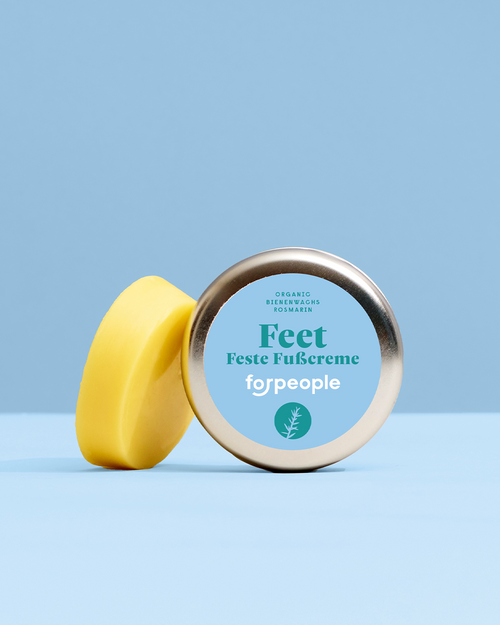
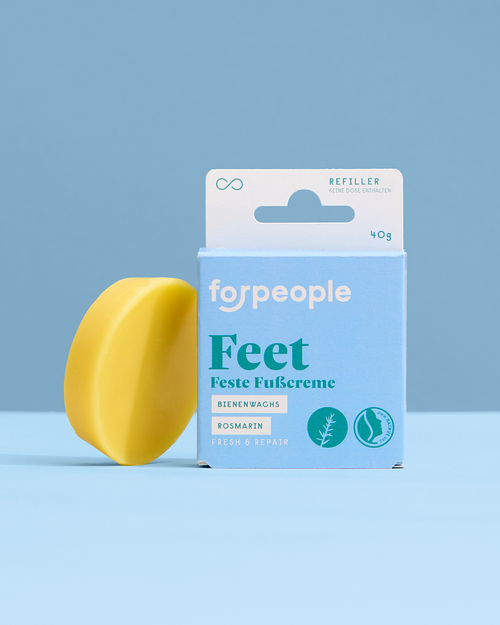
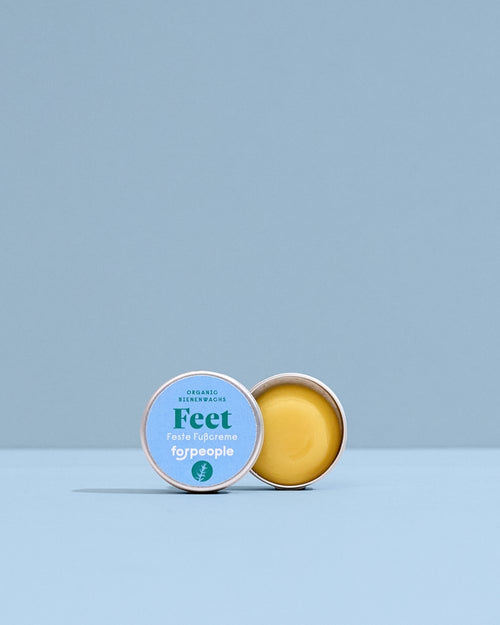
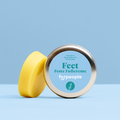
Our Solid Foot Cream – Rosemary & Sage (40 g, €9.90) is water-free and, according to its INCI list, consists of sunflower oil, beeswax, olive oil and shea butter, plus St. John's wort and aloe vera extract and essential oils of rosemary, eucalyptus and clary sage. You refill the tin with the Solid Foot Cream Refill - Rosemary & Sage (40 g, €7.90). To try out the solid format, there is the Solid Foot Cream Travel Size – Rosemary & Sage in a Tin (8 g, €5.90). Softer and easy to take out without pressure is the Beeswax Salve Larch & Mandarin in a Glass Jar (50 g, €12.90); it contains larch resin, propolis and essential oils. More on this: Why do hands get drier with age? · Urea or water-free cream? · How the refill works
From the blog: Cracked Heels, Dry Feet: What Really Helps – and What Doesn't · Well-cared-for feet for spring: care tips
Sources
- Balin AK, Pratt LA (1989): Physiological consequences of human skin aging. Cutis 43(5): 431–436. https://pubmed.ncbi.nlm.nih.gov/2721241/
- White-Chu EF, Reddy M (2011): Dry skin in the elderly: complexities of a common problem. Clin Dermatol 29(1): 37–42. https://doi.org/10.1016/j.clindermatol.2010.07.005
- Lichterfeld A, Lahmann N, Blume-Peytavi U, Kottner J (2016): Dry skin in nursing care receivers: A multi-centre cross-sectional prevalence study in hospitals and nursing homes. Int J Nurs Stud 56: 37–44. https://doi.org/10.1016/j.ijnurstu.2016.01.003
- Kwan RL, Zheng YP, Cheing GL (2010): The effect of aging on the biomechanical properties of plantar soft tissues. Clin Biomech 25(6): 601–605. https://doi.org/10.1016/j.clinbiomech.2010.04.003
- Miikkola M, Lantta T, Suhonen R, Stolt M (2019): Challenges of foot self-care in older people: a qualitative focus-group study. J Foot Ankle Res 12: 5. https://doi.org/10.1186/s13047-019-0315-4
- Parker J, Scharfbillig R, Jones S (2017): Moisturisers for the treatment of foot xerosis: a systematic review. J Foot Ankle Res 10: 9. https://doi.org/10.1186/s13047-017-0190-9