







The problem: what the skin shows after ice bathing
Ice bathing and winter swimming are in season from October to March, from the first dip in a cool autumn lake to the New Year’s swim. The skin reacts visibly. Typical signs are:
- Red skin on the legs, belly and arms, often with a sharp boundary where swimwear was, as soon as you get out of the water and warm up.
- Tingling, burning or stinging in the skin while warming up, often with numbness in fingers and toes.
- Dry, tight skin in the days that follow, especially on the shins, hands and face, sometimes with itching.
- Less often wheals, that is, itchy, raised patches like after nettles, or white, numb fingers. Neither is a normal part of ice bathing and both should be checked; more on this under “When to seek medical advice”.
Redness and brief tingling while warming up are a reaction of the blood vessels to the cold. The dryness afterwards develops like other winter skin, only more strongly.
Why cold and water are so demanding on the skin
The vessels narrow. In the cold, the sympathetic nervous system constricts the blood vessels of the skin. This slows heat loss, but also reduces skin blood flow and the conduction speed of the nerves. Hands and feet have special shunt vessels for this that close in the cold (Esperland et al. 2022). Water draws heat from the body considerably faster than air at the same temperature (Esperland et al. 2022).
As you warm up, they widen again. When the skin gets warm, the vessels open, blood flow to the skin increases and it looks red. At the same time the nerves get going again; you feel this as tingling or burning. In the fingers, researchers also describe cold-induced vasodilation, a periodic opening of the vessels in the middle of the cold. How strong it is varies from person to person, and according to a review, regular cold exposure hardly trains it: even people who spend a lot of time in the cold remain susceptible to cold injuries (Cheung & Daanen 2012).
Cold shock affects the whole body. In the first minutes in cold water, cold receptors in the skin trigger a gasp reflex, uncontrolled rapid breathing and a racing heart. In people with known or unknown heart conditions, rhythm disturbances can occur; anyone who stays in the water for a long time can keep cooling down even after getting out (Knechtle et al. 2020). That is why skincare when ice bathing starts with safety.
The stratum corneum dries out. According to a review, low temperatures and low humidity impair the skin’s barrier function and make it more susceptible to mechanical stress and irritants (Engebretsen et al. 2016). Ice bathing brings it all together: wet skin in the wind, cold air, often a hot shower afterwards and dry heated air in the evening. How heated air affects the skin is covered in Humidity and skin, why hot showers encourage itchy skin in Itchy skin in winter.
The solution step by step
The safety rules come from the German Life Saving Association (DLRG) (DLRG/dpa 2026); the care steps are the usual care for dry winter skin.
| Step | What you do | Why |
|---|---|---|
| Prevention: before the season | If you have heart, circulation or vascular conditions, talk to your GP first. Prepare your body over weeks with cold showers and start in autumn, not in the depths of winter. | Cold shock strains the heart and breathing (Knechtle et al. 2020); gradual acclimatisation is recommended (DLRG/dpa 2026). |
| Prevention: before the dip | Go in a group of at least three. Hat or neoprene cap, and in severe cold neoprene gloves and socks. No thick layer of fat as “cold protection”. | Help and an emergency call are possible right away; a wet head cools down faster (DLRG/dpa 2026). Ointments do not warm, see Cold cream: water-free, but no protection from frost. |
| Immediately: in the water | Keep your head above water. As a beginner, stay in for at most as many minutes as the water has degrees. Get out at once with strong, uncontrolled shivering, pain in fingers or feet, sudden headache or dizziness. | Rule of thumb and warning signs from the DLRG (DLRG/dpa 2026). |
| Immediately: afterwards | Dry off thoroughly, take off wet swimwear, put on dry warm clothes, have a warm non-alcoholic drink, move gently. Do not go straight into the sauna. | Warming up slowly spares the circulation (DLRG/dpa 2026); alcohol speeds up cooling (Knechtle et al. 2020). |
| The same day: skincare | Once you are fully warm again, take a short lukewarm rather than hot shower, pat dry and care for the still damp skin with Body Oil - Lemongrass or Solid Body Butter - Beeswax & Aloe Vera. | A film of fat slows evaporation; on damp skin it spreads easily. On timing, see How soon should you moisturise after a shower? |
| Every day during the season | Hands with Solid Hand Cream - Beeswax, lips with a lip balm, shins and feet with oil or butter in the evening. Do not overheat rooms. | These areas dry out fastest in winter; see Why are shins dry and flaky in winter? |
Whether oil or butter suits you better is mainly a question of how it feels on your skin; the comparison is in Body oil or body butter – which one when? If you also use the sauna, the order is explained in Moisturise before or after the sauna?; for swimming in an indoor pool, see Dry skin after the pool.
What helps – and what rather does not
| Measure or claim | Assessment |
|---|---|
| Applying a thick layer as cold protection | Rather not. Fat does not warm; in studies with conscripts, people using cold-protection ointment even had frostbite on the face more often, see Cold cream. |
| Hat, neoprene gloves and socks | Help to keep head, hands and feet warm (DLRG/dpa 2026). |
| Straight into a hot sauna or under a hot shower afterwards | Rather not. The DLRG advises letting the body warm up slowly (DLRG/dpa 2026); hot water dries the skin out further. |
| A shot of spirits “to warm up” | No. Alcohol speeds up cooling (Knechtle et al. 2020). |
| Ice bathing tightens the skin | Unproven. A review notes that many of the claimed health effects are based on subjective reports and individual cases (Esperland et al. 2022); we have not found studies on skin tightening. |
| Regular dips toughen up the fingers | Not proven. Repeated cold hardly changed blood flow in hands and feet in studies (Cheung & Daanen 2012). |
| Oil or butter on damp skin after showering | Helps against drying out in the following days. |
Typical mistakes
- Staying in too long: time passes quickly in the cold; a watch or a companion on the shore helps.
- Bathing alone: nobody can help in case of cold shock or cramp.
- Dunking your head in the wind: a wet head cools down faster.
- Keeping wet swimwear on: it keeps cooling you while you are trying to warm up.
- Ignoring pain in fingers and toes: it is a warning sign and a reason to get out at once.
- Forgetting your skin afterwards: if you shower hot after a dip and do not moisturise, you often only notice days later from tight shins.
When to seek medical advice
- Before the first dip if you have heart, circulation or vascular conditions, high blood pressure or known heart rhythm disorders. Cold water can trigger rhythm disturbances where there is a predisposition (Knechtle et al. 2020).
- Wheals or swelling after cold, usually while warming up: this may be cold urticaria, a form of hives. A severe allergic reaction of the whole body can also occur (Maltseva et al. 2021). Do not go into cold water again until it has been checked.
- White, numb fingers or toes that turn blue and then red as they warm up: this may be Raynaud phenomenon, episodic reduced blood flow in the cold (DermNet 2021).
- Skin that stays white or greyish, hard or numb or forms blisters: suspected frostbite, get medical care immediately.
- Chest pain, shortness of breath, confusion or impaired consciousness: call emergency services (112 in Europe).
- Dry skin that itches, weeps or cracks for weeks despite care.
Frequently asked questions
Why is my skin so red after ice bathing?
Because the blood vessels in the skin narrow in the cold and widen again as you warm up. The increased blood flow makes the skin red. It usually settles once you are fully warm again.
Why does my skin burn or tingle after ice bathing?
In the cold, the nerves conduct more slowly; as you warm up, blood flow and nerves get going again. Brief tingling is common. Severe pain, wheals or white, numb areas are not.
Is a rash after ice bathing normal?
No. Itchy wheals after cold can indicate cold urticaria. Have it checked by a doctor before going into cold water again.
Does ice bathing tighten the skin?
We have not found any studies on this. The short-term redness and tightness after a dip are reactions of the vessels and the stratum corneum, not lasting firming.
Should I moisturise before ice bathing?
As protection against the cold it does nothing; a layer of fat does not warm. A hat, neoprene gloves and a short dip protect against the cold. Skincare comes afterwards.
What should I put on my skin after ice bathing?
Something oily on skin that is still slightly damp after a lukewarm shower: a body oil or a body butter, a hand cream for the hands and a balm for the lips.
Does ice bathing dry out the skin?
It can contribute: cold, wind and dry air weaken the skin barrier, and a hot shower afterwards adds to that. With lukewarm showers and fat afterwards, this can usually be handled well. General tips are in Dry skin in winter.
Can I go into the sauna after ice bathing?
Not straight away. The DLRG advises giving the body time to warm up slowly, because a quick switch to the other extreme puts a heavy strain on the heart and circulation.
At forpeople
For care after the dip, once you are warm again; the full ingredients list is on each product page.
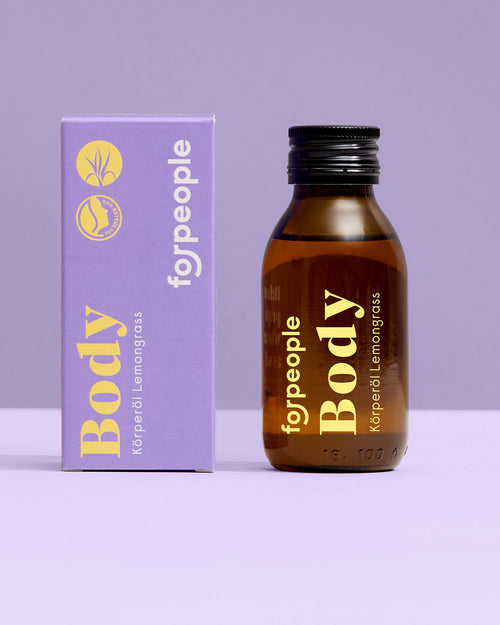
- Body Oil - Lemongrass, 100 ml, €16.90: sesame, safflower, sea buckthorn seed and sunflower oil with lemongrass oil, for the body on still damp skin after showering.
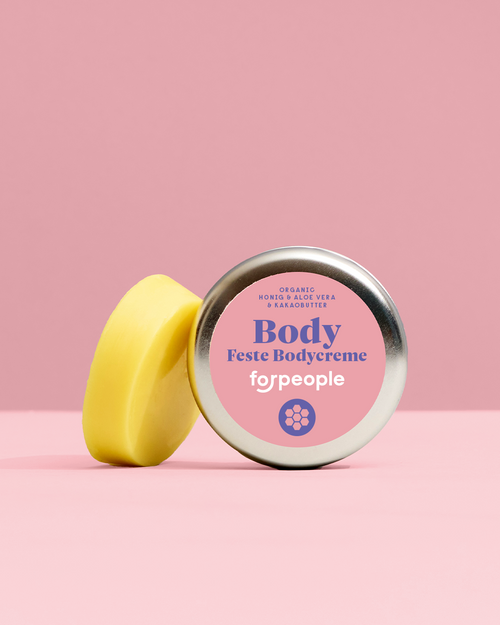
- Solid Body Butter - Beeswax & Aloe Vera, 40 g, €9.90: water-free butter made from cocoa butter, olive oil, beeswax, sunflower oil, shea butter and aloe extract, for dry areas on the body.
- Solid Hand Cream - Beeswax, 30 g, €9.90: beeswax, olive and sunflower oil, without water, for dry hands.
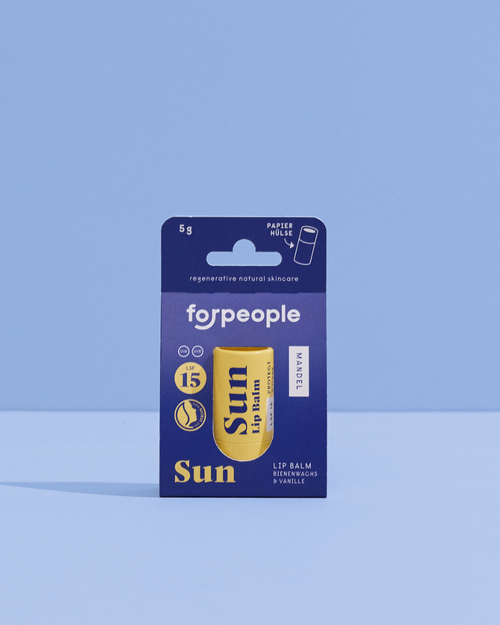
- Lip Balm - SPF15 Almond & Vanilla, 5 g, €7.90: lip balm with SPF 15 and mineral UV filters (zinc oxide, titanium dioxide), for the lips outdoors.
Do not use on broken or irritated skin, and stop using if your skin reacts. If you suspect frostbite or cold urticaria, do not apply anything; have it checked by a doctor.
More on this: Why do lips dry out so quickly? · Cracked, split fingertips
Sources
- Esperland D, de Weerd L, Mercer JB (2022): Health effects of voluntary exposure to cold water – a continuing subject of debate. International Journal of Circumpolar Health 81(1): 2111789. https://doi.org/10.1080/22423982.2022.2111789
- Cheung SS, Daanen HAM (2012): Dynamic adaptation of the peripheral circulation to cold exposure. Microcirculation 19(1): 65–77. https://doi.org/10.1111/j.1549-8719.2011.00126.x
- Knechtle B, Waśkiewicz Z, Sousa CV, Hill L, Nikolaidis PT (2020): Cold Water Swimming – Benefits and Risks: A Narrative Review. International Journal of Environmental Research and Public Health 17(23): 8984. https://doi.org/10.3390/ijerph17238984
- Engebretsen KA, Johansen JD, Kezic S, Linneberg A, Thyssen JP (2016): The effect of environmental humidity and temperature on skin barrier function and dermatitis. Journal of the European Academy of Dermatology and Venereology 30(2): 223–249. https://doi.org/10.1111/jdv.13301
- Pharmazeutische Zeitung/dpa (14 January 2026): DLRG – Fünf Regeln für sicheres Eisbaden [Five rules for safe ice bathing] (with Matthias Stoll, DLRG head office). pharmazeutische-zeitung.de
- Maltseva N, Borzova E, Fomina D, Bizjak M, Terhorst-Molawi D, Košnik M et al. (2021): Cold urticaria – What we know and what we do not know. Allergy 76(4): 1077–1094. https://doi.org/10.1111/all.14674
- DermNet (Maurice P, 2004; revised July 2021): Raynaud phenomenon. Accessed 29 October 2026. https://dermnetnz.org/topics/raynaud-phenomenon