


Where the 3-minute rule comes from
The recommendation to moisturise within three minutes of bathing or showering is found in medical guidelines on skin and allergy care. According to one research group, there is very little evidence for it (Nguyen et al. 2022). An earlier paper had already noted that guidelines recommend moisturising immediately although hardly any measured data existed (Chiang & Eichenfield 2009). The guidelines that paper refers to were written for people with a chronic skin condition, not for healthy skin.
The reasoning behind it: during bathing, the water content of the stratum corneum, the skin's outer layer, rises quickly. Afterwards the water evaporates, and the water content falls to the starting level or below (Ueda et al. 2022). A film is meant to lock the water in before that happens. Why it should be exactly three minutes is not shown by any of the papers cited here. What happens in the skin during a shower is explained on the page Why does skin feel tight after a shower?
What studies show about timing
Three papers have compared immediate and later moisturising directly. None of them is a large study.
| Study | Participants | Comparison | Result |
|---|---|---|---|
| Chiang & Eichenfield 2009 | 10 people, five of them with healthy skin | arm bathed for ten minutes; cream at once, 30 minutes later or not at all | no statistical difference between at once and later; after bathing without cream, skin hydration was below the starting level |
| Nguyen et al. 2022 | 60 healthy adults aged 18 to 25 | three skin areas: not moisturised, straight after washing, 30 minutes later | moisturised areas had more water in the stratum corneum and lower water loss at every measurement; no difference between at once and later |
| Ueda et al. 2022 | 8 healthy women aged 26 to 34 | lower legs; lotion within 5 minutes or 90 minutes after bathing; measured after 12 hours | both areas more hydrated than before application; no significant difference between at once and 90 minutes; only the area moisturised at once was above the untreated one |
What this tells us: Moisturising works, early or late. None of the three papers shows an advantage for a particular minute. Only the third gives a small hint in favour of “soon”: after twelve hours, only the area moisturised at once stood out from the untreated one. The direct comparison, however, showed no difference there either.
Where the limits are: The participants were young, observation lasted hours, and each paper tested a single product. In the 2009 paper, half of the participants had a skin condition, and the published figures come mainly from that group. In the paper by Ueda, three of the four authors are employed by the company that supplied the lotion.
As far as described, the products tested were a commercially available cream and a lotion with humectants such as glycerin. Such products bring water or water-binding substances with them. We did not find a comparable test with pure oil or water-free butter.
What this means for lotion, oil and butter
- Lotion or cream: It is an emulsion and brings water with it. According to the studies above, the exact timing is secondary. The difference from oil is explained in Body oil or body lotion: what is the difference?
- Body oil: It contains no water. In a measurement with six volunteers, four vegetable oils penetrated only into the uppermost layers of the stratum corneum; except for jojoba oil, they lowered water loss through the skin much as paraffin oil did (Patzelt et al. 2012). So an oil holds on to water that is already there. That is why it suits skin that is still slightly damp.
- Solid body butter: It is water-free too. It spreads most easily on warm skin that is still slightly damp.
- Water-based serum: It brings water but no film. Oil or butter belongs on top, see Combining aloe vera serum with oil or solid cream.
According to a review article, film-forming substances have the most pronounced effect when they are applied to slightly dampened skin (Sethi et al. 2016). For oil and butter, “soon after the shower” therefore makes sense. That follows from the mechanics and from practice; it is not a measured result for a time limit in minutes. More on this: Humectants, occlusives, emollients.
The steps after a shower
- Pat dry, do not rub dry. The skin should stay damp but not dripping wet. In a study with 15 healthy volunteers, skin was clearly wetter after patting than after gentle rubbing (Voegeli 2008). The study comes from nursing and did not count that as an advantage, because damp skin means more friction there. Before an oil, the leftover moisture is welcome.
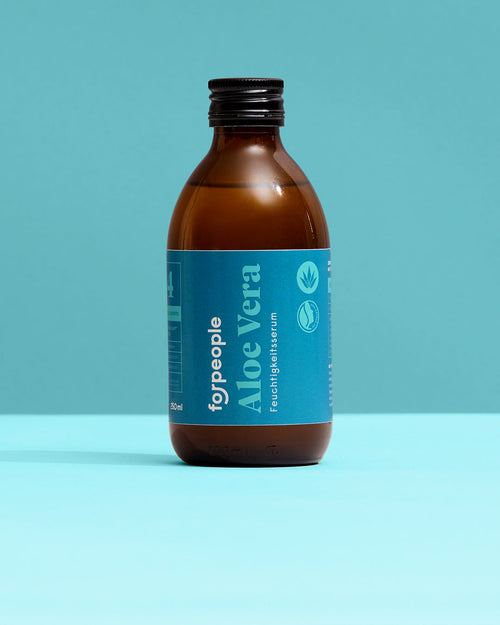
- If you like, something water-based first. Spread a small amount of serum on the skin, for example Aloe Vera Serum 99.6%, and wait briefly until nothing runs any more.
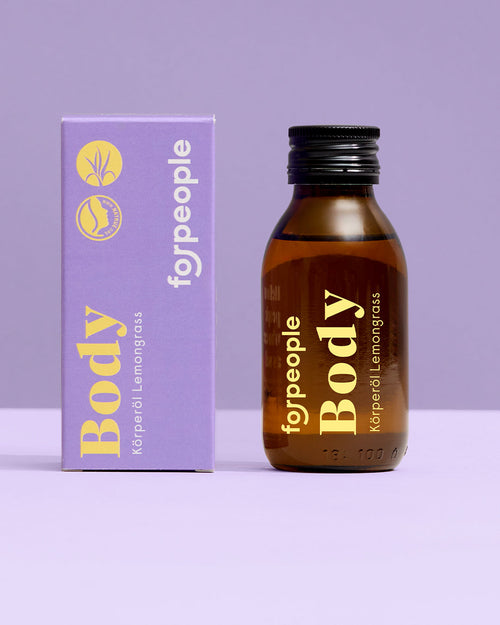
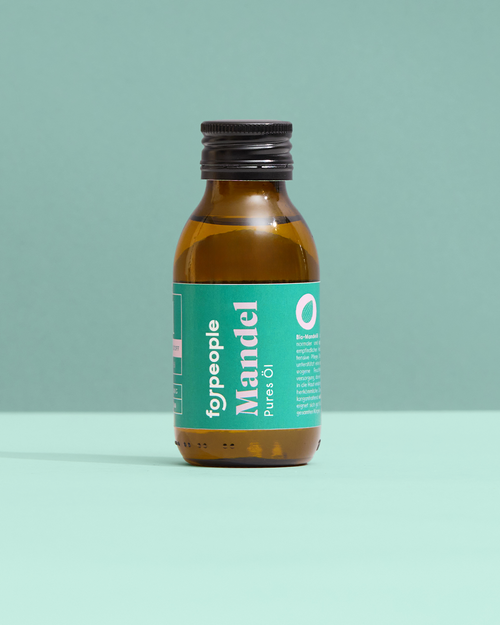
- Oil for the large areas. Rub a few drops between your palms and massage them in. Options are Body Oil - Lemongrass or, with no added scent, Almond Oil - pure.
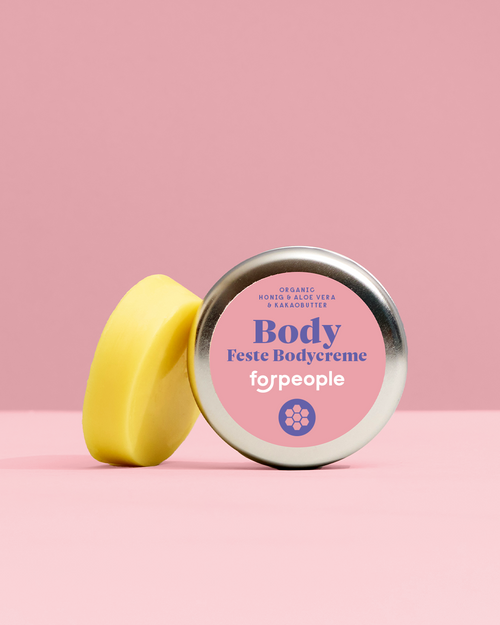
- Butter for individual areas. Warm the Solid Body Butter - Beeswax & Aloe Vera briefly in your hands or stroke it directly over warm skin.
- Wait briefly, then get dressed. If your skin is still clearly shiny after a few minutes, it was too much. What oil leaves on fabric is covered in Does body oil stain? Clothes, bed linen, towels.
Steps two to five are common practice, not a measured rule.
If it ends up being later
- With lotion or cream: simply apply it. This is the case the studies tested.
- With oil or butter: Wet your hands and stroke once over the skin, or put the serum underneath. Then there is water again for the film to hold.
- On days without a shower: The 2009 paper concludes that moisturising also makes sense independently of bathing (Chiang & Eichenfield 2009).
When to seek medical advice?
The question of the right minute is a skincare question. If your skin stays very dry, cracked or red for weeks despite regular moisturising, itches severely or weeps, have it looked at by a doctor. If you have been given medical advice on bathing and moisturising because of a skin condition, stick to it; this page does not replace it. Do not apply skincare products to injured or irritated skin.
Frequently asked questions
Do I really have to moisturise within three minutes?
No. In the studies with healthy adults, skin hydration hardly differed whether moisturiser was applied at once or later. What counted was that it was applied.
So is the 3-minute rule wrong?
No. It does no harm, and as a habit it is practical: if you moisturise straight after the shower, it has a fixed place in your day. Only the three-minute deadline is not backed by evidence.
Do I moisturise wet skin or skin that has been dried?
Skin that has been patted and is still slightly damp. On dripping wet skin an oil runs; on completely dry skin the water the film is meant to hold is missing.
Does this apply to hands as well?
Only in part. Dry your hands well after washing and then apply cream; wet fingers make it hard to pick up a solid cream. More on this: How do I apply a solid cream correctly?
And after exercise?
Then post-exercise sweating comes into it. What that means for timing is covered in Moisturising after exercise: straight after the shower or wait?
At forpeople
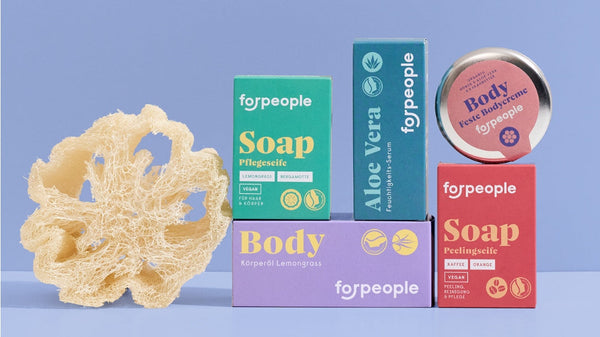
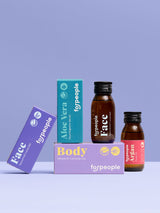
We do not carry a body lotion. Oil and body butter are water-free; the serum is water-based.
- Body Oil - Lemongrass, 100 ml, €16.90: sesame, safflower, sea buckthorn seed and sunflower oil, turmeric extract and lemongrass essential oil. According to the product page, for use after showering on skin that is still damp.
- Almond Oil - pure, 100 ml, €14.90: according to the ingredient list, almond oil only, with no added scent.
- Solid Body Butter - Beeswax & Aloe Vera, 40 g, €9.90: according to the ingredient list, cocoa butter, olive oil, beeswax, sunflower oil, shea butter and aloe vera leaf extract, with no added essential oils.
- Aloe Vera Serum 99.6%, 250 ml, €24.90: aloe juice, citric acid, potassium sorbate and sodium benzoate; contains water and is preserved. Intended as a layer under oil or butter when the skin is already dry.
For all four, the product pages say: avoid contact with the eyes and do not use on injured or irritated skin. If you notice a skin reaction, stop using the product.
More on this: Body Oil or Body Butter – Which One When? · Moisturising your body: morning or evening? · Shower oil or body oil: what is the difference?
From the blog: Less in the bathroom: a skincare routine with three products
Sources
- Nguyen KH, Pham LD, Nguyen TTT, Chu H, Nguyen TD, Ngo DK et al. (2022): Moisturizing effectiveness of immediate compared with delayed moisturization. Journal of Cosmetic Dermatology 21(10): 5134–5140. https://doi.org/10.1111/jocd.15003
- Chiang C, Eichenfield LF (2009): Quantitative assessment of combination bathing and moisturizing regimens on skin hydration in atopic dermatitis. Pediatric Dermatology 26(3): 273–278. https://doi.org/10.1111/j.1525-1470.2009.00911.x
- Ueda Y, Murakami Y, Saya Y, Matsunaka H (2022): Optimal application method of a moisturizer on the basis of skin physiological functions. Journal of Cosmetic Dermatology 21(7): 3095–3101. https://doi.org/10.1111/jocd.14560
- Patzelt A, Lademann J, Richter H, Darvin ME, Schanzer S, Thiede G et al. (2012): In vivo investigations on the penetration of various oils and their influence on the skin barrier. Skin Research and Technology 18(3): 364–369. https://doi.org/10.1111/j.1600-0846.2011.00578.x
- Sethi A, Kaur T, Malhotra SK, Gambhir ML (2016): Moisturizers: The Slippery Road. Indian Journal of Dermatology 61(3): 279–287. https://doi.org/10.4103/0019-5154.182427
- Voegeli D (2008): The effect of washing and drying practices on skin barrier function. Journal of Wound, Ostomy and Continence Nursing 35(1): 84–90. https://doi.org/10.1097/01.WON.0000308623.68582.d7