






What measurements show about the time of day
Skin constantly gives off a little water to the air. Specialists call this transepidermal water loss; how a film slows it is explained on the page Occlusion and TEWL: how a wax film protects your skin. It is not the same at every hour. We read three papers on this:
| Paper | Who was measured, and where | Result |
|---|---|---|
| Yosipovitch et al. 1998 | 16 healthy adults, aged 23 to 53; every two hours over 24 hours; forehead, forearm, upper back, shin | Water loss, pH and skin temperature followed a daily rhythm on the forehead, forearm and shin; the water content of the outer skin layer did not. The group's conclusion: skin is more permeable in the evening and at night than in the morning. |
| Le Fur et al. 2001 | 8 healthy women; 48 hours under constant room conditions; face and inner forearm | A daily rhythm of water loss at both sites, plus shorter fluctuations at intervals of 8 and 12 hours. |
| Matsui et al. 2016 (review) | summarises measurements in humans | Most groups found higher water loss in the late afternoon and evening than in the morning. The results differ, however, depending on measurement times, body site and room climate. |
What can be read from this: In healthy adults, skin at the measured sites tends to give off more water in the evening than in the morning. That is an argument for putting on a film in the evening.
Where the limits are: The groups were small. The 1998 paper reports a statistically confirmed daily rhythm for the forehead, forearm and shin, not for the upper back. The abdomen and thighs do not appear in either series of measurements. None of the three papers tested a cream or an oil. So these measurements do not show that skin takes up skincare better at night or that a cream does more in the evening. The 2016 review was written by employees of a cosmetics company.
Morning or evening: what speaks for each
| Question | Morning | Evening |
|---|---|---|
| What speaks for it? | Many people shower in the morning, and the skin is then still slightly damp. Clothing, heated indoor air and wind follow. | Skin tends to give off more water in the evening. You have time to massage the product in, and the film lies undisturbed. |
| Which form fits? | a thin film that is quick to spread: a few drops of oil | something richer: body butter on dry areas, oil for the larger areas |
| What to watch for? | use little and wait briefly before getting dressed | let it sink in before lying down; scent in bed is a matter of taste |
The rule of thumb “oil in the morning, butter in the evening” from the page Body Oil or Body Butter – Which One When? is a practical division by time and skin feel. It is not a measured result.
More important than the time: after washing, and regularly
Better supported than the time of day is that moisturising does something at all. In a study with 60 healthy adults aged 18 to 25, moisturised skin had more water in the outer skin layer and lower water loss than unmoisturised skin at every measurement point. Whether the cream went on immediately after washing or 30 minutes later made no difference (Nguyen et al. 2022). More on this: How soon should you moisturise after a shower? The 3-minute rule.
For oil and butter there is a practical point as well. Neither contains water. According to a review article, film-forming oils belong on moist skin, for example after patting dry following a bath (Sethi et al. 2016). That gives the simplest rule: moisturise when you have showered. If you shower in the morning, moisturise in the morning. If you shower in the evening, moisturise in the evening.
If your skin is already dry, you can first apply something water-based, for example an aloe serum, and put oil or butter on top. How to do that is described under Combining aloe vera serum with oil or solid cream.
Moisturising in the evening: how long before bed?
There is no evidence-based waiting time. We did not find figures such as “30 minutes before going to bed” in any study. Only the mechanism is known: what lies on the skin is removed again by contact. A research group in Tübingen that reproduced the contact of clothing with skin in an experiment points out that up to 90% of an applied preparation can disappear from the skin again through contact with the surroundings (Herrmann et al. 2017). At night, these surroundings are your pyjamas and the bed linen.
The following points come from practice, not from measurements:
- Use little. A few drops of oil per body area are enough; apply the butter thinly.
- Moisturise first, then the rest of your evening. Moisturise before you brush your teeth. Lie down when your skin no longer shines.
- Put something on. Cotton pyjamas take up residues before they get into the sheet.
What oil leaves behind in sheets and towels, and how to wash them, is on the sister page Does body oil stain? Clothes, bed linen, towels.
Moisturising twice a day?
For moisturisers in general, a review article gives one to three times daily depending on how dry the skin is, especially after bathing (Sethi et al. 2016). That does not yield a fixed number for healthy body skin. As a guide from practice:
- Day to day: once a day, after showering.
- In the heating season or on very dry areas: oil for the larger areas in the morning, butter only on shins, elbows and knees in the evening.
- By feel: if your skin feels tight or rough, reapply, whatever the time. Why a film does not last all day is explained in How long does a care film stay on the skin?
When to seek medical advice?
The time of day you moisturise is a skincare question. If your skin stays very dry, flaky or reddened for weeks despite regular care, if it itches badly, especially at night, or if it weeps, have it looked at by a doctor. If you have a medical plan for a skin condition that says when which preparation goes on the skin, that plan applies; this page does not replace it. Do not apply skincare products to injured or irritated skin.
Frequently asked questions
Is it better to moisturise your body in the morning or in the evening?
There is no measured difference. Moisturise when you have showered and have a few minutes. Regularity counts for more than the time.
Does skin take up skincare better at night?
That has not been shown. What was measured is that skin tends to give off more water in the evening than in the morning. According to our research, nobody has tested whether a cream therefore does more in the evening.
How long before bed should I moisturise?
There is no evidence-based time. In practice: use little, massage it in, and only go to bed when your skin no longer shines.
Does the scent of a body oil get in the way of falling asleep?
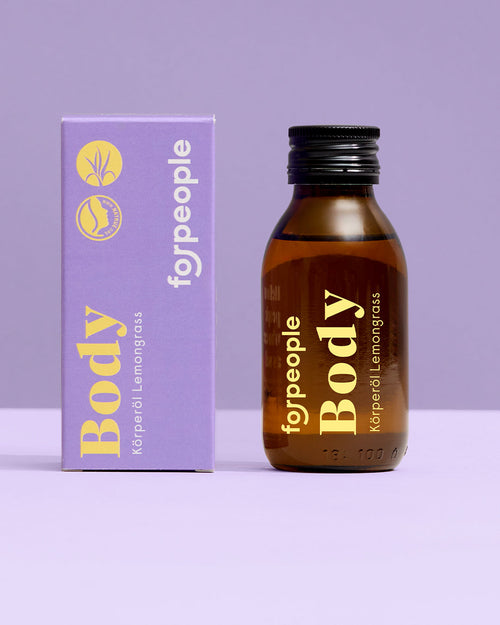
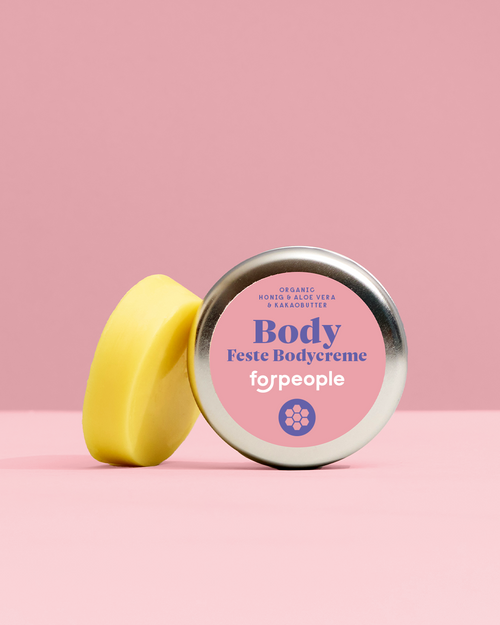
That is a matter of taste. The Body Oil Lemongrass contains lemongrass essential oil and has a distinct scent. The almond oil has no added scent; the solid body butter smells slightly of beeswax.
I shower in the evening after exercise. Do I moisturise straight afterwards?
After exercise the skin often keeps sweating for a while. What that means for timing is covered under Moisturising after exercise: straight after the shower or wait?
At forpeople
We do not carry a body lotion. Oil and body butter are water-free; the serum is water-based.
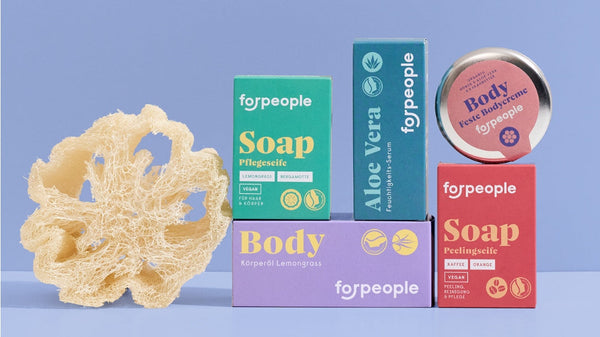
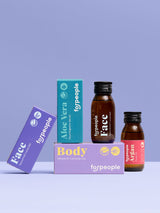
- Body Oil - Lemongrass, 100 ml, €16.90: sesame, safflower, sea buckthorn seed and sunflower oil, turmeric extract and lemongrass essential oil. Liquid and quick to spread, so an obvious choice for the morning.
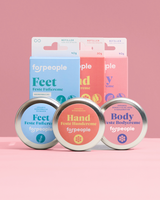
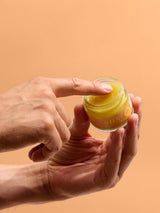
- Solid Body Butter - Beeswax & Aloe Vera, 40 g, €9.90: according to the ingredient list, cocoa butter, olive oil, beeswax, sunflower oil, shea butter and aloe vera leaf extract, with no added essential oils. It leaves a more noticeable film and therefore suits the evening and individual dry areas.
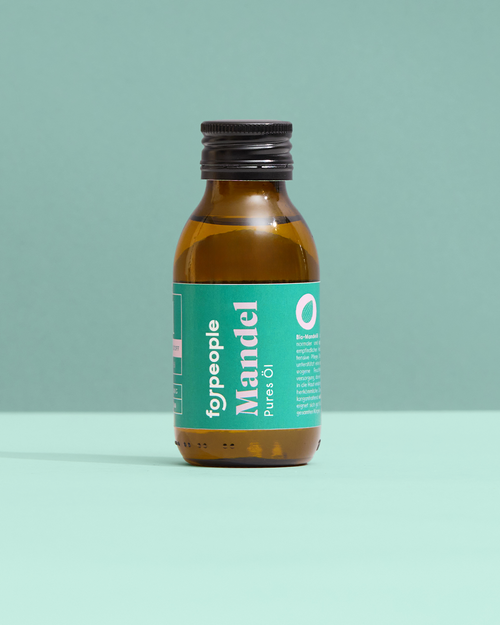
- Almond Oil - pure, 100 ml, €14.90: according to the ingredient list, almond oil only, with no added scent. An option if scent in bed bothers you.
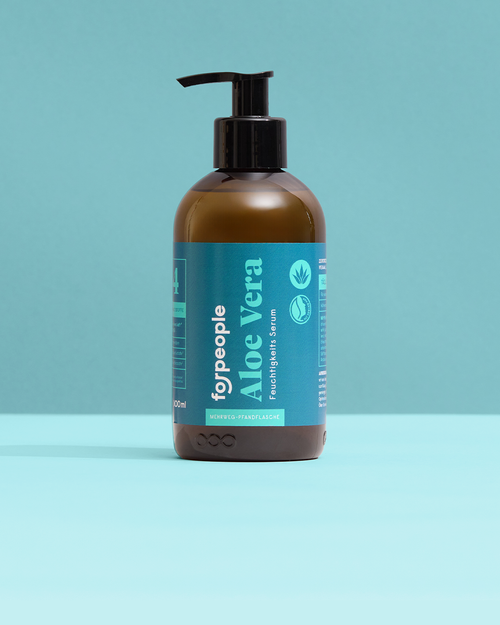
- Aloe Vera Serum 99.6% - Pump Bottle, 300 ml, €27.90: aloe juice, citric acid, potassium sorbate and sodium benzoate; contains water and is preserved. Intended as a water-based layer under oil or butter when the skin is already dry.
For all four, the product pages say: avoid contact with the eyes and do not use on injured or irritated skin. If you notice a skin reaction, stop using the product.
More on this: Body oil or body lotion: what is the difference? · Overnight hand mask: what it does and how to do it · Foot cream overnight with socks: does it help?
From the blog: Less in the bathroom: a skincare routine with three products
Sources
- Yosipovitch G, Xiong GL, Haus E, Sackett-Lundeen L, Ashkenazi I, Maibach HI (1998): Time-dependent variations of the skin barrier function in humans: transepidermal water loss, stratum corneum hydration, skin surface pH, and skin temperature. Journal of Investigative Dermatology 110(1): 20–23. https://doi.org/10.1046/j.1523-1747.1998.00069.x
- Le Fur I, Reinberg A, Lopez S, Morizot F, Mechkouri M, Tschachler E (2001): Analysis of circadian and ultradian rhythms of skin surface properties of face and forearm of healthy women. Journal of Investigative Dermatology 117(3): 718–724. https://doi.org/10.1046/j.0022-202x.2001.01433.x
- Matsui MS, Pelle E, Dong K, Pernodet N (2016): Biological Rhythms in the Skin. International Journal of Molecular Sciences 17(6): 801. https://doi.org/10.3390/ijms17060801
- Nguyen KH, Pham LD, Nguyen TTT, Chu H, Nguyen TD, Ngo DK et al. (2022): Moisturizing effectiveness of immediate compared with delayed moisturization. Journal of Cosmetic Dermatology 21(10): 5134–5140. https://doi.org/10.1111/jocd.15003
- Sethi A, Kaur T, Malhotra SK, Gambhir ML (2016): Moisturizers: The Slippery Road. Indian Journal of Dermatology 61(3): 279–287. https://doi.org/10.4103/0019-5154.182427
- Herrmann S, Daniels R, Lunter D (2017): Methods for the determination of the substantivity of topical formulations. Pharmaceutical Development and Technology 22(4): 487–491. https://doi.org/10.3109/10837450.2015.1135346