







No sebaceous glands in the palm
Sebaceous glands release an oily secretion, sebum, onto the skin surface. Together with sweat it forms a thin film there. Sebaceous glands are found almost everywhere on the body, except on the palms of the hands and the soles of the feet (Smith & Thiboutot 2008). So the inside of your hand has no supply of fat of its own. Instead it has a thick stratum corneum that protects it from pressure and friction.
The back of the hand is different: the skin there is thin and lies directly over tendons and knuckles. There are sebaceous glands, but far fewer than on the face or back, for example. On the knuckles in particular, the skin is stretched a lot when you make a fist. When it is dry and not very elastic, fine cracks appear there first.
Measurements also show how much skin sites differ: in a study with 125 people, water loss, skin hydration and pH, among other things, were measured at 16 body sites, including the back of the hand and the palm. The values differed depending on the body site (Kleesz et al. 2012).
Washing and surfactants
No other part of the body is washed as often as the hands. If you work in healthcare, in a kitchen, in childcare or in cleaning, you often wash them dozens of times a day. Add to that disinfectant, dishwater and cleaning products.
Surfactants in soaps and washing gels dissolve fat and dirt. But in doing so they also dissolve lipids from the stratum corneum, and some attack the proteins of the horny cells. This can lead to tightness, dryness and roughness after washing. Alkaline washing solutions also make the stratum corneum swell (Ananthapadmanabhan et al. 2004). Even tap water with a pH of around 8 raises the skin's pH for a few hours (Lambers et al. 2006).
After washing, the water on your skin evaporates, and with it some of the water from the top layer of skin. If you don't apply cream then, your hands dry out a little more each time. More in Dry, cracked hands from frequent washing.
Cold, indoor heating and friction
In winter, hands dry out particularly quickly. Cold air holds little moisture, and indoors the heating lowers humidity further. Low humidity and low temperatures reduce the skin's barrier function and make it more susceptible to mechanical stress (Engebretsen et al. 2016). Hands are usually uncovered, unlike the rest of the body. You can find tips for the cold season in Dry skin in winter.
Then there is friction: tools, steering wheel, pushchair, paper, garden soil. And wearing gloves for hours softens the skin. When it dries in the air afterwards, it feels especially rough.
Why hands get dry: the causes at a glance
| Cause | What happens in the skin | What you can do |
|---|---|---|
| no sebaceous glands in the palm, few on the back of the hand | hardly any natural film of fat on the surface | apply cream regularly, especially on the backs of your hands and knuckles |
| frequent washing with surfactants | lipids are dissolved out of the stratum corneum | wash with lukewarm water, rinse well, apply cream afterwards |
| hot water | dissolves fats more easily than lukewarm water | use lukewarm water |
| cold and dry air | water evaporates faster, the skin becomes more brittle | apply cream before going outside, wear gloves |
| friction, work with water | the stratum corneum is stressed mechanically and by softening | work gloves, then skincare |
A skincare routine for your hands
Hands don't need a complicated routine, but a regular one. Timing is what matters.
- After washing: wash your hands with lukewarm water, rinse well and gently pat dry. While the skin is still slightly damp, massage in a small amount of hand cream. The film of waxes and oils then slows evaporation. We explain how this works in Occlusion and transepidermal water loss.
- Before going outside: in cold and wind, apply cream before you go out and wear gloves.
- Before your shift: if you work a lot with water, apply cream before you start and again during breaks.
- In the evening: apply a little more cream, ideally with cotton gloves overnight. This is especially helpful for rough knuckles and fingertips.
- Don't forget your cuticles: massage the rest of the cream into your cuticles and nail folds.
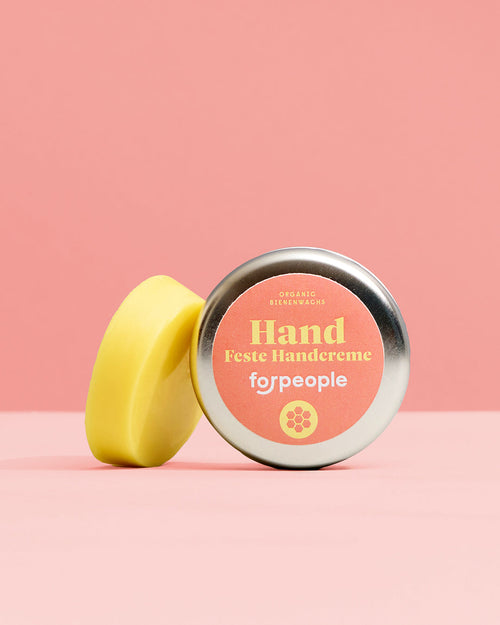
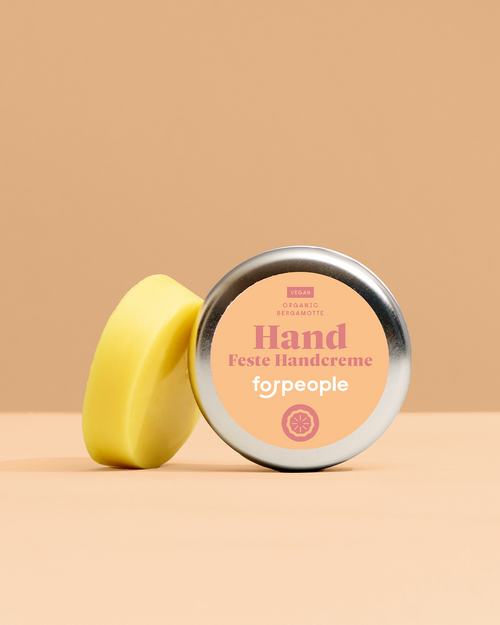
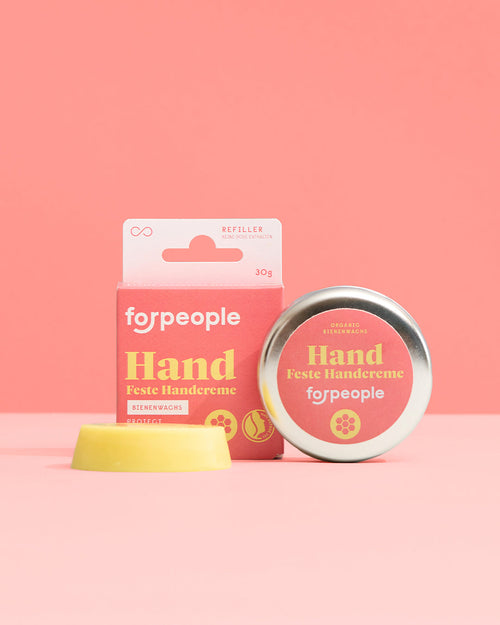
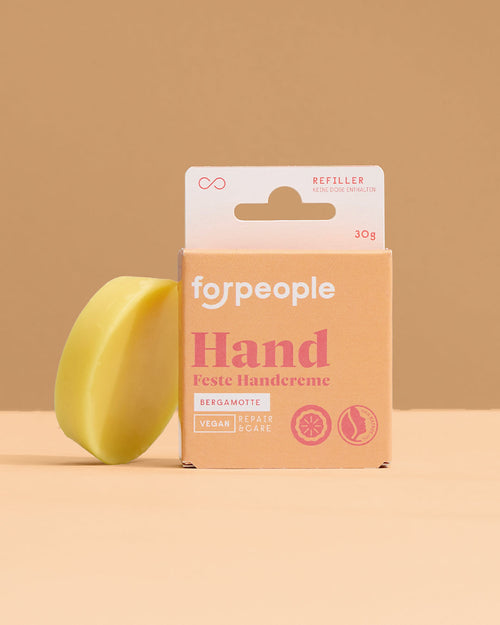
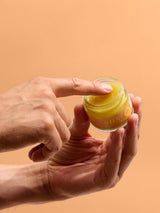
You rub a solid hand cream with beeswax directly over your palm. Your body heat melts a thin layer, which you then spread. Because it contains no water, a little goes a long way. The vegan alternative is the Solid Vegan Hand Cream - Bergamot with candelilla wax. If you want a tin at home and one at work, take the Hand Care Set with two solid hand creams. You refill empty tins with the Beeswax refill or the Bergamot refill, more in Refilling with refills. Which format suits you is covered in Solid cream or tube?
If your skin stays cracked for weeks despite care, bleeds, hurts or changes markedly, have it checked by a doctor. Hand cream cares for your skin; it does not treat skin conditions.
Frequently asked questions
Why are the backs of my hands drier than my palms?
The skin on the back of the hand is thinner, directly exposed to wind and cold, and strongly stretched over the knuckles. The palm has no sebaceous glands, but a much thicker stratum corneum.
How often should I apply hand cream?
Ideally after every wash, if that is doable in everyday life. At least in the morning, in the evening and before going out in the cold.
Does hand sanitiser dry out hands more than soap?
Both put strain on the skin in different ways. Either way, it helps to apply cream afterwards once the product has dried.
Does wearing gloves help?
Yes, in the cold and when working with water or cleaning products. For long periods, cotton gloves under rubber gloves are more comfortable, because otherwise the skin softens.
Does a solid hand cream feel very greasy?
Not if you use only a little. A small amount is enough because it contains no water. If your skin still shines after a few minutes, it was too much.
At forpeople
- Solid Hand Cream - Beeswax, 30 g, €9.90: water-free, made of beeswax, olive oil and sunflower oil, without essential oils.
- Solid Vegan Hand Cream - Bergamot, 30 g, €9.90: vegan, with candelilla wax, jojoba oil and shea butter, scented with essential oils of lemon and bergamot.
- Hand Care Set – For Rough, Cracked Hands (2× Solid Hand Cream), €16.90.
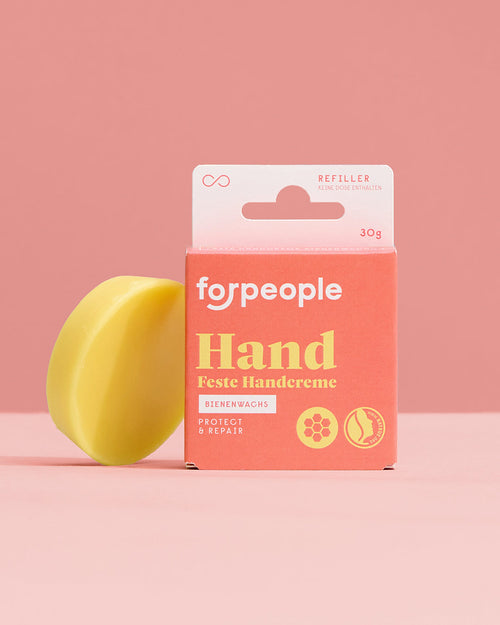
- Solid Hand Cream Refill - Beeswax, €7.90: refillable, you keep the tin.
Sources
- Smith KR, Thiboutot DM (2008): Thematic review series: skin lipids. Sebaceous gland lipids: friend or foe? J Lipid Res 49(2): 271–281. https://doi.org/10.1194/jlr.R700015-JLR200
- Kleesz P, Darlenski R, Fluhr JW (2012): Full-body skin mapping for six biophysical parameters: baseline values at 16 anatomical sites in 125 human subjects. Skin Pharmacol Physiol 25(1): 25–33. https://doi.org/10.1159/000330721
- Ananthapadmanabhan KP, Moore DJ, Subramanyan K, Misra M, Meyer F (2004): Cleansing without compromise: the impact of cleansers on the skin barrier and the technology of mild cleansing. Dermatol Ther 17 Suppl 1: 16–25. https://doi.org/10.1111/j.1396-0296.2004.04s1002.x
- Lambers H, Piessens S, Bloem A, Pronk H, Finkel P (2006): Natural skin surface pH is on average below 5, which is beneficial for its resident flora. Int J Cosmet Sci 28(5): 359–370. https://doi.org/10.1111/j.1467-2494.2006.00344.x
- Engebretsen KA, Johansen JD, Kezic S, Linneberg A, Thyssen JP (2016): The effect of environmental humidity and temperature on skin barrier function and dermatitis. J Eur Acad Dermatol Venereol 30(2): 223–249. https://doi.org/10.1111/jdv.13301