The problem: cracked hands in the cold season
First the skin feels tight after washing your hands, then it becomes rough and dull, and at some point fine lines split open on the knuckles, the fingertips and next to the nails; making a fist stings. This is typical from autumn onwards, when a cold wind blows outside and the heating is on inside, after days with a lot of washing up, cleaning or work outdoors, and in jobs with constant hand washing. The kitchen cupboard holds olive oil, honey and lemons, the bathroom an old tin of udder balm. This page sorts out what helps and what does not. There is a separate page for chapped lips: Honey, oil, quark: how useful are home remedies for chapped lips?; for split fingertips see Cracked, split fingertips: causes and what helps.
Why hands crack in autumn and winter
Cracks form when the outer layer of the skin becomes so dry and inelastic that it breaks open when you move; the drier the skin, the more likely it is to crack (DermNet: Dry skin). According to a review, low humidity and low temperatures reduce the skin's barrier function and make it more susceptible to mechanical stress (Engebretsen et al. 2016). Cold outdoor air holds little water vapour, and when it is heated indoors its relative humidity drops further; this is explained in Humidity and skin: what dry heated air does and what helps.
Then there is washing. Surfactants in soap and washing-up liquid also attack proteins and fats in the outer skin layer; the skin feels tight, and a high pH makes the outer layer swell as well (Ananthapadmanabhan et al. 2004). Hot water makes it worse; dermatological advice is to use lukewarm water (DermNet: Dry skin). More in Dry, cracked hands: causes and what helps.
Skincare can do three things in response (Sethi et al. 2016): humectants attract water, from deeper layers of the skin and only in humid air also from the surroundings. Emollients, mainly oils and fats, make the rough surface soft and flexible. Occlusives lay a water-repellent layer on top and slow down evaporation. Figures from the same review show how differently tight these layers are: petroleum jelly reduces water loss from the skin by more than 98 per cent even at 5 per cent of a formula, lanolin, mineral oil and silicones by 20 to 30 per cent, and its resistance to water vapour is about 170 times that of olive oil. For cracked hands this means: oil makes them supple, but it is mainly waxes and dense fats that hold the water in. In detail: Humectants, occlusives, emollients.
The solution step by step
| When | What you do | Why |
|---|---|---|
| Straight away | Do not treat open, bleeding or reddened cracks yourself; have them looked at | Cosmetics and home remedies are meant for closed skin |
| Straight away | Wash briefly in lukewarm water with little soap, rinse well, pat dry instead of rubbing | Heat and surfactants dissolve fats and proteins in the outer skin layer |
| Every day | After every wash, a small amount of salve, solid cream, udder balm or petroleum jelly on the still slightly damp skin | The film slows down the evaporation of water from the outer skin layer |
| Every evening | A thicker layer with cotton gloves on top | At night the film stays undisturbed for hours |
| Prevention | Gloves for washing up and cleaning, and outdoors in the cold | Washing-up liquid, hot water, cold and dry air weaken the barrier |
| Prevention | Try any new remedy on a small area first | Reactions show up before the whole hand is affected |
Sources for the table: Sethi et al. 2016, Ananthapadmanabhan et al. 2004, DermNet, Engebretsen et al. 2016; the order itself is common practice. How the overnight version works is explained in Overnight hand mask: what it does and how to do it; how to test a new product in Trying a new product: how do I test it on a small area?
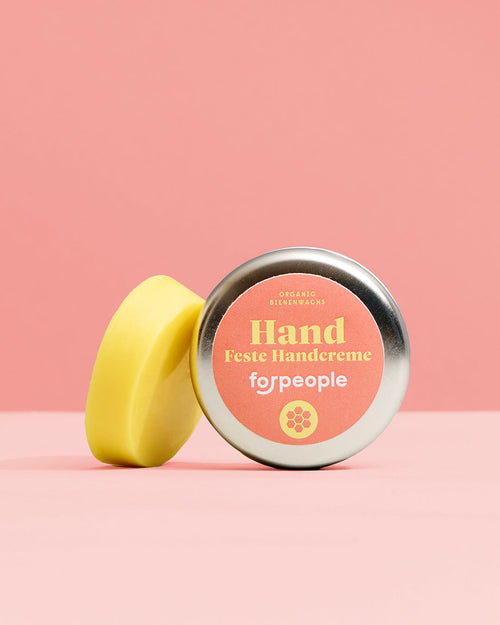
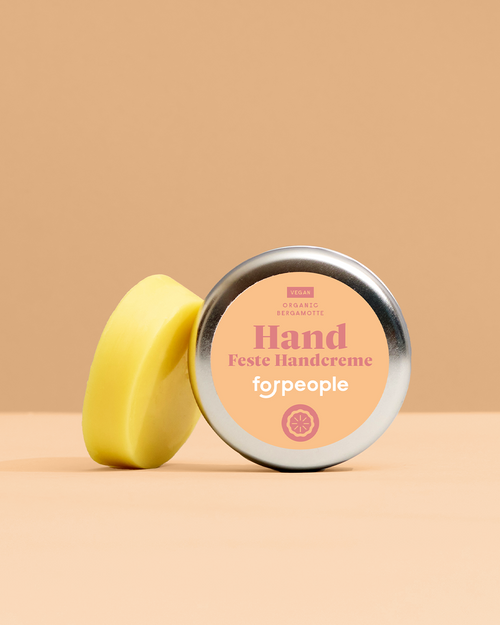
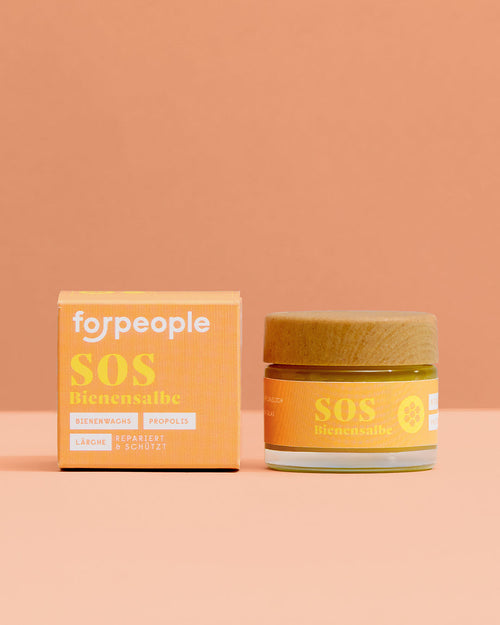
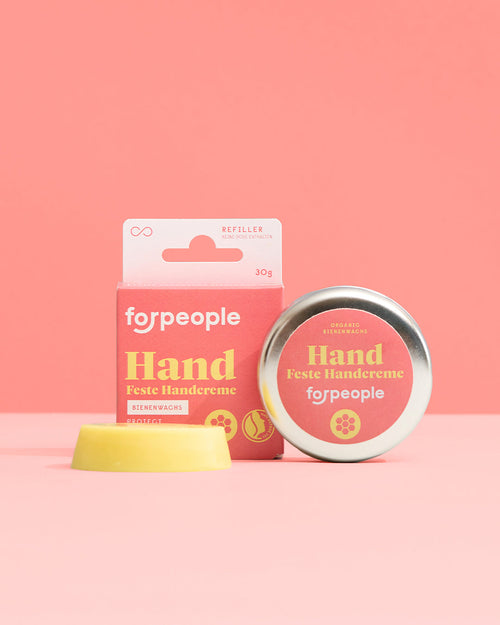
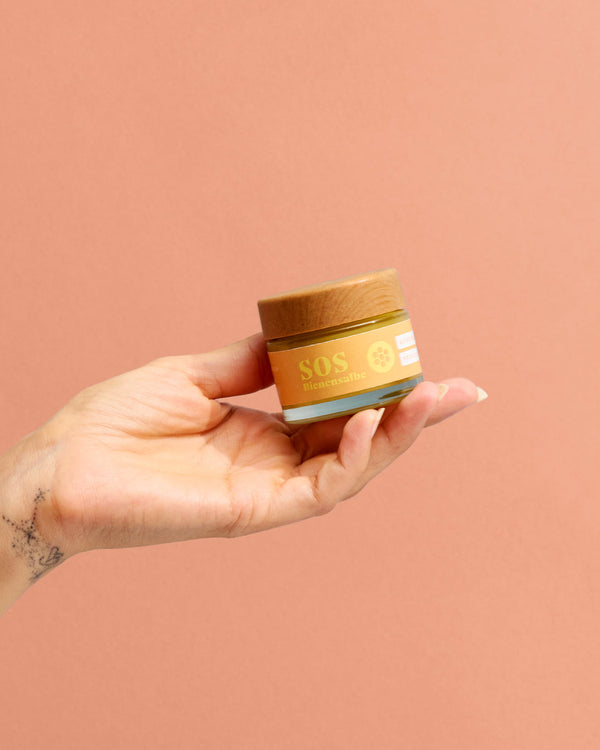
Any salve or solid cream made of wax and oil is suitable for the film. According to its ingredient list, the Solid Hand Cream - Beeswax consists of beeswax, olive and sunflower oil plus St. John's wort and aloe extract, without water or essential oils. The vegan Solid Vegan Hand Cream - Bergamot contains essential oils of lemon and bergamot; what citrus oils mean in the sun is explained in Phototoxic oils: bergamot, citrus oils and St. John's wort in the sun. The Beeswax Salve – Larch & Mandarin in a Glass Jar is meant for individual rough areas in the evening and contains larch resin, propolis and essential oils; according to its product page it is not for open or injured skin, and if you react to resin, propolis or fragrances, read Colophony allergy, propolis, beeswax: symptoms and advice first.
What helps – and what does not
We are not aware of any studies that have compared these home remedies specifically on cracked hands. The assessment is based on how each one works and on measurements on other skin.
| Home remedy | Principle | What it can do | The catch | On cracked skin |
|---|---|---|---|---|
| Udder balm | Occlusive | dense film of petroleum jelly and paraffin | shiny and greasy, some kinds with fragrance | thinly, on closed skin only |
| Petroleum jelly | Occlusive | the densest film among the home remedies | greasy, marks paper and fabric | thinly, on closed skin only |
| Deer tallow | Fat | firm film | animal fat, depending on the product with its own smell | thinly, on closed skin only |
| Olive oil | Emollient | makes skin supple straight away | stays on only briefly without wax; pure olive oil weakened the outer skin layer in one trial | thinly, on closed skin only |
| Sunflower or almond oil | Emollient | makes skin supple, spreads thinly | stays on only briefly without wax | thinly, on closed skin only |
| Coconut oil | Emollient | melts on the skin; on dry skin similar to mineral oil in one study | once melted, as short-lived as any oil | thinly, on closed skin only |
| Honey | Humectant | binds water | sticky, forms no film, has to be washed off | not on open cracks |
| Quark, yoghurt | brings water | feels cool | the water evaporates, then you wash again | not on open cracks |
| Sugar with oil | Friction | loosens flakes | roughens cracked skin further | no |
| Lemon juice, vinegar | Acid | nothing for cracked skin | strongly acidic, stings; lemon is also risky with sunlight | no |
The last column is our assessment, not a measurement. The evidence for the individual remedies:
Udder balm, petroleum jelly, tallow. Classic udder balm made of petroleum jelly and paraffins lays down a dense, water-repellent film; what a particular tin contains is shown by its ingredient list. In detail: What is Melkfett (udder balm)? What it is made of and what it is for. According to the measurements above, petroleum jelly seals most tightly (Sethi et al. 2016); the comparison with wax and plant oil is made in Petroleum jelly or beeswax salve: the difference; on tallow see Deer tallow: what is in it and what the alternatives are.
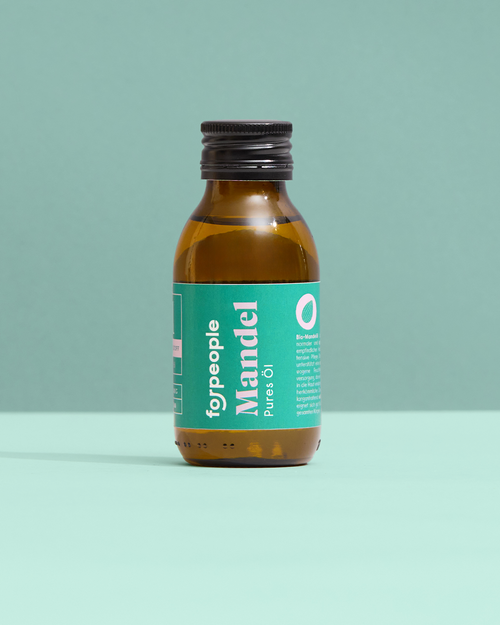
Oils. With oil, rough skin feels smoother straight away, but washing and gripping quickly remove it again. Not every oil is the same, either: in one trial, adults applied six drops of olive oil to one forearm and sunflower oil to the other twice a day for four weeks. Pure olive oil reduced the cohesion of the outer skin layer and caused mild redness; sunflower oil did not, and it improved skin hydration (Danby et al. 2013). The study is small and tested only the pure oil, not olive oil as one of several ingredients in a salve; even so, pure olive oil is not a long-term solution. In a study with 34 people with dry skin on the legs, virgin coconut oil improved skin hydration after two weeks similarly to mineral oil (Agero & Verallo-Rowell 2004). If you want to work with oil, put a few drops on damp hands and add something denser on top, for example with the Almond Oil - pure, which according to its product page is meant for skin, hair and lips. Why oils differ: Linoleic or oleic acid? Fatty acids in plant oils explained.
Honey and quark. Honey is a supersaturated solution consisting mainly of fructose and glucose; in cosmetics it serves as a humectant, usually at 1 to 10 per cent of a formula (Burlando & Cornara 2013). Applied pure it is sticky, and washing it off removes the bound water again. In wound care, specially processed medical-grade honey is used (Burlando & Cornara 2013); that is a different product from honey out of the jar, and it is a doctor's decision. Quark and yoghurt consist largely of water, cool, dry off and also have to be washed off. Do not keep mixtures: Homemade cream: how long does it last, and how can it keep longer?
Common mistakes
- Lemon juice on the cracks. The skin surface has an average pH of about 4.7 (Lambers et al. 2006), lemon juice 2.0 to 2.6 (Clemson Extension). It stings on cracked skin, and lemons contain furocoumarins, which together with sunlight can trigger redness, blisters and later dark patches (Grosu Dumitrescu et al. 2024). Why acidic things sting on cracks: Why does hand cream sting on cracked hands?
- Vinegar or even vinegar essence. Household vinegar has a pH of 2.0 to 3.4 (Clemson Extension) and stings just the same; vinegar essence is corrosive. Details on Vinegar, baking soda, lemon: home remedies for calluses
- Washing up in hot water without gloves. It is exactly this combination of heat and surfactants that strains the outer skin layer; see Rough hands from washing up and cleaning: what helps?
- Scrubbing with sugar, salt or coffee grounds. On cracked skin, the friction roughens the edges of the cracks further, and salt stings on top: Hand scrub for dry hands: a good idea or not?
- Only oil, no film. Oil on its own is gone after the next hand wash.
- Thick during the day, nothing in the evening. A thick film during the day rubs off and gets wiped away; the thick layer belongs to the night.
- Pulling at flaps of skin along the cracks. That makes the crack bigger; leave loose edges alone.
When to get medical advice
Home remedies and cosmetics are meant for dry, closed skin. Have your hands looked at by a GP or dermatologist if
- cracks are deep, bleed, weep or have not closed after two to three weeks of care,
- the skin around a crack becomes red, warm, swollen or painful, or produces pus; bacteria and viruses can enter the skin through cracks (DermNet: Dry skin),
- your hands itch badly, form small blisters or the problem keeps coming back; this may be hand eczema, see Dry hands or hand eczema?,
- the skin turns red, burns or blisters after a home remedy, for example after lemon juice and sun,
- the problem is related to your work; then your company doctor is also a point of contact.
Until then, put neither home remedies nor cosmetics on open areas.
Frequently asked questions
Does olive oil help cracked hands?
For the moment it makes the skin supple. Without wax, though, it stays on only briefly, and in one trial pure olive oil weakened the outer skin layer on the forearm, while sunflower oil did not. Pure olive oil is therefore of little use as a long-term solution; a film of wax and oil on top lasts longer.
Is udder balm good for cracked hands?
For dry, closed skin, yes: classic udder balm made of petroleum jelly and paraffin lays down a dense film that keeps the water in the skin. It brings no water of its own and leaves a shine. It does not belong on open cracks.
Does honey help cracked hands?
Honey binds water but forms no film and has to be washed off again. That is why it does little for cracked hands. Honey from the jar does not belong on open cracks.
Can I put lemon on cracked hands?
No. Lemon juice has a pH of 2.0 to 2.6 and stings on cracked skin. Together with sunlight, components of lemon can also trigger a skin reaction with redness and blisters.
What helps cracked hands overnight?
A thicker layer of salve, solid cream, udder balm or petroleum jelly on slightly damp hands, with cotton gloves on top. That way the film stays undisturbed for several hours.
Why do my hands crack especially in winter?
Cold outdoor air and heated indoor air are dry, and according to the research low humidity and cold weaken the skin's barrier function. On top of that, people often wash in hotter water in winter. Gloves outdoors, lukewarm water and a film of wax and oil after washing address exactly that.
How quickly do cracked hands become smooth again?
With gloves and regular care, many people notice a difference after a few days; that is a rule of thumb from experience. If nothing changes after two to three weeks, have your hands looked at by a doctor.
At forpeople
Our hand care is water-free: wax and oil as a film that stays on. It does not belong on open or irritated skin.
Solid Hand Cream - Beeswax, 30 g, €9.90: beeswax, olive and sunflower oil, St. John's wort and aloe extract, no essential oils.
Solid Vegan Hand Cream - Bergamot, 30 g, €9.90: vegan, with candelilla wax, jojoba oil and shea butter, scented with essential oils of lemon and bergamot.
Beeswax Salve – Larch & Mandarin in a Glass Jar, 50 g, €12.90: for individual dry, rough areas, with larch resin and propolis.
Hand Care Set – For Rough, Cracked Hands (2× Solid Hand Cream), 60 g, €16.90: one tin and one refill of the beeswax cream, for example for the kitchen and the workplace.
More on this: Dry hands despite moisturising: why, and what helps · Cold cream: water-free, but no protection from frost
From the blog: Hands and feet through winter: a routine for morning and evening · Bee Salve: Beeswax & Propolis for Dry, Stressed Skin
Sources
- Sethi A, Kaur T, Malhotra SK, Gambhir ML (2016): Moisturizers: The Slippery Road. Indian J Dermatol 61(3): 279–287. https://doi.org/10.4103/0019-5154.182427
- Danby SG, AlEnezi T, Sultan A, Lavender T, Chittock J, Brown K et al. (2013): Effect of olive and sunflower seed oil on the adult skin barrier: implications for neonatal skin care. Pediatr Dermatol 30(1): 42–50. https://doi.org/10.1111/j.1525-1470.2012.01865.x
- Agero AL, Verallo-Rowell VM (2004): A randomized double-blind controlled trial comparing extra virgin coconut oil with mineral oil as a moisturizer for mild to moderate xerosis. Dermatitis 15(3): 109–116. https://doi.org/10.2310/6620.2004.04006
- Burlando B, Cornara L (2013): Honey in dermatology and skin care: a review. J Cosmet Dermatol 12(4): 306–313. https://doi.org/10.1111/jocd.12058
- Lambers H, Piessens S, Bloem A, Pronk H, Finkel P (2006): Natural skin surface pH is on average below 5, which is beneficial for its resident flora. Int J Cosmet Sci 28(5): 359–370. https://doi.org/10.1111/j.1467-2494.2006.00344.x
- Clemson Cooperative Extension: pH Values of Common Foods and Ingredients. Table (PDF), accessed 29.10.2026. https://www.clemson.edu/extension/food/_files/ph-of-common-foods-table.pdf
- Grosu Dumitrescu C, Jîjie AR, Manea HC, Moacă EA, Iftode A, Minda D et al. (2024): New Insights Concerning Phytophotodermatitis Induced by Phototoxic Plants. Life (Basel) 14(8): 1019. https://doi.org/10.3390/life14081019
- Ananthapadmanabhan KP, Moore DJ, Subramanyan K, Misra M, Meyer F (2004): Cleansing without compromise: the impact of cleansers on the skin barrier and the technology of mild cleansing. Dermatol Ther 17 Suppl 1: 16–25. https://doi.org/10.1111/j.1396-0296.2004.04s1002.x
- DermNet: Dry skin. Oakley A (1997), updated March 2022, accessed 29.10.2026. https://dermnetnz.org/topics/dry-skin
- Engebretsen KA, Johansen JD, Kezic S, Linneberg A, Thyssen JP (2016): The effect of environmental humidity and temperature on skin barrier function and dermatitis. J Eur Acad Dermatol Venereol 30(2): 223–249. https://doi.org/10.1111/jdv.13301