In winter, after a week of heavy cleaning or in a job with constant handwashing, your hands eventually feel like paper. The skin over your knuckles feels tight, it turns red between your fingers, and in the evening it itches. Then the question comes up: is it just a lack of care, or is it more? This page sets out the signs according to guidelines and specialist sources. It does not replace an examination.
Dry hands or hand eczema: the signs compared
Dry hands develop when the outer layer of skin loses more fat and water than it can replace; frequent washing, cold and heated indoor air are the usual reasons (Dry, cracked hands: causes and what helps). The skin is then rough, dull and tight, but it basically stays calm.
Hand eczema is an inflammatory skin disease (Thyssen et al. 2022). In the acute phase you see red patches and bumps, swelling, blisters, weeping, crusts and cracks. In the chronic phase, dryness, scaling and thickened, coarse skin dominate. The itch is often intense; sometimes the skin burns or hurts (DermNet: Hand dermatitis). This is exactly the difficulty: chronic hand eczema can look like very dry skin.
The German guideline separates the two by duration. Hand eczema is called acute if it lasts less than three months and occurs at most once a year; if it lasts longer or comes back at least twice within a year, it counts as chronic (Gensthaler 2023). The guideline itself is a consensus recommendation of the specialist societies, is based on the European guideline from 2022 and is valid until February 2028 (Bauer et al. 2023).
| Feature | Dry, rough hands | Hand eczema, acute | Hand eczema, chronic |
|---|---|---|---|
| Appearance | dull, finely flaking, cracked at knuckles and fingertips | red patches, bumps, swelling, blisters, weeping, crusts | dry, scaly, thickened, often with cracks |
| How it feels | tight, little itch | often very itchy, can burn | itches, burns or hurts, especially at cracks |
| Course | improves within a few days to two weeks once the strain is reduced | less than three months, at most once a year | longer than three months or at least twice a year |
| Response to skincare | clearly better with gloves and regular moisturising | skincare alone is not enough | skincare alone is not enough |
| Who clarifies it | you; if it persists, a GP or dermatologist | dermatologist | dermatologist, at work also the occupational physician |
Sources for the table: DermNet, Gensthaler 2023. The time given for dry skin is a rule of thumb, not a threshold; other guides in this series also name two to three weeks as the point at which you should have it checked. More on skin that comes off in flakes: Skin peeling on fingers and hands: causes and what helps.
How common it is shows an analysis of 66 studies with a good 568,000 people: 14.5 per cent had hand eczema at some point in their lives, 9.1 per cent within one year and 4.0 per cent at the time of the survey. Women are affected 1.5 to 2 times as often, the eczema starts on average in the early to mid-twenties, and about a third of those affected had a history of atopic dermatitis (Quaade et al. 2021).
Which types exist and where they come from
Specialists mainly classify hand eczema by cause: irritant contact dermatitis from irritating substances, allergic contact dermatitis and atopic hand eczema in people prone to atopic dermatitis; less common is a reaction to proteins, for example when working with food. Several causes often act together (DermNet: Hand dermatitis). Of the skin diseases caused by work, 90 per cent are eczema. The most common is cumulative irritant eczema, also called wear-and-tear eczema: it develops over weeks and months from substances that do little on their own, such as water, cleaning agents, oils or solvents. Skin weakened in this way lets allergens in more easily (SVLFG 2021).
| Type | Typical site | Clues | Common triggers |
|---|---|---|---|
| Irritant contact dermatitis | starts in the finger webs, palms often spared | increases with wet work, handwashing and cleaning agents | water, washing-up liquid and cleaners, solvents, long wear of tight gloves |
| Allergic contact dermatitis | where the substance touches the skin | sharp border, for example at the glove cuff; uneven distribution; flares after certain tasks | nickel, fragrances, latex and rubber components, epoxy resin, formaldehyde, plants such as primulas, cattle hair |
| Atopic hand eczema | backs of the hands and wrists | often atopic dermatitis elsewhere or in the past | inborn tendency, made worse by wet work and irritants |
| Blistering type | palms | intensely itchy, skin-coloured blisters in flares | sweating and stress can make flares worse |
| Hyperkeratotic type | palms | thick, dry skin with little redness, less red than psoriasis | varies; the doctor clarifies it |
Sources for the table: DermNet, SVLFG 2021. The classification describes what specialists distinguish. It is not a guide to self-diagnosis; mixed forms are common.
Two diseases look similar and are told apart in practice: psoriasis on the hands usually shows sharply defined, scaly patches on both sides, a fungal infection of the hand usually affects only one hand or is unevenly distributed, with scaling at the edge (DermNet: Hand dermatitis). Hand eczema also often occurs together with eczema on the feet (Agner & Elsner 2020); for telling things apart on the feet, see Dry feet or athlete's foot?
Whether an allergy is behind it only shows in an allergy test: with chronic hand eczema a patch test may be needed, sometimes also a skin scraping to look for fungi (DermNet: Hand dermatitis). How the test works is explained in Colophony allergy, propolis, beeswax: symptoms and advice; on fragrances, see Essential Oils and Fragrance Allergens.
Wet work: when your hands are under particular strain at work
Among the triggers to avoid, the guideline puts wet work first (Gensthaler 2023). The German workplace rule TRGS 401 speaks of wet work when employees regularly have skin contact with water or watery liquids for more than two hours a day, when they put on and take off liquid-tight gloves more than ten times a day in the process, when they wash their hands at least fifteen times a day, or when they wear gloves and wash their hands more than five times a day. Alcohol-based hand sanitisers count as watery liquids here (AGS 2022).
In jobs with a lot of wet work, such as hairdressing, cleaning, healthcare, metalworking and construction, up to 40 per cent of employees have hand eczema at any given time, according to the German Dermatological Society (DDG 2026). More on individual jobs: Hand care in nursing, Hand care for hairdressers: what goes on your skin, and when? and Hand care in farming and the barn.
Severe or recurring hand eczema caused by work can be an occupational disease; in the German list it appears as number 5101, "severe or repeatedly relapsing skin diseases" (BKV Annex 1). If this is suspected, the dermatologist sends a report to the responsible statutory accident insurer, in agriculture for example the SVLFG; the insurer can then cover treatment costs and protective measures at work (SVLFG 2021). The earlier this happens, the more likely you are to keep your job.
What skincare does for dry hands and where it ends
For dry, rough hands without inflammation, a few well-supported rules apply: reduce contact with water and cleaning agents, dry your hands thoroughly after washing, wear suitable gloves for wet work, not for too long and ideally with cotton underneath, and moisturise your hands regularly, including after every wash (DermNet: Hand dermatitis). A film of fat and wax slows the evaporation of water from the skin; the mechanism is explained in Occlusion and TEWL: how a wax film protects your skin. When cream gets in the way under gloves is covered in Hand cream under latex or nitrile gloves?
At work the order is fixed: before work comes a skin protection product according to the company's skin protection plan, after work a skincare product. Skincare products do not replace skin protection products, because some ingredients, such as urea, can help other substances penetrate the skin (AGS 2022). And neither of them replaces protective gloves (DDG 2026).
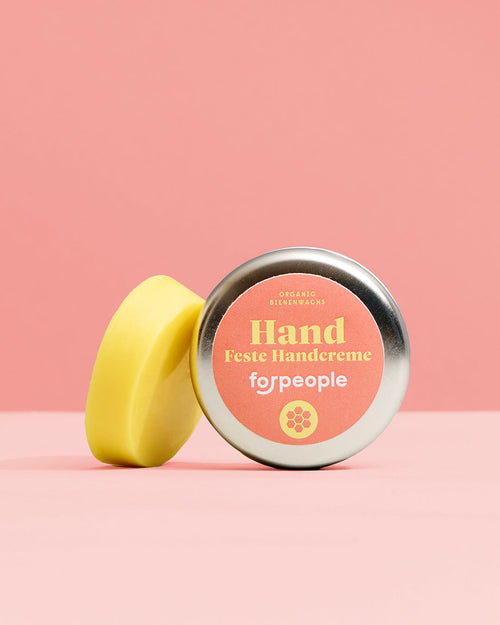
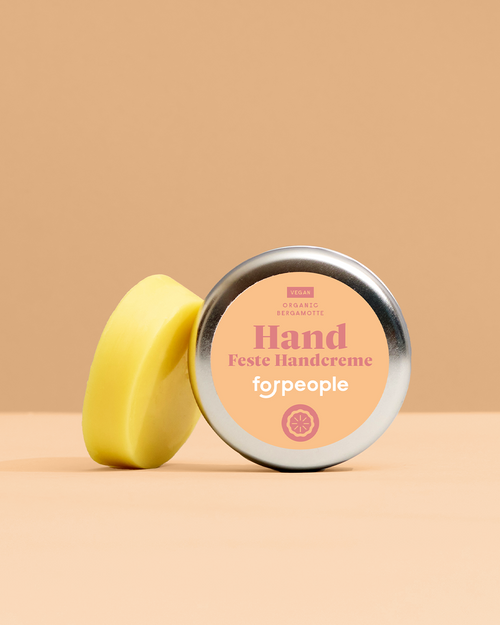
If you know you react to certain substances, read the ingredient list. According to its list, the Solid Hand Cream - Beeswax consists of beeswax, olive and sunflower oil with St. John's wort and aloe extract; it contains no water, no essential oils and no added fragrance. The vegan Solid Vegan Hand Cream - Bergamot, made from candelilla wax, jojoba, olive and hemp oil and shea butter, smells of lemon and bergamot; its list names limonene, geraniol, citral and linalool as components of the essential oils. A bee salve with larch resin and propolis is not an option for people with a resin or propolis allergy.
| Product | Base | Water | Fragrance | Typical use |
|---|---|---|---|---|
| Solid Hand Cream - Beeswax | beeswax, olive and sunflower oil | no | none according to the list | dry hands after washing and in the evening |
| Solid Vegan Hand Cream - Bergamot | candelilla wax, jojoba, olive, hemp oil, shea butter | no | essential oils of lemon and bergamot | dry hands; vegan |
| Beeswax Salve – Larch & Mandarin | oils, beeswax, larch resin, propolis | no | essential oils | individual rough patches; not with a resin or propolis allergy |
| Unperfumed ointment from the pharmacy | usually petroleum jelly or paraffin | usually no | depending on the product, none | dense film, for example overnight |
| Hand cream with urea | water, urea, oils, emulsifiers | yes | depending on the product | rough, horny skin; can sting on cracks |
| Skin protection product | depending on the hazard | depending on the product | at work preferably none | before work according to the skin protection plan |
The table describes composition and use, not a ranking. Why some creams sting on cracked skin is explained in Why does hand cream sting on cracked hands?; try a new product on a small area first: Trying a new product: how do I test it on a small area?
Where skincare ends is stated on our product pages: do not use on injured or irritated skin. A hand that is red, weeping, covered in blisters or cracked open is irritated skin. Treatment of hand eczema is decided by the dermatologist; the guideline describes a stepwise scheme for it (Gensthaler 2023). If your hands stay dry despite skincare without being inflamed, you will find the most common reasons in Dry hands despite moisturising: why, and what helps.
When to get medical advice?
See a GP or dermatologist if
- blisters form, or the skin weeps, crusts or swells,
- the skin itches, burns or hurts a lot,
- cracks are deep, bleed or do not close,
- your hands are not better after two to three weeks despite gloves and regular skincare, or the symptoms keep coming back,
- the redness spreads, the skin becomes warm or there is pus,
- the symptoms are linked to your work; then also talk to the occupational physician.
Bring the products you use to the appointment and, if you have one, your allergy card. Until then, put no cosmetics on open, weeping or inflamed areas. If your skin reacts to a product, stop using it.
Frequently asked questions
How can I tell whether my hands are just dry or have eczema?
Dry hands feel tight and flake slightly, itch little and get better within a few days with gloves and skincare. Redness, intense itching, blisters, weeping, or symptoms that stay or come back point to eczema. Only a doctor can say for sure.
When does hand eczema count as chronic?
When it lasts longer than three months or occurs at least twice within a year. That is how the German guideline defines it.
Is a hand cream enough for hand eczema?
No. Skincare keeps dry skin supple and is part of prevention, but it does not treat inflammation. According to the product information, our creams do not belong on irritated or injured skin. What goes on the skin with eczema is decided by the dermatologist.
Can a hand cream itself trigger eczema?
Yes, if you are allergic to an ingredient. Fragrances are among the common triggers of contact allergies, and resins and propolis also occur; occupational safety bodies therefore advise skin products without fragrances and preservatives. A patch test shows which substances you react to; after that, you read the ingredient lists.
Why do my hands get better on holiday?
That is a sign that your work is putting strain on your skin, for example through wet work, cleaning agents, gloves or a substance you react to. Mention it to your dermatologist and occupational physician.
Who do I turn to if my hands suffer from my work?
The occupational physician and a dermatologist. If a work-related skin disease is suspected, the practice reports it to the responsible accident insurer with a dermatologist's report.
Could it also be a fungus?
Yes. A fungal infection of the hand usually affects only one hand or is unevenly distributed and scales at the edge. Whether it is a fungus is shown by examining skin flakes at the practice.
At forpeople
Our hand creams are skincare for dry, rough hands without inflammation, for after washing, after work and before bed. They are not skin protection products, do not replace gloves and do not treat eczema.
Solid Hand Cream - Beeswax, 30 g, €9.90: beeswax, olive and sunflower oil, without essential oils.
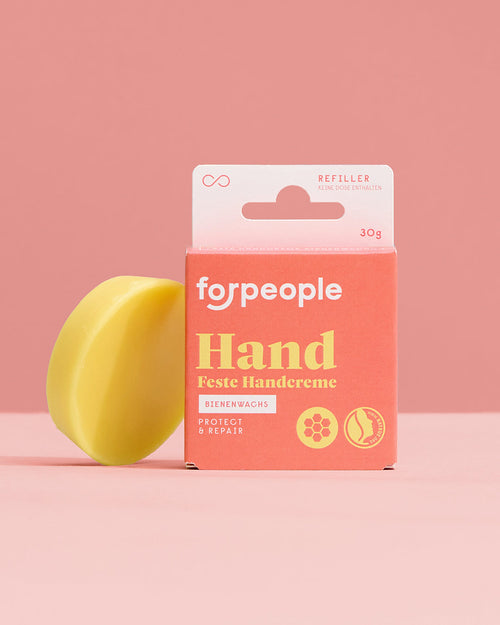
Solid Hand Cream Refill - Beeswax, 30 g, €7.90: the same cream for refilling the tin.
Solid Vegan Hand Cream - Bergamot, 30 g, €9.90: vegan, with essential oils of lemon and bergamot.
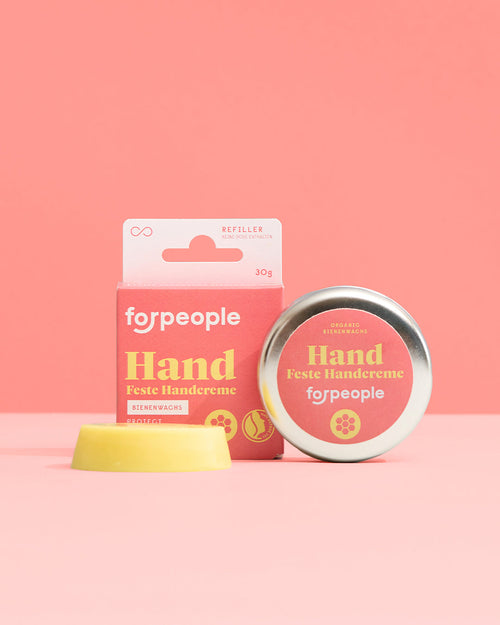
Hand Care Set – For Rough, Cracked Hands (2× Solid Hand Cream), 60 g, €16.90: one tin and one refill of the beeswax cream.
More on this: Dry hands despite moisturising · Hand sanitiser and hand cream: which comes first? · Dry, cracked hands: causes and what helps
Sources
- Bauer A, Brans R, Brehler R, Büttner M, Dickel H, Elsner P et al. (2023): S2k-Leitlinie Diagnostik, Prävention und Therapie des Handekzems. J Dtsch Dermatol Ges 21(9): 1054–1076. AWMF register no. 013-053, valid until 22.02.2028. https://doi.org/10.1111/ddg.15179_g
- Gensthaler BM (2023): Neue Leitlinie mit Stufenschema (Handekzem). Pharmazeutische Zeitung online, 04.08.2023, accessed 28.10.2026. https://www.pharmazeutische-zeitung.de/neue-leitlinie-mit-stufenschema-141494/
- Thyssen JP, Schuttelaar MLA, Alfonso JH, Andersen KE, Angelova-Fischer I, Arents BWM et al. (2022): Guidelines for diagnosis, prevention, and treatment of hand eczema. Contact Dermatitis 86(5): 357–378. https://doi.org/10.1111/cod.14035
- Quaade AS, Simonsen AB, Halling AS, Thyssen JP, Johansen JD (2021): Prevalence, incidence, and severity of hand eczema in the general population – A systematic review and meta-analysis. Contact Dermatitis 84(6): 361–374. https://doi.org/10.1111/cod.13804
- DermNet: Hand dermatitis (hand eczema). Oakley A (1997), updated by Koch K (2018), minor update by Coulson I (July 2024), accessed 28.10.2026. https://dermnetnz.org/topics/hand-dermatitis
- Sozialversicherung für Landwirtschaft, Forsten und Gartenbau (2021): Hautschutz. Broschüre B34, Reihe „Aktuelles zu Sicherheit und Gesundheitsschutz“, Stand 01/2021. https://www.svlfg.de/koerperschutz
- Ausschuss für Gefahrstoffe (2022): TRGS 401 Gefährdung durch Hautkontakt – Ermittlung, Beurteilung, Maßnahmen. Ausgabe Oktober 2022, GMBl 2022 S. 895–926 (Nr. 40), last amended GMBl 2024 S. 769 (Nr. 36); sections 2 (8)–(9), 3.3.6 and 5.5.5 (10). https://www.baua.de/DE/Angebote/Regelwerk/TRGS/TRGS-401
- Deutsche Dermatologische Gesellschaft (2026): Handekzemen vorbeugen: Aktualisierte S2k-Leitlinie zu „Beruflichen Hautmitteln“. Press release of 12.01.2026 (AWMF register no. 013-056), Informationsdienst Wissenschaft. https://idw-online.de/de/news864176
- Berufskrankheiten-Verordnung (BKV), Anlage 1 (BGBl. I 1997, S. 2625–2626, as amended), no. 5101. gesetze-im-internet.de, accessed 28.10.2026. https://www.gesetze-im-internet.de/bkv/anlage_1.html
- Agner T, Elsner P (2020): Hand eczema: epidemiology, prognosis and prevention. J Eur Acad Dermatol Venereol 34 Suppl 1: 4–12. https://doi.org/10.1111/jdv.16061