An early shift on a medical ward or a morning with a home care service: hand disinfection before and after every contact, gloves on and off, personal care at the washbasin, wiping surfaces, handwashing after using the toilet in between. By evening the skin over your knuckles feels tight and your fingertips are rough. What helps is less in the cream tin than in the skin protection plan. How disinfection and hand cream fit together in time is explained in Hand sanitiser and hand cream: which comes first?; this page is about the whole working day.
Why nurses' hands have to take so much
TRGS 401 speaks of wet work when employees regularly have skin contact with water or watery liquids for more than two hours a day, when they change liquid-tight gloves more than ten times in the process, when they wash their hands at least fifteen times a day, or when they wear gloves and wash their hands more than five times a day. Alcohol-based hand sanitisers count as watery liquids here. The rule explicitly names healthcare and nursing as an example: gloves alternating with hand disinfection or handwashing (AGS 2022). From wet work of regularly more than two hours a day, the employer must offer an occupational health check-up; from four hours it is mandatory (AGS 2022).
This has consequences. In an analysis of 15 studies on occupational groups, nurses developed 16.9 new cases of hand eczema per 100 person-years, office workers 4.9 (Jamil et al. 2022). Of 721 Dutch nursing students, 23 per cent had hand eczema in the first year of follow-up and 31 per cent in the third. Frequent handwashing during placements and at home, as well as a side job with wet work, increased the risk (Visser et al. 2014). In a Swedish survey of almost 2,000 employees in municipal care and support services, the one-year share was 34.7 per cent; the more contact with soap and water, the more frequent it was (Sukakul et al. 2025). What distinguishes hand eczema from dry skin is explained in Dry hands or hand eczema?
| Strain at work | What it does to the skin | What occupational safety and hygiene rules provide |
|---|---|---|
| Handwashing | water and washing lotion dissolve skin fats and rinse them away | only when hands are dirty and after using the toilet; otherwise hand disinfection; do not wash and then disinfect straight away |
| Hand disinfection | hardly changes the skin barrier, even on skin that is already irritated | on dry hands; considered less stressful for the skin than washing |
| Disposable gloves | sweat builds up, the outer layer of skin swells | as briefly as necessary; latex only powder-free; cotton liners for long wear |
| Washing and applying cream to patients | water, washing additives and other people's skincare products on your own skin | wear liquid-tight gloves |
| Surface and instrument disinfection | high concentration of irritating substances | chemical protective gloves according to the safety data sheet |
| Rings, watches, artificial nails | moisture and residues act longer underneath; gloves tear more easily | not permitted where hand disinfection is required |
Sources for the table: AGS 2022, KRINKO 2016, DGUV 2026, DDG 2026.
Skin protection plan: what the employer provides and regulates
In healthcare, skin protection is not a private matter. The employer must check whether the wet-work load can be reduced, provide suitable skin protection and skincare products, draw up a skin protection plan and instruct everyone in correct use. At the first signs of skin damage, the occupational health service or a dermatologist should be consulted without delay (KRINKO 2016).
A skin protection plan assigns three kinds of products to three points in time. Skin protection products go on clean, dry skin before the work that stresses it, that is, at the start of the shift and after breaks. Skin cleansing should put as little strain on the skin as possible, without brushes or scrubbing particles. Skincare products after work support the skin's recovery; before work they must not replace skin protection, because some ingredients, such as urea, can help other substances penetrate the skin (AGS 2022). The German Commission for Hospital Hygiene (KRINKO) recommends skincare products at the end of the shift and additionally during work when needed (KRINKO 2016); the statutory accident insurance names longer breaks and the end of work (DGUV 2026).
Two requirements concern the choice of product. Because of the risk of developing an allergy, skin protection and skincare products without added fragrance or preservatives should be preferred. And at work they should come from dispensers or tubes; ointment should not be taken from small pots because of possible contamination (KRINKO 2016). The accident insurance puts it even more clearly: open containers such as jars do not meet hygiene requirements (DGUV 2026). In the sense of these rules, a solid hand cream in a tin is a pot. It has no place in the patient area.
Gloves: as long as necessary, as short as possible
Medical disposable gloves protect patients and nurses, but they put a strain on the skin themselves. Sweat builds up under the glove and the outer layer of skin swells. One measurement shows how quickly healthy skin recovers: in 20 healthy volunteers, the outer layer of skin was measurably over-hydrated 30 minutes after four hours of wearing gloves, but back to baseline three hours later. After seven days with four hours of gloves daily, the researchers found no lasting damage to the skin barrier (Wetzky et al. 2009). However, the study says nothing about skin that is already irritated and nothing about shifts with many glove changes and disinfections in between.
Occupational safety rules therefore set limits. Wearing liquid-tight gloves without a change for more than four hours a day is considered a strain. If gloves become damp inside, change them; liners made of absorbent material take up the sweat. Latex gloves must be powder-free. After taking gloves off, hands should only be dried and not washed or disinfected straight away, because the skin is more vulnerable after the build-up of heat and moisture (AGS 2022). KRINKO considers textile cotton liners that are reprocessed in disinfecting laundry processes useful for longer wear; they are changed together with the protective glove (KRINKO 2016).
A skincare cream does not belong directly under the glove: fats can attack some glove materials and make your grip less secure (Hand cream under latex or nitrile gloves?). A new point comes from the updated guideline on occupational skin products: when washing patients and when applying skincare products to their skin, nurses should wear liquid-tight gloves. This reduces contact with substances that can trigger an allergy, and the number of handwashes (DDG 2026).
A working day for your hands
- At home before your shift: arrive with clean, dry hands; clean very dirty hands and nails at home. Nails short and level with the fingertips, without nail polish; take off rings, bracelets and watches (KRINKO 2016).
- Start of the shift: skin protection product from the dispenser according to the skin protection plan, let it absorb completely.
- During the shift: hand disinfection instead of washing; wash only when hands are visibly dirty and after using the toilet, then dry thoroughly. Gloves only on dry hands; personal care of patients with gloves.
- Small injury: cover a skin injury on your hand with a liquid-tight plaster and put a disposable glove on over it; if the area does not tolerate disinfection afterwards, the facility arranges work away from patients (KRINKO 2016).
- Break and end of shift: skincare product from a dispenser or tube according to the plan, on clean, dry skin.
- At home and before bed: this is the place for your own, richer skincare. KRINKO recommends paying attention to skin protection and care in your free time too (KRINKO 2016); that includes not washing more often than necessary at home and wearing gloves when washing up and cleaning (Rough hands from washing up and cleaning: what helps?).
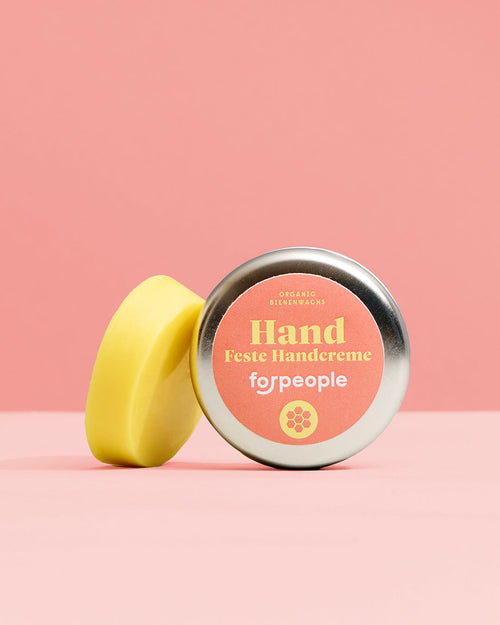
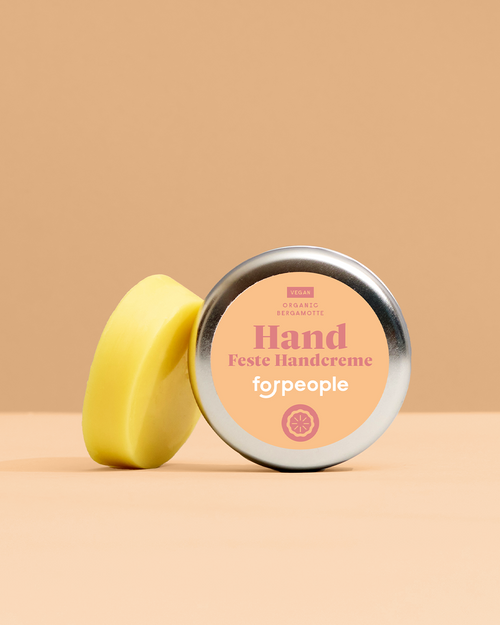
For the evening at home, a water-free cream that leaves a film of wax and oil on the skin works well; how this slows evaporation is explained in Occlusion and TEWL: how a wax film protects your skin. According to its ingredient list, the Solid Hand Cream - Beeswax consists of beeswax, olive and sunflower oil with St. John's wort and aloe extract. It contains neither added fragrance nor preservatives, but it comes in a tin and is therefore meant for home, not for the ward or patient rooms. The vegan Solid Vegan Hand Cream - Bergamot contains essential oils of lemon and bergamot; if you are supposed to use fragrance-free products at work or already react to fragrances, choose the variant without essential oils. Thicker layers overnight are described in Overnight hand mask: what it does and how to do it.
| Product | When | Where | Container | Fragrance |
|---|---|---|---|---|
| Skin protection product according to the skin protection plan | start of shift, after breaks | ward, provided by the employer | dispenser or tube | preferably none |
| Skincare lotion according to the skin protection plan | break, end of shift | ward, provided by the employer | dispenser or tube | preferably none |
| Solid Hand Cream - Beeswax | after the shift, in the evening | at home | tin | no added fragrance |
| Solid Vegan Hand Cream - Bergamot | after the shift, in the evening | at home | tin | essential oils |
| Unperfumed ointment from the pharmacy | overnight | at home | tube or jar | depending on the product, none |
The table describes when and where each product is intended, not a ranking. How to handle a tin hygienically is explained in Hygiene and Water-Free Cosmetics: What to Watch. For hairdressing, which has its own rule, see Hand care for hairdressers: what goes on your skin, and when?
When to get medical or occupational health advice?
If your hands stay red despite the skin protection plan, if they flake, itch or burn, crack or form blisters, go to the occupational health service or a dermatologist, and do so early (KRINKO 2016). If every disinfection stings, that belongs in this conversation too (Why does hand cream sting on cracked hands?). Severe or recurring hand eczema caused by work can be recognised as occupational disease no. 5101 (BKV Annex 1); the dermatologist reports the suspicion to the accident insurer.
For many employees in nursing and healthcare, the responsible body is the Berufsgenossenschaft für Gesundheitsdienst und Wohlfahrtspflege (BGW), for others an Unfallkasse; your HR department knows which. The BGW offers a skin consultation, arranged through its district office: a dermatologist examines the skin, and a specialist discusses the link with your work and suitable protection and skincare measures. You should bring the protective and skincare creams you use and your allergy card, if you have one; there are no additional costs (BGW 2026).
Frequently asked questions
Can I use my own hand cream at work?
At work, the facility's skin protection plan applies. Skincare products there should come from dispensers or tubes, not from pots, jars or tins. Your own cream in a tin is for the time after your shift and for home.
Why should I not wash my hands straight after taking off gloves?
After the glove, the outer layer of skin is swollen and more vulnerable. TRGS 401 therefore advises only drying your hands at that point. Whatever the hygiene plan requires afterwards, such as hand disinfection, takes priority.
Is hand disinfection worse for the skin than handwashing?
No. The occupational safety rule rates hand disinfection as less stressful for the skin than washing. It still stings on cracks; that is one reason to see the occupational physician early.
Can I wear my wedding ring?
Not where hand disinfection is required. KRINKO does not allow rings, bracelets, watches or piercings on the hands and forearms, also because of the risk of injury and because they can damage gloves.
Which gloves are suitable if my hands are already irritated?
The skin protection plan decides that, together with the occupational physician if you have symptoms. Latex only powder-free; with a known latex allergy, other materials. For longer wear, cotton liners that are changed together with the glove help.
I am still in training. Does all this apply to me already?
Yes. In a study of nursing students, almost a quarter already had hand eczema in the first year. Skin protection plan, instruction and occupational health check-ups also apply during training.
Who pays for skin protection and skincare products?
For work, the employer provides suitable skin protection and skincare products. What you use at home is your choice.
At forpeople
Our solid hand creams are skincare for after your shift and for home. They are not skin protection products, do not replace gloves and, because of the tin, do not belong in the patient area. According to the product information, they are not used on injured or irritated skin.
Solid Hand Cream - Beeswax, 30 g, €9.90: beeswax, olive and sunflower oil, no added fragrance.
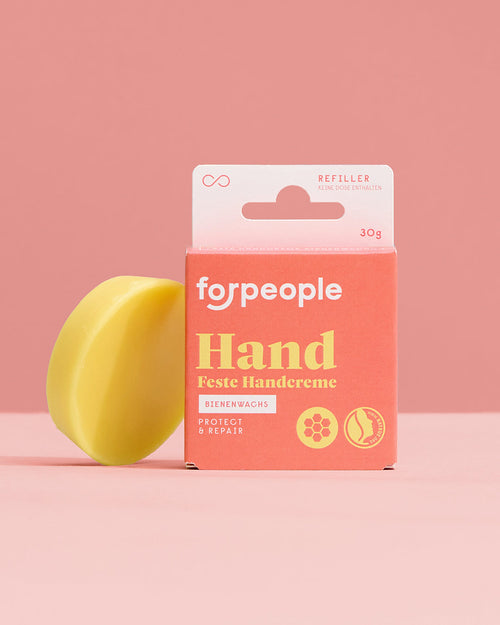
Solid Hand Cream Refill - Beeswax, 30 g, €7.90: for refilling the tin.
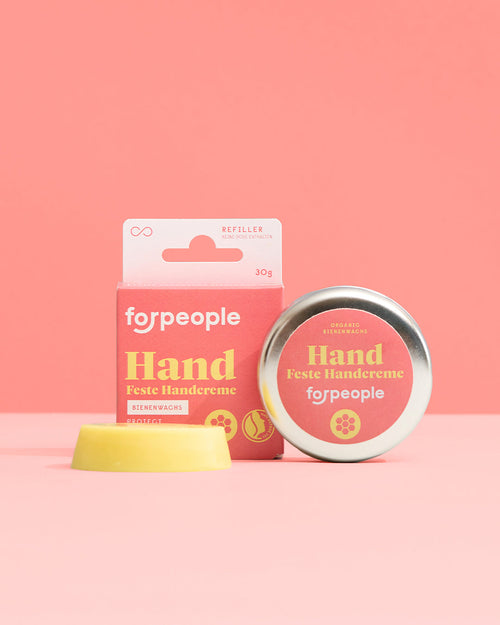
Hand Care Set – For Rough, Cracked Hands (2× Solid Hand Cream), 60 g, €16.90: one tin and one refill.
Solid Vegan Hand Cream - Bergamot, 30 g, €9.90: vegan, with essential oils of lemon and bergamot.
More on this: Hand sanitiser and hand cream: which comes first? · Dry, cracked hands: causes and what helps · Hand care in farming and the barn
Sources
- Ausschuss für Gefahrstoffe (2022): TRGS 401 Gefährdung durch Hautkontakt – Ermittlung, Beurteilung, Maßnahmen. Ausgabe Oktober 2022, GMBl 2022 S. 895–926 (Nr. 40), last amended GMBl 2024 S. 769 (Nr. 36); sections 2, 3.3.6, 5.5.1, 5.5.3, 5.5.5, 5.6, 7 and Annex 1. https://www.baua.de/DE/Angebote/Regelwerk/TRGS/TRGS-401
- Kommission für Krankenhaushygiene und Infektionsprävention (KRINKO) beim Robert Koch-Institut (2016): Händehygiene in Einrichtungen des Gesundheitswesens. Bundesgesundheitsbl 59(9): 1189–1220; sections 3.3, 6.1, 9 and 11. https://doi.org/10.1007/s00103-016-2416-6
- Deutsche Gesetzliche Unfallversicherung (2026): DGUV Information 212-017 Auswahl, Bereitstellung und Benutzung von beruflichen Hautmitteln. Ausgabe August 2026; sections 5.3, 5.4 and 5.5. https://publikationen.dguv.de/regelwerk/dguv-informationen/853/auswahl-bereitstellung-und-benutzung-von-beruflichen-hautmitteln
- Deutsche Dermatologische Gesellschaft (2026): Handekzemen vorbeugen: Aktualisierte S2k-Leitlinie zu „Beruflichen Hautmitteln“. Press release of 12.01.2026 (AWMF register no. 013-056), Informationsdienst Wissenschaft. https://idw-online.de/de/news864176
- Jamil W, Svensson Å, Josefson A, Lindberg M, von Kobyletzki L (2022): Incidence Rate of Hand Eczema in Different Occupations: A Systematic Review and Meta-analysis. Acta Derm Venereol 102: adv00681. https://doi.org/10.2340/actadv.v102.360
- Visser MJ, Verberk MM, van Dijk FJ, Bakker JG, Bos JD, Kezic S (2014): Wet work and hand eczema in apprentice nurses; part I of a prospective cohort study. Contact Dermatitis 70(1): 44–55. https://doi.org/10.1111/cod.12131
- Sukakul T, Hamnerius N, Lejding T, Davidson Källberg K, Josefson A, Detlofssen E et al. (2025): Hand Eczema and Facial Skin Problems – Association with Occupational Exposures among Community Care Personnel in Sweden: A Cross-sectional Study. Acta Derm Venereol 105: adv43771. https://doi.org/10.2340/actadv.v105.43771
- Wetzky U, Bock M, Wulfhorst B, John SM (2009): Short- and long-term effects of single and repetitive glove occlusion on the epidermal barrier. Arch Dermatol Res 301(8): 595–602. https://doi.org/10.1007/s00403-009-0980-4
- Berufsgenossenschaft für Gesundheitsdienst und Wohlfahrtspflege (BGW) (2026): Hautsprechstunde. Website, accessed 28.10.2026. https://www.bgw-online.de/bgw-online-de/service/schulung-beratung/hautsprechstunde-19010
- Berufskrankheiten-Verordnung (BKV), Anlage 1 (BGBl. I 1997, S. 2625–2626, as amended), no. 5101. gesetze-im-internet.de, accessed 28.10.2026. https://www.gesetze-im-internet.de/bkv/anlage_1.html