











What occupational safety and hygiene guidelines say
This question is old and well documented. As early as 1993, the US Occupational Safety and Health Administration (OSHA) stated in writing that some petroleum-based creams can affect the integrity of gloves. Anyone wearing latex gloves should therefore not use petroleum-based or mineral-oil-based skin care (OSHA 1993). The hand hygiene guideline of the US Centers for Disease Control and Prevention (CDC) for health-care settings advises asking about possible harmful effects of oil-containing products on rubber gloves when choosing hand-care products (Boyce & Pittet 2002).
In Germany, the Technical Rule for Hazardous Substances TRGS 401 governs skin protection at work. It separates three kinds of products: skin protection before work, skin cleansing, and skin care afterwards (AGS 2022).
| Source | What it says about cream and gloves |
|---|---|
| OSHA, standard interpretation of 24 August 1993 | With latex gloves, no petroleum-based or mineral-oil-based skin care; some petroleum-based creams can weaken gloves. |
| CDC hand hygiene guideline 2002 | When choosing products, ask about possible harmful effects of oil-containing products on rubber gloves. |
| TRGS 401, section 5.5.5 (6) | Skin protection products under gloves are generally not necessary. If they are used, they must have absorbed completely. Greasy products in particular can reduce the protection of chemical protective gloves. |
| TRGS 401, section 5.5.5 (10) | Skin care products after the end of the task; do not use them as skin protection before work that stresses the skin. |
In short: skin care comes after work, not under the glove. That applies whether the cream is made of mineral oil, plant oils or waxes. Plant oils and waxes are fats too, and TRGS 401 speaks of "greasy" products in general.
Why fat and rubber don't go well together
Disposable gloves are usually made of natural rubber (latex), nitrile rubber or vinyl. Natural rubber is a non-polar material. Non-polar substances such as oils and fats can penetrate this kind of material and make it swell. The glove then becomes softer, stretches more easily and can tear sooner. With very thin disposable gloves, a small amount is enough for that.
Nitrile rubber behaves differently. It is considered much more resistant to oils; gloves for protection against mineral oils are therefore developed from nitrile variants and tested for their breakthrough time (Krzemińska et al. 2016). That does not mean every nitrile glove tolerates every cream. Gloves differ in thickness, composition and testing. What counts is the information from the manufacturer of your glove and, at work, the hand and skin protection plan.
A second point is hygiene. In health care, a glove should not only hold up but also protect against germs. A cream still sitting on the skin can also change how hand disinfectants work; the CDC guideline mentions this point for product selection as well (Boyce & Pittet 2002). In hospitals and practices, the facility's hygiene plan always applies.
What happens to your skin under the glove
A tight glove does not let water vapour escape. The skin sweats, and the outermost horny layer swells. In a study with 20 healthy volunteers, the horny layer was clearly over-hydrated 30 minutes after wearing gloves for four hours; three hours later the readings were back to normal. After one week of wearing gloves for four hours a day, the researchers found no clear long-term effect (Wetzky et al. 2009).
In practice, this means your skin does not need an extra film under the glove. It would tend to increase the build-up of heat and moisture. What matters more is what happens before and after:
- Before putting gloves on: dry your hands completely, including between your fingers. Take off rings.
- While wearing them: wear gloves only as long as necessary. If the glove gets damp inside, change it. For long tasks, sweat-absorbing liner gloves can help (AGS 2022).
- After taking them off: if possible, just dry your hands rather than washing them straight away. The softened skin is more sensitive to water and cleansers at that point (AGS 2022).
Why hands dry out faster than other skin in the first place is explained on Why hands dry out faster. What frequent washing and disinfecting do to your skin is covered in Cracked hands from washing.
The right time for skin care
Most questions resolve themselves once you separate skin care and gloves in time. A rough guide:
| Situation | What fits |
|---|---|
| Start of shift, latex gloves straight afterwards | No greasy skin care. If needed, a skin protection product specified at your workplace, fully absorbed. |
| Short break, gloves back on afterwards | Let your hands dry. There is usually not enough time for a care cream to absorb fully. |
| Longer break without gloves | A small amount of care on clean, dry skin; nothing should be left on the skin before the next pair of gloves. |
| After your shift | This is the time for rich care. Your skin can recover until the next day. |
| Evening and overnight | A slightly thicker layer. Cotton gloves on top stop the bedding from soaking much of it up. |
After your shift, a film of waxes and oils slows down the evaporation of water from the skin. How this works is explained on Occlusion and transepidermal water loss. How to spread a solid cream evenly and sparingly is described in How to apply a solid cream. If your hands feel too greasy afterwards, it was usually too much; more on that in Greasy or cared for?.
Work with leather or fabric work gloves or gardening gloves raises different points. You will find them on Hand care for manual work and gardening.
When to get medical advice
If the skin on your hands stays red, flaky, cracked or forms blisters despite care after your shift, have it checked by a doctor. If this is linked to your job, your occupational physician is the right contact. The same applies if you suspect a reaction to the glove material itself, for example latex. Do not apply cream to open or weeping areas.
Frequently asked questions
Can I use hand cream before nitrile gloves?
Nitrile is considered more resistant to oils than latex. Whether a particular cream is fine under a particular glove can only be answered by the glove manufacturer or your workplace's skin protection plan. If in doubt, apply your cream at the end of your shift.
Does the warning only apply to petroleum jelly and mineral oil?
OSHA explicitly names petroleum-based and mineral-oil-based products. TRGS 401 speaks more generally of greasy products. Creams made of plant oils, butters and waxes are greasy too. So they also do not belong directly under protective gloves. How petroleum jelly and beeswax salve differ is explained on Petroleum jelly or beeswax salve.
What is the difference between a skin protection product and a skin care product?
Skin protection products are applied before work and are sold for specific kinds of stress on the skin. Care products go on cleansed skin after work. TRGS 401 states explicitly that care products should not be used as protection before work.
Can I just use a little less cream and then put gloves on?
As long as you can still feel a film on your skin, this is not advisable. There is often not enough time before the next pair of gloves for a rich cream to absorb. It is better to plan your skin care for times when you won't be wearing gloves for a while.
Why are my hands so soft and wrinkly after wearing gloves?
That is the swollen horny layer from sweat and trapped heat. It usually returns to normal within a few hours. Just dry your hands instead of washing them straight away.
At forpeople
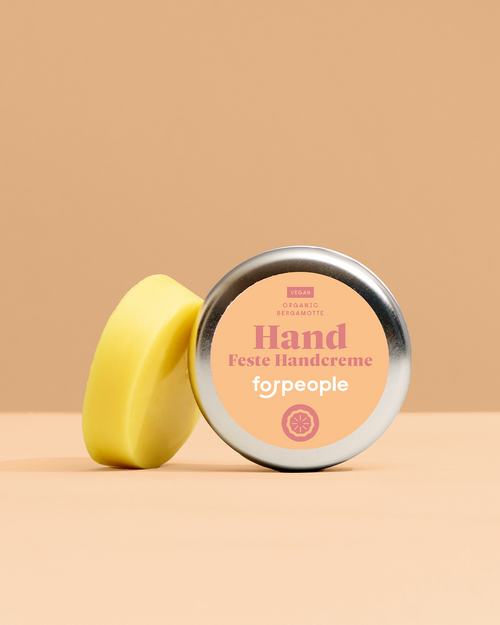
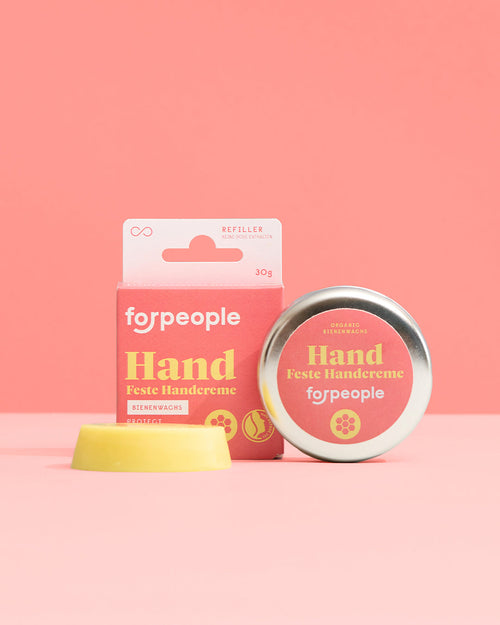
Our solid hand creams are care products for after work. They are not skin protection products, and we have not tested them for compatibility with glove materials. So do not apply them directly before putting on protective gloves. The Solid Hand Cream - Beeswax (30 g, €9.90) is made, according to its ingredient list, of beeswax, olive and sunflower oil, St. John's wort and aloe extract, with no added fragrance and no water. The vegan Solid Vegan Hand Cream - Bergamot (30 g, €9.90) contains candelilla wax, jojoba oil, olive oil, shea butter and hemp oil, plus lemon and bergamot oil for scent. For your locker and your bag there is the Hand Care Set – For Rough, Cracked Hands (2× Solid Hand Cream) (€16.90). You refill the metal tin with the Solid Hand Cream Refill - Beeswax (€7.90), or the vegan version with the Solid Vegan Hand Cream Refill - Bergamot (€7.90). If you notice a skin reaction, stop using the product. More on this: Refilling with a refill · How long does a care film last? · Chafing when running and cycling · Cold cream: water-free and frost
Sources
- Occupational Safety and Health Administration (1993): Mineral oil and/or petrolatum containing skin care products and latex gloves. Standard Interpretation, 24 August 1993. https://www.osha.gov/laws-regs/standardinterpretations/1993-08-24
- Boyce JM, Pittet D (2002): Guideline for Hand Hygiene in Health-Care Settings. Recommendations of the Healthcare Infection Control Practices Advisory Committee and the HICPAC/SHEA/APIC/IDSA Hand Hygiene Task Force. MMWR Recommendations and Reports 51(RR-16): 1–45. PMID 12418624. https://www.cdc.gov/mmwr/preview/mmwrhtml/rr5116a1.htm
- Ausschuss für Gefahrstoffe (2022): TRGS 401 Gefährdung durch Hautkontakt – Ermittlung, Beurteilung, Maßnahmen. Ausgabe Oktober 2022, GMBl 2022 S. 895–926 (Nr. 40), zuletzt geändert GMBl 2024 S. 769 (Nr. 36). https://www.baua.de/DE/Angebote/Regelwerk/TRGS/TRGS-401
- Wetzky U, Bock M, Wulfhorst B, John SM (2009): Short- and long-term effects of single and repetitive glove occlusion on the epidermal barrier. Archives of Dermatological Research 301(8): 595–602. https://doi.org/10.1007/s00403-009-0980-4
- Krzemińska S, Rzymski WM, Malesa M, Borkowska U, Oleksy M (2016): Gloves against mineral oils and mechanical hazards: composites of carboxylated acrylonitrile-butadiene rubber latex. International Journal of Occupational Safety and Ergonomics 22(3): 350–359. https://doi.org/10.1080/10803548.2015.1136111