










What puts strain on your hands in the workshop and garden
Hands that work outdoors or in a workshop deal with a lot at once: soil, dust and shavings, wet plants, cold and wind, friction from tool handles, plus cleaning agents, oils, paints or solvents. Each of these can dry out or roughen the outermost layer of the skin.
Wetness plays a special role. The German Technical Rule for Hazardous Substances TRGS 401 speaks of wet work when employees have skin contact with water or aqueous liquids for a considerable part of their working time, wash their hands frequently, or alternate either of these with wearing liquid-tight gloves (AGS 2022). For risk assessment, the rule names specific thresholds:
| Activity according to TRGS 401, section 3.3.6 | Threshold per working day |
|---|---|
| Skin contact with water or aqueous liquids | regularly more than two hours |
| Wet work frequently alternating with liquid-tight gloves | more than 10 changes |
| Washing hands | at least 15 times |
| Liquid-tight gloves frequently alternating with hand washing | more than 5 times |
Under the current version, wearing liquid-tight gloves on its own does not count as wet work. The rule is aimed at employers. For your own garden, the thresholds are still a useful guide: if you spend a day watering beds, scrubbing pots and washing your hands ten times, your skin is under similar strain.
Gloves: which ones for what
Gloves are the first level of protection. TRGS 401 distinguishes between liquid-tight and non-liquid-tight gloves. Liquid-tight gloves are chemical protective gloves to DIN EN ISO 374-1, medical gloves to DIN EN 455-1 and fabric gloves with a full coating, for example of nitrile rubber. Leather gloves and fabric gloves with no coating or only a partial coating do not count (AGS 2022).
- Rough, dry work (wood, stones, thorns, tools): leather or work gloves against friction and small injuries.
- Wet soil, plant debris, water: fully coated garden gloves so your skin doesn't stay wet for hours.
- Paints, varnishes, solvents, cleaners: gloves suitable for the substance. You'll find guidance in the safety data sheet or on the packaging.
Skin sweats under tight gloves. A study with 20 healthy volunteers found a swollen horny layer after four hours of wearing gloves, which had returned to normal three hours later; after seven days of four hours a day, there was no clear long-term effect (Wetzky et al. 2009). In practice: take your gloves off now and then, let your hands dry, and for long sessions use thin cotton under-gloves. Take off rings beforehand – moisture and dirt stay on the skin underneath them for a particularly long time.
Three products, three moments
TRGS 401 groups skin protection, skin cleansing and skin care products under the term “skin products” and assigns each a fixed moment (AGS 2022). The German Social Accident Insurance explains selection and use in detail in DGUV Information 212-017, whose 2026 edition also covers sunscreens for outdoor work (DGUV 2026).
| Product | When | What for |
|---|---|---|
| Skin protection product | before work that strains the skin, after breaks, on clean and dry skin | can protect against skin irritation; replaces gloves only where gloves may not be worn |
| Skin cleanser | as needed and at the end of work | removes dirt and work materials; as gently as possible |
| Skin care product | during breaks and after work, after cleansing | cares for the cleansed skin and helps keep it from drying out |
Two points from the rule matter in everyday life. First: skin protection products may only replace gloves where gloves are not permitted, for example on machines with a risk of being drawn in. Second: care products should not be used as protection before work, because some ingredients – urea is named – can make it easier for other substances to enter the skin. Research also questions how useful barrier creams are; one review points out that barrier creams used the wrong way may do more harm than good (Zhai & Maibach 2002). More on urea and fat-based care on the page Urea or water-free cream.
Get the dirt off – gently
Cleansing should match how dirty your hands are. TRGS 401 recommends cleansers without scrubbing particles and without organic solvents. Hand cleansers with scrubbing particles are meant for stubborn dirt, should be used as rarely as possible, for example only at the end of the working day, and brushes are best avoided. After wearing liquid-tight gloves, hands should only be dried, not washed (AGS 2022).
- Knock or brush off coarse dirt while it is still dry.
- Wash with lukewarm rather than hot water.
- Use as little cleanser as necessary; scrubbing particles only for resin, oil or paint.
- Rinse thoroughly and dry your hands completely, including between the fingers.
- Then apply care to the dry skin.
Why frequent washing dries out the skin is explained on the pages Cracked hands from washing and Why hands dry out faster. At home, a mild solid soap such as the Aloe Vera Soap – Rosemary & Lemon (75 g, €8.90) can be enough; according to its ingredient list it contains essential oils and water.
Care after work – and don't forget the sun outdoors
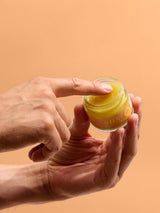
After work, the goal is to give the cleansed skin back some lipids and slow down evaporation. Water-free care made of waxes, butters and oils forms a thin film on the skin for this; how that film reduces evaporation is explained on the page Occlusion and transepidermal water loss. A pea-sized amount is usually enough; how to spread a solid cream evenly is covered in How to apply a solid cream. In the cold season, cold adds to the strain; then it's worth reapplying during breaks as well.
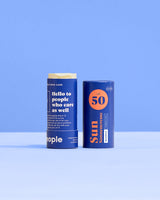
In the garden, people often forget that the backs of their hands, forearms and neck are in the sun for hours. The DGUV has therefore added sunscreens to its information on occupational skin products (DGUV 2026). Clothing, a hat and shade come first; exposed skin gets sunscreen, for example the mineral Solid Sunscreen SPF50 (40 g, €17.90). If you want sun protection and outdoor care together, you'll find both in the Outdoor Set – Sun Protection & SOS Care for Stressed Skin (€79.90).
When to seek medical advice: If redness, flaking, cracks or small blisters don't settle within a few days despite gloves and care, have your skin looked at by a doctor. If the strain is related to your job, your company doctor is the right person to talk to; they can also advise on choosing gloves and skin protection products. Don't put cream on open areas – keep them clean and covered.
Frequently asked questions
Does a barrier cream replace gloves for gardening?
No. Under TRGS 401, barrier creams only replace gloves where gloves may not be worn, for example on machines with a risk of being drawn in. In the garden, gloves are almost always possible and the better choice.
Should I put on my usual hand cream before work?
The workplace rule deliberately separates the two: care products go on clean skin after work, not before. For the time before work there are dedicated skin protection products, which should be chosen together with the company doctor if it's for your job.
Why shouldn't I wash my hands after wearing rubber gloves?
Because the skin has already become damp under tight gloves. Extra washing with water and cleanser dries it out further. TRGS 401 therefore recommends only drying your hands if they aren't dirty.
What helps with resin, oil or paint on my hands?
A hand cleanser with scrubbing particles, but only for these cases and ideally at the end of the day. Solvents such as thinners don't belong on your skin. Better still, avoid this kind of dirt in the first place with suitable gloves.
What care suits a long day in the garden?
Rich care that goes on cleansed, dry skin and slows down evaporation. Whether you prefer a solid cream or a tube is mainly a question of how you use it – see Solid cream or tube.
At forpeople
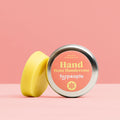
Our solid hand creams are care products for after work – not skin protection products in the sense of TRGS 401 and not a replacement for gloves. According to its ingredient list, the Solid Hand Cream - Beeswax (30 g, €9.90) consists of beeswax, olive and sunflower oil, St. John's wort and aloe extract, with no added fragrance and no water. The vegan Solid Vegan Hand Cream - Bergamot (30 g, €9.90) contains candelilla wax, jojoba oil, olive oil, shea butter and hemp seed oil, with lemon and bergamot oil as fragrance. Both come in a metal tin that you can refill with the Solid Hand Cream Refill - Beeswax or the Solid Vegan Hand Cream Refill - Bergamot (€7.90 each). If you notice a skin reaction, stop using the product. Read more: Refilling with a refill · Calluses on your fingertips from climbing · Cream before or after climbing? · Greasy or cared for? How skin feels
Sources
- Ausschuss für Gefahrstoffe (2022): TRGS 401 Gefährdung durch Hautkontakt – Ermittlung, Beurteilung, Maßnahmen. Ausgabe Oktober 2022, GMBl 2022 S. 895–926 (Nr. 40), zuletzt geändert GMBl 2024 S. 769 (Nr. 36). https://www.baua.de/DE/Angebote/Regelwerk/TRGS/TRGS-401
- Deutsche Gesetzliche Unfallversicherung (2026): DGUV Information 212-017 Auswahl, Bereitstellung und Benutzung von beruflichen Hautmitteln. Ausgabe August 2026. https://publikationen.dguv.de/regelwerk/dguv-informationen/853/auswahl-bereitstellung-und-benutzung-von-beruflichen-hautmitteln
- Wetzky U, Bock M, Wulfhorst B, John SM (2009): Short- and long-term effects of single and repetitive glove occlusion on the epidermal barrier. Archives of Dermatological Research 301(8): 595–602. https://doi.org/10.1007/s00403-009-0980-4
- Zhai H, Maibach HI (2002): Barrier creams – skin protectants: can you protect skin? Journal of Cosmetic Dermatology 1(1): 20–23. PMID 17134447. https://pubmed.ncbi.nlm.nih.gov/17134447/