







Why hands in particular get forgotten
Three things come together. First, position: like the face and neck, the hands are among the body parts that are least often covered all year round. Second, technique: when you apply sunscreen with your hands, you spread it with your palms; the backs of your hands only get whatever happens to be left over. Third, everyday life: hands are washed, dried and wiped on trousers. The German Federal Office for Radiation Protection (BfS) points out that washing or rubbing off reduces the amount of sunscreen on the skin and thus lowers the sun protection factor; it recommends reapplying at least every two hours and especially after bathing and drying off (BfS, UV-Schutz durch Sonnencreme).
How little cream people usually apply is described in the European Commission's recommendation on sunscreen products: the stated sun protection factor applies to 2 mg of product per square centimetre of skin; if only half that amount is applied, the protection can drop by two thirds (Recommendation 2006/647/EC). On the backs of the hands, where people tend to spread thinly, it is especially easy to fall short.
Car, bike, garden: where hands catch the sun
| Situation | What UV gets through | What helps |
|---|---|---|
| Driving, windows closed | UVB is blocked by all windows; depending on the glass, UVA passes through the side windows | on long sunny drives, apply sunscreen to the backs of your hands, use the sun visor |
| Driving, windows open or convertible | a large share of the ambient radiation | apply sunscreen as you would outdoors |
| Bicycle, motorbike | full sun on the backs of your hands, often for hours | gloves or sunscreen; with fingerless gloves, do not forget your fingers |
| Garden, manual work | sun plus frequent hand washing | gloves, reapply after washing |
| Water, snow, mountains | additional reflection, higher radiation | very high protection, reapply often |
On cars in detail: the BfS writes that all windows in a car block UVB and the windscreen also protects against UVA, while UVA can pass through the side windows to a greater or lesser extent (BfS, UV-Schutz im Auto?). In a measurement of 29 cars, the windscreen blocked on average 96% of UVA radiation and the side window only 71%, with a range of 44 to 96% (Boxer Wachler 2016). In a study from Tübingen, the arms of test dummies received 3 to 4% of the ambient radiation with the windows closed, 25 to 31% with the windows open and 62% in an open convertible (Moehrle et al. 2003). If you drive a lot for work, you have a reason to protect the backs of your hands, above all with the window open and through the side window.
There is a separate page for snow and mountains: Sun protection in the mountains and on snow.
How to apply sunscreen to the backs of your hands
- In good time: the BfS recommends applying sunscreen 20 to 30 minutes before going out in the sun (BfS).
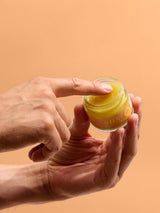
- Deliberately: put the cream on the back of one hand and rub the backs of your hands together. Then fingers, the spaces between them, knuckles and wrists.
- Enough: better a little too much than too little. Why the amount matters so much is explained in SPF, UVA protection and water resistance.
- Reapply: after every hand wash, after drying off and after swimming, otherwise at least every two hours. Even water-resistant sunscreen is removed by soap and towels.
- In the evening: wash your hands and apply a normal hand cream. It cares for your skin but does not protect against UV.
Hand cream with SPF or sunscreen?
A hand cream without a sun protection factor does not protect against UV radiation, even if it leaves a film on the skin. Hand creams with SPF exist, but they are only as good as the amount applied and how often you reapply. For a day outdoors, a proper sunscreen is usually the simpler choice, because it is designed for high protection and you have it with you for your face and arms anyway.
According to the EU recommendation, sunscreen products should protect against both UVB and UVA; the sun protection factor itself only describes protection against the radiation that causes skin reddening, which is mainly UVB. The recommendation also states that scientific findings allow the conclusion that sunscreen products can protect against damage from premature, light-induced skin ageing (Recommendation 2006/647/EC). If you notice spots on your hands that are new or changing, have them looked at by a dermatologist. A cream is no substitute for that.
Mineral filters such as zinc oxide and titanium dioxide sit on the skin; how they cover UVA and UVB is explained in Zinc oxide or titanium dioxide, and particle size in Nano or non-nano. That mineral sunscreen can look white, especially on the backs of the hands, is described in the blog post White cast from sunscreen.
Frequently asked questions
Do my hands need sun protection in winter?
Usually not in everyday life, but yes in the mountains and on snow. There your hands are often covered by gloves, but not during breaks without them.
Is sunscreen in the morning enough for the whole day?
Not on your hands. Every hand wash removes some of it. Reapplying after washing is the most important step.
Does the car window protect my hands?
Against UVB, yes; against UVA, mainly the windscreen. Depending on the glass, some UVA radiation comes through the side windows, and much more with the window open.
Are gloves better than sunscreen?
According to the BfS, clothing is the simplest protection. Gloves are practical for cycling and gardening; where you do not want to wear them, sunscreen helps.
Can I mix sunscreen and hand cream?
Better not. That dilutes the sun protection. Sunscreen during the day, hand cream in the evening.
At forpeople
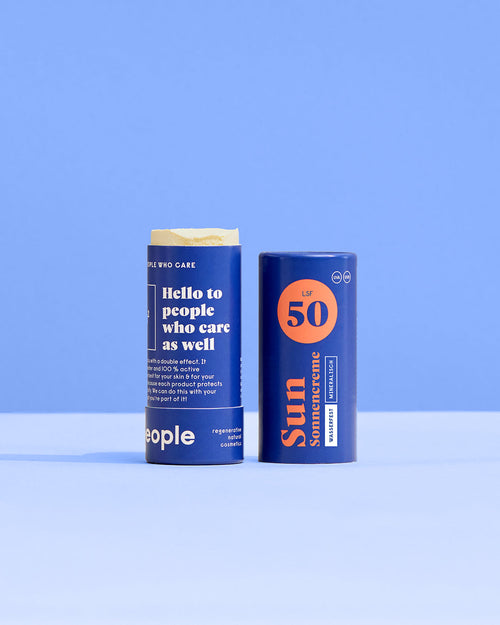
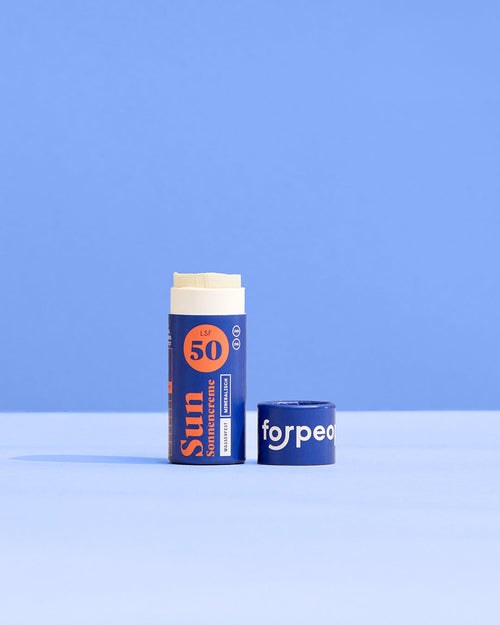
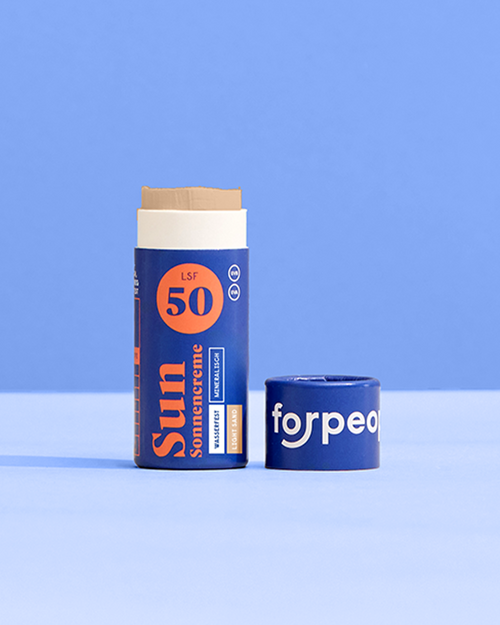
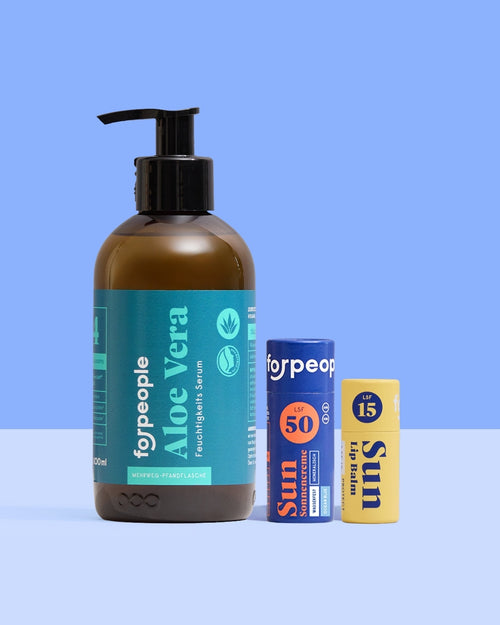
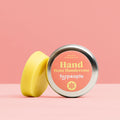
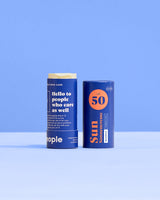
The Solid Sunscreen SPF50 (40 g, €17.90) is a mineral sunscreen with zinc oxide and titanium dioxide (non-nano), tested water-resistant and packed in a paper tube without a plastic coating. For your jacket pocket, handlebar bag or glove compartment there are the Solid Sunscreen SPF50 Mini (20 g, €9.90) and the tinted Solid Sunscreen SPF50 Mini - Shade LIGHT SAND (20 g, €9.90) with iron oxides. For families, the Sensitive Sun Care Set – Mineral SPF 50 & After-Sun (from 10 Months) (€39.90) combines sun protection and care. In the evening, once the sunscreen has been washed off, the Solid Hand Cream - Beeswax (30 g, €9.90) cares for your hands; it has no sun protection factor. For heat in the car, see Storing solid cosmetics. More on this: Do mineral UV filters penetrate the skin? · Hand care for manual work and gardening · Hands as you get older · Protecting a healed tattoo
Sources
- Bundesamt für Strahlenschutz (BfS): UV-Schutz durch Sonnencreme (Stand 04.08.2026). https://www.bfs.de/DE/themen/opt/uv/schutz/sonnencreme/sonnencreme_node.html
- Europäische Kommission (2006): Empfehlung 2006/647/EG über die Wirksamkeit von Sonnenschutzmitteln und diesbezügliche Herstellerangaben. ABl. L 265: 39. https://eur-lex.europa.eu/eli/reco/2006/647/oj
- Bundesamt für Strahlenschutz (BfS): UV-Schutz im Auto? (Stand 04.08.2026). https://www.bfs.de/DE/themen/opt/uv/schutz/auto/auto_node.html
- Boxer Wachler BS (2016): Assessment of Levels of Ultraviolet A Light Protection in Automobile Windshields and Side Windows. JAMA Ophthalmol 134(7): 772–775. https://doi.org/10.1001/jamaophthalmol.2016.1139
- Moehrle M, Soballa M, Korn M (2003): UV exposure in cars. Photodermatol Photoimmunol Photomed 19(4): 175–181. https://doi.org/10.1034/j.1600-0781.2003.00031.x