











The UV ranges in brief
For sunscreens, the European Commission divides ultraviolet solar radiation into two ranges: UVB radiation from 290 to 320 nanometres and UVA radiation from 320 to 400 nanometres (Recommendation 2006/647/EC). UVB is mainly responsible for reddening of the skin. UVA penetrates deeper and is considered one cause of premature skin ageing. In the specialist literature, the UVA range is often divided further:
| Range | Wavelength | Measured via |
|---|---|---|
| UVB | 290–320 nm | sun protection factor (SPF) |
| UVA2 (short-wave UVA) | 320–340 nm | UVA protection factor |
| UVA1 (long-wave UVA) | 340–400 nm | UVA protection factor and critical wavelength |
The EU recommends that UVA protection reaches at least one third of the sun protection factor. Dermatologists additionally recommend a critical wavelength of at least 370 nanometres (Recommendation 2006/647/EC). The critical wavelength shows how far protection reaches into the long-wave UVA range – exactly where zinc oxide and titanium dioxide differ. The test methods are described on the page SPF, UVA and water resistance explained.
Absorbing rather than mirroring
Mineral filters are often described as “physical blockers” that throw light back like a mirror. Measurements tell a different story. In a study with an integrating sphere, a device that records transmitted and reflected light separately, zinc oxide and titanium dioxide reflected on average only 4 to 5 % of the radiation across the UV range – less than an SPF of 2. The rest of the protection comes from absorption: the pigments are semiconductors and absorb UV radiation whose energy lies above their so-called band gap (Cole et al. 2016).
Beyond this limit, in long-wave UVA and visible light, the pigments behave differently: there they hardly absorb anything and reflect up to 60 % of the light (Cole et al. 2016). That explains the white cast. Where exactly absorption ends depends on the material – and so does how far a filter reaches into the UVA range.
Zinc oxide and titanium dioxide compared
A review sums it up: titanium dioxide is more effective in the UVB range, zinc oxide in the UVA range; the combination provides broad protection (Smijs & Pavel 2011). A measurement on human skin compared finely dispersed zinc oxide and titanium dioxide directly: zinc oxide protected better between 340 and 380 nanometres and was less white at every concentration tested (Pinnell et al. 2000).
| Feature | Zinc oxide | Titanium dioxide |
|---|---|---|
| Name on the INCI list | Zinc Oxide | Titanium Dioxide |
| Strength according to the literature | UVA, especially 340–380 nm | UVB and short-wave UVA |
| White cast at the same amount | less | more |
| Maximum as a UV filter (EU) | 25 % | 25 % |
| Nano form approved | yes, with requirements, including a median diameter D50 above 30 nm | yes, with requirements, including a coating and limited photocatalytic activity |
| Restriction | not in applications that may lead to inhalation into the lungs (non-nano too) | nano form not for inhalation; powder forms with a respirable fraction regulated separately |
Sources for the rows on maximum levels and nano form: Regulation (EU) 2016/621 (zinc oxide) and Regulation (EU) 2016/1143 (titanium dioxide). If the regular and nano forms of the same substance are used together, the total may not exceed 25 %. The current consolidated version of the Cosmetics Regulation always applies. Why titanium dioxide is no longer allowed in food and what the powder rule means is explained in Titanium dioxide in food and cosmetics.
Why particle size plays a part
How a pigment absorbs and scatters UV light also depends on the size of its particles. The review by Smijs and Pavel describes it like this: when larger particles are replaced by nanoparticles, the white cast largely disappears, but at the same time the balance between UVA and UVB protection can shift. Mixtures of different particle sizes can make up for this (Smijs & Pavel 2011). Coatings, how evenly the pigment is distributed in the base, and the amount applied also affect protection.
What “nano” and “non-nano” mean and how particle sizes are measured is covered in How big are non-nano zinc oxide particles?. Whether the particles get into the skin is discussed in Do mineral UV filters penetrate the skin?.
What the ingredient list tells you – and what it doesn't
The ingredient list names substances in descending order of weight; ingredients below 1 % may appear at the end in any order (Regulation (EC) No 1223/2009, Article 19). So the order gives you a rough idea of which filter is present in the larger amount. Exact percentages are not on the pack. Whether a sunscreen reaches the recommended UVA protection is only shown by testing the finished product; the list of filters alone doesn't tell you. How to read the list as a whole is explained in Reading an INCI list.
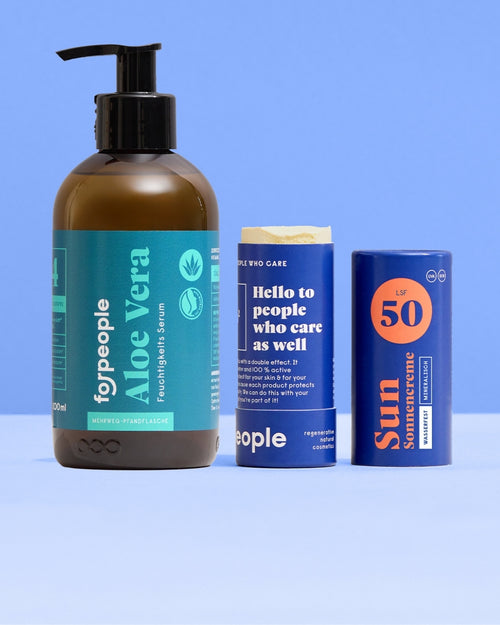
Whatever the filter, the everyday rules are the same: enough cream, spread evenly, reapply after swimming and towelling off – and shade, clothing and a midday break first. Tips for children are on the page Mineral sunscreen for children. If you want sun protection and after-sun care together, there's the Sun Set – Mineral SPF 50 & Aloe After-Sun (€39.90) or the Family Sun Set – SPF 50, After-Sun & Lip Protection (from €39.90).
Frequently asked questions
Which filter is better, zinc oxide or titanium dioxide?
Neither is “better” on its own. Zinc oxide covers long-wave UVA more strongly and leaves less of a white cast; titanium dioxide is more effective in the UVB range. That's why many mineral sunscreens combine both.
Is zinc oxide alone enough for broad protection?
Zinc oxide covers UVB and UVA. Whether a cream with only one filter reaches the recommended UVA protection depends on the amount and the formula and is measured on the finished product.
Do mineral filters reflect sunlight?
Only to a small extent. In the UV range they absorb most of the radiation. What they mainly reflect is visible light – hence the white cast.
Why is zinc oxide often listed before titanium dioxide?
Because ingredients are ordered by weight. If zinc oxide comes first, there is at least as much of it as of titanium dioxide, provided both are above 1 %.
At forpeople
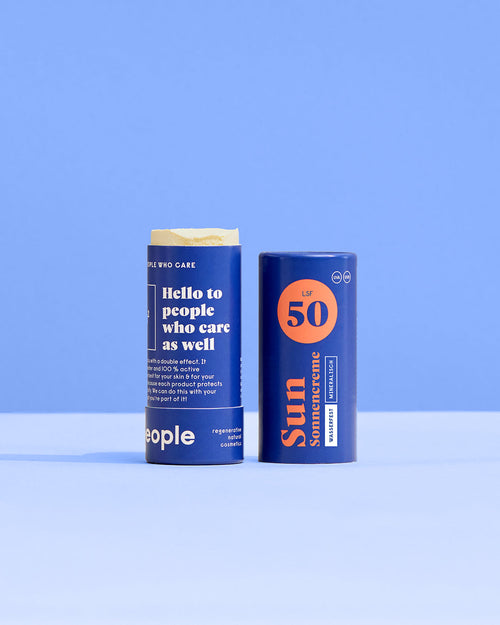
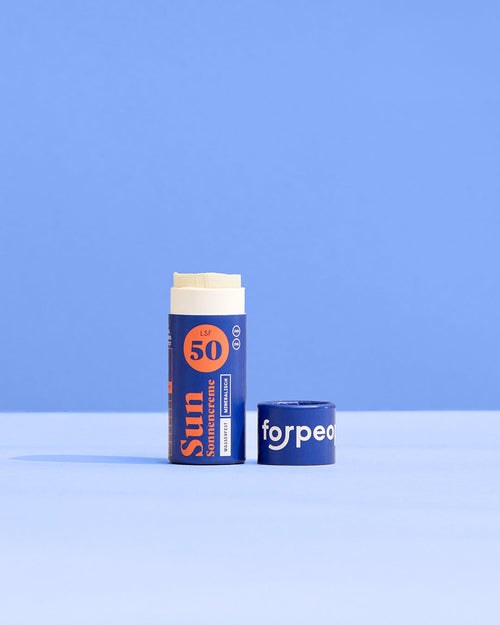
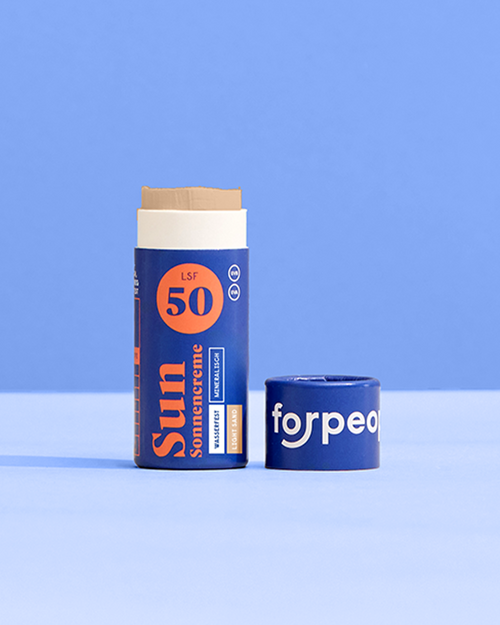
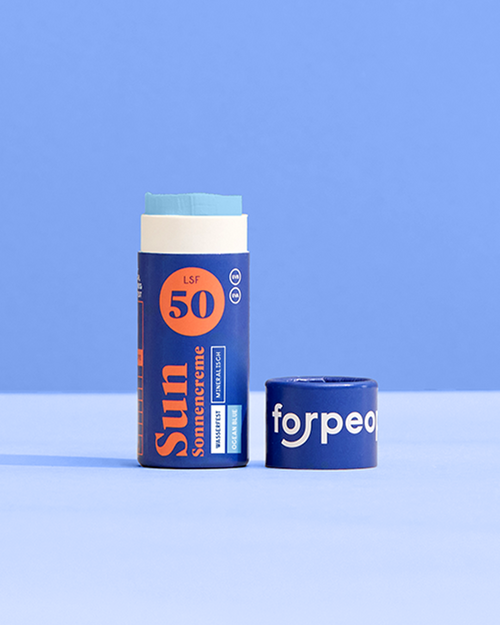
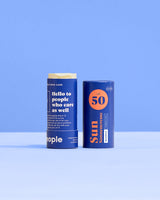
Our solid sunscreens with SPF 50 contain both filters. In the ingredient list of the Solid Sunscreen SPF50 (40 g, €17.90) and the Solid Sunscreen SPF50 Mini (20 g, €9.90), Zinc Oxide and Titanium Dioxide appear in that order, both stated as non-nano, together with shea butter, a plant-based fatty acid blend, beeswax and silica. The tinted minis Solid Sunscreen SPF50 Mini - Shade LIGHT SAND (with iron oxides) and Solid Sunscreen SPF50 Mini - OCEAN BLUE (with ultramarine blue) also contain zinc oxide and titanium dioxide (20 g each, €9.90). All are tested water-resistant and come in a paper tube without plastic coating. Read more: Nano or non-nano? · Storing solid cosmetics in summer · Water-free cosmetics · White cast from sunscreen
Sources
- Europäische Kommission (2006): Empfehlung 2006/647/EG vom 22. September 2006 über die Wirksamkeit von Sonnenschutzmitteln und diesbezügliche Herstellerangaben. ABl. L 265: 39–43. https://eur-lex.europa.eu/eli/reco/2006/647/oj
- Cole C, Shyr T, Ou-Yang H (2016): Metal oxide sunscreens protect skin by absorption, not by reflection or scattering. Photodermatology, Photoimmunology & Photomedicine 32(1): 5–10. https://doi.org/10.1111/phpp.12214
- Pinnell SR, Fairhurst D, Gillies R, Mitchnick MA, Kollias N (2000): Microfine zinc oxide is a superior sunscreen ingredient to microfine titanium dioxide. Dermatologic Surgery 26(4): 309–314. https://doi.org/10.1046/j.1524-4725.2000.99237.x
- Smijs TG, Pavel S (2011): Titanium dioxide and zinc oxide nanoparticles in sunscreens: focus on their safety and effectiveness. Nanotechnology, Science and Applications 4: 95–112. https://doi.org/10.2147/NSA.S19419
- Europäische Kommission (2016): Verordnung (EU) 2016/621 zur Änderung des Anhangs VI der Verordnung (EG) Nr. 1223/2009 (Zinkoxid, Zinkoxid [Nano]). ABl. L 106: 4. https://eur-lex.europa.eu/eli/reg/2016/621/oj
- Europäische Kommission (2016): Verordnung (EU) 2016/1143 zur Änderung von Anhang VI der Verordnung (EG) Nr. 1223/2009 (Titandioxid, Titandioxid [Nano]). ABl. L 189: 40. https://eur-lex.europa.eu/eli/reg/2016/1143/oj
- Europäisches Parlament und Rat (2009): Verordnung (EG) Nr. 1223/2009 über kosmetische Mittel, Artikel 19. ABl. L 342: 59. https://eur-lex.europa.eu/eli/reg/2009/1223/oj