











What “penetrate” actually means
The question sounds simple, but it covers different things. Skin is built in layers: on the outside the horny layer of dead, keratinised cells, below it the living epidermis, then the dermis with its blood vessels. Studies therefore distinguish several stages:
| Stage | What happens | Why it matters |
|---|---|---|
| Deposit on the surface | particles lie on the skin and in skin folds | this is where the UV filter works |
| Entry into the horny layer | particles reach the top layers of dead cells | these layers are constantly shed |
| Deposit in follicles | particles collect in the openings of hair roots and sweat glands | a possible niche that is studied separately |
| Entry into living layers | particles reach the living epidermis | only here could cells react directly |
| Uptake into the body | the substance reaches the blood | the basis of the risk assessment |
Mineral UV filters are insoluble pigments. Zinc oxide has one special feature: it dissolves to a small extent and releases zinc ions. Whether particles or dissolved ions are being measured makes a big difference to the assessment. How the horny layer works as a protective layer is explained on the page The skin barrier, simply explained.
What studies on intact skin show
The question has been studied for more than twenty years with different methods – electron microscopy, nuclear microscopy on skin samples and laser microscopy directly on volunteers. Some of the work at a glance:
| Study | Design | Result according to the abstract |
|---|---|---|
| Schulz et al. 2002 | micronised titanium dioxide, light and electron microscopy | only on the outermost surface of the horny layer, not in deeper layers, the epidermis or the dermis |
| Filipe et al. 2009 | titanium dioxide and zinc oxide in three sunscreen formulas, skin samples under realistic conditions | only on the surface and in the uppermost layers of the horny layer, even after 48 hours under occlusion; deposits in follicle openings; no detectable entry into living tissue |
| Mohammed et al. 2019 | zinc oxide nanoparticles, applied repeatedly to volunteers over five days | particles on the surface and in skin folds, not in the living epidermis; slightly raised zinc ions in the epidermis of excised skin, with no local harmful effect |
| Gulson et al. 2010 | 20 people, five days outdoors, zinc oxide with labelled zinc (isotope zinc-68) | the vast majority not absorbed; small amounts of labelled zinc in blood and urine, after five days about one thousandth of the total zinc in the blood; unclear whether as particles or as dissolved zinc |
The labelled-zinc study is the one most often cited when people say zinc oxide gets “into the blood”. Its authors themselves write that it is not known whether the zinc was absorbed as particles or as dissolved zinc (Gulson et al. 2010). They tested one cream with 19-nanometre particles and one with particles above 100 nanometres. In women using the nano cream, levels were higher than in men using the same cream and higher than in everyone using the cream with larger particles.
Zinc ions are not the same as nanoparticles
The SCCS assessed these findings in 2012. It concluded that there is no indication of zinc oxide nanoparticles penetrating the skin. The zinc found in the study was most likely absorbed in dissolved form. Compared with the zinc pool the body already has, the amount is likely to be insignificantly small (SCCS 2012). Zinc is a trace element that the body takes in every day with food.
For titanium dioxide, which hardly dissolves at all, the SCCS stated in 2014: there is no conclusive evidence that nanoparticles pass through the skin to living cells of the epidermis. Several studies did show, however, that they can reach the outer layers of the horny layer as well as hair follicles and sweat glands. The committee therefore recommended not using titanium dioxide with high photocatalytic activity in sunscreens – that is, no grades that are particularly reactive under light (SCCS 2014).
What the SCCS concludes – and where the limits are
The two opinions reach similar conclusions for use on the skin. For zinc oxide nanoparticles up to 25 % as a UV filter in sunscreens, the SCCS sees no risk of adverse effects in humans after application to the skin (SCCS 2012). For titanium dioxide in nano form, use in products applied to the skin should not pose any significant risk to consumers (SCCS 2014). In 2024 the SCCS confirmed that these conclusions on the skin remain unchanged for the titanium dioxide grades and coatings assessed at the time; for other grades, it requires new data on skin absorption (SCCS 2024).
The opinions also state their limits:
- Only specific materials: The assessments apply to particles with defined purity, size, crystal form and coating. These requirements are now part of the Cosmetics Regulation.
- Not for sprays: For inhalation, the SCCS does not see a sufficient level of safety for either nano form. Nano forms are therefore not permitted in applications that may lead to inhalation into the lungs.
- Open questions: The SCCS itself names uncertainties, for example about damaged skin, repeated long-term use and whether the test methods are suitable for nanomaterials (SCCS 2014).
Most studies deal with nanoparticles, because that is where the question arises most clearly. What “nano” and “non-nano” mean and how particle sizes are measured is explained on the pages Nano or non-nano? and How big are non-nano zinc oxide particles?. Why titanium dioxide is assessed differently in food than on the skin is covered in Titanium dioxide in food and cosmetics.
What this means for how you apply it
Mineral filters work where they lie: as an even film on the skin. That's why the amount matters: if you apply too thinly, the film won't reach the protection stated on the pack. How SPF and UVA protection are tested and which amount they are based on is explained in SPF, UVA and water resistance. Which of the two filters covers which wavelength range is covered in Zinc oxide or titanium dioxide.
- Apply to dry, clean skin and spread well.
- Reapply after swimming, towelling off or heavy sweating.
- Wash off thoroughly in the evening; the pigments come off with gentle cleansing.
- Don't apply to open or injured skin. If you notice a skin reaction, stop using the product.
For children, special rules on shade and clothing apply – see Mineral sunscreen for children. For families there is the Family Sun Set – SPF 50, After-Sun & Lip Protection (from €39.90).
Frequently asked questions
Does zinc oxide from sunscreen get into the blood?
In a study with labelled zinc, small amounts were found in the blood after five days, about one thousandth of the total zinc in the blood. Whether particles or dissolved zinc were absorbed is unclear; the SCCS assumes dissolved zinc.
Do nanoparticles penetrate deeper than larger particles?
In the studies on intact skin, nanoparticles also stayed in the horny layer and in follicle openings. In the labelled-zinc study, levels in women using the nano cream were somewhat higher than with the cream containing larger particles.
Why are sprays with mineral filters restricted?
Because the risk lies in inhalation, not on the skin. Nano forms of zinc oxide and titanium dioxide may therefore not be used in applications that may lead to inhalation into the lungs.
Does this also apply to damaged skin or small injuries?
Most studies concern intact skin, and the SCCS explicitly names damaged skin as an open question. Sunscreen doesn't belong on open or injured areas; if your skin is more severely damaged, get medical advice.
At forpeople
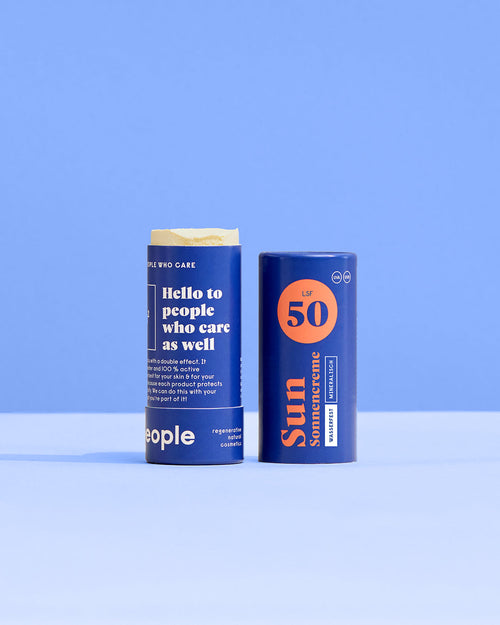
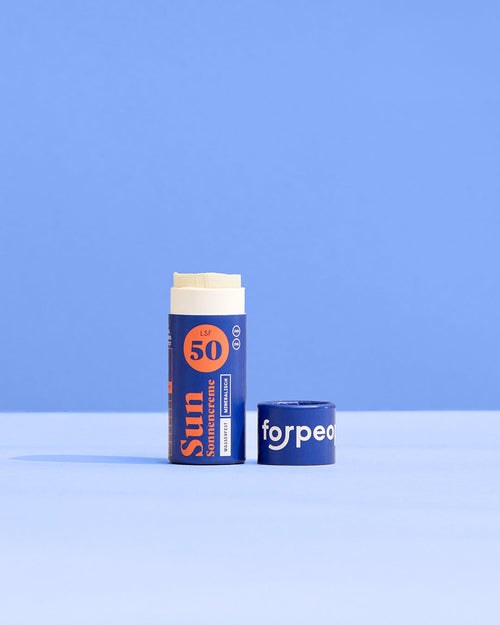
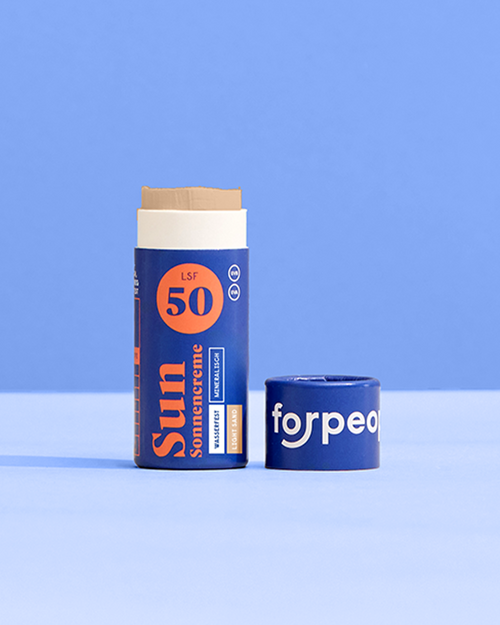
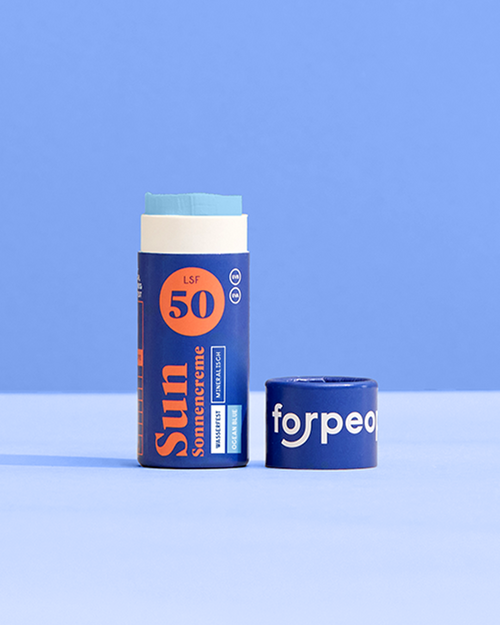
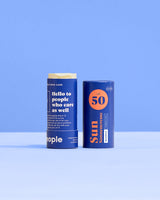
Our sunscreens are solid, water-free sticks with zinc oxide and titanium dioxide as mineral UV filters and SPF 50. According to the ingredient list, the Solid Sunscreen SPF50 (40 g, €17.90) and the Solid Sunscreen SPF50 Mini (20 g, €9.90) contain shea butter, a plant-based fatty acid blend, zinc oxide, titanium dioxide (both stated as non-nano), beeswax and silica. Tinted versions are the Solid Sunscreen SPF50 Mini - Shade LIGHT SAND with iron oxides and the Solid Sunscreen SPF50 Mini - OCEAN BLUE with ultramarine blue (20 g each, €9.90). All are tested water-resistant and come in a paper tube without plastic coating. Read more: Reading an INCI list · Occlusion and water loss · Storing solid cosmetics in summer · White cast from sunscreen
Sources
- Scientific Committee on Consumer Safety (2012): Opinion on Zinc oxide (nano form). SCCS/1489/12, Revision vom 11. Dezember 2012. https://ec.europa.eu/health/scientific_committees/consumer_safety/docs/sccs_o_103.pdf
- Scientific Committee on Consumer Safety (2014): Opinion on Titanium Dioxide (nano form). SCCS/1516/13, Revision vom 22. April 2014. https://ec.europa.eu/health/scientific_committees/consumer_safety/docs/sccs_o_136.pdf
- Filipe P, Silva JN, Silva R, Cirne de Castro JL, Marques Gomes M, Alves LC et al. (2009): Stratum corneum is an effective barrier to TiO2 and ZnO nanoparticle percutaneous absorption. Skin Pharmacology and Physiology 22(5): 266–275. https://doi.org/10.1159/000235554
- Mohammed YH, Holmes A, Haridass IN, Sanchez WY, Studier H, Grice JE et al. (2019): Support for the Safe Use of Zinc Oxide Nanoparticle Sunscreens: Lack of Skin Penetration or Cellular Toxicity after Repeated Application in Volunteers. Journal of Investigative Dermatology 139(2): 308–315. https://doi.org/10.1016/j.jid.2018.08.024
- Gulson B, McCall M, Korsch M, Gomez L, Casey P, Oytam Y et al. (2010): Small amounts of zinc from zinc oxide particles in sunscreens applied outdoors are absorbed through human skin. Toxicological Sciences 118(1): 140–149. https://doi.org/10.1093/toxsci/kfq243
- Schulz J, Hohenberg H, Pflücker F, Gärtner E, Will T, Pfeiffer S et al. (2002): Distribution of sunscreens on skin. Advanced Drug Delivery Reviews 54 Suppl 1: S157–S163. https://doi.org/10.1016/s0169-409x(02)00120-5
- Scientific Committee on Consumer Safety (2024): Scientific Advice on Titanium dioxide (TiO2). SCCS/1661/23, endgültige Fassung vom 13. Mai 2024. https://health.ec.europa.eu/publications/scientific-advice-titanium-dioxide-tio2-casec-numbers-13463-67-7236-675-5-1317-70-0215-280-1-1317-80_en