




Why UV radiation is stronger in the mountains
The atmosphere filters out part of the UV radiation. The higher you are, the thinner the layer of air above you and the more radiation gets through. On top of that comes reflection from the ground: snow throws back a large share of the radiation, which then reaches your skin from below and from the side. The World Health Organization summarises the most important factors in its guide to the UV Index:
| Factor | Value according to the WHO guide |
|---|---|
| Altitude | +10 to 12% UV radiation per 1,000 metres |
| Fresh snow | reflects up to 80% |
| Dry beach sand | reflects about 15% |
| Sea foam | reflects about 25% |
| Light cloud cover | up to 80% of UV radiation gets through |
| High mountains and fresh snow together | can double UV exposure |
Source of the table: WHO 2002. Other sources give slightly different values. The WHO travel handbook, for example, states about 5% more UV per 300 metres of altitude (WHO 2012). The differences come from season, sun elevation, cloud cover and measuring location. The direction is always the same: the higher you are and the more snow there is, the more UV.
Early spring is especially tricky. The WHO advises paying particular attention in early spring, when temperatures are low but the sun is unexpectedly strong (WHO 2002). In March and April the sun is already much higher than in midwinter, while there is still plenty of snow in the mountains. That is classic ski-touring season.
Why you don't feel the sun in the cold
The warmth you feel on your skin in the sun comes from infrared radiation. UV radiation itself can be neither seen nor felt (WHO 2002). At minus ten degrees and in the wind, the sun feels pleasant, even though the UV Index can be high. That is why many people underestimate sun protection in winter sports and only notice it in the evening from reddened skin on the face.
You can find the current UV Index in the weather forecast. The German Federal Office for Radiation Protection points out that UV exposure can be higher than the stated UV Index because of reflection from snow, water and bright surfaces (BfS).
What protection makes sense in the mountains
The order is the same as on the beach in summer: shade and clothing first, sunscreen for the areas that remain exposed. According to the WHO, clothing that covers the arms and legs protects more effectively against UV than sunscreen (WHO 2012). In winter your body is covered anyway; what stays exposed is the face, ears, neck and sometimes the hands. Sunglasses with side protection, a hat or cap and a scarf or neck gaiter for the neck and chin are basic equipment.
For sunscreen itself, the EU recommendation on labelling sets fixed protection categories (European Commission 2006):
| Label on the product | Measured SPF | Category |
|---|---|---|
| 6, 10 | 6 to 14.9 | low protection |
| 15, 20, 25 | 15 to 29.9 | medium protection |
| 30, 50 | 30 to 59.9 | high protection |
| 50+ | 60 and above | very high protection |
The BfS recommends a product with SPF 50+ for stays at high altitudes and on snow (BfS). The amount is just as important as the number. SPF is measured in the lab with 2 mg of sunscreen per square centimetre of skin. In everyday life, people often apply only 0.39 to 1.0 mg/cm², which lowers the protection considerably (Petersen & Wulf 2014). The authors recommend a simple rule: apply before going out and a second time within the first hour. What SPF, UVA protection and the term "water-resistant" mean is explained on SPF, UVA protection and water resistance.
Applying solid mineral sunscreen in the cold
A solid sunscreen consists of butter, oils and wax with the mineral UV filters worked into them. In the cold it gets harder. Here is how to apply it:
- Pre-warm it: carry the sunscreen in an inside pocket close to your body so it stays spreadable.
- Apply before you set off: the BfS recommends applying carefully and generously half an hour before going outside (BfS). Ideally in the warm hut or the car.
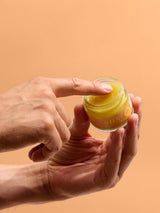
- Be generous: two thin layers one after the other are better than one that is too sparing. Warm the cream between your fingers and spread it evenly.
- Don't forget the undersides: because snow reflects from below, the underside of the nose, the chin, the neck and the earlobes also need protection. Add the bridge of the nose, forehead, cheeks, ears and the back of the neck.
- Reapply: after sweating, after wiping your nose and several times a day. Reapplying maintains protection but does not extend it (BfS).
Mineral filters such as zinc oxide and titanium dioxide can leave a slight white sheen on the skin. How the two filters differ is explained in Zinc oxide or titanium dioxide; what "non-nano" means in Nano or non-nano. Since a solid sunscreen is itself water-free and leaves a film of fat and wax, you usually do not need an extra cold cream underneath on your face. Why no cream protects against frostbite is explained in Cold cream: water-free and frost.
Lips: lips have hardly any protection of their own and get a lot of reflected radiation on snow. A lip balm with SPF 15 falls into the "medium protection" category. On a glacier or on long spring tours that is not much; a scarf over your mouth and chin and frequent reapplication help. More on this in Why do lips dry out so quickly?.
Frequently asked questions
Do I really need sunscreen in winter?
In the mountains and on snow, yes. UV radiation increases with altitude, and fresh snow reflects up to 80% of it. In the lowlands without snow, on the other hand, UV radiation in winter is usually low.
Is SPF 30 enough for skiing?
The BfS recommends SPF 50+ for high altitudes and snow. If you use SPF 30 or 50, apply especially generously, reapply often and also protect your face with a scarf, hat and glasses.
Can I burn in the mountains when it's cloudy?
Yes. Up to 80% of UV radiation gets through light cloud cover. Haze can even increase exposure.
Why do I burn under my nose and on my chin on a ski tour?
Because the snow reflects the radiation back from below. Areas that are normally in shade then get a lot of UV. Make a point of applying sunscreen to these areas.
Does a solid sunscreen get too hard in the cold?
It gets firmer, but you can still apply it if you carry it close to your body beforehand and warm it briefly between your fingers. How solid cosmetics behave in cold and heat is explained in Storing solid cosmetics.
At forpeople
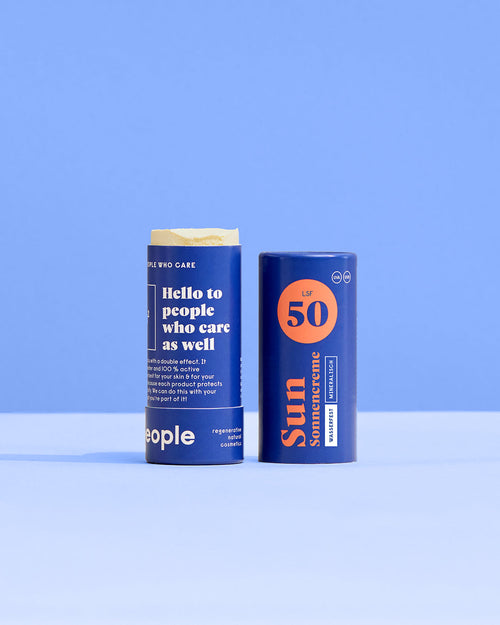
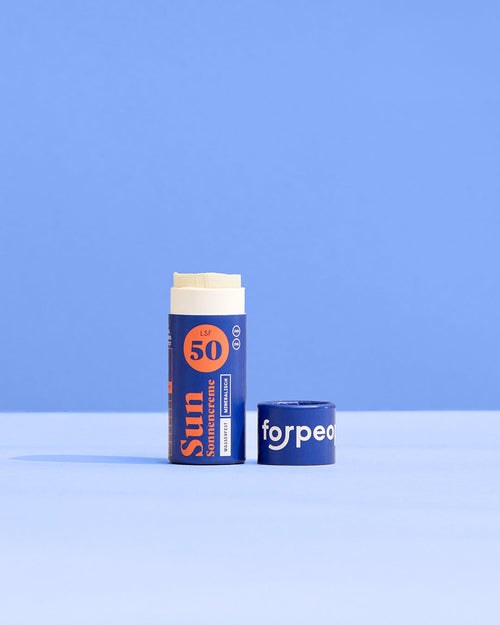
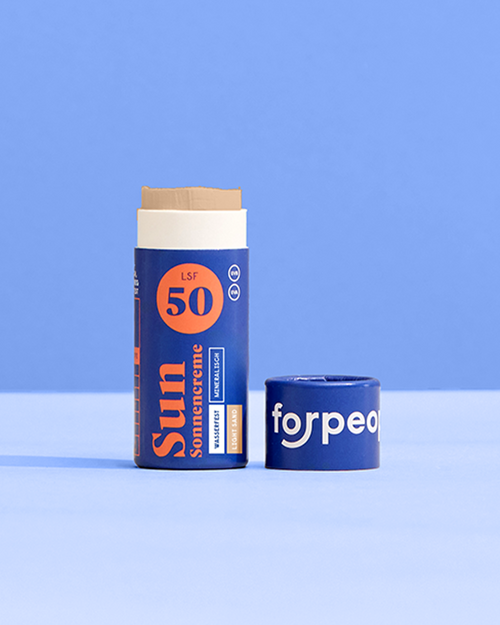
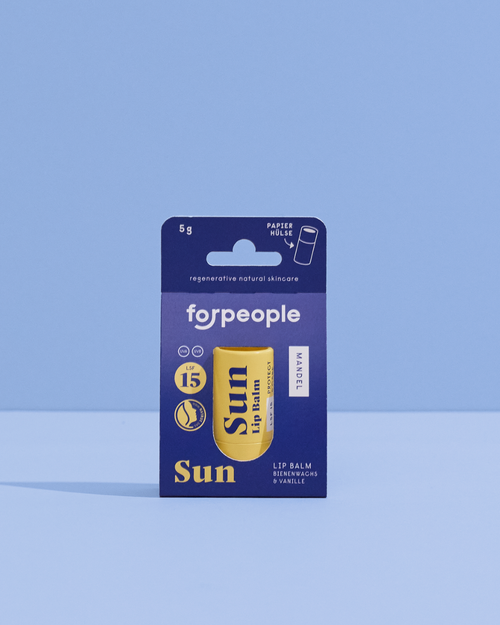
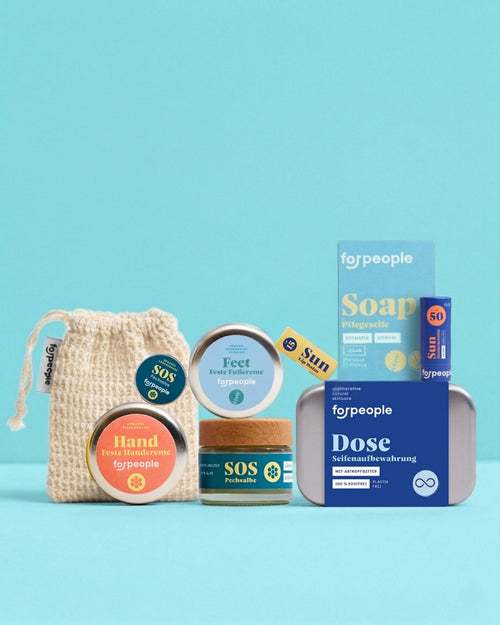
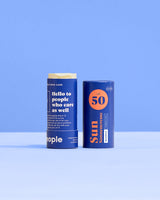
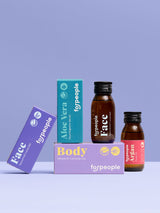
Our Solid Sunscreen SPF50 (40 g, €17.90) protects with the mineral filters zinc oxide and titanium dioxide in non-nano form; it also contains shea butter, a plant-based triglyceride, beeswax and silica, no water and no fragrance. It comes in a paper tube without plastic coating. Under the EU classification, SPF 50 falls into the "high protection" category, not "very high protection". At high altitude and on snow it is therefore especially important to apply generously, reapply often and use clothing, a hat and a scarf. For your jacket pocket there is the Solid Sunscreen SPF50 Mini (20 g, €9.90) and, lightly tinted with iron oxides, the Solid Sunscreen SPF50 Mini - Shade LIGHT SAND (20 g, €9.90). For your lips there is the Lip Balm - SPF15 Almond & Vanilla (5 g, €7.90), also with zinc oxide and titanium dioxide. The Outdoor Set – Sun Protection & SOS Care for Stressed Skin (€79.90) contains a 20 g sunscreen plus salve, hand, foot and lip care. If you notice a skin reaction, stop using the product. More on this: Mineral sunscreen for children · Do mineral UV filters penetrate the skin? · Protecting a tattoo from the sun
Sources
- World Health Organization, World Meteorological Organization, United Nations Environment Programme, International Commission on Non-Ionizing Radiation Protection (2002): Global Solar UV Index: A Practical Guide. WHO/SDE/OEH/02.2. Geneva: WHO. https://iris.who.int/handle/10665/42459
- World Health Organization (2012): International travel and health. Situation as on 1 January 2012. Geneva: WHO. Chapter 3.3 "Ultraviolet radiation from the sun". https://iris.who.int/handle/10665/75329
- Bundesamt für Strahlenschutz (BfS): Tipps zum UV-Schutz. https://www.bfs.de/DE/themen/opt/uv/schutz/tipps/tipps_node.html
- Europäische Kommission (2006): Empfehlung 2006/647/EG vom 22. September 2006 über die Wirksamkeit von Sonnenschutzmitteln und diesbezügliche Herstellerangaben. Amtsblatt der EU L 265: 39–43. https://eur-lex.europa.eu/eli/reco/2006/647/oj
- Petersen B, Wulf HC (2014): Application of sunscreen – theory and reality. Photodermatology, Photoimmunology & Photomedicine 30(2–3): 96–101. https://doi.org/10.1111/phpp.12099