



Why tattoos fade in the sun
Tattoo inks contain pigments, coloured particles that stay in the skin. Many of these pigments are organic colourants that absorb light. UV radiation can chemically change such molecules. In a laboratory study, the red tattoo pigment Pigment Red 22 was dissolved and irradiated with UVB or natural sunlight. The pigment was split, in some solvents almost completely under sunlight. The authors stress that the risk for the skin cannot yet be assessed, because the amounts of pigments and breakdown products in skin are unknown (Engel et al. 2007). A dermatological letter summarises that UV radiation may cause coloured tattoos to fade prematurely (Gonzalez et al. 2020).
For you this means: the less UV radiation a tattoo receives over the years, the longer colours and lines stay crisp. How quickly a tattoo fades also depends on the colour, depth, location and quality of the work. Sun protection helps to slow fading; it cannot prevent it completely.
Which substances tattoo inks may contain has been regulated in the EU since early 2022 under the REACH chemicals legislation. Since then, limits apply to numerous substances; for the pigments Blue 15:3 and Green 7 a longer transition period applied until January 2023 (Regulation (EU) 2020/2081). This concerns the inks themselves, not sunscreen.
Is there a special sunscreen for tattoos?
Not legally. The EU recommendation on sunscreen products sets out how the sun protection factor and UVA protection are stated and defines four protection categories from low to very high. It has no separate class for tattooed skin (Recommendation 2006/647/EC). Products with "tattoo" in their name are sunscreens like any other. What matters:
| Feature | What to look for | Why |
|---|---|---|
| Sun protection factor | at least 30; in the mountains, in snow and by the water 50 or 50+ | recommendation of the German Federal Office for Radiation Protection (BfS) |
| UVA protection | UVA logo in a circle or "broad spectrum" | UVA protection must be at least one third of UVB protection (2006/647/EC) |
| Amount | enough to cover the skin evenly | SPF is measured at 2 mg/cm²; half the amount can reduce protection by two thirds (2006/647/EC) |
| Reapplying | several times a day, after swimming, sweating, towelling | maintains protection but does not extend it (BfS) |
| Filter type | mineral or chemical, as you prefer | both filter UV in front of the pigments; differences lie in skin feel and white cast |
| Tint | with a tinted sunscreen, note that it slightly covers the tattoo | iron oxides or coloured pigments remain visible on the skin |
2 mg/cm² sounds abstract. For the whole body of an average adult, the EU recommendation puts this at about 36 grams (2006/647/EC). For a tattoo of 10 × 10 centimetres, i.e. 100 cm², it is about 0.2 grams. That is more than most people apply by feel. What the information on the pack means is explained in SPF, UVA and water resistance.
Mineral sunscreen on tattoos
Mineral filters such as zinc oxide and titanium dioxide sit on the skin as fine particles and scatter and absorb UV radiation. Zinc oxide also covers the long-wave UVA range well; more in Zinc oxide or titanium dioxide. For a tattoo, the filter type does not play a special role. There are two practical points, though:
- White cast: Mineral sunscreen can leave a light sheen that shows on dark tattooed areas. Working it in well helps; background in White cast from sunscreen.
- Solid sunscreen: It is rubbed directly over the skin and then spread with the fingers. Over a tattoo, better stroke several times in different directions so that the amount is right.
Whether the particles are "nano" or "non-nano" does not change the principle of protection. What the terms mean is explained in Nano or non-nano?
Everyday protection: more than sunscreen
The German Federal Office for Radiation Protection names clothing and a hat as the best and simplest protection, advises seeking shade at midday from a UV index of 3, and warns that snow, water and bright surfaces increase exposure (BfS). For tattoos this means:
- Cover up where you can: A T-shirt over an upper-arm tattoo protects more reliably than any cream.
- Apply to exposed areas: Forearms, ankles, neck and shoulders get the most sun in summer.
- Apply before going out: The BfS recommends half an hour beforehand.
- Renew after swimming: Drying off with a towel removes part of the sunscreen.
- Avoid sunbeds: Artificial UV reaches the pigments too.
After a day in the sun, your skin will appreciate some care. This is for the feel of your skin, not for the tattoo itself; a cream does not bring faded colours back. If you are out in the mountains or in snow, you will find more in Sun protection in the mountains and snow.
Frequently asked questions
When can a new tattoo go in the sun?
Only once it is fully healed. How long that takes and what to do until then is something your studio or doctor will tell you; until then, a fresh tattoo stays covered and in the shade.
Is SPF 30 enough for a tattoo?
For everyday life in Central Europe, SPF 30 is the minimum according to the BfS. By the water, in snow and at high altitude, the BfS recommends SPF 50+. More important than a few extra points is applying enough and reapplying.
Do I need a special tattoo sunscreen?
No. Any sunscreen with a high SPF and UVA protection protects the pigments. Products with "tattoo" in their name are sunscreens like any other; the name is not a separate protection class.
Is mineral sunscreen better for tattoos?
Not in principle. It is one option among several. Some people like it because it has few ingredients; others are bothered by the light sheen.
Can I refresh a faded tattoo with cream?
No. Care makes the skin look smoother but does not bring colour back. Only a studio can touch up a tattoo.
At forpeople
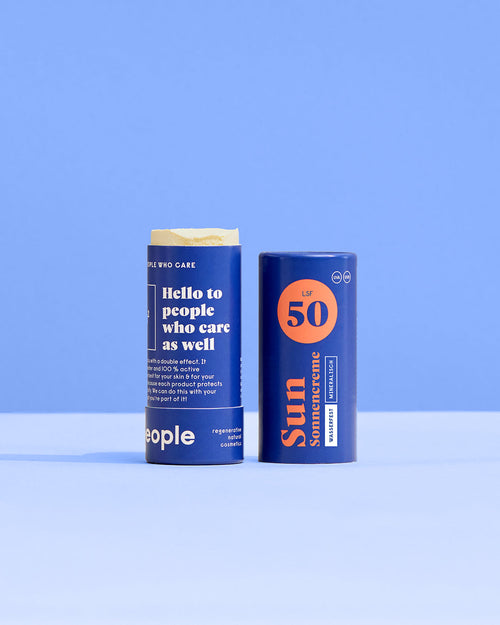
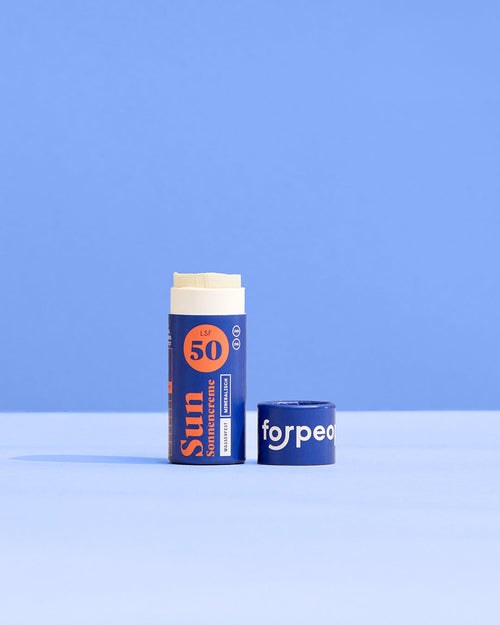
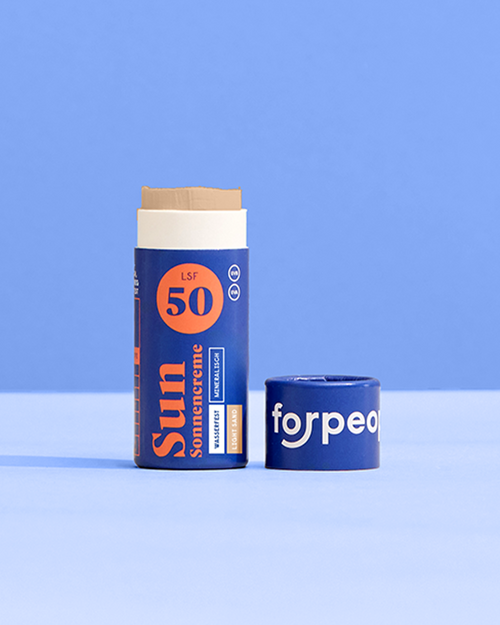
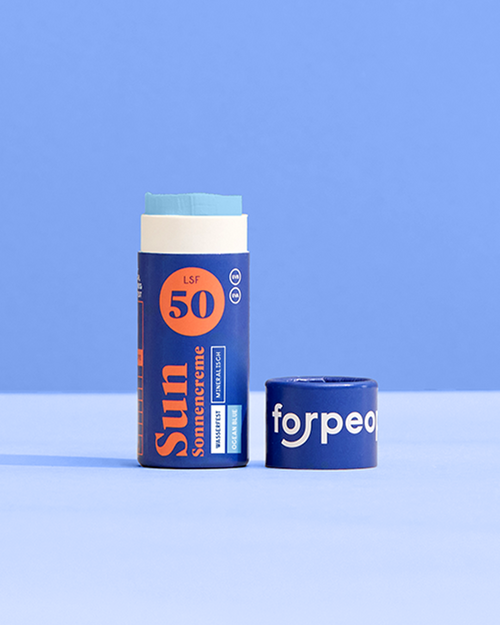
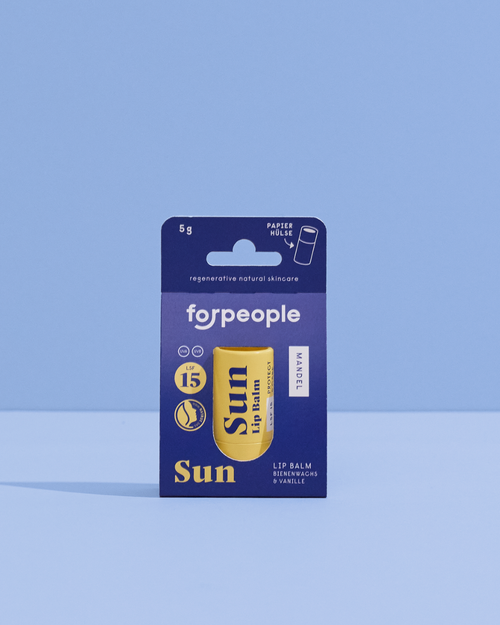
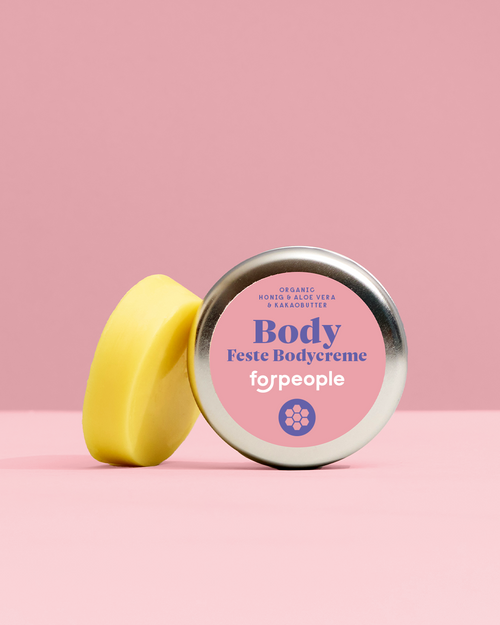
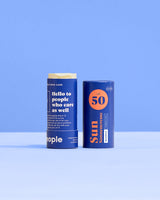
Our Solid Sunscreen SPF50 (40 g, €17.90) is a mineral sunscreen with zinc oxide and titanium dioxide (non-nano) in shea butter and beeswax, in a paper tube without plastic coating. For on the go there is the Solid Sunscreen SPF50 Mini (20 g, €9.90). The Solid Sunscreen SPF50 Mini - Shade LIGHT SAND (20 g, €9.90) is tinted with iron oxides and the Solid Sunscreen SPF50 Mini - OCEAN BLUE (20 g, €9.90) is coloured blue with ultramarine; both visibly cover a tattoo. For your lips there is the Lip Balm - SPF15 Almond & Vanilla (5 g, €7.90). For care after a day in the sun, the Solid Body Butter - Beeswax & Aloe Vera (40 g, €9.90) is a good fit, only on healed, intact skin. More on this: Mineral sunscreen for children · Do mineral UV filters penetrate the skin? · Storing solid cosmetics · SPF and UVA protection explained
Sources
- Engel E, Spannberger A, Vasold R, König B, Landthaler M, Bäumler W (2007): Photochemical cleavage of a tattoo pigment by UVB radiation or natural sunlight. J Dtsch Dermatol Ges 5(7): 583–589. https://doi.org/10.1111/j.1610-0387.2007.06333.x
- Gonzalez CD, Rundle CW, Pona A, Walkosz BJ, Dellavalle RP (2020): Ultraviolet radiation may cause premature fading of colored tattoos. Photodermatol Photoimmunol Photomed 36(1): 73–74. https://doi.org/10.1111/phpp.12509
- Europäische Kommission (2020): Verordnung (EU) 2020/2081 zur Änderung des Anhangs XVII der Verordnung (EG) Nr. 1907/2006 (REACH) betreffend Stoffe in Tätowierfarben oder Permanent-Make-up. ABl. L 423: 6. https://eur-lex.europa.eu/eli/reg/2020/2081/oj
- Europäische Kommission (2006): Empfehlung 2006/647/EG über die Wirksamkeit von Sonnenschutzmitteln und diesbezügliche Herstellerangaben. ABl. L 265: 39. https://eur-lex.europa.eu/eli/reco/2006/647/oj
- Bundesamt für Strahlenschutz (BfS): Tipps zum UV-Schutz (Stand 04.08.2026). https://www.bfs.de/DE/themen/opt/uv/schutz/tipps/tipps_node.html