



What EFSA found about E 171 in 2021
E 171 is titanium dioxide used as a white food colour. EFSA reassessed the additive in 2021 (EFSA 2021). The key points from the summary:
- Fewer than 50 % of the particles in E 171 by number have a smallest dimension below 100 nm; particles below 30 nm make up less than 1 %.
- Titanium dioxide is absorbed only to a small extent in the gut, but it may accumulate in the body.
- Studies on general toxicity and reproduction showed no adverse effects up to the highest doses tested; some individual findings, however, pointed to possible effects.
- In EFSA's assessment, titanium dioxide particles can cause DNA strand breaks and chromosomal damage, but not gene mutations. No threshold and no particle size cut-off could be established.
From this, EFSA concluded that a concern for genotoxicity – possible damage to genetic material – could not be ruled out and that E 171 can no longer be considered safe as a food additive. The authority did not identify any new studies that could resolve these concerns (Regulation (EU) 2022/63, recital 11).
The ban in food
The European Commission withdrew the authorisation of E 171 for food with Regulation (EU) 2022/63 (Regulation (EU) 2022/63). The regulation entered into force on the twentieth day after its publication on 18 January 2022.
| Date | What applies |
|---|---|
| 6 May 2021 | EFSA publishes its opinion on E 171 |
| 14 January 2022 | The Commission adopts Regulation (EU) 2022/63 |
| 7 February 2022 | Cut-off date: food produced under the previous rules benefits from a transition period |
| 7 August 2022 | End of the transition period; older products may then stay on the market until their best-before or use-by date |
Titanium dioxide remains listed only for use as a colour in medicines, because the European Medicines Agency warned of supply shortages if it had to be replaced at short notice. The Commission was to review within three years whether this should remain so (Regulation (EU) 2022/63, Article 3). Food law only governs food; cosmetics have their own rules and their own assessments.
The inhalation classification and the court ruling
Separately from the food question, titanium dioxide was assessed under chemicals law. Delegated Regulation (EU) 2020/217 classified titanium dioxide “in powder form containing 1 % or more of particles with aerodynamic diameter ≤ 10 μm” as a category 2 carcinogen by inhalation, with the hazard statement H351 (inhalation) (Regulation (EU) 2020/217). The reasoning: the effect on the lungs was linked to inhaling respirable, poorly soluble particles, not to dissolved titanium dioxide. So the classification explicitly concerned powders and inhalation – not application to the skin and not eating.
Manufacturers and users challenged it. On 23 November 2022, the EU General Court annulled the classification and labelling, finding that the Commission had made a manifest error in assessing an underlying study. France and the Commission appealed; on 1 August 2025 the Court of Justice of the EU dismissed the appeals and upheld the annulment (Court of Justice of the EU 2025).
What this means for cosmetics
While the 2020 classification applied, the European Commission had to examine whether titanium dioxide could still be used in cosmetics. The basis was an SCCS opinion on inhalation (SCCS 2020). Regulation (EU) 2021/850 added a separate entry to the list of restricted substances (Annex III) for titanium dioxide powder with at least 1 % respirable particles (Regulation (EU) 2021/850):
| Product type | Rule under Regulation (EU) 2021/850 |
|---|---|
| Face products in loose powder form | up to 25 %, pigmentary form only |
| Hair aerosol sprays | up to 1.4 % for consumers, 1.1 % for professional use, pigmentary form only |
| Other products | not in applications that may lead to inhalation into the lungs |
| UV filter titanium dioxide (nano) | was already not permitted in applications involving inhalation |
The 2021 regulation is based on the 2020 classification and on the SCCS opinion. Whether and how the cosmetics entries will be adjusted following the ruling is not clear from the sources cited here; the current consolidated version of the Cosmetics Regulation on eur-lex.europa.eu always applies.
After the EFSA opinion, the Commission asked the SCCS to reassess titanium dioxide in cosmetics, focusing on inhalation and on products that can get into the mouth – lip care, lipstick, toothpaste, loose powder and hair spray are named (SCCS 2024). The May 2024 outcome distinguishes by route of exposure:
- Skin: The previous conclusions for products applied to the skin remain unchanged for the titanium dioxide grades and coatings assessed. The Commission itself notes that the available evidence overall supports a lack of absorption of titanium dioxide particles through the skin.
- Mouth: For almost all grades examined, the data are not sufficient to rule out a genotoxic potential; two nano grades are the exception. At the same time, the SCCS stresses that cosmetics are not meant to be swallowed and that the amounts swallowed unintentionally are far below those from food. It asks for further data.
- Lungs: The earlier conclusions on products that can be inhaled remain unchanged.
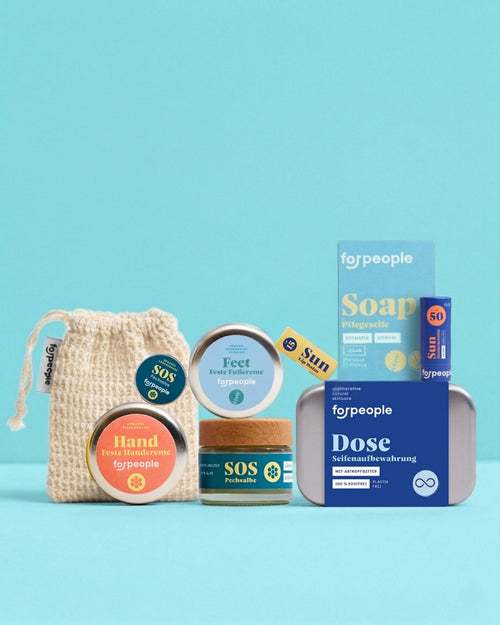
The SCCS also points out that some pigmentary titanium dioxide grades contain more than 50 % nanoscale particles by number (SCCS 2024). How particle sizes are measured is explained in How big are non-nano zinc oxide particles?; what studies on the skin show is covered in Do mineral UV filters penetrate the skin?. A solid sunscreen is spread on, not sprayed – as in the Outdoor Set – Sun Protection & SOS Care for Stressed Skin (€79.90), which includes a 20 g sunscreen.
Frequently asked questions
Why is titanium dioxide allowed in cosmetics when it's banned in food?
Because the assessments concern different routes of exposure. The food ban is based on the assessment of eating it. For products on the skin, the SCCS sees no uptake of the particles through the skin; for sprays, powders and products used on or in the mouth, separate rules apply or further reviews are under way.
Is titanium dioxide classified as carcinogenic?
In 2020 the EU classified titanium dioxide in certain powder forms as suspected of causing cancer by inhalation. The EU General Court annulled this classification in 2022, and the Court of Justice confirmed that in 2025. It never concerned use on the skin.
What about toothpaste and lip products?
In 2024 the SCCS could not rule out a genotoxic potential for most grades when taken in by mouth and asked for further data. It did not recommend specific new limits for this.
Is the titanium dioxide in sunscreen the same as E 171?
Not necessarily. According to the SCCS, the pigmentary grades used in cosmetics differ from E 171 in crystal form, particle size and coating; only some uncoated pigmentary grades are considered equivalent.
At forpeople
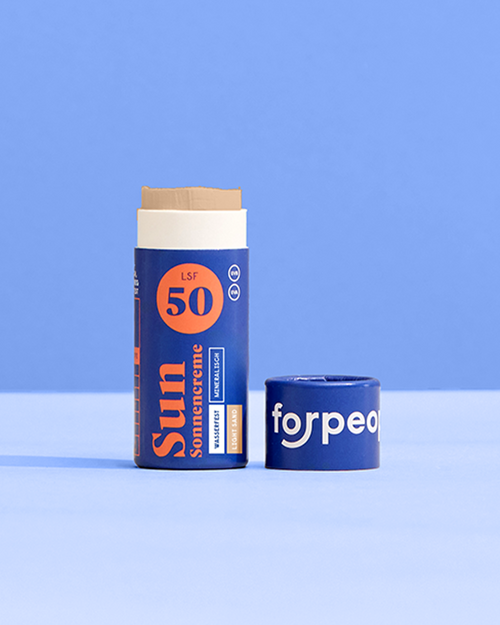
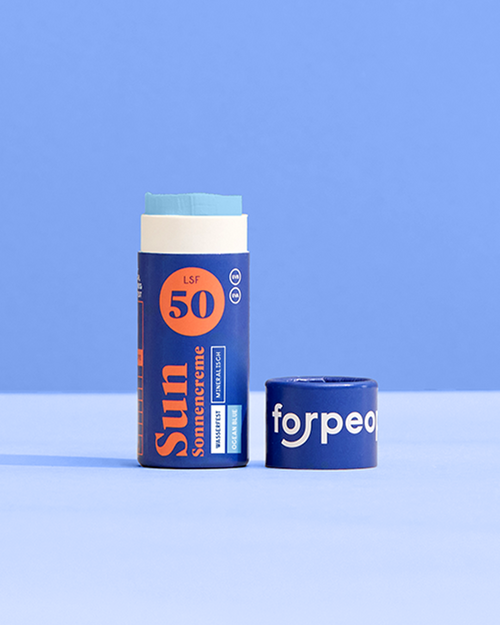
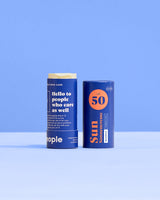
Our sunscreens are solid sticks – not sprays and not powders; they are spread onto the skin. According to the ingredient list, the Solid Sunscreen SPF50 (40 g, €17.90) and the Solid Sunscreen SPF50 Mini (20 g, €9.90) contain titanium dioxide and zinc oxide, both stated as non-nano. The tinted minis Solid Sunscreen SPF50 Mini - Shade LIGHT SAND and Solid Sunscreen SPF50 Mini - OCEAN BLUE (20 g each, €9.90) also contain titanium dioxide and zinc oxide. All are water-free, tested water-resistant and come in a paper tube without plastic coating. Read more: Nano or non-nano? · Zinc oxide or titanium dioxide · Reading an INCI list · Mineral sunscreen for children
Sources
- EFSA Panel on Food Additives and Flavourings (FAF), Younes M, Aquilina G, Castle L, Engel KH, Fowler P et al. (2021): Safety assessment of titanium dioxide (E171) as a food additive. EFSA Journal 19(5): e06585. https://doi.org/10.2903/j.efsa.2021.6585
- Europäische Kommission (2022): Verordnung (EU) 2022/63 vom 14. Januar 2022 zur Änderung der Anhänge II und III der Verordnung (EG) Nr. 1333/2008 hinsichtlich des Lebensmittelzusatzstoffs Titandioxid (E 171). ABl. L 11: 1. https://eur-lex.europa.eu/eli/reg/2022/63/oj
- Europäische Kommission (2019): Delegierte Verordnung (EU) 2020/217 vom 4. Oktober 2019 zur Änderung der Verordnung (EG) Nr. 1272/2008 (Einstufung, Kennzeichnung und Verpackung). ABl. L 44: 1. https://eur-lex.europa.eu/eli/reg_del/2020/217/oj
- Gerichtshof der Europäischen Union (2025): Pressemitteilung Nr. 99/25 vom 1. August 2025 zum Urteil in den verbundenen Rechtssachen C-71/23 P und C-82/23 P (Frankreich und Kommission / CWS Powder Coatings u. a.). https://curia.europa.eu/jcms/upload/docs/application/pdf/2025-08/cp250099de.pdf
- Europäische Kommission (2021): Verordnung (EU) 2021/850 vom 26. Mai 2021 zur Änderung und Berichtigung des Anhangs II und zur Änderung der Anhänge III, IV und VI der Verordnung (EG) Nr. 1223/2009 über kosmetische Mittel. ABl. L 188: 44. https://eur-lex.europa.eu/eli/reg/2021/850/oj
- Scientific Committee on Consumer Safety (2024): Scientific Advice on Titanium dioxide (TiO2). SCCS/1661/23, endgültige Fassung vom 13. Mai 2024. https://health.ec.europa.eu/publications/scientific-advice-titanium-dioxide-tio2-casec-numbers-13463-67-7236-675-5-1317-70-0215-280-1-1317-80_en
- Scientific Committee on Consumer Safety (2020): Opinion on Titanium dioxide (TiO2) used in cosmetic products that lead to exposure by inhalation. SCCS/1617/20, endgültige Fassung vom 6. Oktober 2020. https://ec.europa.eu/health/sites/default/files/scientific_committees/consumer_safety/docs/sccs_o_238.pdf