










Two definitions: cosmetics law and the EU Recommendation
For cosmetics, the definition in the EU Cosmetics Regulation applies. Under it, a nanomaterial is “an insoluble or biopersistent and intentionally manufactured material with one or more external dimensions, or an internal structure, on the scale from 1 to 100 nm” (Regulation (EC) No 1223/2009, Article 2). This definition does not include a percentage threshold.
The European Commission's general Recommendation of 2022 is more precise. It requires looking at the number-based size distribution and sets the 50 % threshold (Recommendation 2022/C 229/01). In its guidance, the Scientific Committee on Consumer Safety (SCCS) notes that this Recommendation has not yet been applied to the Cosmetics Regulation, but advises manufacturers to take it into account already when assessing safety (SCCS 2023).
| Point | Cosmetics Regulation, Art. 2 | EU Recommendation 2022 |
|---|---|---|
| Size range | 1–100 nm, external dimension or internal structure | 1–100 nm, at least one external dimension |
| Threshold | no percentage | at least 50 % of particles by number |
| Aggregates and agglomerates | not explicitly addressed | identifiable constituent particles in them count |
| Exception | – | specific surface area below 6 m²/cm³: not a nanomaterial |
| Origin | intentionally manufactured | natural, incidental or manufactured |
How “nano” is labelled on the pack and what the SCCS says about safety is covered on the page Nano or non-nano?.
Primary particles, aggregates, agglomerates
As powders, zinc oxide and titanium dioxide rarely exist as loose single particles. The EU Recommendation distinguishes three terms (Recommendation 2022/C 229/01):
- Particle: a minute piece of matter with defined physical boundaries. Experts call the smallest building blocks primary particles.
- Aggregate: a particle made of strongly bound or fused particles.
- Agglomerate: a collection of weakly bound particles or aggregates whose surface area is roughly the sum of the individual surface areas.
For the definition, the identifiable constituent particles count, not the cluster. A clump of 500 nanometres made up entirely of 20-nanometre particles is therefore judged by its building blocks. The EU's reasoning: agglomerated particles can have the same properties as free ones, and over time particles can be released from clusters (Recommendation 2011/696/EU, recital 12).
Conversely, even a pigment whose particles are deliberately much larger than 100 nanometres on average can contain a fraction of fine nanoscale particles as a result of how it is made. This is described in a comparative measurement that experts from three titanium dioxide manufacturers carried out on five pigments. Their results agreed well with each other but differed markedly from measurements published elsewhere – for some samples so much that the regulatory classification changed (Theissmann et al. 2024). In other words, the measurement method matters.
Why particles are counted by number
The European Commission explains the number-based distribution by pointing out that a small fraction by mass can contain the largest number of particles (Recommendation 2011/696/EU, recital 8). A quick calculation shows how big the difference is: a sphere 200 nanometres across has the same volume as 1,000 spheres of 20 nanometres, because (200 ÷ 20)³ = 1,000. A powder that contains only a few per cent by weight of fine particles can therefore consist mostly of them by number.
For approved nano UV filters, the Cosmetics Regulation therefore sets values for the number-based distribution. For zinc oxide (nano), the median diameter D50 – 50 % of the particles are smaller – must be above 30 nm, and D1 – 1 % are smaller – above 20 nm (Regulation (EU) 2016/621). For titanium dioxide (nano), there is a corresponding lower limit of 30 nm.
How particle sizes are measured
A single measuring method is rarely enough, because the definition requires the constituent particles inside aggregates to be captured as well. In its guidance, the SCCS names electron microscopy among the methods for size distribution and refers to the volume-specific surface area for clusters (SCCS 2023).
| Method | What it shows | Limits |
|---|---|---|
| Transmission and scanning electron microscopy (TEM, SEM) | images of individual particles, from which a number distribution can be counted; with EDX also the composition | sample preparation strongly affects the result; creams have to be diluted and dispersed |
| X-ray diffraction (XRD) | crystal form (e.g. rutile, anatase, wurtzite) and crystallite size, without pretreating the cream | no direct number distribution of individual particles |
| Specific surface area (BET, giving VSSA) | surface area per volume of a dry powder; below 6 m²/cm³ not a nanomaterial | only for powders, not for the finished cream |
| Light scattering in dispersion (e.g. dynamic light scattering, laser diffraction) | quick measurement of particles in liquid | often captures agglomerates instead of single particles; the result is not directly a number distribution |
| Light microscopy | distribution and clusters in the cream | resolution around 200 nm, nanoparticles cannot be measured |
The rows on microscopy and X-ray diffraction are based on a study by the Taiwanese Food and Drug Administration on commercial sunscreens: light microscopy could not size nanoparticles because of its resolution limit of about 200 nm, while the combination of X-ray diffraction and TEM proved suitable (Lu et al. 2015). The SCCS also stresses that sample preparation for electron microscopy influences the results and that particles can change when they are worked into a formula, for example by clumping together (SCCS 2023).
Raw material or finished cream?
The classification “nano” or “non-nano” refers to the raw material as it goes into the formula. The claim is usually based on the data for the raw material used. In the finished sunscreen, measuring is harder: the pigments have to be isolated from fat, wax and oil or heavily diluted before an electron microscope can show individual particles (SCCS 2023).
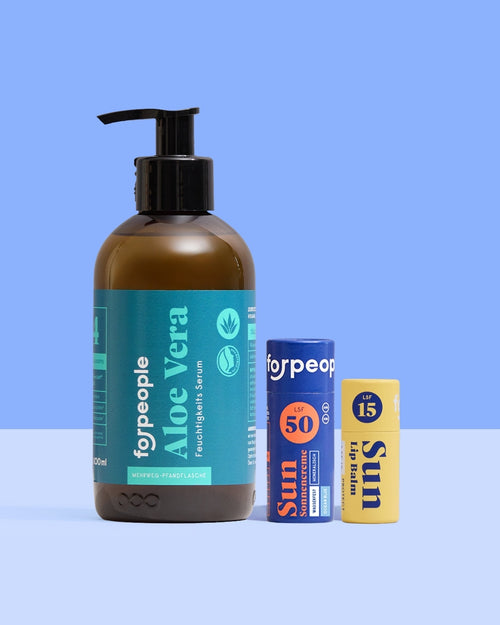
As a buyer, the ingredient list remains your reliable guide. If it says “Zinc Oxide (nano)” or “Titanium Dioxide (nano)”, a nanomaterial is present; if the addition is missing, the manufacturer has not declared the substance as a nanomaterial. How to read the list is shown in Reading an INCI list. Whether the particles pass through the skin is covered on the page Do mineral UV filters penetrate the skin?; which filter covers which UV range is explained in Zinc oxide or titanium dioxide. Mineral sun care sets such as the Family Sun Set – SPF 50, After-Sun & Lip Protection (from €39.90) or the Outdoor Set – Sun Protection & SOS Care for Stressed Skin (€79.90) also contain sunscreens with zinc oxide and titanium dioxide.
Frequently asked questions
Does a non-nano sunscreen contain no particles below 100 nanometres at all?
Not necessarily. Even pigments with a large median particle size can contain a small fraction of fine particles. “Non-nano” means that the material as a whole does not meet the nanomaterial definition.
How big are non-nano zinc oxide particles?
There is no single figure. The size depends on the raw material and how it is made. Under the EU Recommendation of 2022, what matters is that fewer than half of the particles by number are in the range of 1 to 100 nm.
Can I check myself whether a cream contains nanoparticles?
No, that needs laboratory equipment such as an electron microscope. But you can rely on the mandatory “(nano)” labelling in the ingredient list.
Why count by number rather than weight?
Because a few per cent by weight of fine particles can be a very large number of particles. The European Commission therefore deliberately chose the number.
Is non-nano whiter?
Usually yes, because larger particles scatter more visible light. More on this in the article White cast from sunscreen.
At forpeople
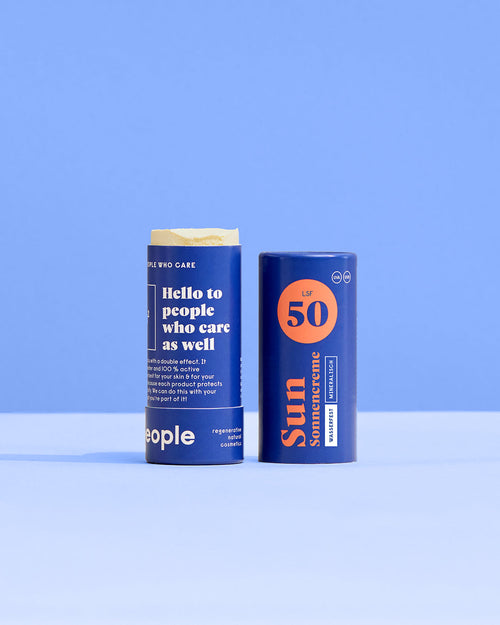
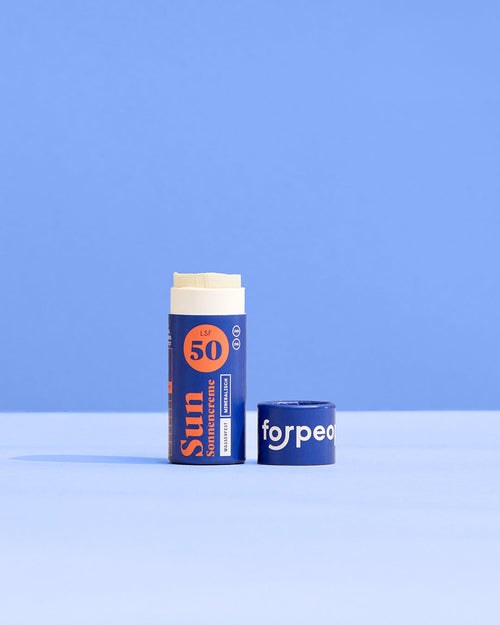
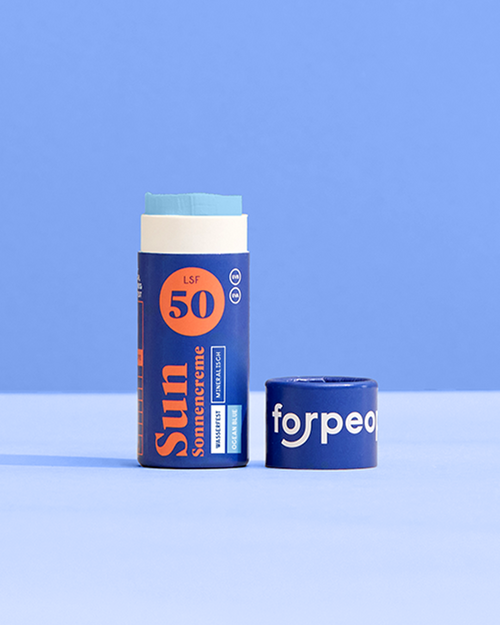
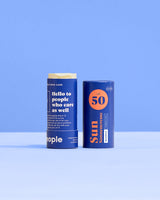
In the ingredient list of our Solid Sunscreen SPF50 (40 g, €17.90) and the Solid Sunscreen SPF50 Mini (20 g, €9.90), zinc oxide and titanium dioxide are marked “non-nano”; for the Solid Sunscreen SPF50 Mini - OCEAN BLUE (20 g, €9.90) it says “mineral, non-nano UV filters”. These statements refer to the raw materials used; the product information does not give a specific particle size. The Sensitive Sun Care Set – Mineral SPF 50 & After-Sun (from 10 Months) (€39.90) combines a mini sunscreen with after-sun care. All our sunscreens are solid, water-free, tested water-resistant and come in a paper tube without plastic coating. Read more: SPF, UVA and water resistance explained · Mineral sunscreen for children · Titanium dioxide in food and cosmetics · Natural cosmetics standards explained
Sources
- Europäisches Parlament und Rat (2009): Verordnung (EG) Nr. 1223/2009 über kosmetische Mittel, Artikel 2 Absatz 1 Buchstabe k und Artikel 19. ABl. L 342: 59. https://eur-lex.europa.eu/eli/reg/2009/1223/oj
- Europäische Kommission (2022): Empfehlung der Kommission vom 10. Juni 2022 zur Definition von Nanomaterialien (2022/C 229/01). ABl. C 229: 1. https://eur-lex.europa.eu/legal-content/DE/TXT/?uri=CELEX:32022H0614(01)
- Scientific Committee on Consumer Safety (2023): Guidance on the Safety Assessment of Nanomaterials in Cosmetics, 2nd revision. SCCS/1655/23, angenommen am 6. Juni 2023. https://health.ec.europa.eu/system/files/2023-07/sccs_o_278.pdf
- Europäische Kommission (2011): Empfehlung 2011/696/EU vom 18. Oktober 2011 zur Definition von Nanomaterialien. ABl. L 275: 38. https://eur-lex.europa.eu/eli/reco/2011/696/oj
- Europäische Kommission (2016): Verordnung (EU) 2016/621 zur Änderung des Anhangs VI der Verordnung (EG) Nr. 1223/2009 (Zinkoxid, Zinkoxid [Nano]). ABl. L 106: 4. https://eur-lex.europa.eu/eli/reg/2016/621/oj
- Theissmann R, Drury C, Rohe M, Koch T, Winkler J, Pikal P (2024): Comparative electron microscopy particle sizing of TiO2 pigments: sample preparation and measurement. Beilstein Journal of Nanotechnology 15: 317–332. https://doi.org/10.3762/bjnano.15.29
- Lu PJ, Huang SC, Chen YP, Chiueh LC, Shih DY (2015): Analysis of titanium dioxide and zinc oxide nanoparticles in cosmetics. Journal of Food and Drug Analysis 23(3): 587–594. https://doi.org/10.1016/j.jfda.2015.02.009