


What the sun protection factor measures
The European Commission defines the SPF as the ratio of two doses of radiation: the dose that just causes redness on skin with sunscreen, compared with the dose that causes redness on the same unprotected skin (Recommendation 2006/647/EC). An SPF of 30 therefore means that in the test, it took thirty times the dose to cause the first redness. Today it is measured according to ISO 24444:2019 (“Cosmetics – Sun protection test methods – In vivo determination of the sun protection factor (SPF)”) on test subjects under controlled conditions.
The number is not linear in the sense of “twice the protection”. The EU recommendation does the maths: a product with SPF 15 absorbs 93 % of UVB radiation, one with SPF 30 absorbs 97 %. SPFs above 50 do not increase protection significantly. That is why there are four categories for the label:
| Category on the label | Labelled SPF | Measured SPF | Minimum UVA protection |
|---|---|---|---|
| low protection | 6 / 10 | 6–9.9 / 10–14.9 | 1/3 of the labelled SPF, critical wavelength 370 nm |
| medium protection | 15 / 20 / 25 | 15–19.9 / 20–24.9 / 25–29.9 | as above |
| high protection | 30 / 50 | 30–49.9 / 50–59.9 | as above |
| very high protection | 50+ | 60 and above | as above |
Source of the table: Recommendation 2006/647/EC, point 14. The category should be at least as visible on the label as the number.
UVA protection and the UVA circle
UVB radiation (290–320 nm) is mainly responsible for redness. UVA radiation (320–400 nm) penetrates deeper; the European Commission calls it a cause of premature skin ageing and states that its risk must not be neglected (Recommendation 2006/647/EC). Because the SPF reflects almost only UVB, the EU recommends two additional minimum values:
- UVA protection factor: at least one third of the labelled SPF. For SPF 30, that means at least 10.
- Critical wavelength: at least 370 nm. It shows how far protection reaches into the long-wave UVA range.
UVA protection is now usually determined in the lab on a film of the cream, according to ISO 24443:2021 (“Cosmetics – Determination of sunscreen UVA photoprotection in vitro”). The European cosmetics association shows that a product meets the EU minimum values with a logo: the letters “UVA” in a circle, no larger than the SPF number (Colipa Recommendation No. 23). The logo is a voluntary industry solution, not a legal requirement. If it is missing, that does not automatically mean there is no UVA protection – only that this label is not used.
Mineral filters such as zinc oxide and titanium dioxide cover UVB and UVA; how particle size and “nano” fit in is explained on Nano or non-nano?.
What “water resistant” and “very water resistant” mean
The 2006 EU recommendation does not set a test for water resistance. In Europe, the recommendation of the industry association Cosmetics Europe applies, last revised in 2023 (Cosmetics Europe 2023). It refers to two standards: ISO 16217:2020 (“Water immersion procedure for determining water resistance”) describes the water bath, ISO 18861:2020 (“Percentage of water resistance”) the calculation.
| Claim | Test | Passed if |
|---|---|---|
| water resistant | 2 × 20 minutes in a water bath | statistically confirmed, at least 50 % of the SPF remains |
| very water resistant | 2 further × 20 minutes, so 4 × 20 minutes | the same condition after the longer test |
So water resistant does not mean that full protection remains. After swimming, part of the cream is gone, and towelling, sand and friction remove more. The EU recommendation therefore advises reapplying, especially after sweating, swimming and towelling.
The right amount and reapplying
The SPF only applies to the test amount of 2 mg per square centimetre. For the body of an average adult, the European Commission puts this at about six teaspoons or around 36 grams. Applying only half can reduce protection by two thirds (Recommendation 2006/647/EC). A review found that in everyday life people apply about 0.39 to 1.0 mg per square centimetre – clearly less than in the test (Petersen & Wulf 2014). The authors recommend a simple rule: apply before going into the sun and reapply once within the first hour.
The German Federal Office for Radiation Protection advises (BfS):
- apply carefully and generously to all uncovered areas about half an hour before going outside,
- use at least SPF 30, and SPF 50+ by the water, in snow, at high altitude and in very sunny regions,
- choose a sunscreen with UVA and UVB filters,
- reapply several times a day and after swimming – reapplying does not extend protection time, it only maintains it.
According to all official recommendations, sunscreen is only one part of protection. The EU recommendation states that no sunscreen can filter all UV radiation. Shade at midday, clothing, a hat and sunglasses come first. Special rules apply to children; more on Mineral sunscreen for children. Why your lips need protection too is explained on Why lips dry out so quickly.
Frequently asked questions
Is SPF 50 twice as strong as SPF 25?
Not in terms of the radiation filtered. Even SPF 15 blocks 93 % of UVB radiation in the test, SPF 30 blocks 97 %. At the top end, the difference is a few percentage points – but they matter when there is a lot of sun.
How long does “water resistant” last?
The claim describes a lab test with two 20-minute immersions, after which at least half of the protection is still measurable. Always reapply after swimming and towelling.
Does reapplying extend my time in the sun?
No. Reapplying maintains protection but does not extend it.
Why do some sunscreens have no UVA circle?
The logo is a voluntary label from the industry association. Whether and how a manufacturer states UVA protection is up to them; if in doubt, ask the manufacturer.
Can I still use last year’s sunscreen?
Check the open-jar symbol and how it was stored. What shelf-life information means is explained on Shelf life of cosmetics; how heat changes solid sunscreen on Storing solid cosmetics in summer.
At forpeople
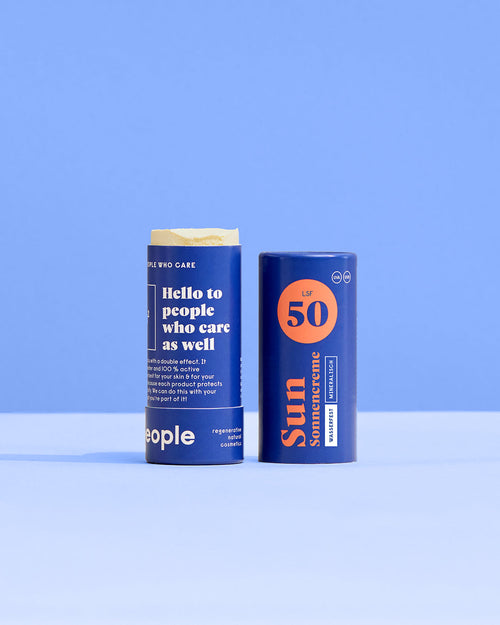
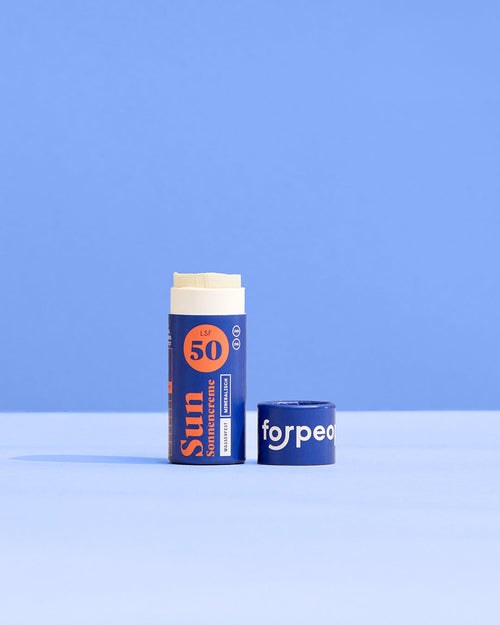
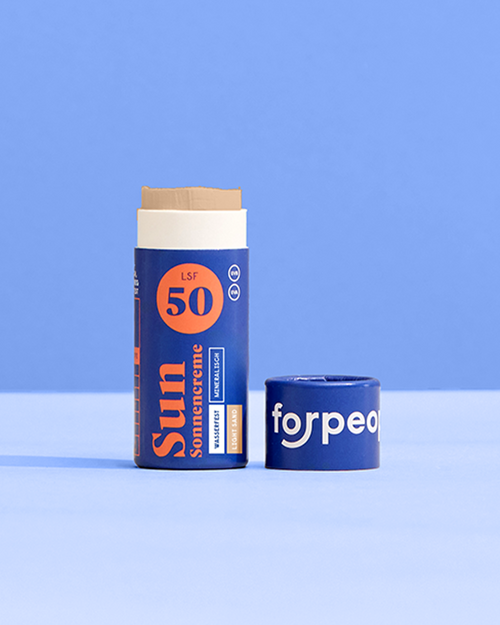
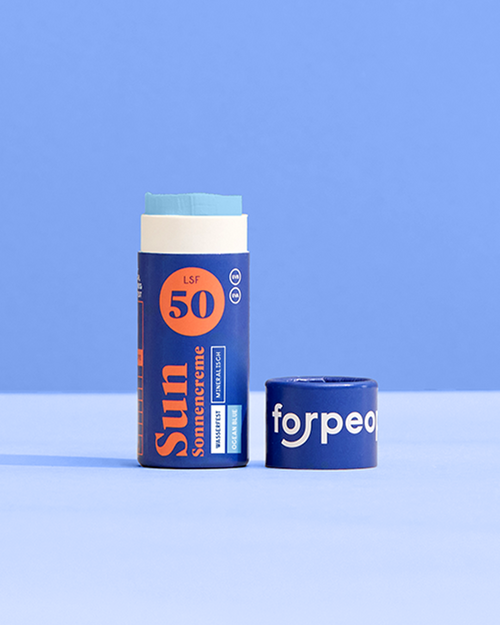
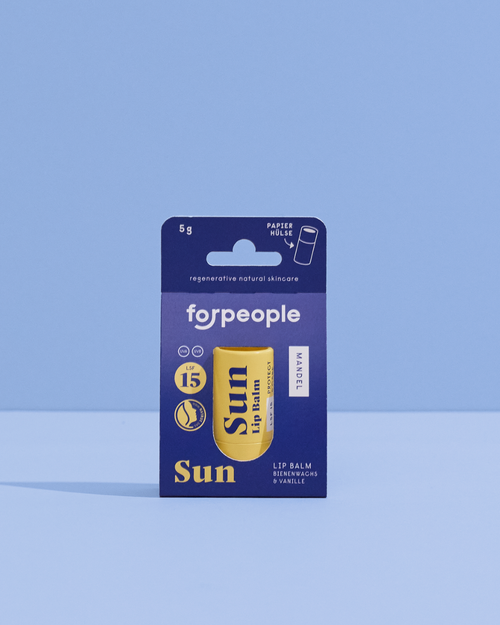
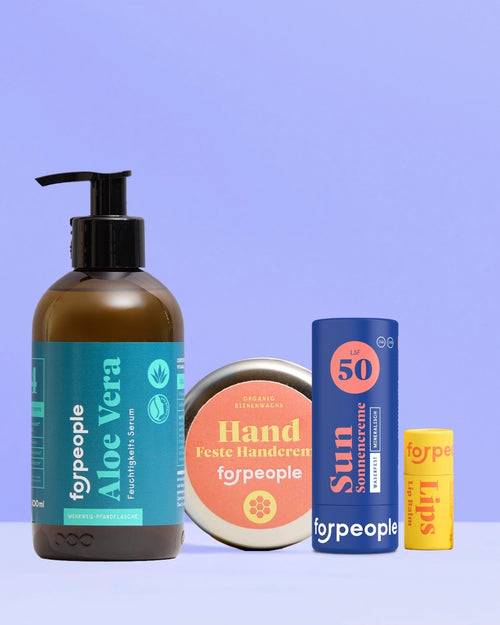
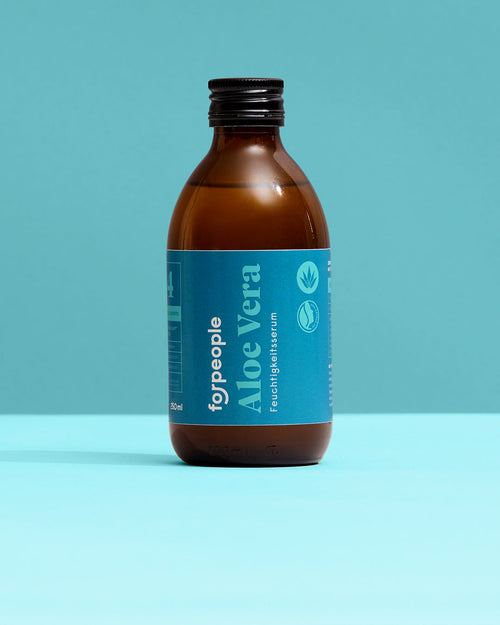
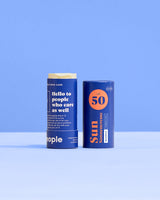
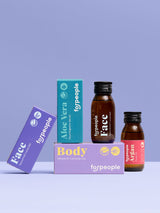
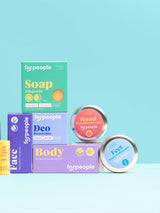
The Solid Sunscreen SPF50 (40 g, €17.90) has a sun protection factor of 50 and has been tested as water resistant. Its only UV filters are zinc oxide and titanium dioxide, non-nano according to the ingredient list. It is water-free and comes in a paper tube without plastic coating. For on the go, there is the Solid Sunscreen SPF50 Mini (20 g, €9.90) and the tinted minis Solid Sunscreen SPF50 Mini - Shade LIGHT SAND and Solid Sunscreen SPF50 Mini - OCEAN BLUE (20 g, €9.90 each). You apply a solid sunscreen straight from the tube and then spread it with your hands – here too, apply generously. For your lips, there is the Lip Balm - SPF15 Almond & Vanilla (5 g, €7.90). The Family Sun Set – SPF 50, After-Sun & Lip Protection (from €39.90) contains sunscreen, Aloe Vera Serum 99.6% and a lip balm. Read more: Water-free cosmetics.
Sources
- Europäische Kommission (2006): Empfehlung 2006/647/EG vom 22. September 2006 über die Wirksamkeit von Sonnenschutzmitteln und diesbezügliche Herstellerangaben. ABl. L 265: 39–43. https://eur-lex.europa.eu/eli/reco/2006/647/oj
- Cosmetics Europe (2023): Recommendation N° 16: Water Resistance Labelling, revised June 2023. https://cosmeticseurope.eu/wp-content/uploads/2024/10/CR_16_Water_Revised_June_2023.pdf
- Colipa (2009): Recommendation N° 23: Important usage and labelling instructions for sun protection products, 24. Februar 2009. https://cosmeticseurope.eu/wp-content/uploads/2024/10/CR-23-Sunscreens_Labelling.pdf
- Petersen B, Wulf HC (2014): Application of sunscreen – theory and reality. Photodermatology, Photoimmunology & Photomedicine 30(2–3): 96–101. https://doi.org/10.1111/phpp.12099
- Bundesamt für Strahlenschutz (BfS): Tipps zum UV-Schutz. https://www.bfs.de/DE/themen/opt/uv/schutz/tipps/tipps_node.html