






Why washing up makes your hands rough
Washing-up liquid is made to remove fat from plates. The surfactants in it don't distinguish between cooking fat and skin fat. Research on cleansing products shows that harsh surfactants attack the skin's proteins and fats. The result is a feeling of tightness, dryness and a weakened barrier (Ananthapadmanabhan et al. 2004). How strong the effect is depends on the type of surfactant. Some are considered milder because they react less with the skin's proteins.
Then there is the pH value. In experiments, solutions with pH 10 made the stratum corneum swell and changed its fats, even without any surfactants (Ananthapadmanabhan et al. 2004). Many all-purpose and degreasing cleaners are alkaline. Even tap water, which in Europe usually has a pH of around 8, raises the skin's pH; according to measurements it takes up to six hours to return to its natural value below 5 (Lambers et al. 2006). If you wash up and clean several times a day, your skin hardly gets a break. What makes up the skin barrier is explained in The skin barrier simply explained.
Hot water makes it worse
Many people wash up with hot water because grease comes off more easily. For the skin, that's unfavourable. In one study, a surfactant solution at 4, 20 and 40 °C was applied to the forearms. The warmer the solution, the stronger the irritation, measured among other things by the skin's water loss (Berardesca et al. 1995). A second study immersed forearms in a soap solution for ten minutes twice a day. At 40 °C the skin then lost clearly more water than at 20 °C. Plain water did not change any of the measured values in this short experiment (Ohlenschlaeger et al. 1996).
In everyday terms: it's not the water alone, but the combination of cleaning agent and heat that strains the skin. Lukewarm water is a simple compromise. Why hands dry out faster than other skin in the first place is covered in Why hands dry out faster.
Gloves: the real protection
In occupational safety this is clearly regulated. The German Technical Rule for Hazardous Substances TRGS 401 speaks of wet work when someone regularly has skin contact with water for more than two hours a day or washes their hands at least 15 times a day. It distinguishes skin protection products, applied before a straining activity, from skin care products, applied to clean skin afterwards. Skin protection products may only replace protective gloves in certain cases (TRGS 401). A hand cream is a care product. It belongs on your skin after washing up, not instead of a glove.
Gloves have a catch too: they hold back sweat and heat. On healthy skin, wearing tight gloves for shorter periods did not measurably change the barrier; on skin that was already irritated, it made it worse (Ramsing & Agner 1996). After four hours the stratum corneum was swollen, three hours later it was back to normal (Wetzky et al. 2009). TRGS 401 therefore recommends under-gloves made of sweat-absorbing material, changing gloves when they get damp inside, and only drying rather than washing your hands after taking them off (TRGS 401). For the household, washing-up gloves with a cotton lining or thin cotton gloves underneath work well. If you react to latex, use nitrile. More in Hand cream under latex or nitrile gloves?.
What helps with which household task
| Task | Strain | What helps |
|---|---|---|
| Washing up by hand | surfactants, warm water, often 15–30 minutes | washing-up gloves with cotton lining, lukewarm water, use washing-up liquid sparingly |
| Cleaning with all-purpose or degreasing cleaner | surfactants, partly alkaline | always gloves, never spread cleaner with bare hands |
| Bathroom and limescale cleaners | acids | gloves, follow the instructions on the label |
| Quickly rinsing something | water, little surfactant | dry your hands afterwards, moisturise in between |
| Cleaning vegetables, peeling potatoes | water, plant juices, friction | wash, dry and moisturise afterwards |
| Cleaning windows, mopping floors | working in cleaning water for a long time | gloves, water not too hot |
Sources for the table: Ananthapadmanabhan et al. 2004, Berardesca et al. 1995, TRGS 401. Similar rules apply to work with soil and tools; they are covered in Hand care for manual work and gardening.
Caring for your hands properly after washing up
- Rinse off any residue of washing-up liquid or cleaner with clear, lukewarm water.
- Dry your hands thoroughly, including between your fingers and at your fingertips.
- Moisturise straight away while your skin is still warm. A pea-sized amount is enough for both hands; a little more on rough areas.
- Keep the hand cream where you wash up. What's within reach gets used.
- After a long day of cleaning, a thicker layer overnight is worth it; how to do that is covered in Overnight hand mask.
TRGS 401 provides for care products during breaks and at the end of work (TRGS 401). At home this means: after washing up and after cleaning, not only in the evening. How to apply a solid cream is covered in How do I apply a solid cream properly?. If you wash your hands a lot, you'll find more in Dry, cracked hands from frequent washing and Bar soap or liquid soap.
When to seek medical advice
Rough, dry hands after housework are common and can usually be managed with gloves and care. Seek medical advice if your skin stays red, cracked or flaky for weeks despite gloves and care, if it weeps, bleeds, forms blisters or hurts, or if the problems always appear in the same places after a particular cleaner.
Frequently asked questions
Is it enough to moisturise after washing up?
It helps, but it doesn't replace a glove. The cream gives your skin fat back; while you work it doesn't protect against washing-up liquid and hot water.
Should I moisturise before washing up?
Under gloves a thin layer is possible. Without a glove the washing-up liquid removes the cream straight away. Care afterwards is better.
Is a dishwasher better for my hands?
For your skin, yes, because your hands hardly come into contact with the washing-up water. Only when pre-rinsing and unloading do they have brief contact.
Is cold water better than warm water?
Cooler water is gentler on the skin. Because grease comes off less easily in cold water, lukewarm is a good compromise.
Which gloves are the right ones?
Washing-up gloves with a cotton lining or thin cotton gloves underneath. If the glove is damp inside, change it or let it dry.
At forpeople
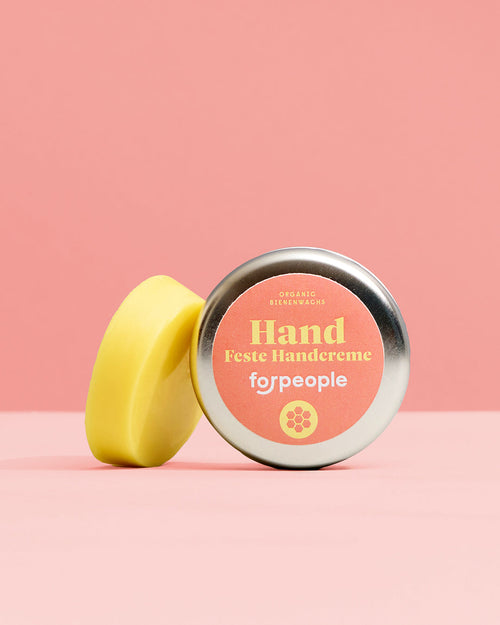
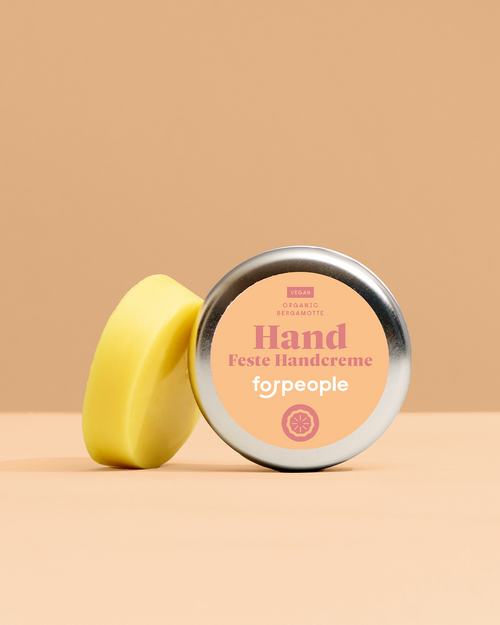
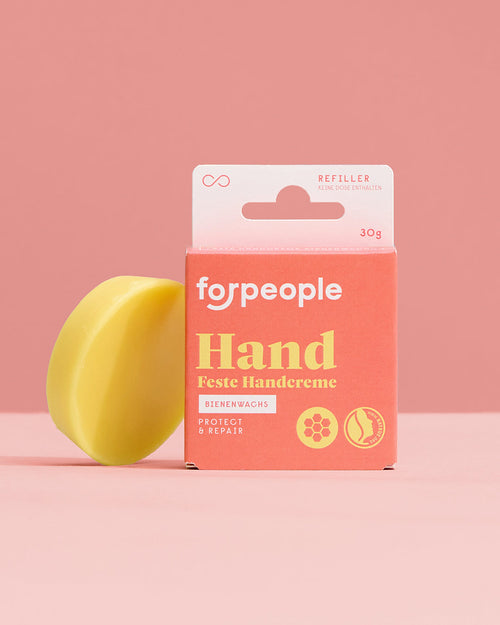
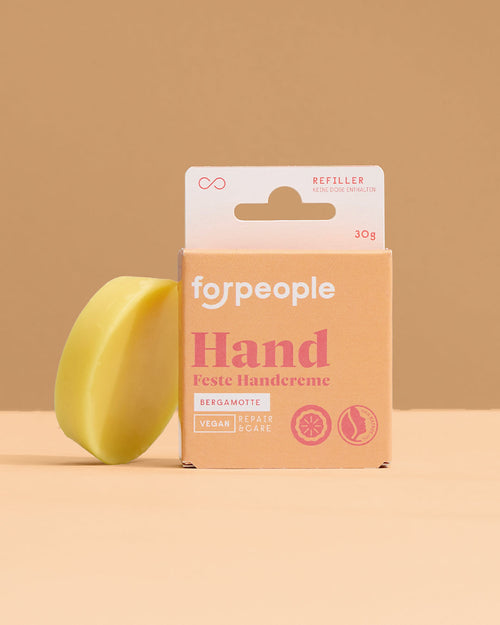
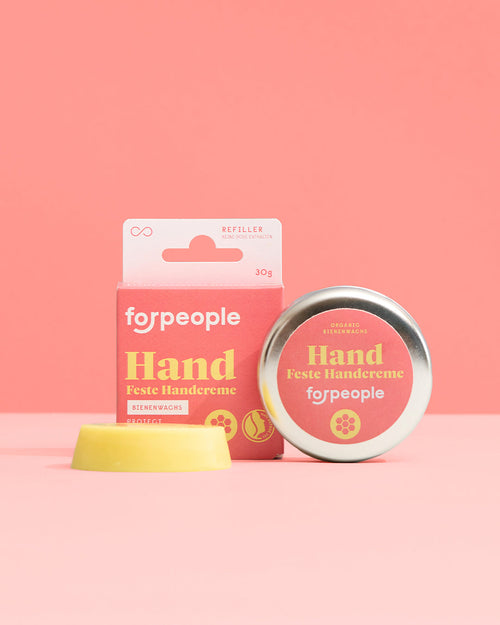
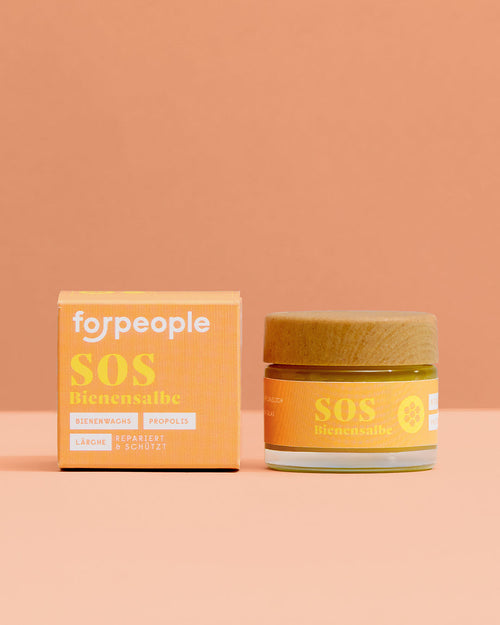
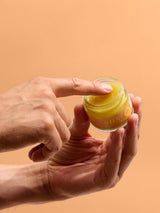
Our solid hand creams are water-free and fit in a small tin by the sink. According to its INCI list, the Solid Hand Cream - Beeswax (30 g, €9.90) contains beeswax, olive and sunflower oil, St. John's wort and aloe extract and no added essential oils. The vegan Solid Vegan Hand Cream - Bergamot (30 g, €9.90) is based on candelilla wax, jojoba oil, olive oil, shea butter and hemp oil and is scented with lemon and bergamot. When the tin is empty, you refill it with the Solid Hand Cream Refill - Beeswax or the Solid Vegan Hand Cream Refill - Bergamot (€7.90 each). For one tin in the kitchen and one in the bathroom there is the Hand Care Set – For Rough, Cracked Hands (2× Solid Hand Cream) (€16.90). For the night, the softer Beeswax Salve Larch & Mandarin in a Glass Jar (50 g, €12.90) is a good fit. More on this: Refillable hand cream · Dry despite moisturising? · Cracked fingertips in winter · Water-free cosmetics
Sources
- Ananthapadmanabhan KP, Moore DJ, Subramanyan K, Misra M, Meyer F (2004): Cleansing without compromise: the impact of cleansers on the skin barrier and the technology of mild cleansing. Dermatol Ther 17(Suppl 1): 16–25. https://doi.org/10.1111/j.1396-0296.2004.04s1002.x
- Berardesca E, Vignoli GP, Distante F, Brizzi P, Rabbiosi G (1995): Effects of water temperature on surfactant-induced skin irritation. Contact Dermatitis 32(2): 83–87. https://doi.org/10.1111/j.1600-0536.1995.tb00751.x
- Ohlenschlaeger J, Friberg J, Ramsing D, Agner T (1996): Temperature dependency of skin susceptibility to water and detergents. Acta Derm Venereol 76(4): 274–276. https://doi.org/10.2340/0001555576274276
- Ramsing DW, Agner T (1996): Effect of glove occlusion on human skin. (I). Short-term experimental exposure. Contact Dermatitis 34(1): 1–5. https://doi.org/10.1111/j.1600-0536.1996.tb02102.x
- Wetzky U, Bock M, Wulfhorst B, John SM (2009): Short- and long-term effects of single and repetitive glove occlusion on the epidermal barrier. Arch Dermatol Res 301(8): 595–602. https://doi.org/10.1007/s00403-009-0980-4
- Ausschuss für Gefahrstoffe (2022): TRGS 401 Gefährdung durch Hautkontakt – Ermittlung, Beurteilung, Maßnahmen. Ausgabe Oktober 2022, GMBl 2022 S. 895–926, zuletzt geändert GMBl 2024 S. 769. https://www.baua.de/DE/Angebote/Regelwerk/TRGS/TRGS-401.html
- Lambers H, Piessens S, Bloem A, Pronk H, Finkel P (2006): Natural skin surface pH is on average below 5, which is beneficial for its resident flora. Int J Cosmet Sci 28(5): 359–370. https://doi.org/10.1111/j.1467-2494.2006.00344.x