










Why hairdressers' hands have to cope with so much
In a salon, your hands are wet many times a day. TRGS 530 names washing hair and cutting and setting damp hair as typical wet work. It sees this as a high hazard, because moisture weakens the skin's protective function against irritant and sensitising substances (AGS 2023). The BGW puts it like this: water and shampoo make the horny layer swell, skin lipids are washed out, and the skin dries out (BGW 2023).
A German study measured how much wetness adds up. Trained observers followed 106 eight-hour shifts. On average, wet work lasted about 2 hours and 17 minutes; in 58 per cent of the shifts it was between two and four hours, in 5 per cent more than that. More customers and more long hair meant more wet work (Kralj et al. 2011). The time spent in tight gloves was counted as well; under today's rule, that alone is no longer wet work.
The glove also asks a lot of your skin: wearing gloves without a break can additionally promote skin damage (AGS 2023). More on this under Hand cream under latex or nitrile gloves?.
What TRGS 530 requires for your hands
The Technical Rule applies in the version of 20 April 2023. It is aimed at employers and also covers mobile work and training establishments (AGS 2023).
| Topic | What the rule requires | Section |
|---|---|---|
| Sharing out wet work | Among several employees, with a balanced alternation between wet and dry work. | 4.3 (1) |
| Duration | Less than four hours a day for everyone; the aim is less than two hours. | 4.3 (2) |
| Gloves | Among other things for washing hair, for colouring, tinting and bleaching, for rinsing, for perms and hair straightening, for mixing, and for wet cleaning and disinfecting. | 4.4 (1) |
| Jewellery | No jewellery on arms or hands at work; underneath it, moisture and chemicals act on the skin particularly strongly. | 4.1 (3) |
| Hand-washing and hand-care station | With temperature-adjustable water, products for skin protection, skin cleansing and skin care, and single-use towels. | 4.2 (3) |
| Skin protection and hand hygiene plan | Is displayed where everyone can see it and assigns protection, cleansing and care to each task. | 4.4 (4) |
For the choice of skin products, the rule refers to TRGS 401; more on this under Hand care for manual work and gardening: what works?.
What goes on your skin, and when?
The BGW's model skin protection plan separates four moments (BGW 2023); free time comes on top as a fifth.
| Moment | Product | What for, and how |
|---|---|---|
| Before starting work and after breaks | Skin protection cream | On dry, clean hands, roughly the size of a hazelnut. It must have absorbed completely before you put gloves on. |
| During the task | Gloves | Long-cuffed disposable gloves or washing gloves for washing hair, disposable gloves for colour, perms, bleach and straightening. No powdered gloves. |
| After individual tasks, if needed | Washing hands | When they are dirty or after contact with hairdressing chemicals, with a pH skin-neutral cleanser. Dry well, then apply skin protection cream again. |
| After work | Skin care cream | On dry, clean hands; massage in carefully, including between the fingers, on the fingertips, nail folds and wrists. |
| Free time and night | Skin care cream | The BGW names skin care for your free time as well. An additional application overnight can support the skin's recovery (DGUV 2026). |
The German Social Accident Insurance also names skin care before longer breaks. That fits the hairdressing plan: skin care at the start of the break, skin protection cream before you carry on. What counts is your salon's own plan.
Two points apply to every care cream. First: it is not a skin protection product and should not be used before or during work that strains the skin (DGUV 2026). Second: skin products that are too greasy can soften the skin further under protective gloves and may reduce the protection the glove gives (AGS 2023).
When choosing products, the BGW advises picking ones without fragrance and without problematic preservatives where possible. For the shared hand-care station, the DGUV recommends dispensers or tubes; open containers such as jars do not meet the hygiene requirements there (DGUV 2026).
Apprentices and the self-employed working alone
During training the same rule applies: wet work is shared out equally among all employees, expressly including apprentices. Before you start the job, and at least once a year after that, there has to be an instruction session that includes advice on skin protection (AGS 2023). Ask about the skin protection plan early on and wear gloves from your very first hair wash.
If you work alone, you cannot share out wet work. Gloves for every hair wash matter all the more, and so does an appointment schedule in which wet and dry tasks alternate. That is our conclusion, not a rule of its own. In Germany, business owners in hairdressing are compulsorily insured with the BGW (BGW 2026).
After work: skin care in three steps
- After your last appointment, wash your hands with lukewarm water and dry them carefully.
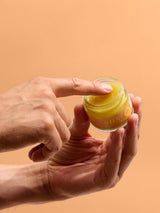
- Apply the care product to dry skin. With a solid cream, stroke your warm fingers over the surface and rub in the thin layer. The technique is shown in How do I apply a solid cream correctly?.
- Before bed, the layer can be a little thicker. Cotton gloves keep it on your hands; more on this under Overnight hand mask: what it does and how to do it.
A film of wax and oil reduces the evaporation of water from the skin. The mechanism is described on the page Occlusion and TEWL: how a wax film protects your skin.
When to seek medical advice?
Have redness, scaling, cracks, small blisters or a burning feeling on your hands looked at early if they do not settle within a few days: by your company doctor or at a skin specialist's practice. TRGS 530 provides for occupational health checks, as an offer from regularly more than two hours of wet work a day and as mandatory from four hours (AGS 2023). In a Danish survey of 5,324 trained hairdressers, three quarters of those affected first had hand eczema between the ages of 15 and 24 (Lysdal et al. 2011). The BGW offers its insured members a skin consultation with an examination by a specialist doctor (BGW 2026). Cosmetics do not belong on open or weeping areas.
Frequently asked questions
Can I use my own hand cream in the salon?
During working hours, your salon's skin protection and hand hygiene plan applies. Your own care product belongs to the time after work and to your free time. A tin you dip your finger into is a personal item, not a product for the shared wash station.
Can I put on hand cream before washing hair instead of wearing gloves?
No. Under TRGS 530, gloves are to be worn for washing hair. A care cream is not a skin protection product, and a greasy film under the glove can soften the skin further.
Do I have to wash my hands after taking my gloves off?
Not every time. The BGW advises drying your hands with a single-use towel after taking the gloves off, provided direct skin contact with hairdressing chemicals can be ruled out. You wash them when they are visibly dirty or after contact with chemicals.
Do cotton gloves under disposable gloves help?
The BGW recommends them when you wear the gloves for longer, for example when colouring. Change liner gloves once they are damp.
With or without scent: which care product fits after work?
The BGW advises choosing products without fragrance where possible. Essential oils are fragrances too. Which of our products contain no added scent is shown in the overview Without fragrance and essential oils: ingredients at a glance.
At forpeople
Our solid hand creams are care products for the time after work. They are not skin protection products and no substitute for gloves, and we have not tested them for compatibility with glove materials. So do not apply them right before putting gloves on.
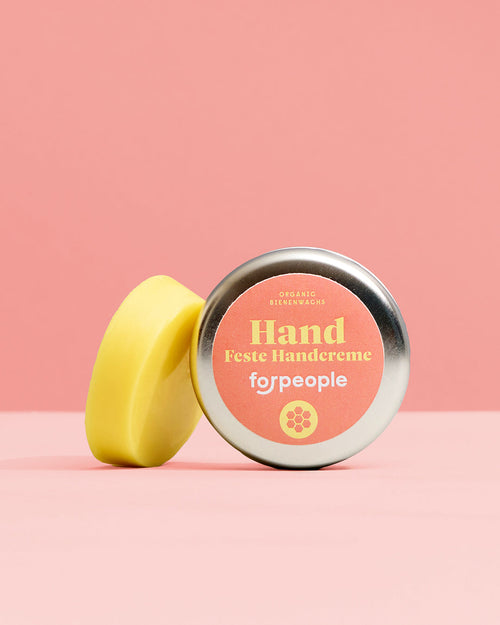
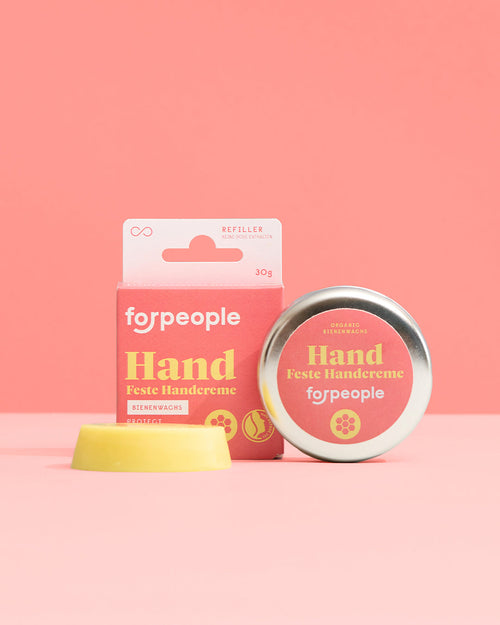
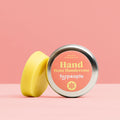
- Solid Hand Cream - Beeswax, 30 g, €9.90: according to the ingredient list, beeswax, olive and sunflower oil, St. John's wort and aloe extract. Without water and without added scent; it smells faintly of beeswax.
- Hand Care Set – For Rough, Cracked Hands (2× Solid Hand Cream), 60 g, €16.90: one tin and one refill.
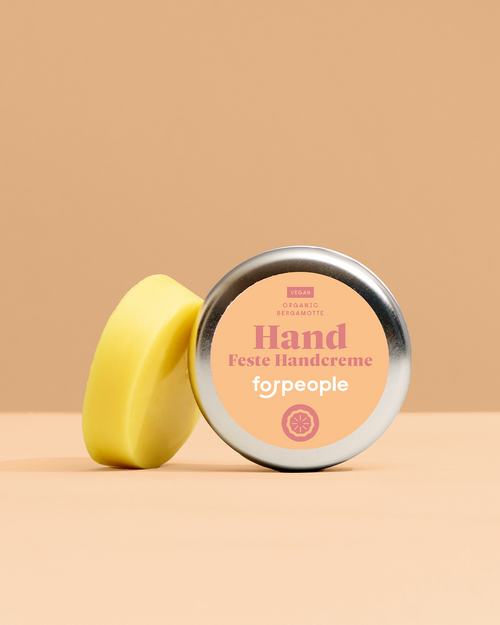
- Solid Vegan Hand Cream - Bergamot, 30 g, €9.90: vegan, with candelilla wax, jojoba oil, olive oil, shea butter and hemp oil. It contains lemon and bergamot oil; the ingredient list names limonene, geraniol, citral and linalool.
- Beeswax Salve Larch & Mandarin in a Glass Jar, 50 g, €12.90: a soft salve for the evening. It is scented and contains larch resin, propolis and essential oils; more on this under Allergic to tree resin, colophony or propolis?.
If you notice a skin reaction, stop using the product. More on this: Dry, cracked hands from frequent washing: what helps? · Hand sanitiser and hand cream: which comes first? · Solid hand cream: beeswax or bergamot – which one suits you?
From the blog: Switching to solid skincare: what is different in the first weeks
Sources
- Ausschuss für Gefahrstoffe (2023): TRGS 530 Friseurhandwerk. Technische Regel für Gefahrstoffe, Fassung vom 20.04.2023, GMBl 2023 S. 627–634 (Nr. 30). https://www.baua.de/DE/Angebote/Regelwerk/TRGS/TRGS-530
- Berufsgenossenschaft für Gesundheitsdienst und Wohlfahrtspflege (2023): Hautschutz- und Händehygieneplan für Mitarbeiterinnen und Mitarbeiter im Friseurhandwerk. Bestell-Nr. BGW 06-13-090, Stand 10/2023. https://www.bgw-online.de/bgw-online-de/service/medien-arbeitshilfen/medien-center/hautschutz-und-haendehygieneplan-friseurhandwerk-20178
- Deutsche Gesetzliche Unfallversicherung (2026): DGUV Information 212-017 Auswahl, Bereitstellung und Benutzung von beruflichen Hautmitteln. Ausgabe August 2026. https://publikationen.dguv.de/regelwerk/dguv-informationen/853/auswahl-bereitstellung-und-benutzung-von-beruflichen-hautmitteln
- Kralj N, Oertel C, Doench NM, Nuebling M, Pohrt U, Hofmann F (2011): Duration of wet work in hairdressers. International Archives of Occupational and Environmental Health 84(1): 29–34. https://doi.org/10.1007/s00420-010-0564-9
- Lysdal SH, Søsted H, Andersen KE, Johansen JD (2011): Hand eczema in hairdressers: a Danish register-based study of the prevalence of hand eczema and its career consequences. Contact Dermatitis 65(3): 151–158. https://doi.org/10.1111/j.1600-0536.2011.01935.x
- Berufsgenossenschaft für Gesundheitsdienst und Wohlfahrtspflege (2026): Pflichtversicherung für Unternehmerinnen und Unternehmer; Hautsprechstunde. Internetseiten der BGW, abgerufen am 08.10.2026. https://www.bgw-online.de/bgw-online-de/service/beitrag-leistung/versicherungsschutz/pflichtversicherung-fuer-unternehmerinnen-und-unternehmer-91482 · https://www.bgw-online.de/bgw-online-de/service/schulung-beratung/hautsprechstunde-19010