Five in the morning in the milking parlour, midday on the tractor with the crop sprayer, afternoon building fences, evening feeding the calves and greasing the mower bar. Hardly any job switches so often between wet, dirty, oily and cold. What helps in the barn in winter is described in Cracked hands from stable work: what helps in winter?. This page goes through the whole year and all the jobs on the farm.
What puts a strain on your hands on the farm
The German agricultural social insurance SVLFG lists five groups that damage the skin: moisture, mechanical strain from abrasion and injuries, cold, heat and UV radiation, chemical substances such as acids, alkalis and solvents, and biological strain from bacteria, viruses, fungi and plant and animal allergens (SVLFG 2021). On a dairy farm, almost all of these come together in a single day.
How often this leads to skin problems was studied by Finnish researchers in large surveys in the 1990s. Of 10,847 farmers, 16 per cent of the women and 7 per cent of the men reported skin problems on the hands or forearms within one year; among women on farms with more than nine dairy cows, the figure was 20 per cent. Occupational risks included daily handling of disinfectants and silage additives, milking and machine maintenance (Susitaival et al. 1994). When those affected were examined by doctors, 93 per cent of the skin problems were eczema, 70 per cent were considered work-related, and 39 per cent of the people tested were allergic to cattle (Susitaival et al. 1995). The data are old and come from Finland, where allergies to cattle dander are particularly common; in the Finnish register of occupational diseases from 2005 to 2016, cattle dander, together with flour and grain, was the most common trigger of contact urticaria and protein contact dermatitis (Pesonen et al. 2020). The SVLFG also lists cattle hair among the common allergy triggers (SVLFG 2021).
| Job | What strains the skin | Hand protection | Afterwards |
|---|---|---|---|
| Milking, udder and teat care | wet work, disinfectants, cattle hair and dander | disposable nitrile glove with a long cuff, cotton glove underneath | take off gloves, dry your hands |
| Feeding, mucking out, bedding | friction from fork and shovel, dust, damp bedding | work glove against mechanical strain (EN 388) | knock off dust, wash only when visibly dirty |
| Calving, sick animals | body fluids, pathogens | disposable gloves, liquid-tight | hand disinfection according to the plan |
| Applying crop protection products, cleaning the sprayer | crop protection products that can be absorbed through the skin | chemical protective glove for crop protection (ISO 18889 or EN 374) | rinse the glove, wash your hands, then apply skincare |
| Machine maintenance, workshop | oils, greases, solvents; risk of being drawn in at rotating parts | chemical protective glove; no glove at rotating parts | remove oil without solvents |
| Field work and harvest | sun, friction, dust | work glove; sun protection on uncovered skin | skincare in the evening |
| Wood, fencing, forestry | splinters, resin, cold | work glove, in winter with cold protection (EN 511) | loosen resin with oil, then wash |
Sources for the table: SVLFG 2021, SVLFG 2020, AGS 2022, DGUV 2026. The assignment to individual farm jobs is practice; it has not been measured. How to get oil, grease and resin off your skin: Oil and grease on your hands: how do you wash them off gently? and Getting resin off your hands and fingers: how to do it with oil.
Milking: wet work with gloves
The SVLFG explicitly names milking as an example of wet work (SVLFG 2021). Under the German workplace rule TRGS 401, wet work exists when someone regularly has skin contact with water or watery liquids for more than two hours a day, or frequently wears liquid-tight gloves alternating with contact with water (AGS 2022). For the milking parlour, the SVLFG recommends disposable nitrile gloves with a long cuff: liquid-tight, latex-free and with a good sense of touch (SVLFG 2021). In the SVLFG's sample skin protection plan for the cowshed, a cotton glove comes first for milking, with the long-cuff nitrile glove over it (SVLFG 2020).
The cotton glove has a reason: sweat builds up under tight gloves and the outer layer of skin swells. TRGS 401 advises changing gloves when they become damp inside and rates wearing them without a change for more than four hours a day as a strain. After taking them off, hands should only be dried and not washed straight away, because the skin is more vulnerable then (AGS 2022). How cream and glove material get along is covered in Hand cream under latex or nitrile gloves?
No skincare cream belongs on your hands right before milking. A film of fat and wax makes your grip less secure and does not belong on the udder. Before work, if the skin protection plan provides for it, a skin protection product goes on; skincare products must not replace a skin protection product, because some ingredients, such as urea, can help other substances penetrate the skin (AGS 2022).
The classic skincare product from the barn is milking grease (Melkfett). It was developed for udders and teats, traditionally consists of petroleum jelly and paraffin, and has long been used for rough hands too. What is in it and what to look for when buying it is explained in What is Melkfett (udder balm)? What it is made of and what it is for; the comparison with wax and oil salves is made in Petroleum jelly or beeswax salve: the difference.
Crop protection, workshop and sun: protection first, then skincare
Chemical protective gloves must be used for handling crop protection products; some substances damage the skin directly or are absorbed through it. Before each use, check the glove for holes and tears; after each use, rinse it thoroughly with water and replace it regularly, because it loses its protective effect in contact with the product. How long it lasts with a particular product is stated in the safety data sheet. And: do not use skin protection products under chemical protective gloves, because they can impair the glove's protective effect (SVLFG 2021); the SVLFG's skin protection plan limits this to gloves without cotton liners (SVLFG 2023). The same applies all the more to skincare creams. Skincare comes after work, when your hands are washed and dry.
The workshop has an exception: at machines where there is a risk of being drawn in, such as rotating shafts, wearing protective gloves is prohibited (AGS 2022). Here, skin protection according to the plan applies, and afterwards you remove oil and grease with a skin cleanser instead of thinner or a brush (SVLFG 2021).
Anyone who works outdoors a lot around midday in spring and summer, for example in agriculture and horticulture, is usually exposed to a high dose of UV. The statutory accident insurance orders protection like this: first shade and working hours, then clothing, headwear and long sleeves, and in addition sunscreen on all uncovered skin; on top of that comes the offer of an occupational health check-up (DGUV 2026). That includes the backs of your hands; more in Sun protection for the backs of your hands. For your hands during field work, a solid stick such as the Solid Sunscreen SPF50, mineral with zinc oxide and titanium dioxide, works well; it does not replace gloves or clothing.
A skin protection plan for the farm
The SVLFG calls skin protection products, skin cleansing, skincare and protective gloves inseparable parts of skin protection; only together do they work (SVLFG 2021). Its plan for the washing area sums up the rules briefly (SVLFG 2023):
- Skin protection before starting work, after breaks and after handwashing, on clean skin.
- Gloves only over clean, dry hands; change soaked ones; cotton gloves under liquid-tight gloves.
- Handwashing only when hands are visibly or noticeably dirty. More than ten handwashes a day damage the skin barrier. Cleansers pH-neutral for the skin and without perfume, no brushes, no scouring agents, no cleaning petrol.
- Skincare after work, after the last handwash. Skincare and protection products should contain no fragrances or preservatives.
- Hand disinfection after hygienically sensitive jobs, in the sample plan for the cowshed for example after helping with calving (SVLFG 2020), on dry hands and without rinsing.
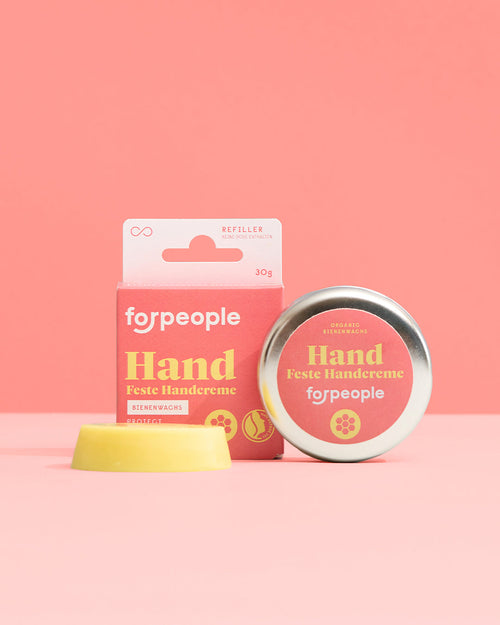
For skincare after work, a water-free cream made of wax and oil works well. According to its ingredient list, the Solid Hand Cream - Beeswax consists of beeswax, olive and sunflower oil with St. John's wort and aloe extract, without added fragrance and without preservatives. In a cold barn it becomes firm; carry the tin close to your body. For individual rough patches in the evening, for example on fingertips or knuckles, the SOS Pitch Salve - Larch Resin in a Glass Jar leaves a tough film; the softer Beeswax Salve – Larch & Mandarin in a Glass Jar also contains propolis and essential oils. Both contain larch resin; if you react to tree resins, colophony or propolis, check this first (Colophony allergy, propolis, beeswax: symptoms and advice). Thicker layers overnight are described in Overnight hand mask: what it does and how to do it.
| Product | Base | When | Fragrance | Note |
|---|---|---|---|---|
| Skin protection product according to the plan | depending on the hazard | before work, after breaks | preferably none | not under chemical protective gloves without liners |
| Classic milking grease | petroleum jelly, paraffin | after work, overnight | usually none | for your hands, choose one labelled as a cosmetic |
| Solid Hand Cream - Beeswax | beeswax, olive and sunflower oil | after work, in the evening | no added fragrance | becomes firm in the cold; carry it close to your body |
| SOS Pitch Salve - Larch Resin | olive oil, larch resin, beeswax | in the evening on individual rough patches | natural scent of the resin | not with a resin allergy |
| Beeswax Salve – Larch & Mandarin | oils, beeswax, larch resin, propolis | in the evening on individual rough patches | essential oils | not with a resin or propolis allergy |
The table describes composition and use, not a ranking. None of these products protects against frost: Cold cream: water-free, but no protection from frost. For horticulture and trades, see Hand care for manual work and gardening: what works?
When to get medical advice?
Have your hands checked by a dermatologist or an occupational physician if they stay red, flake, itch, crack or form blisters despite gloves and skincare, if they react after contact with animals, plants or barn products, or if symptoms keep coming back. If a work-related skin disease is suspected, the practice sends a dermatologist's report to the SVLFG; in the dermatologist procedure, treatment costs and protective measures can be covered so that you can stay in your job (SVLFG 2021). How hand eczema differs from dry skin is explained in Dry hands or hand eczema?
Skin fungi from cattle are a special case. Cattle ringworm is transmitted by Trichophyton verrucosum, often causes strong inflammation in humans and is not infrequently mistaken at first for a bacterial infection. Examining skin scales is decisive for the diagnosis; it can be recognised as an occupational disease (Schumny et al. 2020). In the German list it appears under number 3102, "diseases transmissible from animals to humans", and hand eczema under 5101 (BKV Annex 1). Strongly inflamed, scaly or pus-filled skin areas after contact with cattle therefore belong in a doctor's practice, not under a cream. No cosmetics go on open, bleeding or weeping areas.
Frequently asked questions
Should I moisturise before milking?
Not with a skincare cream. It makes your grip less secure and does not belong on the udder. Before work, if your skin protection plan provides for it, a skin protection product goes on; skincare follows after milking.
Which gloves should I use for milking?
The SVLFG names disposable nitrile gloves with a long cuff. A thin cotton glove underneath absorbs the sweat; change gloves that have become damp.
Can I apply cream under chemical protective gloves?
No. The SVLFG advises not using skin protection products underneath, because they can impair the protective effect; the same applies to skincare creams. Skincare comes after work.
How often a day can I wash my hands?
As often as necessary, but not out of habit. According to the SVLFG, more than ten handwashes a day damage the skin barrier. Coarse, dry dirt can often be knocked off.
Is milking grease good for your hands?
It is a rich, water-free ointment and suits dry hands after work and overnight. For your hands, choose one labelled as a cosmetic; it does not replace gloves.
Why do my hands react to the cows?
Cattle hair and dander are among the common allergy triggers in farming. Whether you are allergic is shown by an allergy test at a dermatologist; sometimes an infection such as cattle ringworm is the cause.
Can I also use the hand cream on the udder?
No. Our hand creams are cosmetic products for human skin. There are separate products for the udder; ask your vet about them.
At forpeople
Our solid creams and salves are skincare for after work and for the evening. They are not skin protection products, no protection from frost and no substitute for gloves, and according to the product information they are not used on injured or irritated skin.
Solid Hand Cream - Beeswax, 30 g, €9.90: beeswax, olive and sunflower oil, no added fragrance.
Hand Care Set – For Rough, Cracked Hands (2× Solid Hand Cream), 60 g, €16.90: one tin and one refill for topping up.
SOS Pitch Salve - Larch Resin in a Glass Jar, 50 g, €16.90: olive oil, larch resin and beeswax for individual rough patches.
Solid Sunscreen SPF50, 40 g, €17.90: mineral stick with zinc oxide and titanium dioxide for uncovered skin during field work.
More on this: Cracked hands from stable work · What is Melkfett (udder balm)? · Hand care in nursing
Sources
- Sozialversicherung für Landwirtschaft, Forsten und Gartenbau (2021): Hautschutz. Broschüre B34, Reihe „Aktuelles zu Sicherheit und Gesundheitsschutz“, Stand 01/2021. https://www.svlfg.de/koerperschutz
- Sozialversicherung für Landwirtschaft, Forsten und Gartenbau (2020): Hand- und Hautschutzplan – Muster für den Kuhstall (Melkarbeit, Futtervorlage), Stand 20.04.2020, accessed 28.10.2026. https://cdn.svlfg.de/fiona8-blobs/public/svlfgonpremiseproduction/94652077c0c3bd3a/b2093227783a/hand-hautschutzplan-beispiel.pdf
- Sozialversicherung für Landwirtschaft, Forsten und Gartenbau (2023): Hand- und Hautschutzplan für Waschplätze mit Tipps zur Anwendung, PDF, accessed 28.10.2026. https://cdn.svlfg.de/fiona8-blobs/public/svlfgonpremiseproduction/d246569307c2c4c0/1382611514dc/hand-und-hautschutzplan-am-waschpl.pdf
- Ausschuss für Gefahrstoffe (2022): TRGS 401 Gefährdung durch Hautkontakt – Ermittlung, Beurteilung, Maßnahmen. Ausgabe Oktober 2022, GMBl 2022 S. 895–926 (Nr. 40), last amended GMBl 2024 S. 769 (Nr. 36); sections 3.3.6, 5.5.1, 5.5.3, 5.5.5 and 5.6. https://www.baua.de/DE/Angebote/Regelwerk/TRGS/TRGS-401
- Susitaival P, Husman L, Horsmanheimo M, Notkola V, Husman K (1994): Prevalence of hand dermatoses among Finnish farmers. Scand J Work Environ Health 20(3): 206–212. https://doi.org/10.5271/sjweh.1407
- Susitaival P, Husman L, Hollmén A, Horsmanheimo M, Husman K, Hannuksela M (1995): Hand eczema in Finnish farmers. A questionnaire-based clinical study. Contact Dermatitis 32(3): 150–155. https://doi.org/10.1111/j.1600-0536.1995.tb00805.x
- Pesonen M, Koskela K, Aalto-Korte K (2020): Contact urticaria and protein contact dermatitis in the Finnish Register of Occupational Diseases in a period of 12 years. Contact Dermatitis 83(1): 1–7. https://doi.org/10.1111/cod.13547
- Deutsche Gesetzliche Unfallversicherung (2026): DGUV Information 212-017 Auswahl, Bereitstellung und Benutzung von beruflichen Hautmitteln. Ausgabe August 2026; section 5.2 Sonnenschutzmittel. https://publikationen.dguv.de/regelwerk/dguv-informationen/853/auswahl-bereitstellung-und-benutzung-von-beruflichen-hautmitteln
- Schumny U, Wiegand C, Hipler UC, Darr-Foit S, Peckruhn M, Uhrlaß S, Nenoff P, Elsner P (2020): Berufliche Infektion mit Trichophyton verrucosum bei einem Rinderzüchter. Hautarzt 71(11): 899–902. https://doi.org/10.1007/s00105-020-04655-7
- Berufskrankheiten-Verordnung (BKV), Anlage 1 (BGBl. I 1997, S. 2625–2626, as amended), nos. 3102 and 5101. gesetze-im-internet.de, accessed 28.10.2026. https://www.gesetze-im-internet.de/bkv/anlage_1.html