




Why strings build calluses
When you fret a note, you press a thin string onto the fingerboard with a small contact area, often hundreds of times in one practice hour. The skin responds to pressure and friction by thickening its outer layer. Studies of calluses show that more skin cells are produced, the cells stick together more firmly and they shed more slowly (Kim et al. 2010). The result is a firm, less sensitive layer exactly where the strings hit.
This is common among musicians. In a survey at 19 German universities of music, 89 of 412 respondents reported instrument-related skin changes; calluses were the most frequent, and string and plucked-string players were affected most (Gambichler et al. 2008). In this survey, calluses were also significantly associated with frequent practice and with playing professionally. So calluses are not a flaw; they are wanted. The only question is how to keep them in good shape.
Too soft or too hard: what the debate is about
Guitar forums offer two opposing pieces of advice: "never moisturise, or the calluses go soft" and "moisturise, or they will crack". Both contain some truth; they just apply at different times.
Water softens calluses. Skin cells take up water, swell and become more pliable; in a laboratory study they increased markedly in thickness and volume when immersed in water and became softer (Évora et al. 2024). You know this after a bath or washing up: your fingertips are wrinkled and soft, and playing hurts more afterwards.
Dry calluses become brittle. Measurements on thickened skin show that callus holds less moisture and is less elastic than the skin next to it (Hashmi et al. 2015, measured on the foot). A stiff, dry edge is more likely to crack when it catches on a string or when the skin dries out further in winter. How the outer skin layer holds water is explained in The skin barrier explained simply.
| Phase | What happens at the fingertips | Care |
|---|---|---|
| The first weeks | fingertips hurt, skin thickens | practise briefly and regularly, do not soak your fingertips, at most moisturise very thinly in the evening |
| Calluses have formed | firm, smooth fingertips | moisturise thinly after playing or in the evening, smooth the edges when needed |
| Winter, heated air, lots of hand washing | fingertips get rough, edges lift | moisturise more regularly, wear gloves outdoors |
| Longer break | calluses get thinner | keep up normal care, then build up slowly again |
How to care for your fingertips
- Before playing: wash your hands with soap and water, dry them well, no cream. Otherwise grease and sweat end up on the strings and fingerboard. Right after a long shower, wait a few minutes until your fingertips are no longer softened.
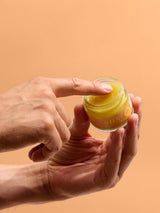
- After playing or in the evening: put a small amount of cream or balm on your fingertips and massage it in. Water-free creams made of wax and oil leave a film that reduces evaporation without softening the calluses the way water does. More on the principle in Occlusion and TEWL and How long does a care film stay on the skin?
- Smooth the edges: if an edge lifts, file it down carefully with a fine file or pumice stone, ideally on dry skin. Do not peel, do not bite, do not cut with blades.
- Keep your nails short: on the fretting hand, long nails push the fingertip onto the string at an angle. For the picking hand on classical guitar, different rules apply.
- Wipe the strings: after playing, wipe the strings with a dry cloth so sweat and skin oil do not stay on them.
Research on gripping also shows why fingertip moisture matters: participants held an object with the least force when their fingertips had a medium level of moisture that was favourable for friction (André et al. 2010). Too dry is therefore just as unhelpful as too moist. The same logic applies to climbing, where it is described in detail in Caring for fingertip calluses when climbing and Moisturise before or after climbing?
What stresses calluses
- Hot water and washing-up liquid: soften the fingertips and strip oil from the skin. Gloves help when washing up; more in Rough hands from washing up.
- Winter air: cold outside, dry heated air inside. Why fingertips crack then is explained in Cracked fingertips in winter.
- Long sessions after a break: the skin has thinned, and the load comes suddenly. Several short sessions are better.
- Picking at them: tearing off loose callus often takes healthy skin with it and leaves a sensitive spot.
When to seek medical advice
A crack or an open blister on a fingertip is not a job for cream. Take a break, keep the spot clean and cover it. Have it checked by a doctor if cracks bleed or do not close, if there is redness, swelling, warmth or increasing pain, or if numbness or tingling in your fingers does not go away after playing.
Frequently asked questions
Does hand cream make calluses soft?
A thin layer of water-free cream after playing makes calluses supple, but not soft the way long exposure to water does. It keeps them supple so they are less likely to become brittle and crack.
How long does it take for calluses to form?
That varies and depends on how often and how long you play. Regular short sessions work better than rare long ones.
Should I use alcohol or salt water to toughen them?
That dries the skin out and makes it more brittle. Regular playing is enough to build calluses.
Can I moisturise right before a gig?
Better not. Care belongs to the evening before or after the show. Before playing, wash and dry your hands.
Does this also apply to bass, ukulele and violin?
Yes, the principle is the same for all string instruments. Thicker strings spread the pressure over a larger area; thin steel strings concentrate it.
At forpeople
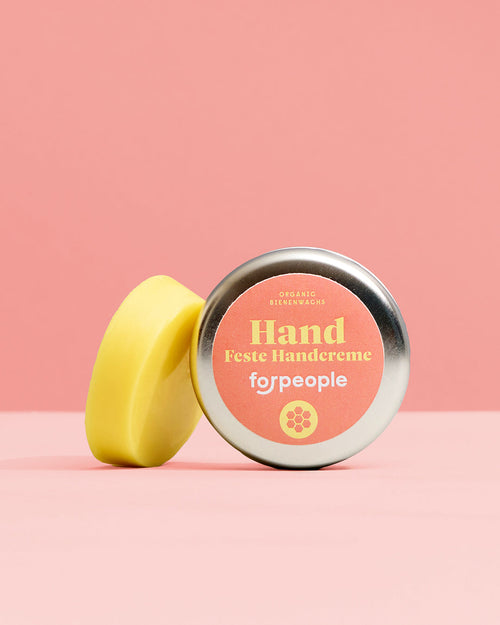
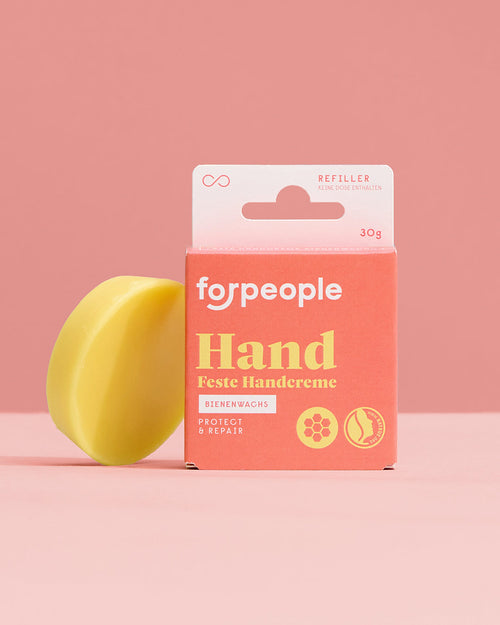
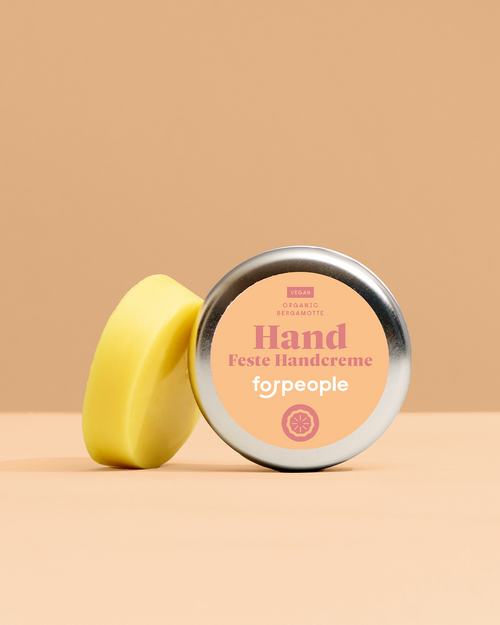
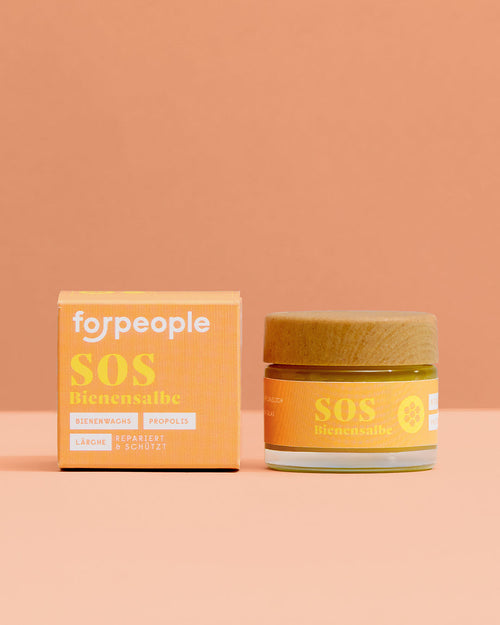
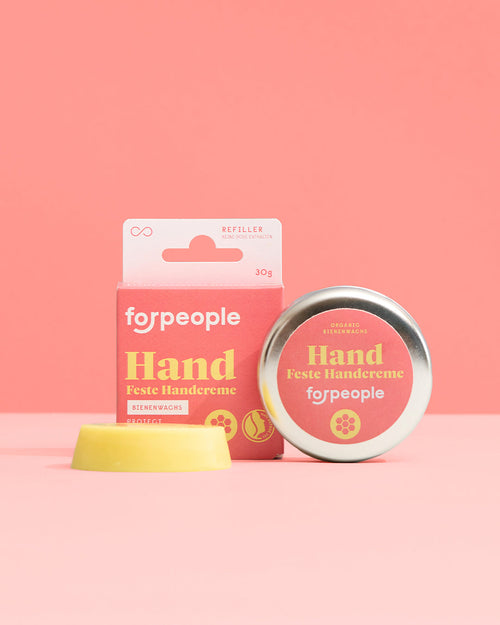
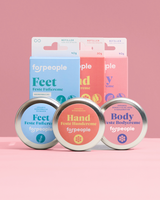
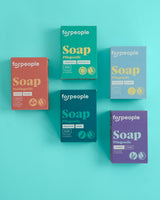
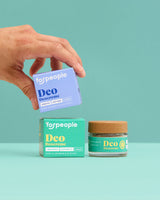
The Solid Hand Cream - Beeswax (30 g, €9.90), made from beeswax, olive and sunflower oil, is easy to dose on your fingertips because only as much melts as you rub; according to its INCI list it has no added fragrance and no essential oils. The tin fits into the pocket of your gig bag and does not leak. You can refill it with the Solid Hand Cream Refill - Beeswax (€7.90). A vegan option scented with lemon and bergamot oil is the Solid Vegan Hand Cream - Bergamot (30 g, €9.90). If you prefer a thicker film in the evening, try the Beeswax Salve Larch & Mandarin in a Glass Jar (50 g, €12.90); it contains larch resin and essential oils, see Allergy to tree resin. For the rehearsal room and home, there are two tins in the Hand Care Set – For Rough, Cracked Hands (2× Solid Hand Cream) (€16.90). For heat in the tour van, see Storing solid cosmetics. More on this: Calluses from strength training · How to apply a solid cream · Why hands dry out faster · Hand cream for men
Sources
- Kim SH, Kim S, Choi HI, Choi YJ, Lee YS, Sohn KC et al. (2010): Callus formation is associated with hyperproliferation and incomplete differentiation of keratinocytes, and increased expression of adhesion molecules. Br J Dermatol 163(3): 495–501. https://doi.org/10.1111/j.1365-2133.2010.09842.x
- Gambichler T, Uzun A, Boms S, Altmeyer P, Altenmüller E (2008): Skin conditions in instrumental musicians: a self-reported survey. Contact Dermatitis 58(4): 217–222. https://doi.org/10.1111/j.1600-0536.2007.01310.x
- Évora AS, Zhang Z, Johnson SA, Adams MJ (2024): The effects of hydration on the topographical and mechanical properties of corneocytes. J Mech Behav Biomed Mater 150: 106296. https://doi.org/10.1016/j.jmbbm.2023.106296
- Hashmi F, Nester C, Wright C, Newton V, Lam S (2015): Characterising the biophysical properties of normal and hyperkeratotic foot skin. J Foot Ankle Res 8: 35. https://doi.org/10.1186/s13047-015-0092-7
- André T, Lefèvre P, Thonnard JL (2010): Fingertip moisture is optimally modulated during object manipulation. J Neurophysiol 103(1): 402–408. https://doi.org/10.1152/jn.00901.2009