A golden drop of resin glistens on a spruce trunk, and the memory of the salve in your grandmother's cupboard comes straight back. Making pitch salve yourself is not difficult. The tricky part is the detail: which resin, how much of it, how hot, and what you need to consider when collecting, heating and giving it away. These instructions stay within cosmetics; what pitch salve is and is not is explained in Larch resin salve and resin salve: what is in them and how they differ.
Ingredients and proportions
Pitch salve has three building blocks. Weigh everything on kitchen scales; spoon measures are too imprecise for resin and wax. The values are practical experience, not a standard. Two home recipes from Salzburg that we read on 28 October 2026 each use 100 g olive oil, 30 g larch and spruce resin and 10 g beeswax.
| Ingredient | Role | Starting value (for about 140 g) | Range | More of it makes the salve … |
|---|---|---|---|---|
| Plant oil, traditionally olive oil | dissolves the resin, forms the base | 100 g | reference amount | softer |
| Resin, easiest is purified larch resin | scent, tough and adhesive texture | 25 g | 20–30 g | stickier, more resinous in scent |
| Beeswax | makes the mixture firm | 15 g | 10–20 g | firmer, less greasy |
How wax makes oil firm and which proportions suit salve, cream and stick is explained in Making solid cream at home: how much wax to oil? Resin also makes the mixture tougher, so a pitch salve needs a little less wax than a plain wax-and-oil salve. More resin, however, also means more of the substances some people are allergic to.
Which resin: buy it or collect it?
For a start, purified larch resin is the easiest. It stays viscous because its resin acids hardly crystallise in air, and during production it is cleaned, filtered several times, gently warmed and clarified by decanting (Lagoni 2012). It is also sold as larch turpentine or Venice turpentine. Make sure it is offered for use on the skin; products from art suppliers are intended for paints and varnishes.
Spruce and pine resin harden in air. Solid resin from wounds in the tree is traditionally collected with a scraper ("scrape resin") (BOKU). It contains bits of bark, needles and insects and has to be dissolved in oil and filtered. The scent is more austere and the colour darker.
If you collect resin yourself, you need permission from the forest owner or the forestry office. Never cut into a tree: tapped trunks are more susceptible to pests and disease, and the timber can lose value (BOKU). Only take small amounts of resin that has already seeped out and hardened. How resin used to be harvested is described in Pitch salve: origin, name and how it used to be made; what distinguishes resin from pitch and wood tar in Larch resin, pine pitch, wood tar: the difference.
Tools and workspace
- Kitchen scales, ideally accurate to 0.1 g
- A pan for the water bath and a heat-resistant glass or stainless steel container that you only use for resin from now on; resin residue is stubborn
- A cotton cloth, tea filter or fine sieve for filtering, plus a second container
- A spoon or wooden stick for stirring, and a metal spoon in the freezer for the test
- Clean, completely dry jars or tins and labels
- Disposable gloves if you handle raw resin
- An electric or induction hob, an open window and a matching lid within reach
Step by step
- Prepare: open the window, clear away anything flammable, keep children and pets out of the kitchen. Clean all containers and let them dry completely.
- Dissolve the resin in the oil: weigh oil and resin, place the glass in the water bath and warm while stirring until the resin has dissolved. Larch resin takes a few minutes, solid spruce resin much longer; recipes let it steep in the warm oil for up to an hour. Only heat as much as necessary.
- Filter: pour the warm mixture through the cloth into the second container. Bark, needles and impurities stay behind.
- Add the wax: add the beeswax to the filtered mixture and melt it in the water bath. Its melting range is 62 to 65 °C (Regulation (EU) No 231/2012); a water bath is quite enough for that.
- Spoon test: put a few drops on the chilled spoon and wait a minute. If the sample is too soft, add a little wax; if it is too hard, a little oil.
- Fill: pour into the jars and let it set uncovered at room temperature. Only put the lid on once the salve has cooled completely, so that no condensation forms.
- Label: write the contents, ingredients and date on the label.
- Clean up: resin residue on containers and hands comes off best with oil, then with washing-up liquid and warm water. More in Removing resin from hands and fingers: how to do it with oil.
Safety: fire, skin, allergy
Resin is not only sticky, it contains volatile substances. In eight commercial larch resins, essential oil made up 7.8 to 15.5 percent, and more than half of it was alpha-pinene (Batista et al. 2024). The flash point of alpha-pinene is 33 °C (PubChem); above this temperature, the vapours can ignite at an ignition source. When you heat resin, you therefore work without an open flame.
| Hazard | Why | What you do |
|---|---|---|
| Fire | Vapours from the resin are flammable, hot oil can catch fire | Only in a water bath, never directly on the hob, never over a gas flame or candle; do not leave unattended |
| Fat fire | Water evaporates instantly in burning fat and carries it along | Never use water; turn off the hob, put a lid on (DFV/vfdb 2019); if it keeps burning, leave the room and call 112 |
| Scalding | Hot oil and wax stick to the skin | Hold the container with oven gloves, pour slowly |
| Contact allergy | Resins are well-known contact allergens | Gloves when handling raw resin; test the finished salve on a small area first |
On the allergy risk: in a meta-analysis of 73 studies, an average of 3.54 percent of people tested because of skin complaints reacted to colophony, the solid part of pine resin (Karimian et al. 2026). Larch resin is not colophony, but in a study of people with suspected colophony allergy it proved a useful additional test substance (Karlberg & Lidén 1985). Even for traditional use, the Bavarian State Institute of Forestry notes that irritation and allergic skin reactions always had to be expected (Lagoni 2012). If you know you react to colophony, you are better off skipping homemade resin salve or checking with a doctor first. Everyone else tests it on a small area first, as described in Trying new skincare: how do I test on a small area? More in Colophony allergy, propolis, beeswax: symptoms and advice.
Shelf life and storage
Microorganisms need water; one review calls water an ideal growth factor for germs in cosmetics (Halla et al. 2018). A salve made only of oil, resin and wax offers them hardly any conditions to grow, as long as no water gets in. It can still age: the oil oxidises, and the terpenes in the resin change in air and light. Larch turpentine is therefore stored tightly closed and protected from light (Lagoni 2012); the same applies to the salve.
- Only take it out with dry, clean fingers or a spatula.
- Store cool, dark and closed; in summer, not on the windowsill.
- If the salve smells rancid, like paint or clearly different from the start, throw it away.
There is no fixed figure; how long a salve keeps depends mainly on the oil. Background: Homemade cream: how long does it keep, and how can it last longer? · How to recognise rancid skin oil · Hygiene with water-free cosmetics: what to watch out for
Common mistakes and what helps
| Problem | Likely cause | Solution |
|---|---|---|
| Salve is very sticky | a lot of resin, little wax | melt again, add oil and a little wax |
| Too hard, hard to take out | too much wax | melt again, add oil, spoon test |
| Too soft, almost liquid | too little wax or very warm storage | add a little wax; store somewhere cooler |
| Crumbs, bits of bark | not filtered or cloth too coarse | dissolve again and filter through a finer cloth |
| Smells burnt | overheated, for example without a water bath | start again; only work in a water bath |
| Drops under the lid | lid put on the warm salve | dab off the drops; next time let it cool uncovered |
Giving it away and selling it: what cosmetics law says
For your own use there are no requirements. But as soon as a salve is supplied in the course of a commercial activity, whether for payment or free of charge, the EU Cosmetics Regulation applies (Regulation (EC) No 1223/2009, Art. 2). It then needs a responsible person, a safety assessment with a safety report and a notification before it is placed on the market (Art. 4, 10 and 13). That covers selling at a market or online as well as a business's free samples. If you give it away privately, write down the ingredients and the date and point out the resin and beeswax. Promises against complaints do not belong on a homemade label either.
When to seek medical advice
If redness, itching or blisters appear after contact with resin or the salve, stop using it and have the area checked by a doctor if it does not settle. If your face, lips or throat swell or you have trouble breathing, call 112. Burns from hot oil or wax that blister or are larger need medical care. And: homemade pitch salve is a care salve for dry, rough, intact skin, not a remedy for injured, red or painful areas.
Frequently asked questions
Which resin is suitable for pitch salve?
The easiest is purified larch resin, because it stays liquid and dissolves directly in the oil. Spruce resin is also used traditionally; it is solid and has to be filtered. Colophony is not a good choice for skin salves because it is a well-known contact allergen.
May I collect resin in the forest?
Only with the forest owner's permission. Do not cut into any tree and only take a little resin that has seeped out and hardened.
Why is my pitch salve so sticky?
Usually the resin content is high and the wax content low. Melt the salve in the water bath, add a little oil and wax and do the spoon test.
How long does homemade pitch salve keep?
As long as the oil stays fresh and no water gets in. There is no fixed figure. If it smells rancid or different from the start, stop using it.
Can I add essential oils?
Yes, but the resin already brings its own fragrance substances, and every essential oil adds more. If you add some, use little and only stir it into the slightly cooled mixture. More in Essential oils and fragrance allergens.
Can pitch salve be made without beeswax?
Yes, with candelilla wax. It is harder; start with about half to two thirds of the beeswax amount. The differences are explained in Candelilla wax or beeswax: the differences.
May I sell my pitch salve at a market?
Only if all obligations of the Cosmetics Regulation are met, including a safety assessment by a qualified person and notification to the EU portal.
If you would rather not make it yourself
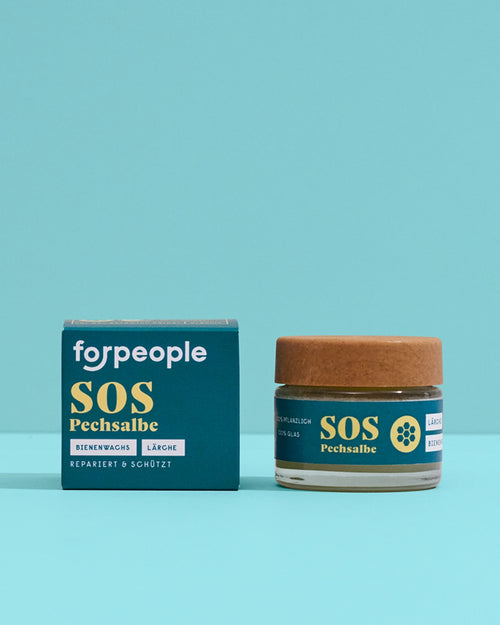
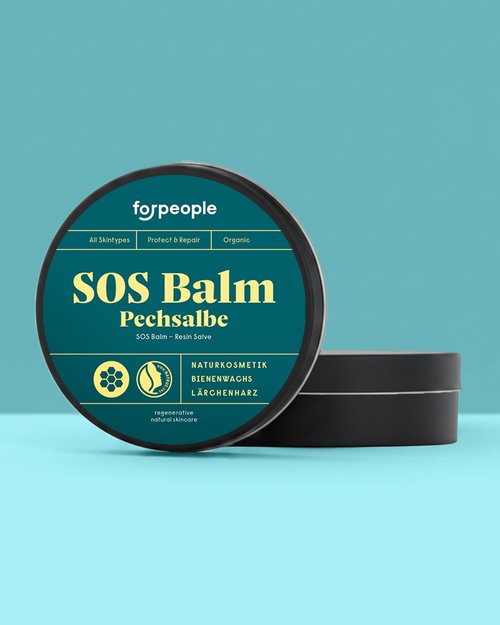
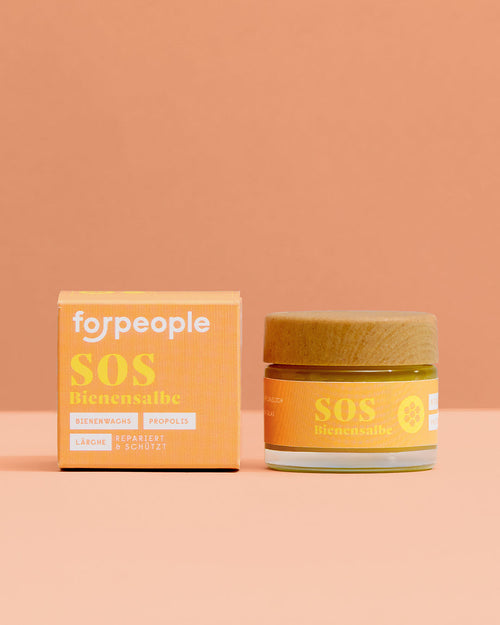
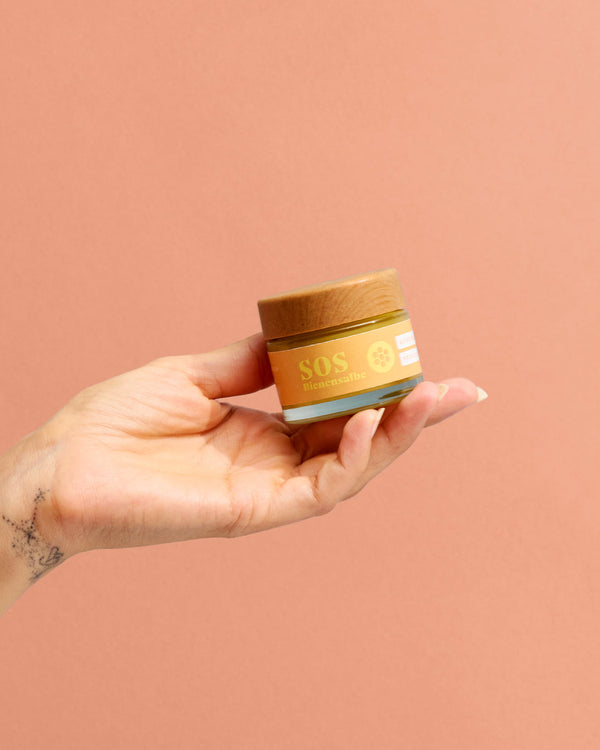
Our SOS Pitch Salve - Larch Resin in a Glass Jar (50 g, €16.90) is built on the same principle: its ingredient list names olive oil, larch resin and beeswax, with the resin in second place, plus the terpenes pinene, terpinolene, alpha-terpinene and terpineol. It contains no water and no added essential oils and, according to its product page, is intended for dry, rough areas on hands, elbows or feet. The same formula is available as SOS Pitch Salve - Larch Resin in a Tin (150 g, €39.90). If you like propolis and a mandarin scent, there is the Beeswax Salve – Larch & Mandarin in a Glass Jar (50 g, €12.90). For your own salve there is the Empty Cosmetic Tin (€3.90).
More: Is pitch salve the same as drawing salve? · Balm, salve, cream, butter: what is the difference? · Making lip balm at home · Making deodorant cream at home
From the blog: Bee salve: beeswax and propolis for dry, stressed skin
Sources
- Lagoni N (2012): Vom Lärchenharz zum Terpentin bis Lärchenöl. LWF Wissen 69: 79–81. Bayerische Landesanstalt für Wald und Forstwirtschaft. https://www.lwf.bayern.de/mam/cms04/biodiversitaet/dateien/vom_laerchenharz_w69.pdf
- Universität für Bodenkultur Wien (BOKU) (n.d.): Steckbrief Harz, Pech, Balsam. https://boku.ac.at/fileadmin/data/H03000/H91000/H91300/Forschung/Steckbrief_Harz.pdf
- Batista JVC, Melo MNO, Holandino C, Maier J, Huwyler J, Baumgartner S, Boylan F (2024): Characterization of Larix decidua Mill. (Pinaceae) oleoresin's essential oils composition using GC-MS. Front Plant Sci 14: 1331894. https://doi.org/10.3389/fpls.2023.1331894
- National Library of Medicine: PubChem, Compound Summary alpha-Pinene (CID 6654), section "Flash Point" (33 °C, closed cup; from the Hazardous Substances Data Bank), accessed 28.10.2026. https://pubchem.ncbi.nlm.nih.gov/compound/6654
- European Commission (2012): Regulation (EU) No 231/2012 laying down specifications for food additives listed in Annexes II and III to Regulation (EC) No 1333/2008, Annex, E 901 beeswax. OJ L 83, 22.3.2012, p. 1. https://eur-lex.europa.eu/eli/reg/2012/231/oj
- Gemeinsamer Ausschuss Brandschutzerziehung und -aufklärung von vfdb und DFV (2019): Fachempfehlung „Verhalten im Brandfall", November 2019. https://www.feuerwehrverband.de/app/uploads/2020/05/DFV_vfdb_Fachempfehlung_Verhalten_Brandfall_2019b.pdf
- Halla N, Fernandes IP, Heleno SA, Costa P, Boucherit-Otmani Z, Boucherit K et al. (2018): Cosmetics Preservation: A Review on Present Strategies. Molecules 23(7): 1571. https://doi.org/10.3390/molecules23071571
- European Parliament and Council (2009): Regulation (EC) No 1223/2009 on cosmetic products, Art. 2, 4, 10 and 13. OJ L 342, 22.12.2009, p. 59. https://eur-lex.europa.eu/eli/reg/2009/1223/oj
- Karimian K, Isufi D, Jensen MB, Johansen JD, Schwensen JFB (2026): Prevalence of Contact Allergy to Colophonium in Dermatitis Patients: A Systematic Review and Meta-Analysis. Contact Dermatitis 95(1): 1–16. https://doi.org/10.1111/cod.70153
- Karlberg AT, Lidén C (1985): Clinical experience and patch testing using colophony (rosin) from different sources. Br J Dermatol 113(4): 475–481. https://doi.org/10.1111/j.1365-2133.1985.tb02363.x