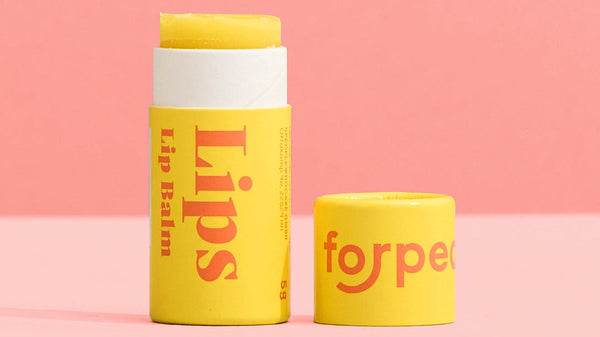
A lip balm is the smallest DIY project: three ingredients, a water bath, a quarter of an hour. Even so, the first attempt often turns out too hard, too greasy or grainy, with a hole gaping in the middle of the stick. Here you can read why that happens, how to work cleanly and what is better left out of a balm for the lips.
Why lips need a balm of their own
The red part of the lips is the only place on the face where the oral mucosa is permanently exposed to the air. In a study of 303 women in winter, almost three times as much water evaporated through the lips as through the cheek, and the moisture of the surface was about one third. The authors attribute this to incompletely formed horny cells on the lip surface (Kobayashi & Tagami 2004). A lip balm should therefore above all form a film that stays and slows evaporation. The wax takes care of that. More background: Why do lips dry out so quickly?
Two more things set lips apart from the skin on hands or feet: part of the balm is swallowed when eating, drinking and licking (Swallowing lip care: is it a problem?), and whatever is on the lips stays on thin, permeable skin for a long time. Both argue for few, simple ingredients.
Recipes in grams: stick, vegan, tin
Each recipe makes about 20 g, enough for four 5 g tubes. Weigh to 0.1 g; with wax, a single gram decides between hard and soft. The proportions are practical values and match the starting values in Making solid cream at home: how much wax to oil?
| Ingredient | Stick with beeswax | Vegan stick | Soft balm for a tin |
|---|---|---|---|
| Beeswax | 7 g | – | 4 g |
| Candelilla wax | – | 4.5 g | – |
| Shea butter or cocoa butter | 4 g | 4 g | 6 g |
| Almond or sunflower oil | 9 g | 11.5 g | 10 g |
| Wax content | 35% | about 23% | 20% |
Candelilla wax is harder and melts at a higher temperature than beeswax: the EU specifications give 68.5 to 72.5 °C compared with 62 to 65 °C, and carnauba wax 82 to 86 °C (Regulation (EU) No 231/2012). For a vegan stick you therefore use only about two thirds of the beeswax amount. How the waxes feel on the lips is described in Lip care with beeswax or vegan: what is the difference?
What the ingredients do
| Ingredient | Role | What to watch out for |
|---|---|---|
| Wax | gives the stick its shape, forms the film | too much makes the stick hard and dull |
| Shea butter | makes the balm supple and fuller | can turn grainy if it cools slowly |
| Cocoa butter | firmer than shea butter, with its own chocolate scent | makes the stick a little harder |
| Almond or sunflower oil | lets the balm glide | use fresh oil; it determines how long the balm keeps |
| Castor oil (optional, 1–2 g instead of almond oil) | adds shine, adheres well | very viscous, feels sticky |
| Vitamin E (tocopherol, a few drops) | protects the oils from going rancid (CosIng: antioxidant) | is not a preservative |
Tocopherol is listed in the EU database CosIng as an antioxidant, among other functions (CosIng); it does not help against germs. Why honey, quark or plain oil do little on the lips is explained in Honey, oil, quark: how useful are home remedies for chapped lips? Honey also cannot be stirred into fat; it separates.
Step by step
- Clean and dry: rinse tubes, tins, glass and spoon with hot water and let them dry completely. Wash your hands.
- Melt: put the wax and butter in the glass in a water bath and melt them, then add the oil and stir until everything is clear. Do not heat directly on the hob.
- Spoon test: put a drop on a spoon from the freezer, wait a minute and check with your finger. Too hard: a little oil; too soft: a little wax.
- Vitamin E: if you like, stir in a few drops now.
- Fill: pour into the tubes with a pipette or a small jug with a spout, first to just below the rim. As it cools, the balm contracts and a dip forms in the middle. After a few minutes, top up with the rest of the warm mixture.
- Cool: let it set at room temperature, not in the fridge, so that no cracks form. Only then put on the caps.
- Label: note the ingredients and date.
How a stick in a paper tube is built and how to use it is shown in Lip balm in a paper tube: how to use it properly.
Essential oils: why you are better off leaving them out
Many recipes add peppermint, orange or lavender oil to the balm. For the lips that is not a good idea, for several reasons:
- Weak barrier: the lip surface holds water poorly and lets more through than facial skin (Kobayashi & Tagami 2004).
- Fragrances as triggers: in an analysis from the Mayo Clinic, 91 people with persistent lip inflammation were patch tested. In 45 percent, the final diagnosis was an allergic contact reaction; the most important triggers included fragrance mix and balsam of Peru, as well as certain antioxidants and preservatives (O'Gorman & Torgerson 2016).
- Sunlight: furocoumarins such as 5-methoxypsoralen must not be added to cosmetics; only their normal levels in natural essential oils are permitted (Regulation (EC) No 1223/2009, Annex II No 358). They occur in bergamot oil, for example. Why this matters in light is explained in Phototoxic oils: bergamot and St. John's wort.
- No safety check: for a lip product you buy, the formula is part of the mandatory safety assessment (Regulation (EC) No 1223/2009, Art. 10). When you make it yourself, nobody knows how much fragrance is in the finished stick.
If you want scent, use ingredients that smell of their own accord, such as unrefined cocoa butter. Beeswax is not entirely neutral for the lips either: reactions are rare, but the cases described mainly involve lip balm, partly due to residues of propolis in the wax (de Groot et al. 2026). More in Colophony allergy, propolis, beeswax: symptoms and advice.
Sun protection and colour: what you cannot do at home
You cannot stir in a sun protection factor. According to the European Commission's recommendation, the level of protection a product offers against UV radiation should be determined with standardised, reproducible test methods (Recommendation 2006/647/EC). A few grams of zinc oxide powder in the balm do not provide reliable protection, because nobody knows how evenly they are distributed and what factor they reach. When a lip balm with SPF makes sense is explained in Do I need lip care with sun protection?
Colour also calls for care: cosmetic products may only contain colourants listed in Annex IV of the Cosmetics Regulation (Regulation (EC) No 1223/2009, Art. 14). For your own use, a small piece of a lipstick you already have, melted in, is the simplest way. Powders from the kitchen do not dissolve in fat and feel grainy.
Common mistakes and what helps
| Problem | Cause | What helps |
|---|---|---|
| Stick too hard, does not glide | too much wax | melt, add 1–2 g oil |
| Too soft, smears | too little wax, warm place | melt, add 0.5–1 g wax |
| Grainy, small lumps | shea butter cooled slowly | melt completely and let it cool quickly at room temperature |
| Hole or dip in the middle | balm contracts as it cools | pour in two steps |
| Stick breaks off | very hard wax, pushed out too far | only push out a few millimetres; more butter |
| Smells rancid | old oil, stored warm | throw away; fresh oil, store cool |
Hygiene, shelf life, giving it away
A stick touches the lips directly. Use your own, apply it to clean lips and close it afterwards. Because a balm made of wax, butter and oil contains no water, germs find hardly any conditions to grow in it; water is considered an ideal growth factor for microorganisms in cosmetics (Halla et al. 2018). The balm can still age: oils, especially those with many polyunsaturated fatty acids, go rancid over time. If it smells different from the start, throw it away; there is no fixed figure for how long it keeps. More in How to recognise rancid skin oil and Cosmetics shelf life: hourglass symbol and PAO after opening.
Homemade balm is intended for your own use. Anyone who supplies it in the course of a commercial activity, even as a free extra, needs a safety assessment among other things (Regulation (EC) No 1223/2009, Art. 2 and 10). If you give it away privately, write down the ingredients.
When to seek medical advice
Dry lips usually improve with care within a few days. Have it checked by a doctor if your lips stay cracked, red or swollen for weeks despite care, if they weep, form blisters or crusts, or if a spot does not heal. If your lips sting or swell after a balm, stop using it; if your lips, tongue or throat swell severely or you have trouble breathing, call 112. On cracked mouth corners: Cracked mouth corners: causes, care and when to see a doctor.
Frequently asked questions
How much wax belongs in a lip balm?
About 35 percent beeswax for a stick, about 20 percent for a soft balm in a tin. With candelilla wax, around two thirds of that amount is enough.
Can I use coconut oil?
Yes, as part of the oil phase. It is semi-solid at room temperature and makes the stick softer in summer. You can balance that with a little more wax.
Why is my lip balm grainy?
Usually the shea butter formed crystals while cooling slowly. Melt the balm completely and let it set quickly at room temperature. The grains melt on the lips.
May I add honey to lip balm?
Honey does not mix with fat and separates. It also tastes sweet and gets licked off, and licking dries out the lips.
How long does homemade lip balm keep?
As long as the oil stays fresh. Date each stick, store it cool and throw it away as soon as it smells rancid.
Can I colour my lip balm?
The simplest way is with a small piece of a lipstick that you already use without problems. Only colourants from an EU list are permitted in cosmetics; kitchen powders do not dissolve in fat.
Which tubes are suitable?
Twist-up tubes or push-up paper tubes, each clean and dry. For the soft balm, a small tin works well.
Can I use lip balm on my hands too?
Yes, the ingredients are the same as in a solid hand cream. For larger areas, a tin is more practical than a stick.
If you would rather not make it yourself
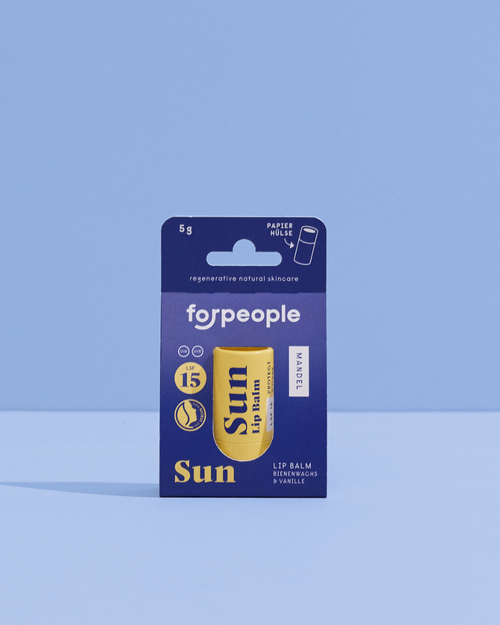
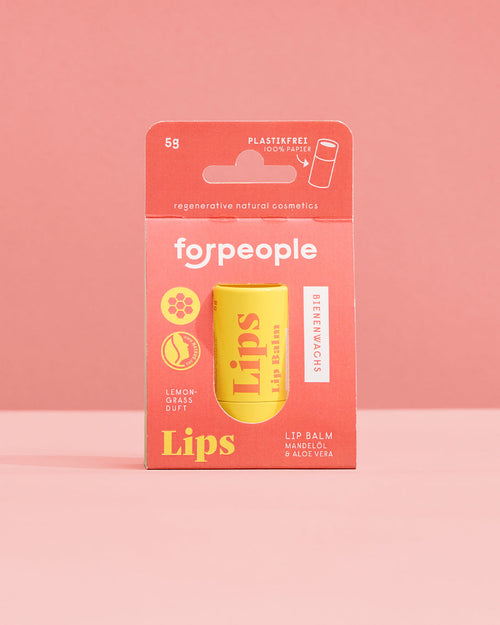
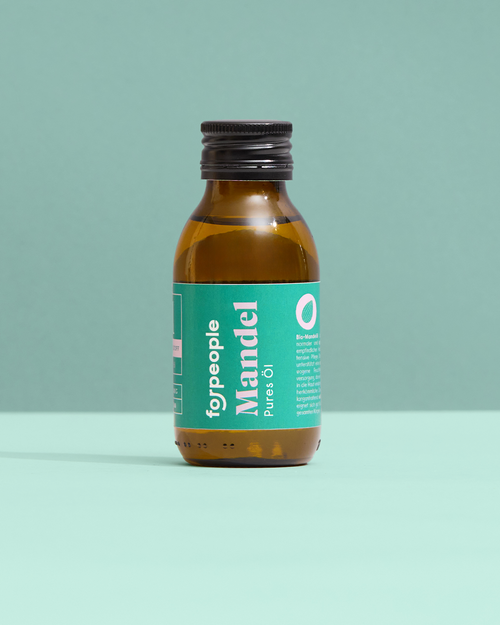
Our two lip balms are water-free sticks with beeswax at the top of the ingredient list. According to its ingredient list, the Lip Balm - SPF15 Almond & Vanilla (5 g, €7.90) contains no essential oil, but vanilla extract as well as zinc oxide and titanium dioxide as mineral UV filters for sun protection factor 15, which you cannot make yourself. The Lip Balm - Lemongrass (5 g, €4.90) contains essential lemongrass oil, which is why citral, citronellol and geraniol appear on the list. For your own oil phase there is Almond Oil - pure (100 ml, €14.90), which according to its product page is intended as a care oil for the lips too and as a base for your own blends, and for the balm in a tin the Empty Cosmetic Tin (€3.90).
More: Dry lips in the morning: does overnight lip care help? · Candelilla wax or beeswax: the differences · Making pitch salve at home · Making deodorant cream at home
From the blog: What is in our lip balm – and why
Sources
- Kobayashi H, Tagami H (2004): Functional properties of the surface of the vermilion border of the lips are distinct from those of the facial skin. Br J Dermatol 150(3): 563–567. https://doi.org/10.1046/j.1365-2133.2003.05741.x
- European Commission (2012): Regulation (EU) No 231/2012 laying down specifications for food additives listed in Annexes II and III to Regulation (EC) No 1333/2008, Annex, E 901 beeswax, E 902 candelilla wax, E 903 carnauba wax. OJ L 83, 22.3.2012, p. 1. https://eur-lex.europa.eu/eli/reg/2012/231/oj
- O'Gorman SM, Torgerson RR (2016): Contact allergy in cheilitis. Int J Dermatol 55(7): e386–e391. https://doi.org/10.1111/ijd.13044
- de Groot AC, Ipenburg NA, Rustemeyer T (2026): Propolis and Beeswax in Cosmetics: A Market Survey and Literature Review on Their Relationship and Role in Allergic Contact Dermatitis. Contact Dermatitis 94(5): 494–503. https://doi.org/10.1111/cod.70108
- Halla N, Fernandes IP, Heleno SA, Costa P, Boucherit-Otmani Z, Boucherit K et al. (2018): Cosmetics Preservation: A Review on Present Strategies. Molecules 23(7): 1571. https://doi.org/10.3390/molecules23071571
- European Parliament and Council (2009): Regulation (EC) No 1223/2009 on cosmetic products, Art. 2, 10 and 14, Annex II No 358. OJ L 342, 22.12.2009, p. 59. https://eur-lex.europa.eu/eli/reg/2009/1223/oj
- European Commission (2006): Recommendation 2006/647/EC of 22 September 2006 on the efficacy of sunscreen products and the claims made relating thereto, points 9 and 11. OJ L 265, 26.9.2006, p. 39. https://eur-lex.europa.eu/eli/reco/2006/647/oj
- European Commission: CosIng – database of cosmetic ingredients, entry TOCOPHEROL (functions include antioxidant), accessed 28.10.2026. https://ec.europa.eu/growth/tools-databases/cosing/