


Why lips have little to set against the sun
The red of the lips is built differently from the skin next to it. A review article summarises the differences (Sun et al. 2025):
- Thin: The surface of the red of the lips consists of 3 to 5 cell layers, the rest of the facial skin of about 16.
- Little pigment: The red of the lips contains less melanin and fewer pigment-forming cells. The authors therefore consider it more susceptible to UV radiation than facial skin.
- Hardly any sebaceous glands, no sweat glands, no hair: The lips produce hardly any oil of their own.
Habit adds to this: forehead, nose and cheeks get sunscreen, the lips often do not. More on how lips are built: Why do lips dry out so quickly?
When SPF on the lips makes sense
The UV index from the weather forecast is a useful guide. According to Germany's Federal Office for Radiation Protection (BfS), no protective measures are normally needed at values 1 and 2; from 3 upwards protection is required: shade at midday, clothing, a hat, sunglasses and sunscreen for uncovered skin (BfS, UV index). Snow, water and light-coloured surfaces reflect the radiation; exposure can then be higher than the UV index indicates.
| Situation | What determines UV exposure | Lip care |
|---|---|---|
| Ski touring, glaciers, hiking at altitude | altitude and reflection from snow | with SPF, reapply often, plus a scarf over mouth and chin |
| Beach, boat, outdoor pool | water and pale sand reflect | with SPF, reapply after swimming and towelling dry |
| Summer days outdoors, also cool, sunny spring days | the UV index (3 and above), not the temperature | with SPF, seek shade at midday |
| Winter in the lowlands, short trips | usually a low UV index (1 to 2) | lip balm without SPF is generally enough |
The BfS itself names one caveat: in summer, a UV index of 2 can persist for hours on cloudy days; if you are outdoors for a long time then, you should still protect yourself. More on altitude and snow: Sun protection in the mountains and on snow.
What SPF 15 means
The sun protection factor is a ratio: the UV dose that just causes reddening on skin with sunscreen, divided by the dose that does so on unprotected skin. The European Commission recommends labelling sunscreens in four categories (Recommendation 2006/647/EC):
| Number on the label | Measured SPF | Category |
|---|---|---|
| 6, 10 | 6 to 14.9 | low protection |
| 15, 20, 25 | 15 to 29.9 | medium protection |
| 30, 50 | 30 to 59.9 | high protection |
| 50+ | 60 and above | very high protection |
So SPF 15 sits at the lower end of the medium category. According to the same recommendation, a product with SPF 15 absorbs 93% of UVB radiation, one with SPF 30 absorbs 97%; no sunscreen can filter out all UV radiation.
To put this in context: for the skin, the BfS recommends at least SPF 30, and SPF 50+ at high altitude, on snow and by and in the water (BfS, UV protection tips). These tips do not give a separate figure for the lips. Measured against that, SPF 15 is little for a day on a glacier or on a boat; there, a scarf over mouth and chin and frequent reapplication belong with it. More on this: SPF, UVA and water resistance: what the labels mean.
Applying and reapplying
The sun protection factor is measured with 2 mg of product per square centimetre of skin. If less is applied, protection drops disproportionately (Recommendation 2006/647/EC). With a stick it is easy to apply too little: in a study with 52 people, the application thickness of sunscreen sticks was 0.35 mg per square centimetre as a geometric mean, compared with 1.1 mg for lotion (Novick et al. 2015). The measurements were made on skin, not on lips; we are not aware of a separate measurement for lip balm sticks. The conclusion still suggests itself: better to go over the lips several times.
- Apply before you go out. For sunscreen, the BfS advises half an hour beforehand.
- Go over both lips several times, right to the edge and into the corners of the mouth.
- Reapply after eating, drinking and wiping your mouth. The film is removed in the process; this is everyday experience, not a measured figure.
- Reapply after swimming and towelling dry. The EU recommendation advises this for sunscreens in general.
- Do not lick your lips. Saliva takes the film with it.
Reapplying maintains protection; it does not extend it (BfS, UV protection tips). On the amount for solid sticks for face and body: How much solid sunscreen do I need?
Mineral filters on the lips: zinc oxide and titanium dioxide
Lip balm with SPF contains UV filters: soluble organic filters or mineral pigments such as zinc oxide and titanium dioxide (comparison: Zinc oxide or titanium dioxide: which protects against what?). Both pigments are white; a pale sheen can remain on the lips.
There is an official assessment of titanium dioxide in lip products that you should know about. Titanium dioxide is authorised in the EU as a UV filter for cosmetics. After the food additive E 171 was re-evaluated, the European Commission asked its Scientific Committee on Consumer Safety (SCCS) to examine titanium dioxide in products that can get into the mouth, including lip care and lipstick. The outcome of May 2024 (SCCS 2024):
- For almost all titanium dioxide grades examined, the data are not sufficient to exclude a genotoxic potential when taken up via the mouth. The committee asks for further data and has not recommended any new limits.
- At the same time it notes: cosmetics are not meant to be swallowed; what gets into the mouth unintentionally is far below the amounts from food.
- For products applied to the skin, its earlier conclusions remain unchanged.
The question is therefore open. The details are under Titanium dioxide: banned in food, allowed in cosmetics. If you would rather avoid titanium dioxide on your lips, you will find it in the ingredient list as “Titanium Dioxide”; what remains then is shade, a hat and a scarf over your mouth. What “non-nano” means: Nano or non-nano? Zinc oxide and titanium dioxide explained.
When should you seek medical advice?
Have it checked by a doctor if a spot on your lips changes and does not go away: rough, flaky, hardened, with a crust that keeps coming back or white patches. The same applies if blisters regularly appear after sun exposure (cold sores), if your lips swell or sting badly, or if you suspect you are reacting to a lip balm. Some medicines make the skin more sensitive to light; ask at your doctor's practice or pharmacy.
Frequently asked questions
Is SPF 15 enough for the lips?
In everyday life with a medium UV index, SPF 15 is medium protection under the EU categories. For glaciers, snow and days on the water, the BfS recommends SPF 50+ for the skin; there you should also cover your lips and reapply often.
How often do I need to reapply lip balm with SPF?
There is no fixed number. Reapply as soon as the film is gone: after eating and drinking, after wiping your mouth, after swimming and towelling dry.
Does a lip balm without SPF also offer a little sun protection?
You should not rely on that. A balm made of wax and oil without UV filters has no declared sun protection factor.
Does mineral lip balm leave a white film?
Zinc oxide and titanium dioxide are white pigments. Spread thinly, a pale sheen is more likely to remain; a thick layer is more visible.
Why does the stick feel firm at first?
A stick made of wax and oil is firm at room temperature, and a little more so in the cold. In reviews of the Lip Balm - Lemongrass, which also lists beeswax first, customers describe the stick as firm at first, occasionally as slightly crumbly. Hold it against your lips for a moment before you apply it.
At forpeople
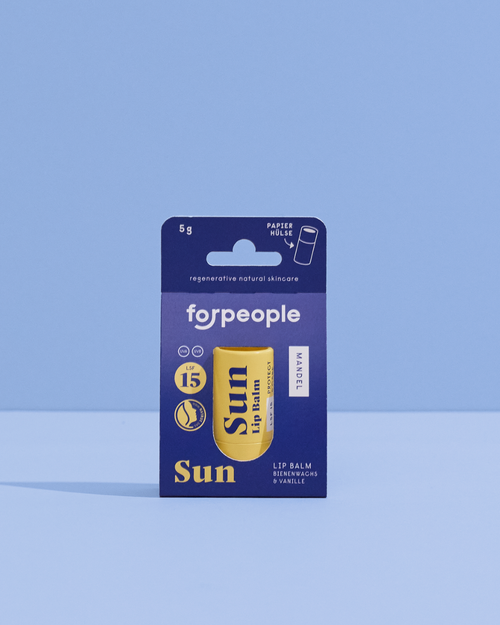
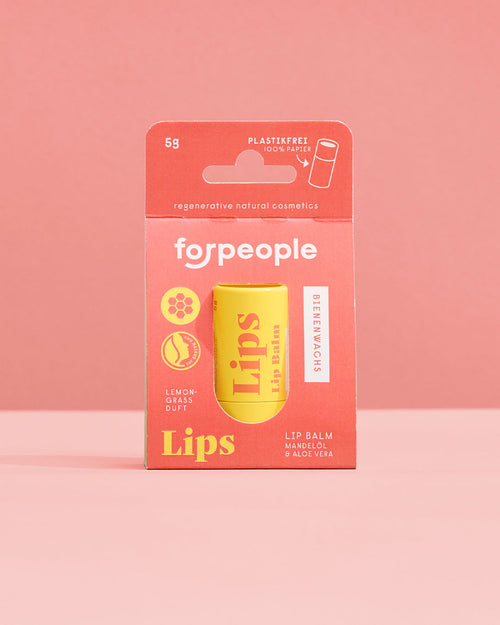
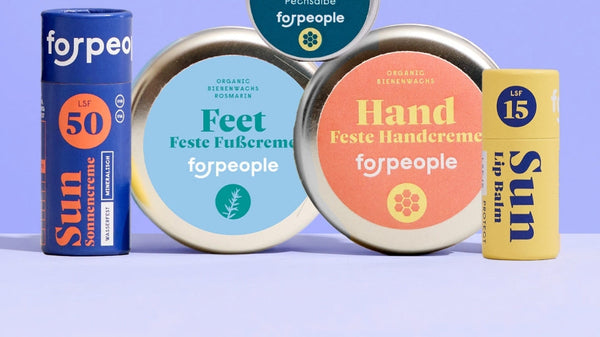
We offer two lip balms, both water-free sticks with beeswax in first place in the ingredient list. The Lip Balm - SPF15 Almond & Vanilla (5 g, €7.90) contains zinc oxide and titanium dioxide as UV filters, non-nano according to the product information, and no essential oils. The Lip Balm - Lemongrass (5 g, €4.90) contains no UV filter but does contain lemongrass essential oil; it suits days with a low UV index and the evening. We do not offer a lip balm with a sun protection factor higher than 15.
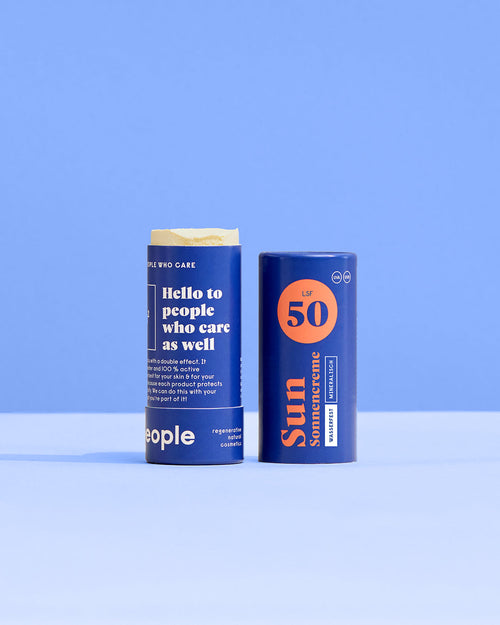
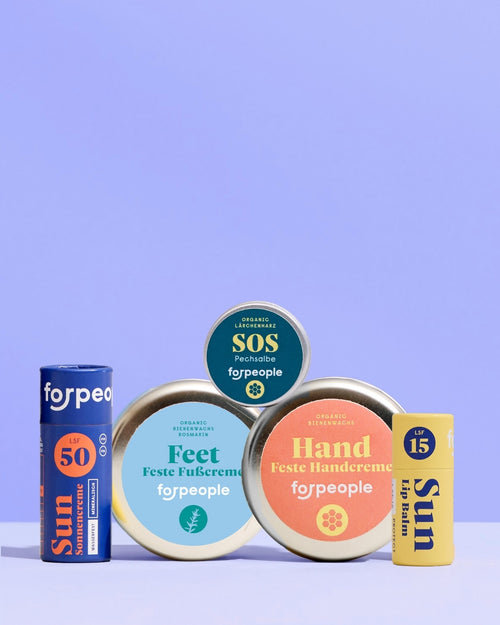
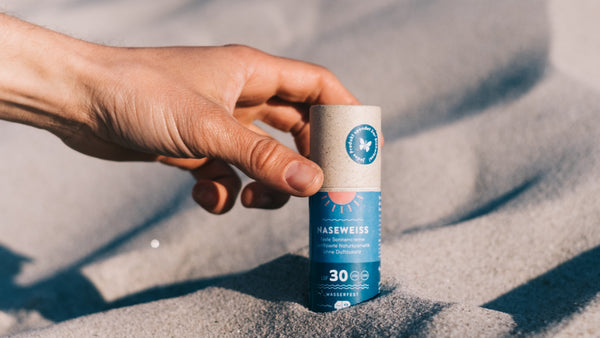
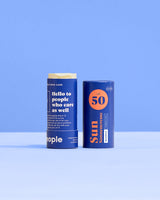
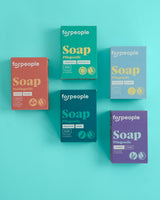
For face and body there is the Solid Sunscreen SPF50 (40 g, €17.90), mineral with zinc oxide and titanium dioxide, non-nano according to the ingredient list, tested as water-resistant, in a paper tube without a plastic coating. A travel-size sunscreen and the lip balm with SPF 15 are both in the skincare Travel Set – for Your Carry-On (€39.90). All products are cosmetics; if your skin reacts, stop using them.
More on this: Lip balm with beeswax or vegan: what is the difference? · Storing solid cosmetics: heat, summer and winter · Can I still use last year's sunscreen?
From the blog: Skincare for days in the snow: hands, lips, face · Why does sunscreen leave a white cast?
Sources
- Europäische Kommission (2006): Empfehlung 2006/647/EG vom 22. September 2006 über die Wirksamkeit von Sonnenschutzmitteln und diesbezügliche Herstellerangaben. ABl. L 265 vom 26.9.2006, S. 39. https://eur-lex.europa.eu/eli/reco/2006/647/oj
- Bundesamt für Strahlenschutz (BfS): Tipps zum UV-Schutz. Stand 4. August 2026. https://www.bfs.de/DE/themen/opt/uv/schutz/tipps/tipps_node.html
- Bundesamt für Strahlenschutz (BfS): Was ist der UV-Index? Stand 4. August 2026. https://www.bfs.de/DE/themen/opt/uv/uv-index/einfuehrung/einfuehrung.html
- Sun F, Liu Y, Zhang T (2025): Aging of the Human Lip: Current Knowledge and Clinical Implications. J Cosmet Dermatol 24(8): e70310. https://doi.org/10.1111/jocd.70310
- Scientific Committee on Consumer Safety (2024): Scientific Advice on Titanium dioxide (TiO2). SCCS/1661/23, endgültige Fassung vom 13. Mai 2024. https://health.ec.europa.eu/publications/scientific-advice-titanium-dioxide-tio2-casec-numbers-13463-67-7236-675-5-1317-70-0215-280-1-1317-80_en
- Novick R, Anderson G, Miller E, Allgeier D, Unice K (2015): Factors that influence sunscreen application thickness and potential preservative exposure. Photodermatol Photoimmunol Photomed 31(4): 212–223. https://doi.org/10.1111/phpp.12171