


What 2 milligrams per square centimetre means
The sun protection factor (SPF) is measured in the laboratory with a fixed amount: 2 mg of sunscreen per square centimetre of skin. A product only reaches the value printed on the pack with this amount (Recommendation 2006/647/EC; BfS). What else the SPF tells you is explained on the page SPF, UVA and water resistance: what the labels mean.
Converted, this means: an area of 10 by 10 centimetres takes 0.2 grams. For the whole body, the official bodies give these amounts:
| Figure | Amount | Source |
|---|---|---|
| Test amount in SPF measurement | 2 mg per cm² | European Commission, BfS |
| Whole body, average adult | six teaspoons, about 36 g | European Commission |
| The same amount in tablespoons | four heaped tablespoons | BfS |
| A 200 ml bottle of sunscreen | empty after covering the whole body about five times | BfS |
So the amount is considerably larger than most people expect. Less sunscreen lowers the protection disproportionately: if only half is applied, the protective effect can drop by two thirds, according to the European Commission (Recommendation 2006/647/EC).
Why too little often ends up on the skin with a stick
In everyday use, people apply only about 0.39 to 1.0 mg per cm², according to a review (Petersen & Wulf 2014). There is less data on sticks. In one study, 52 people applied lotion, spray and stick. The geometric mean was 1.1 mg per cm² for the lotion, 1.6 mg for the spray and 0.35 mg for the stick (Novick et al. 2015). The stick was therefore furthest below the test amount.
A likely reason: a solid stick leaves only a thin film per stroke, and you do not see a portion in your hand that would help you judge the amount. This is our reading, not a measured result.
How to reach the amount with a stick
- Early enough: The BfS, Germany's Federal Office for Radiation Protection, advises applying sunscreen 20 to 30 minutes before going out in the sun (BfS).
- Push out a little, stroke often: Push the sunscreen only a short way out of the tube. Reviews mention that it is hard to push back once it sticks out too far.
- Four passes per area: The American Academy of Dermatology (AAD) recommends that with sticks you go over each area of skin four times back and forth and then rub the sunscreen in (AAD 2025). This is a rule of thumb, not a measured value; how much one pass leaves depends on temperature, pressure and formulation.
- Rub it in: Spread the sunscreen with your fingers until the film is even, see How do I apply a solid cream correctly?
- Second layer: Repeat the whole thing shortly afterwards. In one trial, 31 people in swimwear applied sunscreen twice, 20 minutes apart. After the first application a median of 0.60 mg per cm² was on the skin, after the second 1.10 mg; even then only about one person in five reached the 2 mg (Heerfordt et al. 2018). The review gives similar advice: apply before sun exposure and reapply once within the first hour (Petersen & Wulf 2014).
- Weigh it once: Weigh the stick on kitchen scales once before and after applying. That gives you a feel for your amount. This is a practical tip; in the trial, too, the amount was determined by weight.
For orientation: in the surface model used in that trial, the face makes up 3.5% of the body surface and both arms together 14%. Applied to the European Commission's 36 g, that would work out at a good 1 g for the face and about 5 g for the arms. This is our own conversion, not an official figure.
Areas that are often missed
In the same trial, black light showed which areas were left without sunscreen. Participants applied a sunscreen provided to them as they would at the beach; different product formats were not compared (Heerfordt et al. 2018):
| Body area | without sunscreen after one application | after two applications |
|---|---|---|
| Ears (women) | 80% | 44% |
| Back | 26% | 15% |
| Arms | 25% | 4% |
| Tops of the feet | 24% | 10% |
| Thighs | 22% | 7% |
| Backs of the hands | 8% | 1% |
| Face | 3% | 1% |
| Accessible skin in total | 20% | 9% |
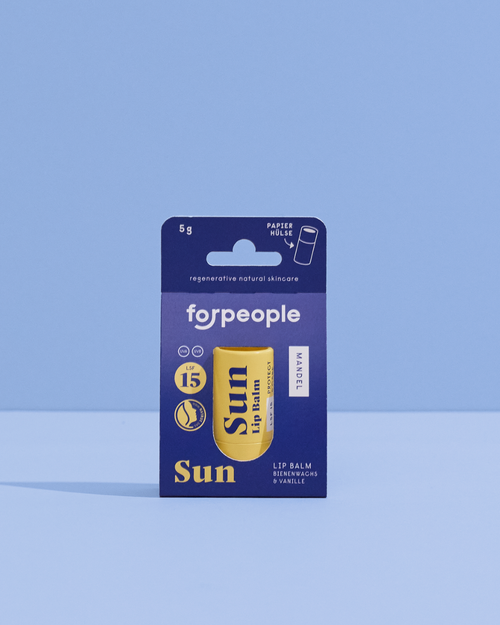
The figures are the median of the area left uncovered. For your back, a second person helps. The hands have their own page: Sun protection for the backs of your hands. On snow, the underside of the nose and the chin are added, see Sun protection in the mountains and on snow. For the lips there are separate sticks such as the Lip Balm - SPF15 Almond & Vanilla; more on this under Do I need lip balm with SPF?
Reapplying and what else counts
The BfS recommends reapplying at least every two hours, especially after swimming and towelling off. Reapplying maintains the protection but does not extend it (BfS). This also applies to water-resistant products.
Sunscreen is only one part of sun protection. No sunscreen can filter all UV radiation (Recommendation 2006/647/EC). Avoiding strong sun, clothing, a hat and sunglasses come first; sunscreen is meant for the skin that is still uncovered (BfS). The more your clothing covers, the less sunscreen you need. Separate rules apply to children, see Mineral sunscreen for children: what to look for.
When to seek medical advice
Seek medical advice for a sunburn with blisters, fever, chills or circulation problems, and for any sunburn in babies and small children. If your skin reacts to a sunscreen with redness, hives or itching, stop using it and have the cause checked. Skin spots that are new or changing belong in a dermatology practice. If you take medication, ask whether it makes the skin more sensitive to light.
Frequently asked questions
Is it enough to go over the skin once with the stick?
Usually not. In one study, the amount applied with sticks averaged 0.35 mg per cm²; the test amount is 2 mg. Four passes back and forth per area, rubbing in and a second layer work better.
Reviews say solid sunscreen goes a long way and should be applied sparingly. Is that right?
For the feel on the skin and the white film, that is understandable. For the sun protection factor, however, the test amount is what counts. If you use considerably less, you do not reach the value on the pack. More on how far solid care goes under Why does solid cream last so long?
Does the white cast get stronger if I apply more?
Yes. Zinc oxide and titanium dioxide are white pigments, and more sunscreen means more pigment. Rub the sunscreen in thoroughly instead of using less. Tinted versions even out the pale sheen with colour pigments.
Can I use less if the sun protection factor is higher?
You should not rely on that. According to a review, a very high SPF can only partly make up for too small an amount (Petersen & Wulf 2014). The value on the pack applies to 2 mg per cm².
Does the stick leave less in the cold?
A solid sunscreen is made of butter, oil and wax. It becomes harder in the cold and softer in the warmth. The harder it is, the less comes off per stroke; this is practice, not a measured value. In the cold, carry the stick close to your body and stroke more often. Storage tips are under Storing solid cosmetics: heat, summer and winter.
At forpeople
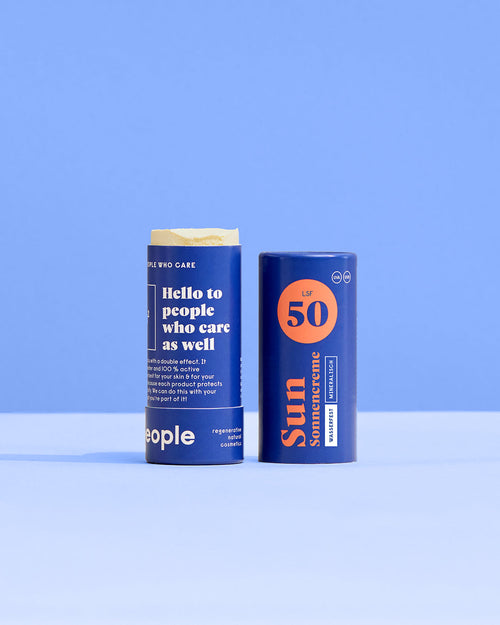
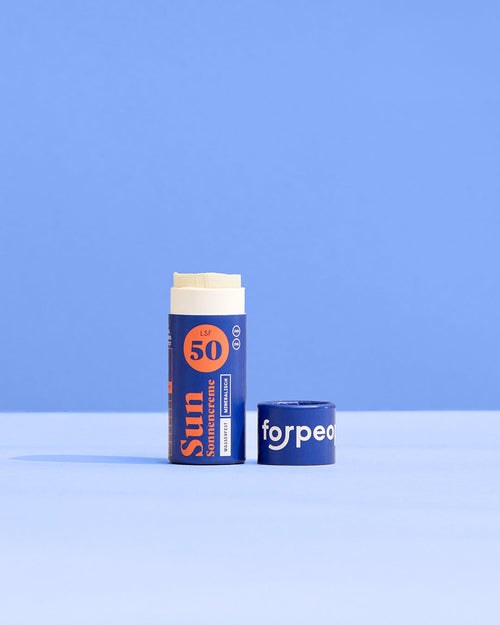
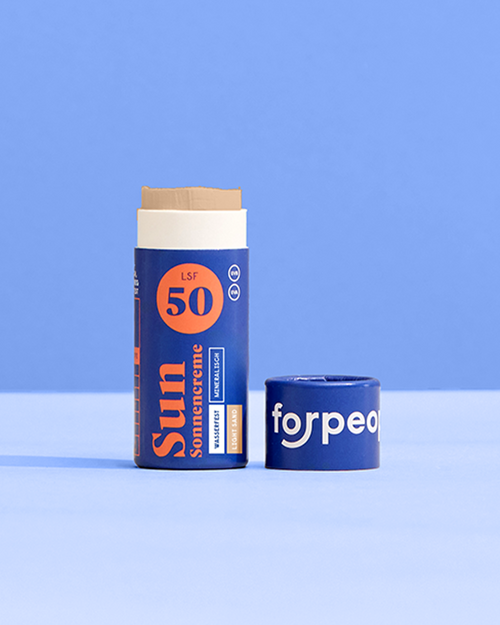
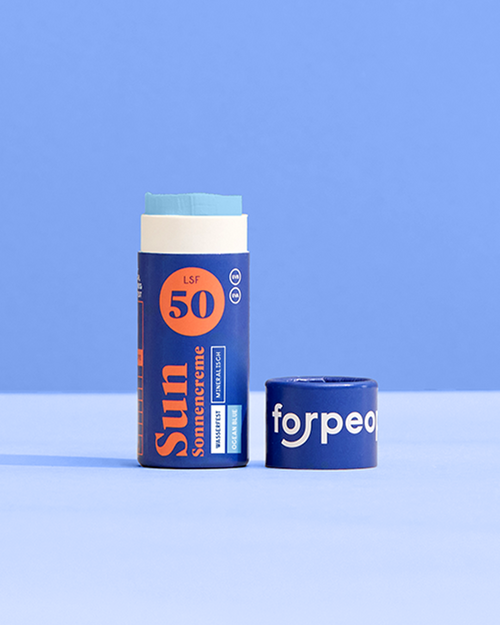
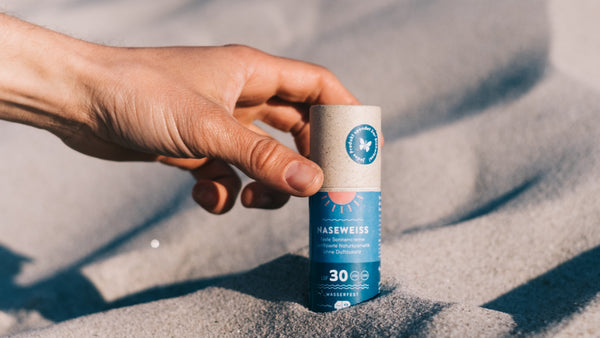
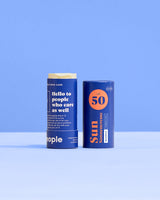
The Solid Sunscreen SPF50 (40 g, €17.90) has sun protection factor 50 and is tested as water-resistant. As UV filters it contains zinc oxide and titanium dioxide, non-nano according to the ingredient list, plus shea butter, a plant-based triglyceride, beeswax and silica. It is water-free and comes in a paper tube without a plastic coating. For on the go there is the Solid Sunscreen SPF50 Mini (20 g, €9.90). The tinted versions are the Solid Sunscreen SPF50 Mini - Shade LIGHT SAND (20 g, €9.90) with iron oxides and the Solid Sunscreen SPF50 Mini - OCEAN BLUE (20 g, €9.90) with ultramarine; with the blue one you can easily see where sunscreen has already been applied. How long a stick lasts depends on how much skin is uncovered and how generously you apply it. If your skin reacts, stop using it.
More on this: SPF, UVA and water resistance: what the labels mean · Can I still use last year's sunscreen? · How do I wash off mineral sunscreen?
From the blog: Why does sunscreen leave a white cast?
Sources
- Europäische Kommission (2006): Empfehlung 2006/647/EG vom 22. September 2006 über die Wirksamkeit von Sonnenschutzmitteln und diesbezügliche Herstellerangaben. ABl. L 265: 39–43. https://eur-lex.europa.eu/eli/reco/2006/647/oj
- Bundesamt für Strahlenschutz (BfS): UV-Schutz durch Sonnencreme (Stand 04.08.2026). https://www.bfs.de/DE/themen/opt/uv/schutz/sonnencreme/sonnencreme_node.html
- Petersen B, Wulf HC (2014): Application of sunscreen – theory and reality. Photodermatol Photoimmunol Photomed 30(2–3): 96–101. https://doi.org/10.1111/phpp.12099
- Novick R, Anderson G, Miller E, Allgeier D, Unice K (2015): Factors that influence sunscreen application thickness and potential preservative exposure. Photodermatol Photoimmunol Photomed 31(4): 212–223. https://doi.org/10.1111/phpp.12171
- Heerfordt IM, Torsnes LR, Philipsen PA, Wulf HC (2018): Sunscreen use optimized by two consecutive applications. PLoS One 13(3): e0193916. https://doi.org/10.1371/journal.pone.0193916
- American Academy of Dermatology Association (AAD): How to use stick and spray sunscreens (zuletzt aktualisiert am 15.08.2025). https://www.aad.org/public/everyday-care/sun-protection/shade-clothing-sunscreen/how-to-use-stick-spray-sunscreens