




What the packaging says: a date or an open jar
The EU Cosmetics Regulation knows two ways of stating shelf life (Regulation (EC) No 1223/2009, Art. 19). If a product keeps for 30 months or less unopened, the packaging must carry a date of minimum durability, the best-before date. If it keeps longer, the date may be omitted; an open jar with a number is shown instead. This is called the “period after opening”, PAO for short.
| What you find on the packaging | What it means | Last year's sunscreen |
|---|---|---|
| Hourglass or “best used before the end of” with a date | until then the product, stored under appropriate conditions, continues to fulfil its initial function | Date not yet reached and well stored: usable. Date passed: replace. |
| Open jar with a figure such as “12 M” | the number of months after first opening during which the product can be used safely | Count from the month of opening. Period over or month of opening unknown: replace. |
| A note such as “store in a cool, dry place” | the condition under which the shelf-life statement applies | Not kept to: the date alone does not help. |
| Nothing legible any more | shelf life cannot be determined | replace |
The open jar counts from first opening, not from purchase: if you open the product in June, “12 M” ends in June of the following year. The best-before date expressly assumes appropriate storage; the period after opening is not meant for weeks in a hot car either. More on the symbols: Cosmetics Shelf Life and the PAO Symbol.
Why it matters more for sunscreen than for a hand cream
The sun protection factor is a measured value. It is determined with 2 mg of sunscreen per square centimetre of skin (Recommendation 2006/647/EC). If a hand cream fades over time, it cares less well, and you notice. With a sunscreen you cannot tell by looking whether it still reaches the stated sun protection factor. That only shows once the skin has already had too much sun.
Whatever the age of the product: no sunscreen filters all UV radiation, and protection is only maintained if you re-apply frequently, especially after perspiring, swimming or towelling (Recommendation 2006/647/EC). More on this: SPF, UVA and water resistance: what the labels mean.
What heat in the car and on the beach does to sunscreen
A series of measurements with a dark car on sunny days shows how hot it gets: at outside temperatures between roughly 22 and 36 °C, the temperature inside rose by about 22 °C on average within one hour; 80% of the rise occurred in the first 30 minutes. Even on the coolest day measured, the interior reached around 47 °C (McLaren et al. 2005).
Heat acts in several ways:
- Oils age faster. Fats and oils react with oxygen; temperature, light and oxygen affect how stable they are (Choe & Min 2006). In the end the product smells rancid.
- Emulsions can separate. Liquid sunscreens usually consist of water and oil; after strong heat a layer sometimes settles out.
- Solid sunscreen softens or melts. Butters and oils soften in summer warmth, long before the wax melts. More on this: Storing solid cosmetics: heat, summer and winter.
The US authority FDA, which regulates sunscreens as non-prescription drugs, recommends not exposing the containers to direct sun and, when outside, wrapping them in a towel or keeping them in the shade (FDA 2026). Labelling there differs from the EU, but the advice carries over: do not leave sunscreen in the car, not even in the glove compartment, and on the beach keep it in your bag or in the shade.
How to tell that it is no longer good
The date and the period are the first check, your senses the second.
| Sign | What may be behind it | What to do |
|---|---|---|
| smells rancid, sharp or of old fat | the oils have oxidised | replace; background on How to tell if a skin oil is rancid |
| liquid and cream have separated | the emulsion has become unstable | replace |
| colour clearly more yellow or darker | oxidation or the influence of light | replace |
| grainy or crumbly | temperature changes; in solid products often fat crystals | Grains alone do not mean the product has gone off. If the smell or colour has changed too: replace. |
| a solid stick was completely liquid and has set again | you cannot tell from the outside whether the filters are still evenly distributed | ask the manufacturer or replace |
| spots, a coating, a musty smell | possible spoilage by germs, mainly in products that contain water | dispose of it |
If none of these signs is present, nothing speaks against the product. It does not show whether the protection is still complete.
Solid, water-free sunscreen: what is different
- No emulsion: without water, no water phase can separate from an oil phase.
- Less for germs to work with: micro-organisms need freely available water. More on this: Hygiene and Water-Free Cosmetics: What to Watch
- Mineral filters do not break down: zinc oxide and titanium dioxide are inorganic pigments, fine particles in the fat. They do not evaporate and do not decompose in storage. Shelf life is limited by the oils and waxes, not by the filters.
- Nothing settles in the solid form: in a liquid lotion, pigments can sink over time; that is why some bottles say “shake before use”. In a solid stick, the set mass of butter and wax holds the particles in place. This is a physical explanation, not a measurement on our product. If the stick has ever melted completely, it no longer applies with certainty.
Organic UV filters, by contrast, are carbon compounds, and such compounds can change over time. This has been measured for one individual filter: in 16 commercial products containing octocrylene, the degradation product benzophenone averaged 39 milligrams per kilogram, and 75 after six weeks of accelerated ageing (Downs et al. 2021). The study concerns this one filter and says nothing about whether a product keeps its sun protection factor; several comments on it have appeared in the same journal. For every sunscreen, the date on the packaging applies.
What remains are the fats: a water-free sunscreen also contains butter, oils and wax, and these can turn rancid. It is also applied directly to the skin, so sweat, water and sand end up on the stick. Wipe it dry after a day at the beach; a paper tube does not belong in a wet swim bag. So “water-free” is no licence for a second or third summer.
How to get sunscreen through the winter
- Note the month of opening: with a pen on the tube or the lid.
- Clean it before putting it away: wipe off sand, water and residues, close it firmly.
- Store cool, dry and dark: in a cupboard, not on the windowsill or in the attic.
- Check it in spring: first the date or period, then smell, colour and consistency. If in doubt, replace it.
When to seek medical advice
If the skin turns red, stings or blisters after application, wash the product off and stop using it. If the reaction does not subside, have it checked by a doctor. A sunburn with blisters, fever, chills or circulation problems needs medical attention.
Frequently asked questions
How long does opened sunscreen keep?
As long as the packaging says: until the best-before date, or for the number of months next to the open jar, counted from first opening. There is no uniform period for all sunscreens in the EU.
Is unopened sunscreen from last year still good?
If it carries a best-before date, that date applies. If a correctly labelled product carries no date, its minimum durability is more than 30 months. Both assume appropriate storage.
My solid sunscreen went soft in the heat. Can I still use it?
Soft does not mean spoiled. Let it firm up again in a cool place and check its smell and appearance. If it was completely liquid, you cannot tell from the outside whether the mineral filters are still evenly distributed. In that case ask the manufacturer or replace it.
I pushed the stick too far out of the tube. Does that matter?
The part that sticks out is unprotected: it picks up sand and dirt and is easily squashed in a bag. Only ever push out enough for the stick to stand just above the rim, and use up first whatever sticks out too far.
Does this also apply to lip balm with SPF?
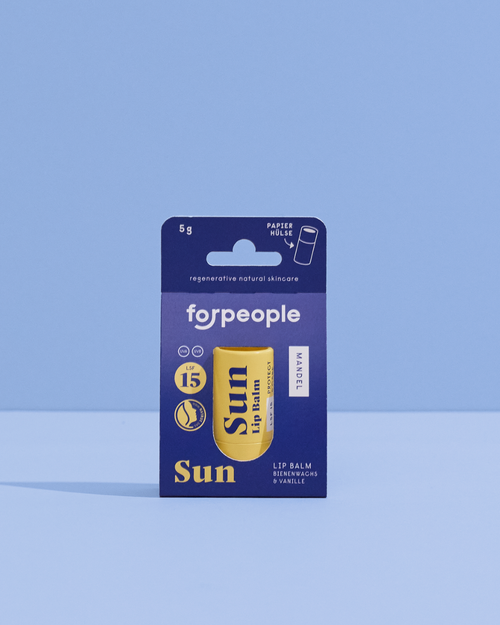
Yes, the same labelling rules apply, and a lip balm often spends months in a jacket pocket. Check the Lip Balm - SPF15 Almond & Vanilla in the same way: the statement on the packaging, smell, appearance. When SPF on the lips makes sense is explained on Do I need lip balm with SPF?
At forpeople
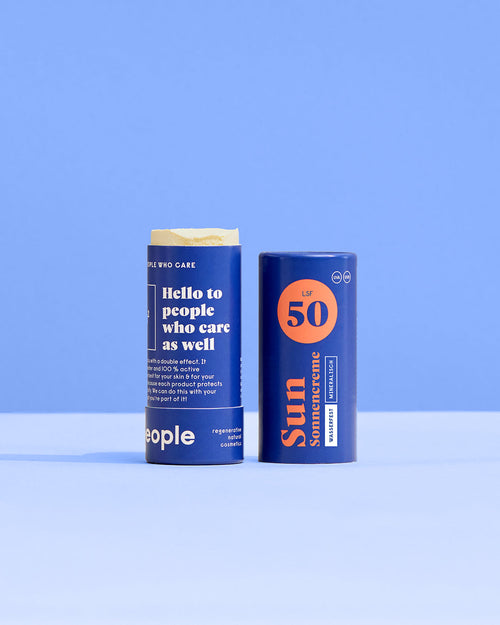
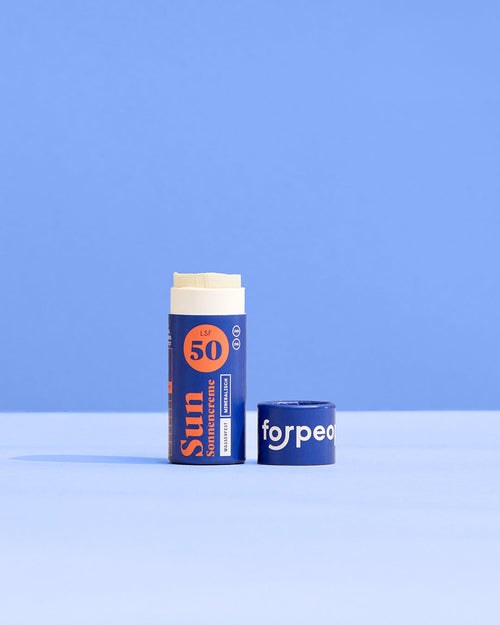
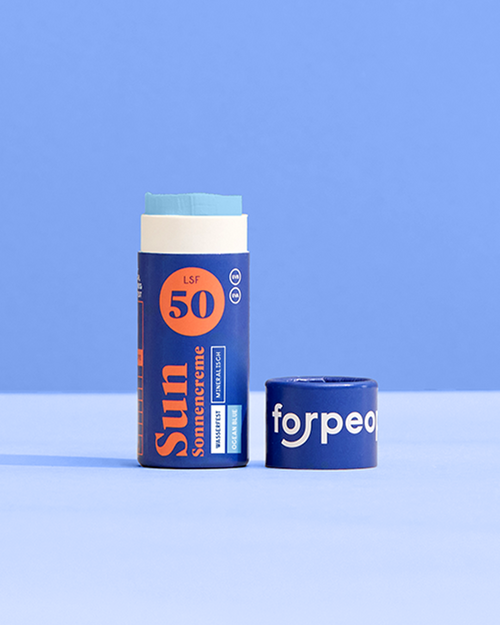
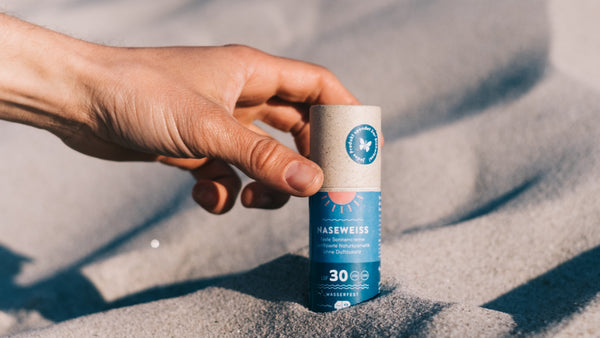
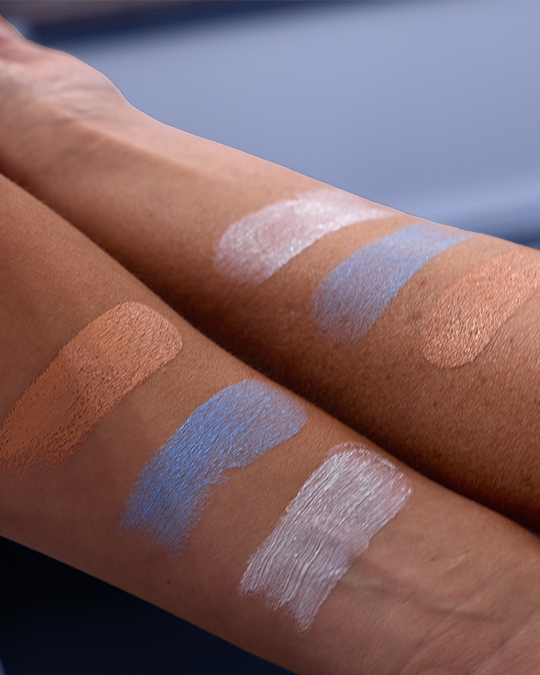
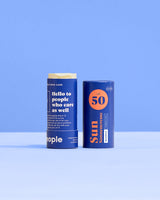
The solid sunscreens from forpeople have SPF 50, have been tested as water resistant and contain zinc oxide and titanium dioxide (non-nano) as UV filters. According to the ingredient list the formula is water-free: shea butter, a plant-based fatty acid blend, the two filters, beeswax and silica. The tinted versions also contain colour pigments, OCEAN BLUE additionally kaolin. The packaging is a paper tube without plastic coating.
The solid sunscreens from forpeople have a minimum durability of 30 months from production. A stick bought last year can therefore still be within that period; what counts is the date printed on the tube of your sunscreen. The storage note in the shop reads: store in a cool, dry place and protect from direct sunlight.
- Solid Sunscreen SPF50, 40 g, €17.90
- Solid Sunscreen SPF50 Mini, 20 g, €9.90
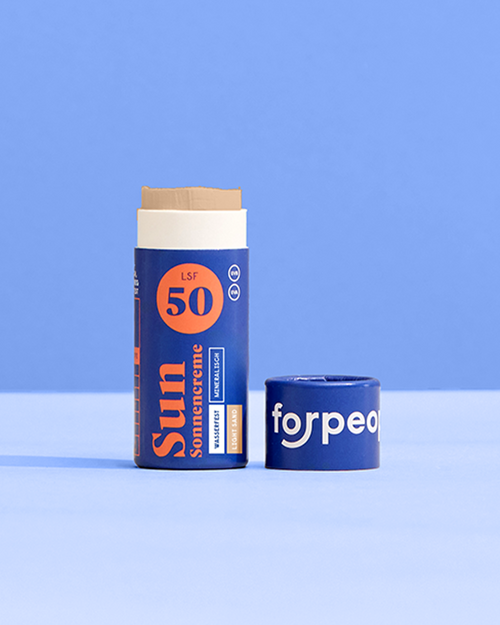
- Solid Sunscreen SPF50 Mini - Shade LIGHT SAND, 20 g, €9.90, tinted beige with iron oxides
- Solid Sunscreen SPF50 Mini - OCEAN BLUE, 20 g, €9.90, tinted blue with ultramarine
Read more: How much solid sunscreen do I need? · How do I wash off mineral sunscreen? · Zinc oxide or titanium dioxide: which protects against what? · Sun protection in the mountains and on snow · Why does beeswax smell of honey, and why does the scent change?
From the blog: Why does sunscreen leave a white cast? · Sunscreen without chemical filters – what you should know
Sources
- Europäisches Parlament und Rat (2009): Verordnung (EG) Nr. 1223/2009 vom 30. November 2009 über kosmetische Mittel, Art. 19 Abs. 1 Buchst. c und Anhang VII. ABl. L 342 vom 22.12.2009, S. 59. https://eur-lex.europa.eu/eli/reg/2009/1223/oj
- Europäische Kommission (2006): Empfehlung 2006/647/EG vom 22. September 2006 über die Wirksamkeit von Sonnenschutzmitteln und diesbezügliche Herstellerangaben. ABl. L 265 vom 26.9.2006, S. 39. https://eur-lex.europa.eu/eli/reco/2006/647/oj
- McLaren C, Null J, Quinn J (2005): Heat stress from enclosed vehicles: moderate ambient temperatures cause significant temperature rise in enclosed vehicles. Pediatrics 116(1): e109–e112. https://doi.org/10.1542/peds.2004-2368
- Choe E, Min DB (2006): Mechanisms and factors for edible oil oxidation. Compr Rev Food Sci Food Saf 5(4): 169–186. https://doi.org/10.1111/j.1541-4337.2006.00009.x
- U.S. Food and Drug Administration (2026): Sunscreen: How to Help Protect Your Skin from the Sun. Stand der Seite: 10. September 2026. https://www.fda.gov/drugs/understanding-over-counter-medicines/sunscreen-how-help-protect-your-skin-sun
- Downs CA, DiNardo JC, Stien D, Rodrigues AMS, Lebaron P (2021): Benzophenone Accumulates over Time from the Degradation of Octocrylene in Commercial Sunscreen Products. Chem Res Toxicol 34(4): 1046–1054. https://doi.org/10.1021/acs.chemrestox.0c00461