



Why lips are drier in the morning than in the evening
The red of the lips loses a lot of water by nature. In a study of 303 women, almost three times as much water evaporated from the lips as from the cheek (Kobayashi & Tagami 2004); more on this under Why do lips dry out so quickly? At night, four things are added:
- Nobody reapplies: At night there are six to eight hours between two layers, and part of the film ends up on the pillow.
- Breathing through the mouth: If your mouth is open while you sleep, your breath passes over your lips for hours. The American professional association of skin doctors (AAD) mentions this specifically in its advice on dry lips (AAD).
- Dry indoor air: Heated winter air is dry. In a trial with 16 young men, skin and eyes became dry at 30 per cent relative humidity and below (Sunwoo et al. 2006). The lips were not measured.
- The skin's daily rhythm: On the forehead, forearm and shin, water loss varies over 24 hours; the authors conclude that skin is more permeable in the evening and at night than in the morning (Yosipovitch et al. 1998). This has not been studied for the red of the lips.
Narrowing down the cause: what you can change at night
| Cause | How to recognise it | What to change |
|---|---|---|
| Breathing through the mouth | your mouth and throat are also dry in the morning | blow your nose before bed, apply a thicker layer in the evening |
| Dry indoor air | the hygrometer shows less than 40 per cent | keep the bedroom cooler, measure the humidity, humidify if needed |
| Toothpaste on the edge of the lips | the edge of your lips feels tight after brushing | rinse your mouth and lips with water afterwards |
| Licking and picking | you catch yourself doing it in bed at night | keep the balm by the bed and apply it instead of licking |
| Layer too thin or too early | by the time you fall asleep, nothing of the film can be felt | apply generously as the last step after brushing your teeth |
The AAD names dry air and licking as causes; it recommends a humidifier in the bedroom (AAD). More is not always better: Germany's Federal Environment Agency recommends 40 to 60 per cent relative humidity and a hygrometer to keep an eye on it, giving protection against mould as the reason, not the skin (Umweltbundesamt 2024). Cooler air has a higher relative humidity at the same water content. The rows on toothpaste and timing are based on practice.
What a thick layer does overnight – and what it does not
Waxes and oils are occlusive: they lay a water-repellent film on the surface and reduce evaporation. More on this under Occlusion and TEWL: how a wax film protects your skin. There is a study on the lips themselves: a cosmetics manufacturer had 20 women use blends of common oils and waxes for four weeks, one highly occlusive and one weakly occlusive. With the highly occlusive one, the lips looked less rough and the water content of the horny layer rose. The authors attribute this to the occlusion, not to a specific active ingredient (Tamura et al. 2020).
The advantage of the night is time. During the day you remove any film again by eating, drinking and talking; at night it stays in place longer. A thicker layer lasts longer. Whether it seals better than a thin one has not been measured for the lips.
What the layer does not do: it does not supply the lip with water, and it does not fully make up for a night with an open mouth. Nobody has shown that care does more at night than during the day. The AAD simply advises applying balm several times a day and before bed (AAD). Your lips do not get used to it as a result: Can you become dependent on lip balm?
“Lip sleeping mask”: what is behind the term
Legally, an overnight lip mask is a cosmetic product like any lip balm; the name is freely chosen. The ingredient lists mostly show the same groups of substances as a balm: fats, oils and waxes, often with humectants, fragrance and flavour added. The main difference is the texture: the mass is softer than a stick so that a thick layer can be applied. This is our reading of ingredient lists, not a market survey.
What matters is what is in it. For chapped lips, the AAD advises products without fragrance and without flavourings such as cinnamon, citrus or mint; menthol and camphor are also on its list. If a product burns or tingles, stop using it. And for very dry, cracked lips, a thick ointment such as white petroleum jelly holds water in for longer than waxes or oils (AAD). More on this: Petroleum jelly or beeswax salve: the difference.
Applying in the evening: step by step
- Brush your teeth, then rinse: That way no toothpaste stays on the edge of your lips.
- Pat dry: A balm made of wax and oil does not adhere well to wet lips.
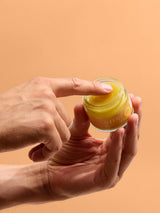
- Apply generously: Run the stick over each lip two or three times until you can see a film. Take a salve from the jar with a clean finger.
- Just beyond the edge: The transition to the facial skin dries out as well.
- Leave it on: Do not wipe it off and do not lick it off. If you have another drink, reapply afterwards.
The steps are based on practice; nobody has measured them. A stick contains a lot of wax so that it keeps its shape, and it leaves a thin, firm film. A salve from a jar contains more oil and can be applied more thickly; in return it shines and can rub off on the pillow. The same principle is used in Overnight hand mask: what it does and how to do it and Foot cream overnight with socks: does it help?
When to seek medical advice
The AAD gives two to three weeks as a guide: if your lips are not clearly better by then despite care, see a skin doctor (AAD). Have them looked at sooner if the corners of your mouth crack, blisters or crusts form, your lips swell, weep or bleed, or a single spot stays rough and scaly. If you snore loudly, your breathing stops during sleep or your nose is blocked for weeks, talk to your GP or an ear, nose and throat practice; a lip balm does not change that.
Frequently asked questions
Is a normal lip balm stick enough for the night, or do I need a mask?
A stick is enough if you run it over each lip several times. A mask or salve is softer and makes it easier to get a thick layer.
Do I apply lip balm before or after brushing my teeth?
Afterwards, as the last thing you do before going to sleep. Otherwise you remove part of the film again when brushing and rinsing.
Do I need a lip balm with SPF at night?
No. UV filters have no job to do at night. You can still use a stick with SPF in the evening; the fats and waxes in it form the same film. When the filter matters: Do I need lip balm with SPF?
Why are my lips dry in the morning despite lip balm?
Mostly because the cause remains: an open mouth during sleep, dry indoor air or licking. Also check the ingredient list for menthol, camphor and flavourings.
Do I swallow the thick layer in my sleep?
You take in a small part with your saliva, just as you do during the day. What that means is explained on the page You swallow some of your lip balm: is that a problem?
At forpeople
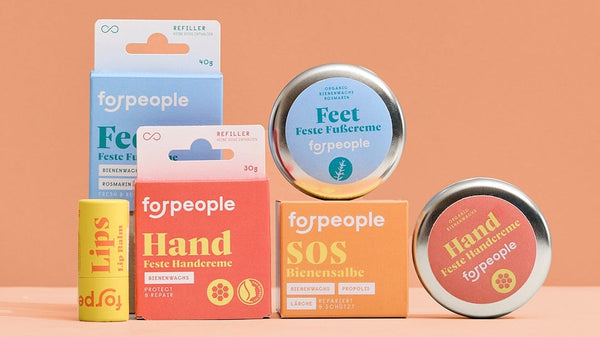
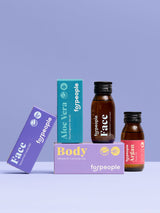
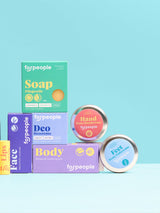
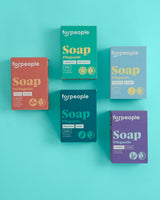
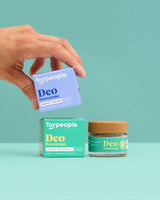
We do not have a dedicated overnight lip mask. Two solid sticks and a soft salve are suitable for the evening, all three water-free. Our beeswax comes from northern Germany and from organic beekeeping with Bioland certification. According to the product information, the products are not to be used on injured or irritated skin.
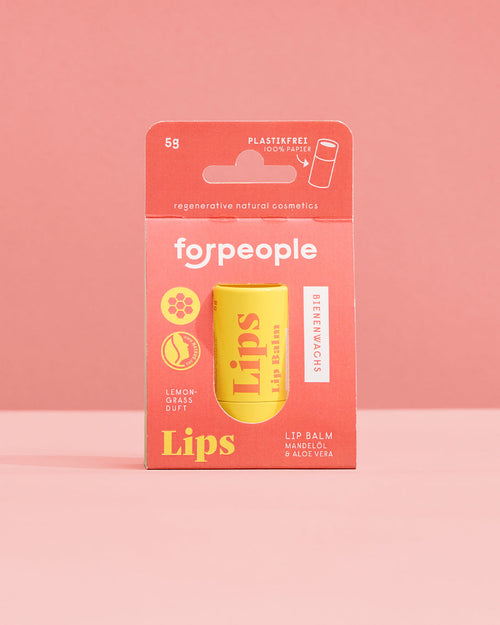
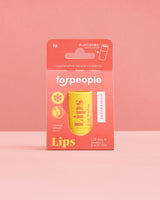
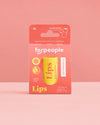
- Lip Balm - Lemongrass, 5 g, €4.90: solid stick in a paper tube. According to the ingredient list: beeswax, sunflower oil, shea butter, almond oil, hemp seed oil, aloe vera extract and lemongrass essential oil.
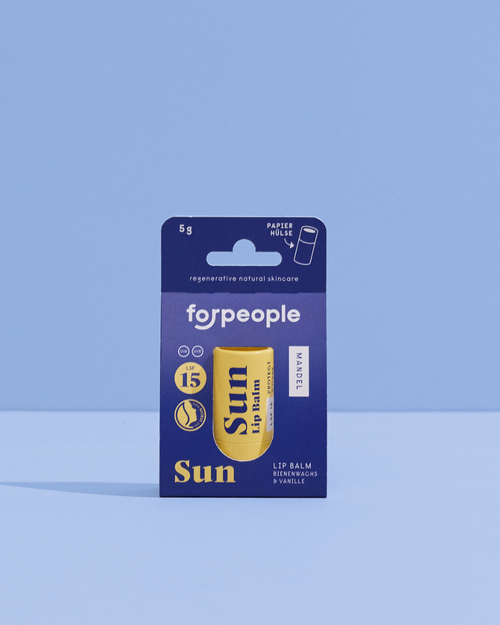
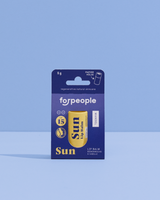
- Lip Balm - SPF15 Almond & Vanilla, 5 g, €7.90: the same base without essential oil, with vanilla extract and the mineral filters zinc oxide and titanium dioxide (non-nano). Nobody needs the sun protection at night; the stick suits the evening if you want to do without essential oil.
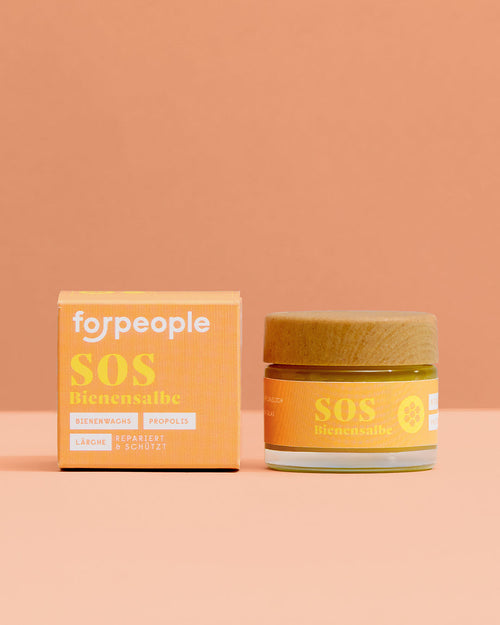
- Beeswax Salve Larch & Mandarin in a Glass Jar, 50 g, €12.90: soft salve made of olive, almond and castor oil, beeswax, larch resin and propolis, with essential oils from mandarin, rosemary and fir. It can be applied more thickly than a stick, but it has a distinct scent. Try it on a small area first. See Allergic to tree resin, colophony or propolis?
If you notice a skin reaction, stop using the product. More on this: Why do lips dry out so quickly? · Can you become dependent on lip balm? · Lip scrub: is it worth it, how often and with what?
From the blog: Hands and feet through winter: a routine for morning and evening
Sources
- Kobayashi H, Tagami H (2004): Functional properties of the surface of the vermilion border of the lips are distinct from those of the facial skin. British Journal of Dermatology 150(3): 563–567. https://doi.org/10.1046/j.1365-2133.2003.05741.x
- American Academy of Dermatology (o. J.): 7 dermatologists' tips for healing dry, chapped lips. Abgerufen am 08.10.2026. https://www.aad.org/public/everyday-care/skin-care-basics/dry/heal-dry-chapped-lips
- Sunwoo Y, Chou C, Takeshita J, Murakami M, Tochihara Y (2006): Physiological and subjective responses to low relative humidity. Journal of Physiological Anthropology 25(1): 7–14. https://doi.org/10.2114/jpa2.25.7
- Yosipovitch G, Xiong GL, Haus E, Sackett-Lundeen L, Ashkenazi I, Maibach HI (1998): Time-dependent variations of the skin barrier function in humans: transepidermal water loss, stratum corneum hydration, skin surface pH, and skin temperature. Journal of Investigative Dermatology 110(1): 20–23. https://doi.org/10.1046/j.1523-1747.1998.00069.x
- Umweltbundesamt (2024): Wie lüfte ich richtig? – Tipps und Tricks zur Schimmelvermeidung. Zuletzt aktualisiert am 13.12.2024. https://www.umweltbundesamt.de/themen/gesundheit/umwelteinfluesse-auf-den-menschen/schimmel/wie-luefte-ich-richtig-tipps-tricks-zur
- Tamura E, Yasumori H, Yamamoto T (2020): The efficacy of a highly occlusive formulation for dry lips. International Journal of Cosmetic Science 42(1): 46–52. https://doi.org/10.1111/ics.12583