


How much lip balm ends up in your mouth
What is measured is not what someone swallows but what is applied. In its guidance, the EU's Scientific Committee on Consumer Safety (SCCS) gives daily amounts per product type. For “lipstick, lip salve” it lists 0.057 grams per day, that is 57 milligrams (SCCS 2023). The figure comes from usage studies in five European countries and is a cautious choice: 90% of users do not exceed it.
The committee notes that lipstick is normally not intended to be swallowed and that it assesses intake by mouth case by case (SCCS 2023). For its assessment of mineral oil in lip care products, Germany's Federal Institute for Risk Assessment (BfR) assumed the worst case: the 57 milligrams are swallowed completely (BfR 2018).
Projected over a year, that is 57 milligrams times 365 days, just under 21 grams a year, or about four sticks of 5 grams each. This is our calculation from the committee's figure, not a measured value; if you apply less often, you are below it.
What the Cosmetics Regulation requires
Lip balm is a cosmetic product; the regulation names the lips explicitly in its definition. Three rules matter here (Regulation (EC) No 1223/2009):
- Safe under foreseeable use: A cosmetic product must be safe for human health when used under normal or reasonably foreseeable conditions of use (Article 3).
- Safety report before sale: Before that, the product must have undergone a safety assessment that takes into account how much individual ingredients may burden the body (Article 10).
- Swallowing is part of it: The report covers amount, duration and frequency of use, and also routes that do not result from direct application. As an example, the regulation names the “non-intended ingestion of lip products” (Annex I, Part A, No 6).
That does not mean lip balm is edible. It means: whoever writes the safety report has to assess the raw materials as if part of them ended up in the mouth.
Groups of substances in lip balm and how they are classified
| Group of substances | Examples in the ingredient list | Classification |
|---|---|---|
| Plant oils and plant butters | Helianthus Annuus Seed Oil, Prunus Amygdalus Dulcis Oil, Butyrospermum Parkii Butter | Sunflower and almond oil are also familiar from the kitchen. That does not make a cosmetic raw material a food. |
| Beeswax | Cera Alba | Authorised in the EU as food additive E 901, for example as a coating on confectionery. |
| Essential oils and their components | Cymbopogon Flexuosus Oil; Citral, Citronellol, Geraniol | Provide scent and taste. Certain components must be listed individually. |
| Mineral UV filters | Zinc Oxide, Titanium Dioxide | Both are authorised as UV filters. For titanium dioxide in lip products, the SCCS asked for more data in 2024. |
| Mineral oil components | Paraffinum Liquidum, Petrolatum, Cera Microcristallina | For lip care, the industry association recommends only grades for which an acceptable daily intake has been set. |
| Colourants | “CI” with a five-digit number | Only listed colourants are allowed. Some must not be used in products applied on mucous membranes. |
Beeswax. According to the food safety authority EFSA, the components of beeswax are poorly absorbed from the gastrointestinal tract. It did not set an acceptable daily intake because data on beeswax itself were lacking. It did conclude, however, that the use as an additive in food is not of safety concern (EFSA 2007). That is an assessment for food, not a statement about any particular lip balm.
Mineral oil. The industry association Cosmetics Europe recommends that manufacturers use only mineral oils and waxes in lip care for which an acceptable daily intake applies. If that is followed, the BfR expects no health effects from intake by mouth. However, studies in Switzerland and Germany found products that did not comply with the recommendation (BfR 2018). How to spot mineral oil in the list: Hand cream without mineral oil: spotting paraffin.
Scent. Which components have to be named individually, and why: Essential Oils and Fragrance Allergens.
Titanium dioxide and zinc oxide in lip balm with SPF
Titanium dioxide and zinc oxide are authorised as UV filters in the EU, each up to a maximum concentration of 25% (Regulation (EC) No 1223/2009, Annex VI). For zinc oxide that is not in nano form, the scientific committee has confirmed its use in cosmetic products up to 25% as safe; applications in which it can be inhaled are excluded (Regulation (EU) 2016/621).
With titanium dioxide the situation is less settled. After the re-evaluation of the food additive E 171, the SCCS examined titanium dioxide in products that can get into the mouth, including lip care. The result from May 2024 (SCCS 2024):
- For almost all grades examined, the data are not sufficient to exclude a genotoxic potential when taken up via the mouth; two nano grades are the exception. The committee asks for more data.
- At the same time it stresses: cosmetics are not meant to be swallowed, and what gets into the mouth unintentionally is far below the amounts from food.
- For products applied to the skin, its earlier conclusions remain unchanged.
The question is therefore open. Titanium dioxide is still authorised as a UV filter. If you want to avoid it on your lips, you will find it in the ingredient list as “Titanium Dioxide”, and on days with little sun you can use a lip balm without a UV filter. More on this: Titanium dioxide: banned in food, allowed in cosmetics and Do I need lip balm with SPF?
What you can do yourself
- Apply thinly during the day. A thick layer is more likely to be worn off when you eat and drink.
- Do not lick it off. Licking removes the balm and dries the lips out: Why do lips dry out so quickly?
- Read the list. It names all ingredients in descending order: How to Read an INCI List
When to seek medical advice?
The fact that small amounts get into your mouth in normal use is not in itself a reason to see a doctor. Seek advice if your lips sting, swell, redden or form blisters after using a lip balm; stop using it then, because a contact allergy may be behind it. If someone has accidentally swallowed a larger amount and feels unwell, a poison information centre can help.
Frequently asked questions
How much lip balm do you swallow in a year?
There is no measured figure. The SCCS assumes 57 milligrams of applied lip product per day. If you swallowed all of it, that would be just under 21 grams a year. That is an upper limit for the calculation, not an average.
Is lip balm edible?
No. Lip balm is a cosmetic product, not a food. The safety assessment only takes into account that small amounts get into the mouth unintentionally.
What about mineral oil in lip balm?
If a manufacturer follows the industry association's recommendation on mineral oil grades, the BfR expects no health effects from intake by mouth. Whether a stick contains mineral oil is shown in the ingredient list.
What about titanium dioxide in lip balm with SPF?
The question is open. In 2024 the SCCS could not exclude a genotoxic potential when taken up via the mouth for almost all grades and asks for more data. It did not recommend new limits.
Do the forpeople lip balms contain mineral oil or colourants?
Not according to the ingredient list. The SPF version contains the white pigments zinc oxide and titanium dioxide; there they serve as UV filters.
At forpeople
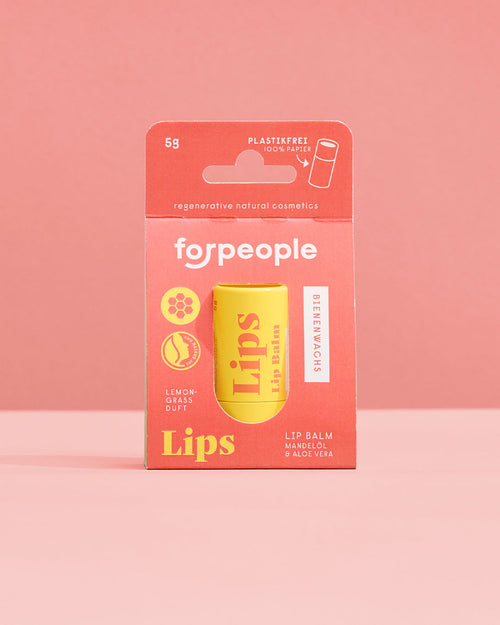
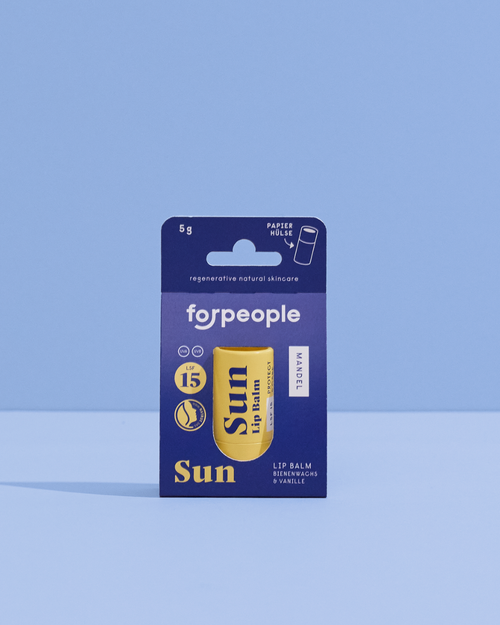
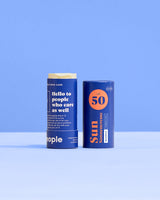
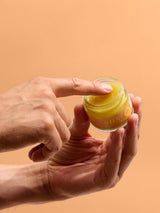
We offer two lip balms, both water-free sticks in a paper tube. Both contain beeswax, sunflower oil, shea butter, almond oil, hemp seed oil and aloe vera extract. The full lists:
- Lip Balm - Lemongrass, 5 g, €4.90. Ingredients: Cera Alba, Helianthus Annuus Seed Oil, Butyrospermum Parkii Butter, Prunus Amygdalus Dulcis Oil, Cannabis Sativa Seed Oil, Aloe Barbadensis Leaf Extract, Cymbopogon Flexuosus Oil, Citral, Citronellol, Geraniol. The last three are components of the lemongrass essential oil. No UV filter.
- Lip Balm - SPF15 Almond & Vanilla, 5 g, €7.90. Ingredients: Cera Alba, Helianthus Annuus Hybrid Oil, Butyrospermum Parkii Butter, Prunus Amygdalus Dulcis Oil, Zinc Oxide, Titanium Dioxide, Cannabis Sativa Seed Oil, Helianthus Annuus Seed Oil, Aloe Barbadensis Leaf Extract, Silica, Tocopherol, Vanilla Planifolia Extract. Zinc oxide and titanium dioxide are non-nano according to the product information. No essential oil.
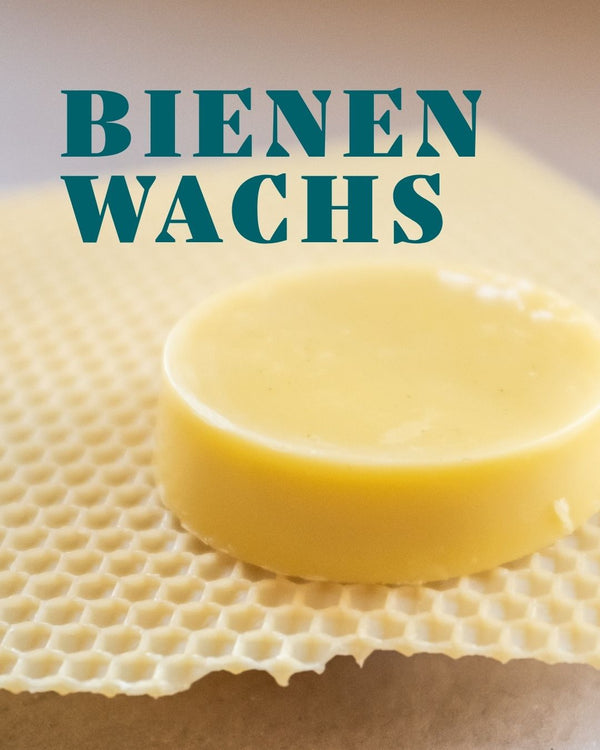
Our beeswax is unbleached, comes from northern Germany and from organic beekeeping with Bioland certification. Both sticks are cosmetics and not intended for consumption; according to the product information, they are not to be used on injured or irritated skin.
More on this: Hemp seed oil in cosmetics: does it contain THC or CBD? · Silica in sunscreen and lip balm: what is it for? · Nano or non-nano? Zinc oxide and titanium dioxide explained · Honey, oil, quark: do home remedies help chapped lips?
From the blog: Beeswax in Cosmetics: What It Does – and Why We Love It · UV filters: chemical vs. mineral
Sources
- Scientific Committee on Consumer Safety (2023): The SCCS Notes of Guidance for the Testing of Cosmetic Ingredients and their Safety Evaluation, 12th Revision. SCCS/1647/22, angenommen am 15. Mai 2023, Corrigendum 2 vom 21. Dezember 2023, Tabelle 3A. https://health.ec.europa.eu/system/files/2023-12/sccs_o_273_final.pdf
- Europäisches Parlament und Rat (2009): Verordnung (EG) Nr. 1223/2009 vom 30. November 2009 über kosmetische Mittel, Artikel 2, 3, 10 und 19, Anhänge I, IV und VI. ABl. L 342 vom 22.12.2009, S. 59. https://eur-lex.europa.eu/eli/reg/2009/1223/oj
- Bundesinstitut für Risikobewertung (2018): Hochraffinierte Mineralöle in Kosmetika: Gesundheitliche Risiken sind nach derzeitigem Kenntnisstand nicht zu erwarten. Aktualisierte Stellungnahme Nr. 008/2018 vom 27. Februar 2018. https://doi.org/10.17590/20180219-123914
- European Food Safety Authority (2007): Beeswax (E 901) as a glazing agent and as carrier for flavours. Scientific Opinion of the Panel on Food additives, Flavourings, Processing aids and Materials in Contact with Food (AFC). The EFSA Journal 615: 1–28. https://doi.org/10.2903/j.efsa.2007.615
- Scientific Committee on Consumer Safety (2024): Scientific Advice on Titanium dioxide (TiO2). SCCS/1661/23, endgültige Fassung vom 13. Mai 2024. https://health.ec.europa.eu/publications/scientific-advice-titanium-dioxide-tio2-casec-numbers-13463-67-7236-675-5-1317-70-0215-280-1-1317-80_en
- Europäische Kommission (2016): Verordnung (EU) 2016/621 vom 21. April 2016 zur Änderung des Anhangs VI der Verordnung (EG) Nr. 1223/2009 über kosmetische Mittel. ABl. L 106 vom 22.4.2016, S. 4. https://eur-lex.europa.eu/eli/reg/2016/621/oj