







For many people, homemade deodorant cream is the entry point to making their own skincare: a few ingredients from the kitchen cupboard, a jar, done. After a few days the questions come. Why is it grainy? Why do my underarms sting? And how much baking soda actually belongs in it? The answers lie in the chemistry of the ingredients.
What a deodorant cream is made of
A deodorant cream without water has four building blocks. Their functions are also listed in the EU ingredient database CosIng (CosIng).
| Building block | Role | Name on the ingredient list | Too much | Too little |
|---|---|---|---|---|
| Shea butter and plant oil | carry the powders, make the cream spreadable | Butyrospermum Parkii Butter, Helianthus Annuus Seed Oil | greasy, marks on clothing | dry, crumbly |
| Wax (optional) | makes the cream more stable in warmth | Cera Alba, Euphorbia Cerifera Cera | hard, difficult to take out | liquid in summer |
| Starch | absorbs a little moisture, gives firmness (CosIng: "absorbent") | Zea Mays Starch, Solanum Tuberosum Starch | dusty, white residue | soft, smeary |
| Baking soda | binds odour substances (CosIng: "deodorant", "buffering") | Sodium Bicarbonate | more frequent redness and stinging | shorter odour protection |
Wax only melts at higher temperatures: beeswax at 62 to 65 °C, candelilla wax at 68.5 to 72.5 °C (Regulation (EU) No 231/2012). Even a little of it keeps the cream in shape in summer. How the two waxes differ is explained in Candelilla wax or beeswax: the differences.
Basic recipe in grams
Weigh by weight, not with spoons; spoon measures vary a lot with powders. The amounts make about 50 g, enough for a small jar. They are practical values, not a standard.
| Ingredient | To start with (5% baking soda) | Standard (10% baking soda) |
|---|---|---|
| Shea butter | 15 g | 15 g |
| Plant oil, for example sunflower or almond oil | 10 g | 10 g |
| Beeswax (or 1.5 g candelilla wax) | 2 g | 2 g |
| Corn or potato starch | 20.5 g | 18 g |
| Baking soda, finely ground | 2.5 g | 5 g |
For comparison: two recipes we read on 28 October 2026 range from half a teaspoon of baking soda to three tablespoons of starch up to 25 g of baking soda in 75 g of cream, which is one third. There is no standard; the range shows how different the recipes are. Only increase the baking soda if your underarms cope well with the low amount for a few weeks and the odour protection is not enough.
Step by step
- Prepare: clean the jar, spoon and bowl and let them dry completely. No water must get into the cream.
- Prepare the powders: grind the baking soda finely in a mortar or push it through a fine sieve and mix it with the starch. Coarse crystals will rub on the skin later.
- Melt the fats: melt the shea butter, oil and wax in a water bath until everything is clear. Then take it off the heat.
- Stir in the powders: stir the powder mixture into the liquid fat a spoonful at a time until no lumps are visible.
- Stir until it thickens: baking soda and starch do not dissolve in fat; they only float in it and sink in the liquid mixture. So keep stirring until the cream thickens, and only then fill it.
- Fill and label: fill into a clean, dry jar or tin, let it cool uncovered, close it and label it with the ingredients and date.
How wax, butter and oil work together is explained in detail in Making solid cream at home: how much wax to oil?
Baking soda and skin: why less is often more
Baking soda, chemically sodium hydrogen carbonate, is alkaline: according to the EU specification, a one percent solution has a pH of 8.0 to 8.6 (Regulation (EU) No 231/2012). The skin surface, by contrast, is acidic. In a study of 330 people, the natural skin pH on the forearm was about 4.7 on average; even tap water with a pH of around 8 raised it for up to six hours (Lambers et al. 2006). In the same study, skin with a pH below 5 was in better condition, measured by barrier function, moisture and scaling.
Several things come together in the underarm: it is warm and moist, sweat dissolves the baking soda, and the skin is often shaved. Shaving and plucking damage the skin and lead to redness and dryness in the short term (Evans et al. 2012). So when you make your own:
- start with little baking soda, as in the "to start with" recipe;
- test a new mixture under one arm only for a few days;
- do not apply it straight after shaving; ideally shave in the evening and apply in the morning;
- apply thinly; a pea-sized amount per underarm is enough.
If the skin turns red or stings, stop using the cream. More in Baking soda in deodorant: what it is for and when the skin reacts and Deodorant after shaving: why does it sting, and what helps?
What a deodorant cream can and cannot do
Fresh sweat hardly smells. The typical odour substances of the underarm, above all certain carboxylic acids and sulphur compounds, only form when enzymes from skin bacteria split odourless precursors from the secretion of the underarm glands (Natsch & Emter 2020). This is where a deodorant cream comes in: baking soda, as a mildly alkaline substance, can bind acidic odour substances, and starch absorbs a little moisture. That does not change the amount of sweat. Antiperspirants reduce it with aluminium salts that form a gel plug at the openings of the sweat glands (Teerasumran et al. 2023); a homemade deodorant cream cannot do that. The differences are explained in How do aluminium-free deodorants work? Odour, sweat and ingredients and Deodorant or antiperspirant: what is the difference?
Grainy, too hard, too soft: common problems
| Problem | Cause | What helps |
|---|---|---|
| Cream is grainy | coarse baking soda; or the shea butter formed crystals while cooling slowly | grind the baking soda finely; melt the cream and let it cool quickly at room temperature |
| Powder has settled at the bottom | filled too early while the mixture was liquid | melt it slightly again and stir until it thickens |
| Too hard | a lot of starch or wax, cold room | warm it with your fingertip; use more oil next time |
| Too soft or liquid | warmth, no wax, a lot of oil | store somewhere cooler; add 1 to 2 g wax |
| White residue on the skin | too much applied or a lot of starch | use less, spread it well |
| Marks on your shirt | too much cream, not absorbed | apply more thinly, wait a moment; see Does deodorant cream leave stains? |
Background on shea butter is in Shea butter: composition, origin, refining; why solid creams change firmness with temperature is in Storing solid cosmetics: heat, summer and winter.
Shelf life and hygiene
Microorganisms need water; one review calls it an ideal growth factor for germs in cosmetics (Halla et al. 2018). A deodorant cream without water offers them hardly any conditions. That changes if water gets in, for example from wet fingers after showering; then the starch becomes a breeding ground too. So take the cream out with dry fingers or a small spatula. It can still age: shea butter and oil turn rancid over time. If the cream smells rancid or different from the start, or spots or water droplets appear, throw it away. There is no fixed shelf-life figure. More in Hygiene with water-free cosmetics: what to watch out for and Homemade cream: how long does it keep?
Homemade deodorant cream is intended for your own use. Anyone who supplies it in the course of a commercial activity, even free of charge, needs a safety assessment among other things (Regulation (EC) No 1223/2009, Art. 2 and 10). If you give it away privately, add the ingredients and the date and point out the baking soda.
When to seek medical advice
A deodorant cream is a cosmetic. Seek medical advice if redness in the underarm does not settle after you stop using it, if the skin weeps, forms blisters or hurts, or if reactions keep coming back. If you sweat very heavily for no apparent reason, or your sweat or body odour suddenly changes noticeably, have that checked by a doctor as well.
Frequently asked questions
How much baking soda belongs in a deodorant cream?
There is no fixed rule. We recommend starting with about 5 percent of the mixture, so 2.5 g for 50 g, and increasing to 10 percent at most if your skin copes well with it.
Can deodorant cream be made without baking soda?
Yes. Then starch and fat do the work alone, and the odour protection is usually shorter. Ready-made deodorants without baking soda often work with zinc compounds or magnesium hydroxide; what they do is explained in How do aluminium-free deodorants work?
Why does my homemade deodorant cream sting?
Often there is too much baking soda in it, the skin was freshly shaved or the crystals were coarse. Stop using the cream until the skin has calmed down, and make the next batch with less, finer baking soda.
Can I use coconut oil?
Yes, many recipes do. But coconut oil turns liquid even at warm room temperature; with shea butter and a little wax the cream keeps its shape better.
Corn or potato starch?
Both are listed in the EU database CosIng as "absorbent" and do the same job. Differences show more in how they feel on the skin. Our deodorant cream contains both.
May I add essential oils?
It is possible, but every essential oil brings fragrance substances, and in the underarm they stay on warm, often freshly shaved skin for a long time. A cream without fragrance is the simplest start; more in Fragrance-free deodorant: what to look out for with sensitive underarms.
Can I add lemon juice, aloe gel or hydrosol?
Better not. Anything watery turns the water-free cream into a breeding ground for germs and would need a preservative; why is explained in Homemade cream: how long does it keep? Acids such as lemon juice or vinegar also react with the baking soda: it fizzes, and the baking soda is used up.
How do I apply the cream correctly?
To the washed, dry underarm, a pea-sized amount, warmed between your fingers and spread thinly. Details in How to apply deodorant cream: how much, when, how often?
If you would rather not make it yourself
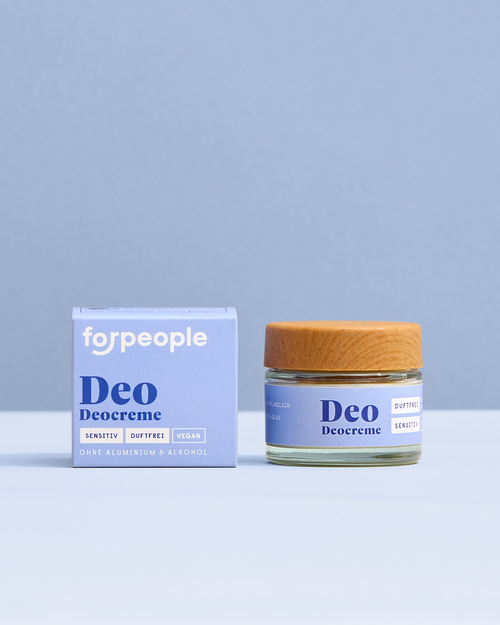
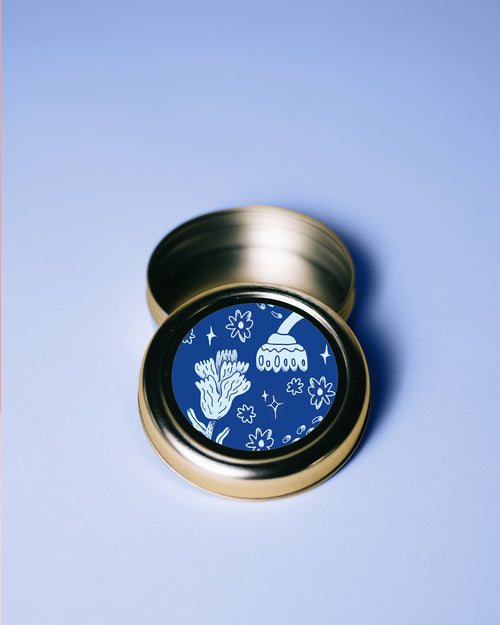
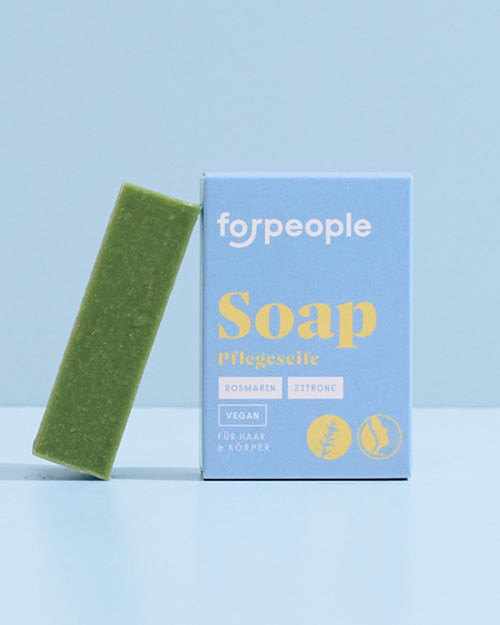
Our Sensitive Deodorant Cream (50 g, €8.90) follows the same design. Its ingredient list names potato starch, shea butter, baking soda, sunflower oil, corn starch and candelilla wax; baking soda is in third place. According to its ingredient list it contains no water, no alcohol, no aluminium salts and no added fragrance. If you react to baking soda, it is not the right choice for you. For your own mixture there is the Empty Cosmetic Tin (€3.90). To wash your underarms before applying, a bar of Aloe Vera Soap – Rosemary & Lemon (75 g, €8.90) works well.
More: Aluminium-free deodorant: how it works and how to switch · Testing new skincare on a small area · Making pitch salve at home · Making lip balm at home
Sources
- European Commission (2012): Regulation (EU) No 231/2012 laying down specifications for food additives listed in Annexes II and III to Regulation (EC) No 1333/2008, Annex, E 500 (ii) sodium hydrogen carbonate, E 901 beeswax, E 902 candelilla wax. OJ L 83, 22.3.2012, p. 1. https://eur-lex.europa.eu/eli/reg/2012/231/oj
- Lambers H, Piessens S, Bloem A, Pronk H, Finkel P (2006): Natural skin surface pH is on average below 5, which is beneficial for its resident flora. Int J Cosmet Sci 28(5): 359–370. https://doi.org/10.1111/j.1467-2494.2006.00344.x
- Natsch A, Emter R (2020): The specific biochemistry of human axilla odour formation viewed in an evolutionary context. Philos Trans R Soc Lond B Biol Sci 375(1800): 20190269. https://doi.org/10.1098/rstb.2019.0269
- Evans RL, Marriott RE, Harker M (2012): Axillary skin: biology and care. Int J Cosmet Sci 34(5): 389–395. https://doi.org/10.1111/j.1468-2494.2012.00729.x
- European Commission: CosIng – database of cosmetic ingredients, entries SODIUM BICARBONATE, ZEA MAYS STARCH and SOLANUM TUBEROSUM STARCH, accessed 28.10.2026. https://ec.europa.eu/growth/tools-databases/cosing/
- Teerasumran P, Velliou E, Bai S, Cai Q (2023): Deodorants and antiperspirants: New trends in their active agents and testing methods. Int J Cosmet Sci 45(4): 426–443. https://doi.org/10.1111/ics.12852
- Halla N, Fernandes IP, Heleno SA, Costa P, Boucherit-Otmani Z, Boucherit K et al. (2018): Cosmetics Preservation: A Review on Present Strategies. Molecules 23(7): 1571. https://doi.org/10.3390/molecules23071571
- European Parliament and Council (2009): Regulation (EC) No 1223/2009 on cosmetic products, Art. 2 and 10. OJ L 342, 22.12.2009, p. 59. https://eur-lex.europa.eu/eli/reg/2009/1223/oj