


What “fragrance-free” means in the INCI list
What counts is the ingredient list, not the front of the pack. Fragrance shows up there in three places:
- “Parfum”: Perfume and aromatic compositions may be listed collectively as “Parfum” or “Aroma” (Regulation (EC) No 1223/2009, Art. 19). Imported products often say “Fragrance” instead.
- Essential oils: They appear in the list with the Latin plant name, for example “Citrus Bergamia Peel Oil”. They provide scent as well. With the 2023 regulation, some essential oils themselves were added to the list of fragrance substances that must be named individually, among them bergamot oil and lemongrass oil (Regulation (EU) 2023/1545).
- Individually named fragrance substances: Names such as Linalool, Limonene, Citral or Geraniol at the end of the list. They must be named as soon as their content exceeds 0.001% in products that stay on the skin. A deodorant is one of these. For rinse-off products the threshold is 0.01%.
Until 2023 this obligation applied to 24 fragrance substances. Regulation (EU) 2023/1545 extended the list considerably. Products labelled under the old rules could still be placed on the market until 31 July 2026 and may be sold until 31 July 2028 (Regulation (EU) 2023/1545). For the time being, both kinds of labelling will therefore sit side by side on the shelf. The background is explained on the page Essential Oils and Fragrance Allergens.
“No perfume”, “sensitive”, “hypoallergenic”: what the terms tell you
Everything on the front of the pack is a product claim. Common EU criteria apply: a claim must be truthful, supported by evidence and honest (Regulation (EU) No 655/2013). How this is to be read for individual terms is described in a technical document by a working group of Member States and associations chaired by the European Commission. It is guidance and not legally binding; in individual cases, authorities and courts decide (Technical document on cosmetic claims 2017).
| Statement | What is laid down | What it tells you |
|---|---|---|
| “Parfum” in the INCI list | Mandatory information under the Cosmetics Regulation | Fragrance substances have been added to the product. |
| “no perfume”, “fragrance-free” | According to the technical document, not to be used if an ingredient exerts a perfuming function in the product, even if it has other functions as well. | What is absent. The statement says nothing about how well you tolerate the product. |
| “free from allergens” | According to the technical document, not allowed, because a complete absence of risk cannot be guaranteed. | You should not find it on cosmetics. |
| “hypoallergenic” | According to the technical document, only if the product has been designed to keep its allergenic potential low, avoids known allergens and the manufacturer has evidence for this. | No guarantee: the document states explicitly that a reaction cannot be ruled out. |
| “sensitive”, “for sensitive skin” | No definition of its own. The technical document contains no specific guidance on it; the general criteria apply. | A statement by the manufacturer. What is meant only becomes clear from the INCI list. |
What makes the underarm special
The skin of the underarm is moist, occluded and easily irritated (SCCS 2012). Hair removal comes on top: shaving and plucking damage the skin and lead to redness and dryness in the short term (Evans et al. 2012). Something that goes unnoticed elsewhere on the body may therefore be more noticeable in the underarm.
Fragrance substances are only one possible trigger. Others that you find in the INCI list or in everyday life:
- Alcohol: In the INCI list “Alcohol” or “Alcohol Denat.”. It serves as a solvent, mainly in sprays and roll-ons, and can sting on freshly shaved skin.
- Baking soda: “Sodium Bicarbonate” is slightly alkaline, the skin surface slightly acidic. Some skin reacts to it with redness or stinging. More on this under Baking soda in deodorant.
- Shaving: Many things sting on freshly shaved skin. Leave some time between shaving and deodorant, see Deodorant after shaving: why does it sting, and what helps?
- Amount, friction, moisture: A lot of product, tight clothing and an underarm that stays damp for long put extra strain on the skin. Apply thinly to dry skin, see How to apply deodorant cream: how much, when, how often?
How to read a deodorant label
- Put the front in context: “Deo”, “sensitive” or “0% aluminium” are product claims. On the difference between the product types: Deodorant or antiperspirant: what is the difference?
- Find the INCI list: It is on the packaging under “Ingredients”. How it is structured is explained on the page How to Read an INCI List.
- Look for “Parfum”: also for “Fragrance” and “Aroma”.
- Look for essential oils: Latin plant name plus “Oil”, for example “Lavandula Angustifolia Oil”. Fatty oils such as “Helianthus Annuus Seed Oil” (sunflower) are not fragrance substances.
- Read the end of the list: If Limonene, Linalool, Citral, Geraniol or Citronellol appear there, the product contains fragrance substances.
- Check further substances: “Alcohol” or “Alcohol Denat.”, “Sodium Bicarbonate” and aluminium salts beginning with “Aluminum”. “Cetearyl Alcohol” is a fatty alcohol and not the same as drinking alcohol.
- Compare with your own list: If you know what you react to, compare substance by substance.
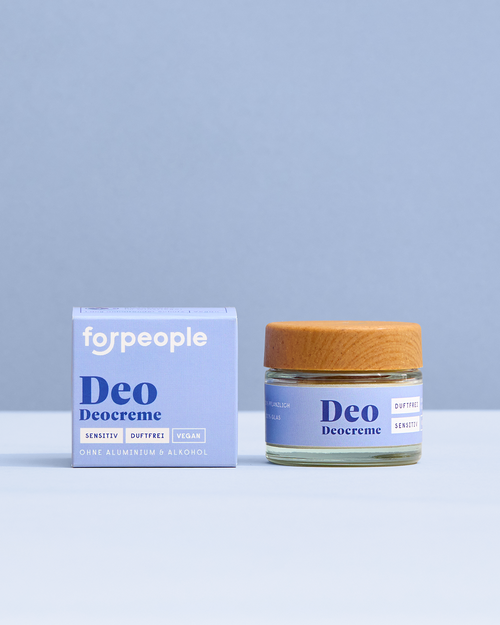
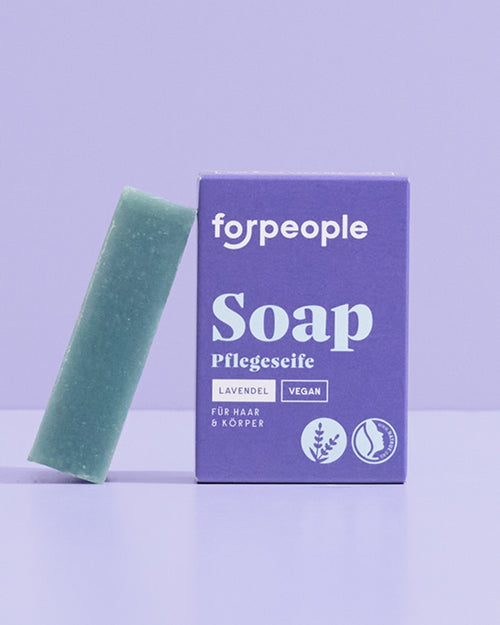
An example: the INCI list of the Sensitive Deodorant Cream names potato starch, shea butter, baking soda, sunflower oil, corn starch and candelilla wax. It contains no parfum, no essential oil, no individually named fragrance substance and no alcohol, but it does contain baking soda. Also think about what you use before the deodorant: a soap such as the Aloe Vera Soap – Lavender contains essential oils but is rinsed off.
If your underarm reacts
- Pause: Stop using the product until the skin looks normal again.
- Change only one thing: If you switch deodorant, razor and shower gel at the same time, you will not know what caused it.
- Start small: Apply a new product under one arm only for a few days.
- Not on shaved or broken skin: Shave in the evening and apply the deodorant the next morning.
When to seek medical advice
Seek medical advice if redness does not subside after you stop using the product, if the skin weeps, forms small blisters or swells markedly, or if reactions keep coming back. If you suspect a contact allergy to a fragrance substance, a skin specialist can check this with a patch test; afterwards you know which names to avoid in the INCI list. Very heavy sweating without an apparent reason, or a sudden change in sweating and body odour, should also be checked by a doctor.
Frequently asked questions
May a deodorant with essential oils be called “no perfume”?
According to the technical document on cosmetic claims, “free from perfume” should not be used if an ingredient exerts a perfuming function in the product. Essential oils added for their scent fall under this. The document is guidance; so rely on the INCI list.
Is a fragrance-free deodorant automatically well tolerated?
No. Only one possible trigger is absent. Baking soda, alcohol, shaving or simply too much product can irritate the skin as well.
The deodorant cream is called “Sensitive”. Is that a promise for sensitive skin?
No. “Sensitive” is the product name and stands for the formula without added fragrance and without essential oils. The cream contains baking soda, which some skin reacts to.
My underarm stings after application. Is it the fragrance?
Possibly, but not necessarily. Freshly shaved skin, baking soda or alcohol are also possible causes. Pause until the skin looks normal, and then change only one thing.
Does a fragrance-free deodorant smell of nothing?
Not necessarily. Raw materials such as shea butter have a slight smell of their own. That is not an added fragrance and is therefore not listed as a fragrance substance in the INCI list.
Is alcohol in a deodorant a fragrance substance?
No. Alcohol serves mainly as a solvent. It is listed as “Alcohol” or “Alcohol Denat.” in the INCI list.
At forpeople
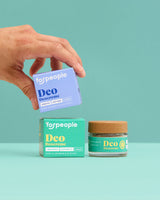
Both deodorant creams are deodorants in solid, water-free form. According to their INCI lists, both contain baking soda, no alcohol and no aluminium salt. They differ in scent:
- Sensitive Deodorant Cream, 50 g, €8.90: six ingredients, without added fragrance and without essential oils according to the INCI list.
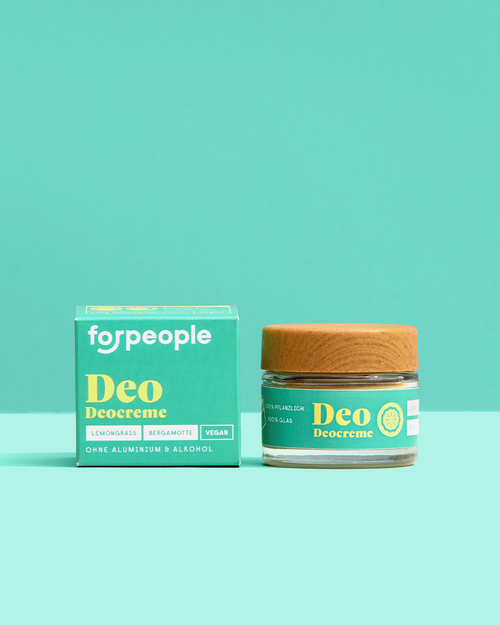
- Deodorant Cream - Lemon, 50 g, €8.90: the same base, plus essential oils of bergamot and lemongrass. The INCI list names Limonene, Linalool, Citral, Citronellal and Geraniol. If you avoid fragrance substances, it is not the right choice.
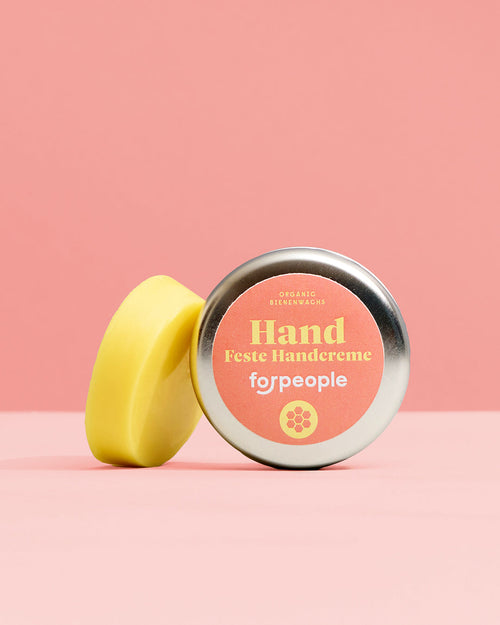
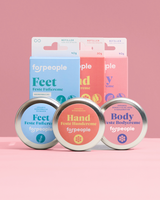
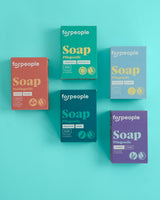
- Solid Hand Cream - Beeswax, 30 g, €9.90: likewise without added fragrance and without essential oils according to the INCI list.
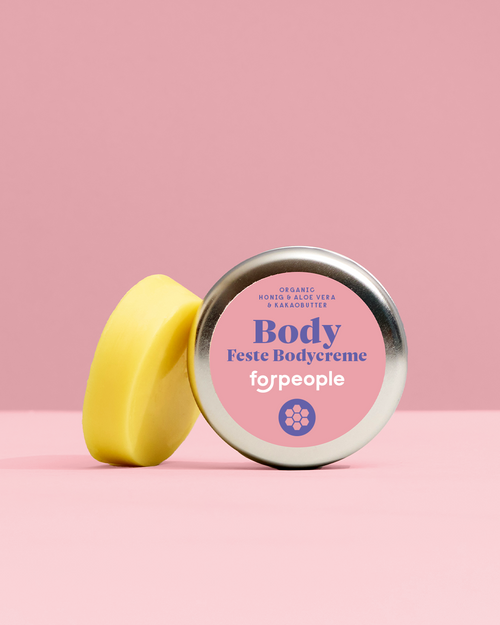
- Solid Body Butter - Beeswax & Aloe Vera, 40 g, €9.90: likewise without added fragrance and without essential oils according to the INCI list.
More on this: Without fragrance and essential oils: ingredients at a glance · Baking soda in deodorant · Deodorant without aluminium: how it works and switching · Essential Oils and Fragrance Allergens · Storing solid cosmetics: heat, summer and winter
From the blog: Deodorant Cream: How Well Does Natural Deodorant Cream Really Work?
Sources
- Verordnung (EG) Nr. 1223/2009 des Europäischen Parlaments und des Rates vom 30. November 2009 über kosmetische Mittel, Art. 19 und 20 sowie Anhang III. ABl. L 342 vom 22.12.2009, S. 59. eur-lex.europa.eu/eli/reg/2009/1223/oj
- Verordnung (EU) 2023/1545 der Kommission vom 26. Juli 2023 zur Änderung der Verordnung (EG) Nr. 1223/2009 hinsichtlich der Kennzeichnung allergieauslösender Duftstoffe in kosmetischen Mitteln. ABl. L 188 vom 27.7.2023, S. 1. eur-lex.europa.eu/eli/reg/2023/1545/oj
- Verordnung (EU) Nr. 655/2013 der Kommission vom 10. Juli 2013 zur Festlegung gemeinsamer Kriterien zur Begründung von Werbeaussagen im Zusammenhang mit kosmetischen Mitteln. ABl. L 190 vom 11.7.2013, S. 31. eur-lex.europa.eu/eli/reg/2013/655/oj
- Sub-Working Group on Claims (2017): Technical document on cosmetic claims. Fassung vom 3. Juli 2017, Anhang III („Free from claims“) und Anhang IV („Hypoallergenic claim“), anzuwenden ab 1. Juli 2019. ec.europa.eu/docsroom/documents/24847
- Scientific Committee on Consumer Safety (SCCS) (2012): Opinion on fragrance allergens in cosmetic products. SCCS/1459/11, verabschiedet am 26.–27. Juni 2012. ec.europa.eu – sccs_o_102.pdf
- Evans RL, Marriott RE, Harker M (2012): Axillary skin: biology and care. Int J Cosmet Sci 34(5): 389–395. https://doi.org/10.1111/j.1468-2494.2012.00729.x