If you switch from an antiperspirant to a deodorant without aluminium salts, you usually notice it under your arms first: they stay damp. That is not a fault of the product but its principle. Whether such a deodorant is enough in everyday life depends on what bothers you: the wetness or the odour.
Sweat and odour: how underarm odour develops
Two kinds of sweat glands work in the underarm. Eccrine glands sit almost everywhere on the body and cool it; their sweat is watery and contains salts, lactic acid and urea. Apocrine glands are found only in a few places, such as the underarms and the genital area. They only become active at puberty, open into the hair follicles and release an oily secretion with fatty acids, proteins and steroids. Each underarm has more than 25,000 sweat glands in total, and it is warm and moist, a good habitat for bacteria (Teerasumran et al. 2023).
Freshly secreted, the apocrine secretion does not smell. It only takes on the typical pungent odour when it comes into contact with skin bacteria (Natsch & Emter 2020). It follows that how much you sweat and how strongly you smell are two different questions. A deodorant only answers the second.
The glands do not release the later odour molecules ready-made, but as odourless precursors bound to building blocks of proteins. Underarm bacteria have enzymes that split these compounds and release the odour molecule (Natsch & Emter 2020). Corynebacteria are considered the main cause, with staphylococci also involved (James et al. 2013; Natsch & Emter 2020). Above all, the following are released:
- Branched fatty acids such as 3-hydroxy-3-methylhexanoic acid and 3-methyl-2-hexenoic acid. They make up the largest share by quantity.
- Sulphur compounds such as 3-sulfanyl-3-methylhexan-1-ol. They occur in smaller amounts but are among the most important odour carriers.
- Steroids from the 16-androstene group, plus short- and medium-chain fatty acids.
Sources for the list: Natsch & Emter 2020, James et al. 2013. Which substances form, and in what proportion, is partly inherited; a twin study found very similar patterns in pairs of twins. In a large share of people in East Asia, a variant of the ABCC11 gene means the precursors are not secreted at all, and the typical underarm odour hardly forms. Children before puberty smell weaker and rather sour, because their apocrine glands are not yet working (Natsch & Emter 2020).
A deodorant can act on this chain at three points: it slows the bacteria, it binds the released odour molecules, or it masks them with fragrance (Teerasumran et al. 2023). An antiperspirant acts earlier: aluminium salts temporarily close the sweat ducts so that less sweat reaches the skin. The difference in detail is explained in Deodorant or antiperspirant: what is the difference?
What the individual ingredients do
The table shows typical ingredients of deodorants without aluminium salts, with their INCI names. Their functions come from CosIng, the European Commission's ingredient database (CosIng), and from a review of deodorant actives (Teerasumran et al. 2023). The last column shows which of them are in our Sensitive Deodorant Cream.
| Ingredient (INCI) | Job in the deodorant | Limits and notes | In the Sensitive Deodorant Cream |
|---|---|---|---|
| Baking soda (Sodium Bicarbonate) | odour absorber; listed in CosIng as deodorant and buffering | does not change the amount of sweat; slightly alkaline, can irritate some people's skin | yes |
| Starch (Solanum Tuberosum Starch, Zea Mays Starch) | absorbs moisture (absorbent) | does not hold back sweat | yes, potato and corn starch |
| Magnesium hydroxide (Magnesium Hydroxide) | absorbent and buffering | does not change the amount of sweat | no |
| Zinc ricinoleate (Zinc Ricinoleate) | binds odour molecules; listed in CosIng as deodorant | does not change the amount of sweat | no |
| Zinc oxide (Zinc Oxide), zinc carbonate (Zinc Carbonate) | according to CosIng, zinc oxide slows the growth of microorganisms; zinc carbonate serves as an odour absorber | do not change the amount of sweat | no |
| Triethyl citrate (Triethyl Citrate) | listed in CosIng as deodorant; meant to lower the pH in the underarm | in one study the pH stayed unchanged | no |
| Alcohol (Alcohol, Alcohol Denat.) | solvent; according to CosIng slows the growth of microorganisms and has an astringent effect | evaporates; can sting on freshly shaved skin | no |
| Essential oils, parfum (components e.g. Limonene, Linalool) | mask odour | contain fragrance substances that must be listed individually above certain amounts | no, no added fragrance |
| Shea butter, sunflower oil, candelilla wax | base of a deodorant cream, give it its texture | do not act on odour | yes |
Baking soda is a weak base. The most abundant odour molecules in the underarm are acids; baking soda can neutralise them, and then there is less smell. It does not change sweating. Because baking soda is alkaline, some skin reacts with redness or stinging, often only after a few days or after shaving. Details in Baking soda in deodorant: why it's there and skin reactions.
Essential oils are added to deodorants mainly to mask odour. Some inhibited bacteria involved in odour formation in laboratory tests; whether this holds on the skin of the underarm was not tested in those studies (Teerasumran et al. 2023). Essential oils consist of many individual substances, some of which can trigger contact allergies; what that means for the label is explained in Essential Oils and Fragrance Allergens. What to look for in a fragrance-free deodorant is covered in Fragrance-free deodorant: what to look for with sensitive underarms.
Alcohol serves as a solvent in many sprays and roll-ons and evaporates after application. On freshly shaved skin it can sting; why is explained in Deodorant after shaving: why does it sting, and what helps? The INCI list shows which substance is in your deodorant; plain-English names are in INCI names explained: our ingredients in plain English.
What aluminium-free deodorants cannot do
Reduce sweat. Antiperspirant technology is based on aluminium salts (Teerasumran et al. 2023). A deodorant without them leaves the amount of sweat as it is. Starch absorbs some moisture, but it does not prevent damp underarms or sweat marks.
Give one number of hours that applies to everyone. How well a deodorant works is usually assessed by trained panellists who smell the underarm or a worn T-shirt after a set time. The results of two laboratories cannot be compared directly (Teerasumran et al. 2023). Another review notes that over-the-counter deodorants and antiperspirants are not always enough for people who sweat heavily and produce strong odour (Kanlayavattanakul & Lourith 2011). That is why we give no number of hours for our deodorant cream: how long one application lasts depends on how much you sweat, how warm it is and what you are wearing.
A switch without a transition. If you stop using an antiperspirant, the bacterial community in your underarm changes. In one study, the number of culturable bacteria rose after stopping and approached that of people who use no product at all (Urban et al. 2016). A study with nine people found the bacterial community stable as long as the habit stayed the same, whether with daily deodorant or none at all; with the switch it changed clearly (Callewaert et al. 2014). This fits the experience of many people that the odour is different, and sometimes stronger, in the first days after switching. Neither study measured how long this phase lasts, nor whether the amount of sweat changes afterwards. Practical tips for the first weeks are in Deodorant without aluminium: how it works and switching.
What you can do yourself
- Wash first: water and soap remove sweat and odour molecules, for example with the Aloe Vera Soap – Rosemary & Lemon. Then dry thoroughly. How to shower with a bar of soap is explained in Bar soap or shower gel: differences for skin and everyday use.
- Apply thinly: for a deodorant cream, about a pea-sized amount per underarm is enough. More does not work better; it ends up in your clothes. Amount and timing: How to apply deodorant cream: how much, when, how often?; stains: Does deodorant cream stain? Prevent and remove.
- Reapply on clean skin: after sport or on hot days, wash and dry your underarms, then apply again.
- Keep a gap after shaving: ideally shave in the evening and apply deodorant the next morning.
- Keep the tin clean: take product out with clean, dry fingers and keep water out (Hygiene and Water-Free Cosmetics: What to Watch). In warmth a deodorant cream gets softer, in cold firmer (Storing solid cosmetics: heat, summer and winter).
When to seek medical advice
Deodorants influence odour; they do not treat any condition. See a doctor if
- you sweat very heavily for no obvious reason; excessive sweating (hyperhidrosis) affects about 2 to 3 per cent of the population (Teerasumran et al. 2023), and there are medical treatments,
- your sweat or body odour suddenly changes noticeably,
- the skin in your underarm stays red, stings, weeps or keeps reacting after you stop a product,
- you feel a swelling or a lump in your underarm.
Frequently asked questions
Do aluminium-free deodorants work at all?
Yes, on odour: depending on the formula, they bind or neutralise odour molecules, slow the bacteria or mask the odour with fragrance. They have no effect on the amount of sweat. Whether that is enough for you depends mainly on how much you sweat and how strongly you smell.
Why do I sweat more with an aluminium-free deodorant than before?
You do not sweat more than without any product. The antiperspirant had reduced the amount of sweat before; without aluminium salts, the full amount reaches the skin again.
How long does an aluminium-free deodorant last?
A number of hours that applies to everyone cannot be given in good faith. It depends on how much you sweat, how warm it is and what you are wearing. After sport, wash and dry your underarms and apply again.
Which ingredient helps most against odour?
There is no reliable ranking. Which bacteria live in the underarm and which odour molecules form differs from person to person. What works for you shows in everyday use.
Are there deodorants without aluminium and without baking soda?
Yes. Some rely on magnesium hydroxide, zinc ricinoleate or triethyl citrate instead; the INCI list shows this. Our Sensitive Deodorant Cream contains baking soda. If your skin reacts to it, it is not the right choice for you.
What does “Sensitive” mean for the deodorant cream?
It is the name of the variant without added fragrance and, according to the INCI list, without essential oils; it is not a promise for every skin. Baking soda is included. Try it under one arm for a few days first.
At forpeople
We make deodorants, not antiperspirants. For the deodorant cream, the product page says: do not use on broken or irritated skin; stop using it if your skin becomes irritated.
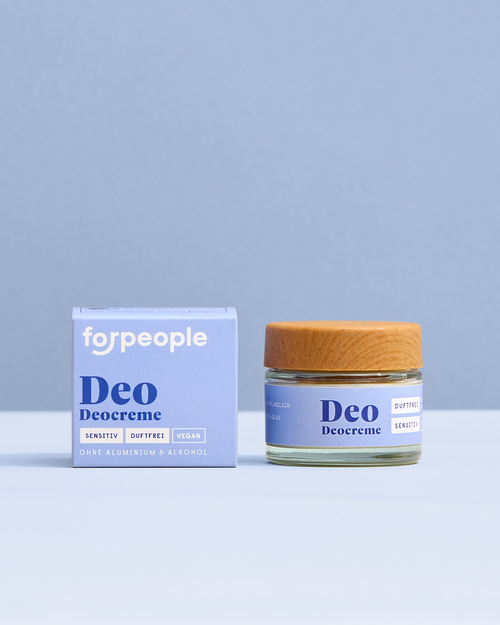
- Sensitive Deodorant Cream, 50 g, €8.90: potato starch, shea butter, baking soda, sunflower oil, corn starch and candelilla wax; according to the INCI list without aluminium salts, alcohol, water, added fragrance or essential oils.
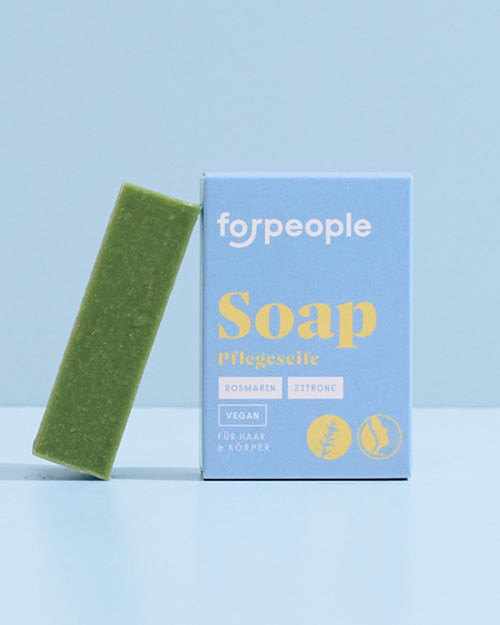
- Aloe Vera Soap – Rosemary & Lemon, 75 g, €8.90: for washing before you apply deodorant; with rosemary and lemon oil.
- All-Round Set for Dry Skin, €89.90: includes, among other things, a deodorant cream without added fragrance, a bar soap and a body oil.
More on this: Deodorant or antiperspirant · Baking soda in deodorant · Deodorant without aluminium: how it works and switching · How to apply deodorant cream
Sources
- Natsch A, Emter R (2020): The specific biochemistry of human axilla odour formation viewed in an evolutionary context. Philos Trans R Soc Lond B Biol Sci 375(1800): 20190269. https://doi.org/10.1098/rstb.2019.0269
- James AG, Austin CJ, Cox DS, Taylor D, Calvert R (2013): Microbiological and biochemical origins of human axillary odour. FEMS Microbiol Ecol 83(3): 527–540. https://doi.org/10.1111/1574-6941.12054
- Teerasumran P, Velliou E, Bai S, Cai Q (2023): Deodorants and antiperspirants: New trends in their active agents and testing methods. Int J Cosmet Sci 45(4): 426–443. https://doi.org/10.1111/ics.12852
- Kanlayavattanakul M, Lourith N (2011): Body malodours and their topical treatment agents. Int J Cosmet Sci 33(4): 298–311. https://doi.org/10.1111/j.1468-2494.2011.00649.x
- Callewaert C, Hutapea P, Van de Wiele T, Boon N (2014): Deodorants and antiperspirants affect the axillary bacterial community. Arch Dermatol Res 306(8): 701–710. https://doi.org/10.1007/s00403-014-1487-1
- Urban J, Fergus DJ, Savage AM, Ehlers M, Menninger HL, Dunn RR, Horvath JE (2016): The effect of habitual and experimental antiperspirant and deodorant product use on the armpit microbiome. PeerJ 4: e1605. https://doi.org/10.7717/peerj.1605
- European Commission: CosIng – database for information on cosmetic substances and ingredients. Entries Sodium Bicarbonate, Solanum Tuberosum Starch, Zea Mays Starch, Magnesium Hydroxide, Zinc Ricinoleate, Zinc Oxide, Triethyl Citrate, Alcohol, Alcohol Denat.; accessed 28 October 2026. ec.europa.eu/growth/tools-databases/cosing