







The problem: dry skin between the fingers
The skin in the spaces between your fingers becomes rough and tight, fine cracks form in the fold, and it itches in the evening. Sometimes the area is red and flaky, sometimes white and softened. The fold between thumb and index finger, the sides of the fingers and the skin under a ring are particularly often affected. This is typical from autumn: in cold and flu season, hands are washed more often and rubbed with sanitiser, towards the end of the year there is more cooking, washing up and cleaning, it is cold outside, and gloves get damp.
The spaces between the fingers are more than a minor matter. Skin problems on the hands often show up here first, and conditions that have nothing to do with dry skin also hide here. What to look out for is described in the section on medical advice.
Why the skin between the fingers gets dry in winter
Thin skin, lots of strain. The skin in the spaces between the fingers is particularly thin. A German statutory accident insurance institution describes that the first signs of skin problems on the hands usually appear there: the skin is dry, red and itchy (BGN 2018). According to a dermatology reference, too, the finger webs are the first place where irritation from water and cleaning agents shows; the palms are often spared (DermNet: Hand dermatitis).
Washing and hot water. Soap and warm water dissolve fats from the outer layer of the skin. In a study with 50 healthy volunteers, water loss through the skin rose after a hand bath in hot water from around 26 to around 59 g per hour and square metre, and much less after cold water; the authors recommend cold or lukewarm water for hand washing (Herrero-Fernandez et al. 2022). How washing dries out the hands is explained in Dry, cracked hands: causes and what helps.
Soap residue and wetness in the folds. Lather collects between the fingers and is easily missed when rinsing quickly. When drying, the towel wipes over palms and backs of the hands, and the spaces between the fingers stay damp. This is an observation from practice. Expert sources explicitly advise drying the hands completely after washing, including the spaces between the fingers (DermNet: Hand dermatitis), (BGN 2018).
Rings. Moisture builds up under a ring, and dirt and cleaning agents collect underneath; the accident insurance institution names this as the reason why skin conditions can develop under rings (BGN 2018). Rings can also contain nickel, one of the most common triggers of contact allergy (DermNet: Nickel allergy).
Gloves. The skin sweats under tight rubber gloves; sweating under gloves makes irritated skin worse, and cotton gloves underneath make wearing them more comfortable (DermNet: Hand dermatitis). What to bear in mind when moisturising under disposable gloves is covered in Hand cream under latex or nitrile gloves? In winter, wet wool gloves after shovelling snow add to this.
Cold and heated air. According to a review, low temperatures and low humidity reduce the skin's barrier function and make it more reactive to irritants (Engebretsen et al. 2016). More on indoor air in Humidity and skin: what dry heated air does and what helps.
Between thumb and index finger. This fold of skin is stretched every time you grip, and bag handles, leads and tools rub exactly there. This is based on experience; how stretching and drying out interact on the hands is explained in Dry knuckles: why exactly there?
Palm of the hand. The palm has a very thick outer layer of skin; why it peels and what helps then is covered in Skin peeling on fingers and hands: causes and what helps. People often ask whether a nutrient deficiency is behind it; usually the causes are external, see Dry skin and vitamin deficiency: causes and what you can do.
The solution step by step
| Step | What you do | Why |
|---|---|---|
| Straight away | Take off rings when washing, washing up and moisturising; do not scratch or pull off flakes of skin | Moisture builds up under the ring; scratching tears the thin skin further |
| Every day | Wash with lukewarm water and little soap, and rinse the spaces between the fingers thoroughly with clean water | Hot water and soap residue dry out the skin |
| Every day | Run the towel between each pair of fingers and pat until the folds are dry | If the folds stay damp, the skin there softens; expert sources advise drying completely |
| Every day | After washing, apply a thin layer of a rich hand cream to the backs of your hands and interlace your fingers so the cream gets into the spaces between them | Experts explicitly name the spaces between the fingers as an area not to forget when moisturising |
| Every evening | Moisturise more generously, and for very dry skin wear cotton gloves over it | Overnight the care stays on the skin for longer |
| Prevention | Wear protective gloves for washing up and cleaning, with cotton gloves underneath for longer wear; only put gloves on dry hands | Water, cleaning agents and sweat under the glove strain the skin |
| Prevention | Wear gloves outdoors and change wet gloves | Cold and wetness dry the skin out further |
Sources for the table: BGN 2018, DermNet: Hand dermatitis, Herrero-Fernandez et al. 2022, Engebretsen et al. 2016; the order and the moves are common practice. More on overnight care in Overnight hand mask: what it does and how to do it.
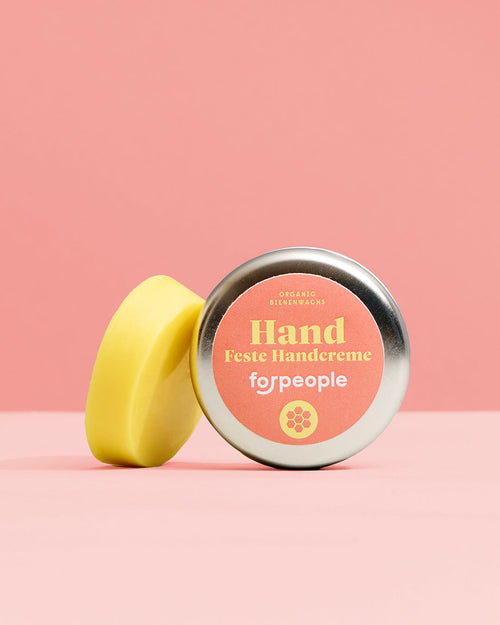
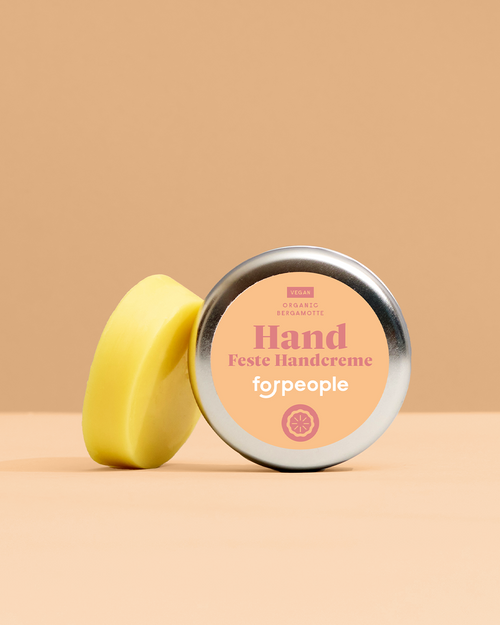
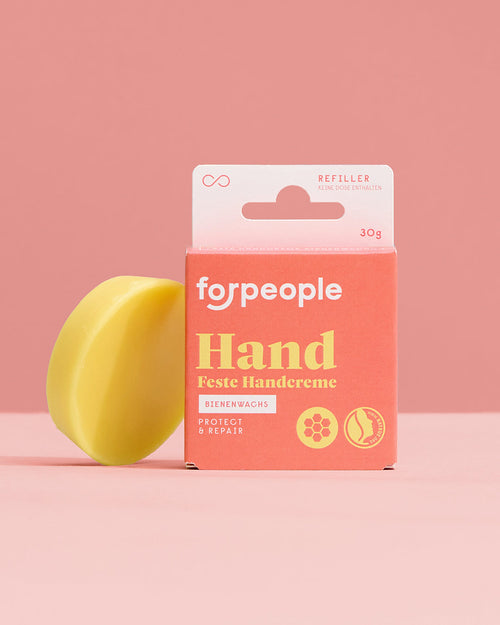
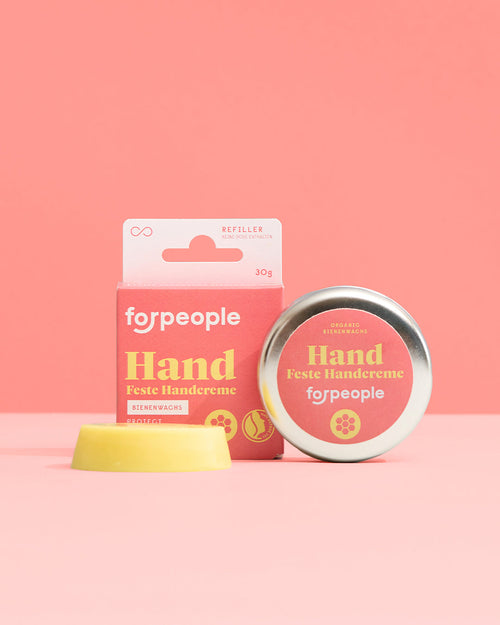
A solid hand cream can be applied precisely: rub the bar briefly between your palms, spread the cream over the backs of your hands and then interlace your fingers; how this works in detail is shown in How do I apply a solid cream correctly? According to its ingredient list, the Solid Hand Cream - Beeswax consists of beeswax, olive oil, sunflower oil, St. John's wort and aloe extract and contains no essential oils; its product page describes it for dry, rough and heavily stressed hands. If you are looking for a vegan option, use the Solid Vegan Hand Cream - Bergamot with candelilla wax, jojoba oil, olive oil, shea butter and hemp oil; it contains lemon and bergamot oil and therefore does not belong on red or cracked skin. When the tin is empty, refill it with the Solid Hand Cream Refill - Beeswax.
What helps – and what tends not to
| Measure or assumption | Assessment |
|---|---|
| Taking off rings when washing | helps; otherwise soap and water stay underneath |
| Drying each space between the fingers | helps; takes a few seconds |
| Moisturising thinly, including between the fingers | helps dry, intact skin |
| Applying a thick layer of cream to white, softened finger webs | better not; too much moisture is the problem there, not too little fat; have it looked at if it persists |
| Hot water so the hands get cleaner | better not; lukewarm water cleans well enough and dries the skin out less |
| Fungus cream or cortisone cream on suspicion | not without consulting a doctor; first it has to be clear what it is |
| Lemon juice or vinegar for rough skin | better not; acid stings in fine cracks, see Cracked hands in winter: home remedies, causes, what helps |
Sources: BGN 2018, Herrero-Fernandez et al. 2022. The other entries are our assessment.
Common mistakes
- Keeping your ring on while washing your hands. Soap and water then stay on the skin underneath for hours.
- Only drying palms and backs of the hands. The spaces between the fingers stay wet.
- Only moisturising the palms. The backs of the hands, the spaces between the fingers and the sides of the fingers miss out.
- Putting gloves on damp or freshly moisturised hands. The skin then softens under the glove.
- Washing up and cleaning without gloves. Water and cleaning agents affect the thin skin between the fingers first.
- Treating a spot yourself for weeks. Anything that persists despite care, keeps coming back or spreads needs a diagnosis.
When to seek medical advice
Hand cream cares for dry skin; it does not treat eczema or an infection. Between the fingers it is worth taking a close look, because several conditions start exactly here. See your GP or a dermatologist if
- small, deep-seated, intensely itchy blisters form on the sides of your fingers or on your palms, after which the skin peels; this can be dyshidrotic eczema, which often comes back (DermNet: Dyshidrotic eczema),
- it itches badly, the itch gets worse at night and fine burrows or small bumps appear between your fingers, perhaps also in people you live closely with; the spaces between the fingers are among the typical sites of scabies, the first symptoms appear 2 to 5 weeks after a first infestation, and the diagnosis should be made by a dermatologist (RKI-Ratgeber Skabies),
- a sore, red patch with a rim of white, softened skin develops between two fingers, often between the middle and ring finger, especially with a lot of wet work; this can be a yeast infection (Schlager et al. 2018),
- only one palm becomes dry, peels and itches slightly, especially if you have athlete's foot at the same time; a fungal infection of the hand often shows up on one hand and both feet (DermNet: Tinea manuum), see also Dry feet or athlete's foot? Signs and when to see a doctor,
- the spaces between the fingers stay red, flaky and itchy despite gloves and care; this can be the start of hand eczema (BGN 2018). How to tell the difference is explained in Dry hands or hand eczema? How to tell the difference. If it is related to your job, the occupational health service is a good first point of contact,
- an itchy rash stays exactly under your ring; a patch test clarifies a nickel allergy (DermNet: Nickel allergy),
- cracks bleed, weep or do not close, or the skin turns red, swells and feels warm.
Which dry patches are usually harmless is explained in Dry patches on the skin: when harmless, when to see a doctor?
Frequently asked questions
Why is the skin between my fingers dry?
The skin there is thin, and when you wash, soap and water stay in the folds. On top of that come rings, gloves, hot water and, in winter, cold and heated air.
What do red, dry patches between the fingers mean?
Often they are irritation from frequent washing and cleaning agents, which shows up there first. If they persist despite gloves and care, itch badly or form blisters, have them looked at by a doctor.
What do white patches between the fingers mean?
White, softened skin develops when the fold stays damp for a long time, for example under gloves or after poor drying. If the patch has a sore, red centre or persists despite keeping it dry, a yeast infection may be behind it.
Why is the skin between my thumb and index finger dry?
The fold of skin is stretched every time you grip and rubs against bags, leads and tools. Drying it and moisturising thinly helps; if the area stays red and flaky, have it looked at.
Why is the palm of my hand dry?
Usually because of washing, cleaning agents and cold. If only one palm becomes dry and flaky, especially if you also have athlete's foot, a fungal infection may be behind it.
Can a ring irritate the skin between the fingers?
Yes. Moisture builds up under the ring, soap stays behind, and some rings release nickel. Take it off when washing and moisturising.
Can I moisturise between my fingers?
Yes, thinly on dry, intact skin. Unlike between the toes, care belongs here. This does not apply if the skin is white and softened, weeping or open.
Is it scabies if it itches between my fingers?
Usually not; dry skin itches too. If the itch gets worse at night, you see fine burrows, or people in your household itch too, have it checked by a dermatologist.
At forpeople
For the hands we have solid, water-free hand creams in a refillable metal tin.
Solid Hand Cream - Beeswax, 30 g, €9.90: beeswax, olive and sunflower oil, without essential oils.
Solid Vegan Hand Cream - Bergamot, 30 g, €9.90: vegan with candelilla wax, with lemon and bergamot oil.
Solid Hand Cream Refill - Beeswax, 30 g, €7.90: the same formula for refilling the tin.
Hand Care Set – For Rough, Cracked Hands (2× Solid Hand Cream), one tin and one refill, €16.90.
More on this: Dry hands despite moisturising: why, and what helps · Bar soap or liquid soap: which is better for your hands? · Rough hands from washing up and cleaning: what helps? · Hand sanitiser and hand cream: which comes first?
From the blog: Hands and feet through winter: a routine for morning and evening
Sources
- Berufsgenossenschaft Nahrungsmittel und Gastgewerbe (BGN) (2018): Hautschutz im Beruf. Mannheim, as of 01/2018, including the chapter "Haut und Arbeitsplatz", 5.4 "Tragen von Schmuck" and the model skin protection and hygiene plan. Accessed 29.10.2026. https://vorschriften.bgn-branchenwissen.de/daten/asi/infobroschuere_haut_im_beruf.pdf
- DermNet: Hand dermatitis. Oakley A (1997), updated by Koch K, March 2018, minor update Coulson I, July 2024, accessed 29.10.2026. https://dermnetnz.org/topics/hand-dermatitis
- Herrero-Fernandez M, Montero-Vilchez T, Diaz-Calvillo P, Romera-Vilchez M, Buendia-Eisman A, Arias-Santiago S (2022): Impact of Water Exposure and Temperature Changes on Skin Barrier Function. J Clin Med 11(2): 298. https://doi.org/10.3390/jcm11020298
- Engebretsen KA, Johansen JD, Kezic S, Linneberg A, Thyssen JP (2016): The effect of environmental humidity and temperature on skin barrier function and dermatitis. J Eur Acad Dermatol Venereol 30(2): 223–249. https://doi.org/10.1111/jdv.13301
- DermNet: Nickel allergy. Oakley A (1997), reviewed by Coulson I, April 2023, accessed 29.10.2026. https://dermnetnz.org/topics/nickel-allergy
- DermNet: Dyshidrotic eczema. Jain MA, Jarrett P (2023), reviewed by Coulson I, February 2023, accessed 29.10.2026. https://dermnetnz.org/topics/dyshidrotic-eczema
- Robert Koch Institute: RKI-Ratgeber Skabies (Krätze). As of 27.05.2025, accessed 29.10.2026. https://www.rki.de/DE/Aktuelles/Publikationen/RKI-Ratgeber/Ratgeber/Ratgeber_Skabies.html
- Schlager E, Ashack K, Khachemoune A (2018): Erosio interdigitalis blastomycetica: A review of interdigital candidiasis. Dermatol Online J 24(8). PubMed: https://pubmed.ncbi.nlm.nih.gov/30677843/
- DermNet: Tinea manuum. Created 2003, accessed 29.10.2026. https://dermnetnz.org/topics/tinea-manuum