The problem: dry, itchy skin in older age
Dry skin in older age feels rough and dull, flakes when you take off your tights and feels tight after showering. On the shins, fine lines often appear that look like a net. Itching is common too, and it gets worse in the evening in a warm bed. In a French study in GP practices, 55.6 per cent of people aged 65 and over had dry skin; it was more common in older people, women, people taking medicines that can dry out the skin, and those who had dry skin earlier in life (Paul et al. 2011).
Where on the body: In a survey of 1,710 people in 14 nursing homes and 6 hospitals in Germany, just under half had dry skin (48.8 per cent), most often on the feet and legs (42.9 per cent) (Lichterfeld et al. 2016). In a study in Berlin nursing homes, the skin on the legs was drier than on the arms and trunk (Hahnel et al. 2017). Both studies apply to people in nursing homes and hospitals, not to all older people. On the lower leg the skin produces little sebum anyway; the figures are under Why are shins dry and flaky in winter? The back and flanks are hard to reach, so they are easily missed when moisturising.
Dry skin is common in older age but, according to one review, not a normal part of ageing (White-Chu & Reddy 2011). So it is worth doing something about it.
Why skin gets drier with age
Sebum: In men, sebum output barely changes until around the age of 80; in women it declines gradually after the menopause (Pochi et al. 1979). In a series of measurements on 150 healthy women aged 18 to 80, the amount of sebum on cheek, neck, décolleté, forearm and back of the hand fell markedly with age and was lowest in those over 70 (Luebberding et al. 2013).
Lipids of the outer skin layer: On the face, hand and leg of women in different age groups, one study found markedly lower levels of all major lipid types in the outer skin layer (stratum corneum) with increasing age, ceramides in particular (Rogers et al. 1996).
What hardly changes: In the series on 150 women, the water content of the outer skin layer and water loss through the skin were only weakly related to age (Luebberding et al. 2013). So what older skin lacks is mainly fat. How slowly it recovers once its barrier has been disturbed is shown by the measurements under Why do hands get drier with age? What the hormonal change contributes in women is covered under Dry skin during menopause: what changes?
Why it gets worse in autumn and winter
Two developments add up. In the same study on the lipids of the outer skin layer, levels on the face, hand and leg were again much lower in winter than in spring and summer. The authors see this as one reason why aged skin is particularly prone to dryness in the winter months (Rogers et al. 1996).
Then there is the climate. Cold outdoor air and heated indoor air contain little moisture; according to a review, low humidity and cold weaken the skin's barrier function and make it more susceptible to irritation and mechanical stress (Engebretsen et al. 2016). In winter many people bathe longer and hotter, sit close to the radiator and wear clothing that rubs. What dry indoor air does is described in Humidity and skin: what dry heated air does and what helps.
A third point is often overlooked: many older people take several medicines, and some of them can dry out the skin or cause itching. Dry skin is then not the only cause, but it intensifies itching that has other reasons (Kremer et al. 2020).
The solution step by step
| Step | What you do | Why |
|---|---|---|
| Right away: change how you shower | shower briefly and lukewarm, do not bathe daily; soap only on armpits, groin and feet, otherwise a soap-free wash (syndet) or just water | Soap-free washes improved dry skin in older people compared with soap (Lichterfeld-Kottner et al. 2020) |
| Right away: moisturise sitting down | after drying off, sit on a stable chair and moisturise the still slightly damp skin, soles of the feet last | Care straight after showering keeps the water in the skin; sitting down, nobody slips |
| Every day: apply fat | a rich product such as the Solid Body Butter - Beeswax & Aloe Vera or Almond Oil - pure; on the lower legs a second time in the evening | A structured care programme with twice-daily application reduced dryness in nursing homes within eight weeks (Hahnel et al. 2017) |
| For very dry skin | additionally a lotion or cream with urea or glycerin from the pharmacy, with the fat on top | The best-studied products are rich ones with humectants; they reduced dryness and itching (Lichterfeld-Kottner et al. 2020) |
| Every day: accept help | have your back and feet moisturised with a lotion applicator, by relatives or by the care service | What you cannot reach stays dry |
| Prevention: room climate | do not overheat rooms, air them in short bursts, do not sit right next to the radiator | Dry, warm air draws water from the skin (Engebretsen et al. 2016) |
| Prevention: look at the skin | while moisturising, watch for redness, cracks and thin areas | Regular skin checks and tailored care prevented skin damage in nursing homes (Völzer et al. 2024) |
How to moisturise without slipping:
- Shower briefly with lukewarm water. Armpits, groin and feet need soap; on arms and legs, water is usually enough. That is common practice, not a measured rule.
- Step out first, then moisturise. Do not apply oil in the shower or in the bath, and do not add it to bath water if you are unsteady on your feet. Even a few drops make the floor slippery, for the next person too.
- Pat dry and sit down. The skin can still be slightly damp. Sit on a stable chair, with a non-slip mat or a towel under your feet.
- Pour the oil into your hand, not onto your skin. That way nothing drips.
- Soles of the feet last, and only while seated. Put on socks or slippers before you stand up.
- Wipe your hands before you reach for a grab rail, walking stick or rollator. Wipe up drops on the floor straight away with a little washing-up liquid.
When someone else does the moisturising: In the survey from nursing homes and hospitals, people who could care for their skin themselves had dry skin less often than those who needed help (Lichterfeld et al. 2016). If you moisturise a relative: the person sits safely, you warm the oil or butter briefly in your hands, and you take a look at the skin as you go. Show anything unusual to the GP practice or the care service.
There are separate pages for hands and feet: Why do hands get drier with age? and Why do feet get drier with age?
Oil, butter or both, and what about urea?
Oil spreads quickly over large areas such as the back and legs. A solid butter leaves the more noticeable film and suits small, very dry patches. The comparison is under Body Oil or Body Butter – Which One When?
Neither contains water or humectants. A position paper by German dermatologists states that care for dry skin should contain both water-binding and lipid-replenishing components, and that the drier the skin, the higher the lipid content should be, preferably as a water-in-oil cream. According to this paper, urea has by far the best evidence (Augustin et al. 2019). To be honest: our butter and our oils only provide the fat side. If your skin is very dry, it is better to combine both; how the two work together is explained under Urea or water-free cream? Rough heels and dry hands.
The review on dry skin in older people advises watching out for known contact allergens in skincare products, such as wool wax (lanolin), aloe vera and parabens (White-Chu & Reddy 2011). Essential oils can also trigger reactions. How to test beforehand is described under Trying a new product: how do I test it on a small area?
What helps – and what doesn't
| Measure or home remedy | What is behind it | Assessment |
|---|---|---|
| Rich care every day | slows evaporation | helps; the basis of any winter care |
| Care with urea or glycerin | binds water in the outer skin layer | helps, especially combined with fat (Lichterfeld-Kottner et al. 2020) |
| Olive oil from the kitchen | adds fat, contains no humectant | possible; comparison in Olive oil and sunflower oil on the skin |
| Petroleum jelly, udder balm | dense, very occlusive film | for small, very dry areas; see Petroleum jelly or beeswax salve: the difference |
| Oil bath | adds fat to the skin while bathing | better not if you are unsteady on your feet: tub and tiles get slippery |
| Hot full bath | dissolves skin lipids | better not; short and lukewarm instead |
| Soap all over the body | alkaline, removes fat | better not; soap only where needed (Lichterfeld-Kottner et al. 2020) |
| Rubbing alcohol (Franzbranntwein) on the legs | consists mainly of alcohol | better not; alcohol lowered skin hydration in studies (Löffler et al. 2007) |
| Humidifier | raises the humidity in the room | can help if it is kept clean |
Why alcohol can dry out the skin is explained in Alcohol in cosmetics: alcohol denat., fatty alcohols and benzyl alcohol.
Typical mistakes
- Only moisturising in the evening. Straight after showering the skin is still damp; that is when the care product holds the water best.
- Applying oil in the shower or tub. It makes the floor slippery, also for the next person.
- Only caring for areas that are easy to reach. Back and lower legs then stay dry.
- Scratching. It brings brief relief but irritates the skin further; short fingernails help, and cotton gloves at night.
- Trying many products at once. If the skin reacts, nobody knows what to. Test anything new on a small area first.
- Dismissing itching as normal. Common does not mean harmless; persistent itching should be checked by a doctor.
When should you seek medical advice?
Cosmetics care for intact skin; they do not treat diseases. In older people, persistent itching often has internal or several causes at once, and dry skin merely intensifies it (Kremer et al. 2020). Have your skin checked by your GP or a dermatologist if
- it itches for weeks despite regular care, especially at night or all over the body; possible causes include diseases of the kidneys, liver, blood or thyroid and side effects of medicines (Kremer et al. 2020),
- the skin cracks in a net-like pattern, is red or weeps; doctors often call this asteatotic eczema,
- the skin is so thin that it tears with a slight knock, or areas bleed and do not close,
- a leg swells, changes colour or becomes warm, or new spots and other skin changes appear,
- the dryness began suddenly or with a new medicine; do not stop it on your own, talk to your doctor,
- nothing changes after a few weeks of regular care,
- you have diabetes: then have your lower legs and feet checked regularly by a doctor or podiatrist.
Care products do not belong on open or inflamed skin. More on itching in winter in general is covered in Itchy skin in winter: showering, care and when to see a doctor.
Frequently asked questions
Why is skin in older age especially dry in winter?
The skin produces less sebum, and the outer skin layer contains fewer lipids with age; in winter the levels drop again. On top of that come dry heated air, cold and hot baths.
Which cream helps with dry skin in older age?
The best-studied are rich care products with a humectant such as urea or glycerin. Oil and butter add fat and slow evaporation, but do not bind water. If your skin feels supple with oil, that is enough. If it stays rough and flaky, a urea lotion underneath can make sense.
How often should I moisturise?
Once a day straight after showering is a good start, with a second time in the evening on dry lower legs. In a nursing home study, products were applied twice a day.
Can I apply the oil while still in the shower, or take an oil bath?
If you are unsteady on your feet, better not. Oil makes the shower tray, bathtub and tiles slippery. Step out first, sit down and then apply the oil to skin that is still slightly damp.
How do I reach my back and lower legs if bending is difficult?
You can reach your lower legs while seated, with your foot on a low stool. For the back, medical supply shops sell long-handled applicators; an oil is easier to spread with one than a solid butter.
Does olive oil help with dry skin in older age?
It adds fat and slows evaporation, but contains no humectant. It can be used for daily care, but it does not bind water in the skin.
Is itching in older age normal?
It is common, but not harmless. Dry skin is often a contributing cause, but diseases or medicines can also be behind it. If it persists, have it checked by a doctor.
How do I moisturise a relative?
The person sits securely, you warm the oil or butter briefly in your hands and look at the skin while you apply it. Show any redness, cracks or thin areas to the GP practice or the care service.
Is the solid body butter too hard for stiff fingers?
It is solid at room temperature and softens with body warmth. After showering, stroke the bar straight over warm, still slightly damp skin. An oil works without any pressure.
Do the oil and the butter have a scent?
Body Oil Lemongrass contains lemongrass essential oil. According to their ingredient lists, the almond oil and the body butter contain no added essential oils; the butter smells slightly of beeswax.
At forpeople
Our care products are water-free and provide the fat side of winter care. They do not contain a humectant such as urea.
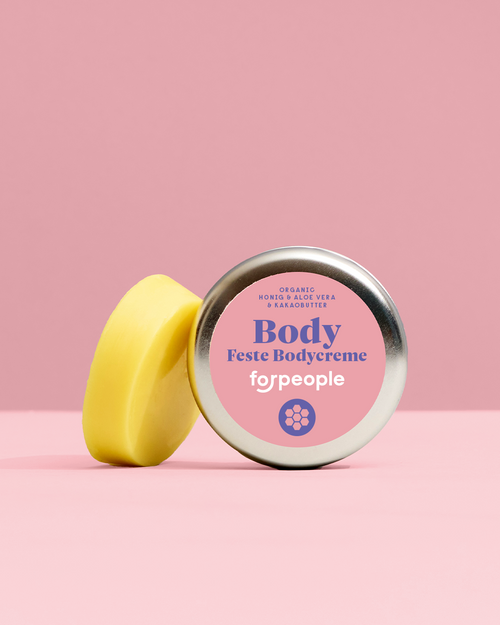
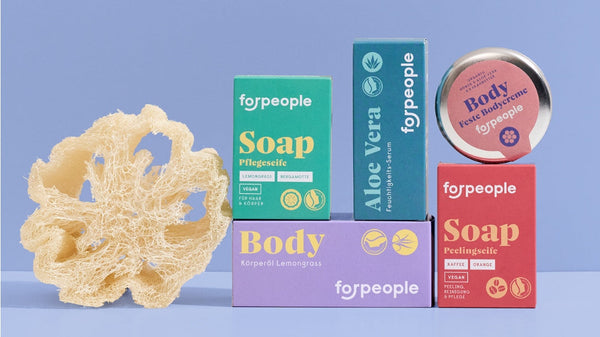
- Solid Body Butter - Beeswax & Aloe Vera, 40 g, €9.90: cocoa butter, olive oil, beeswax, sunflower oil, shea butter and aloe vera extract; no added fragrance; for dry areas such as shins and elbows, applied after showering to still damp skin.
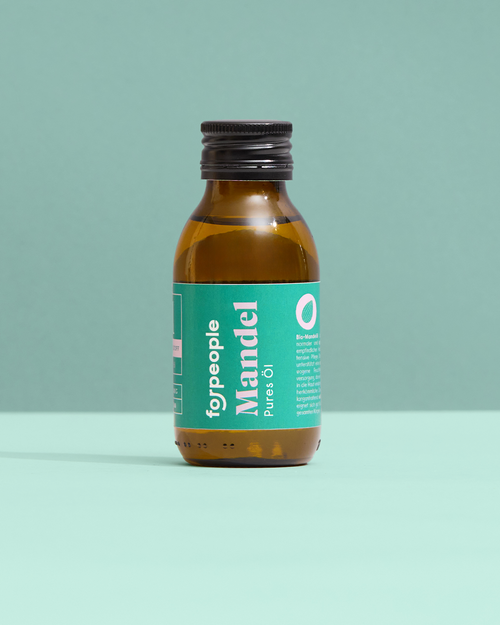
- Almond Oil - pure, 100 ml, €14.90: a single oil without added fragrance; spreads easily over large areas such as back and legs.
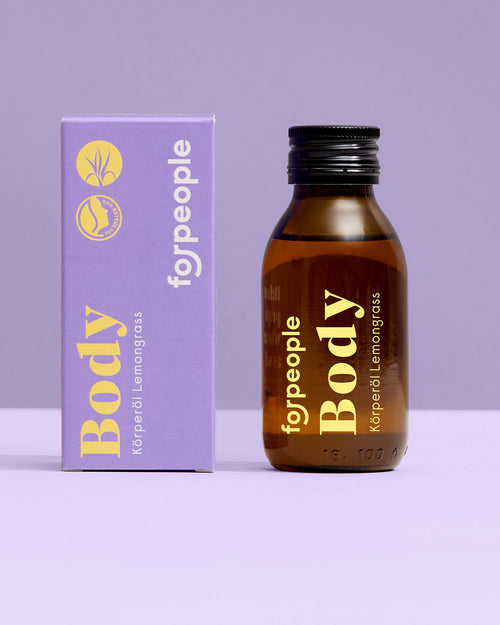
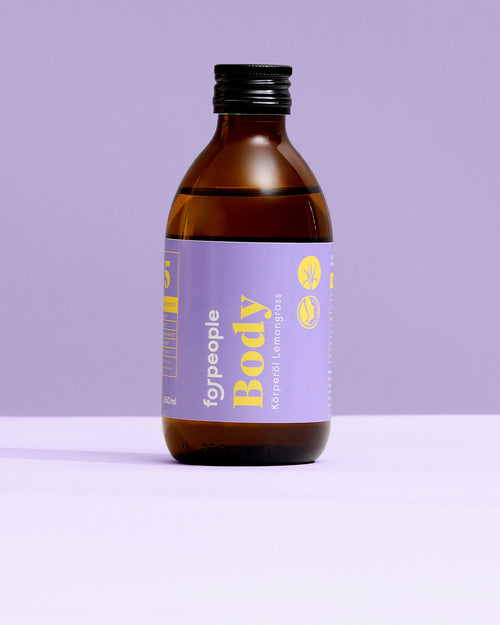
- Body Oil - Lemongrass, 100 ml, €16.90, or in the 250 ml bottle for €34.90: sesame, safflower, sea buckthorn seed and sunflower oil with turmeric extract and lemongrass essential oil.
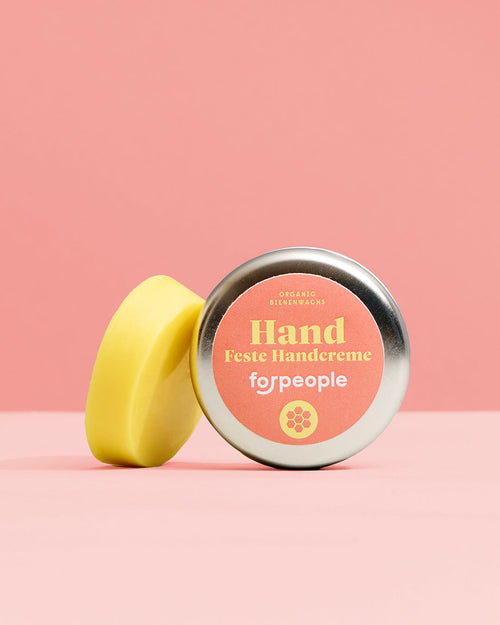
- Solid Hand Cream - Beeswax, 30 g, €9.90: five ingredients, no added fragrance, for dry, rough hands.
Do not use the products on broken or irritated skin. The oils come in glass bottles; do not handle them with oily hands.
Read more: How soon should you moisturise after a shower? The 3-minute rule · Dry skin in winter: what helps with cold and indoor heating · Compression stockings: when and with what to moisturise legs and feet
From the blog: Less in the bathroom: a skincare routine with three products
Sources
- Paul C, Maumus-Robert S, Mazereeuw-Hautier J, Guyen CN, Saudez X, Schmitt AM (2011): Prevalence and risk factors for xerosis in the elderly: a cross-sectional epidemiological study in primary care. Dermatology 223(3): 260–265. https://doi.org/10.1159/000334631
- Lichterfeld A, Lahmann N, Blume-Peytavi U, Kottner J (2016): Dry skin in nursing care receivers: A multi-centre cross-sectional prevalence study in hospitals and nursing homes. International Journal of Nursing Studies 56: 37–44. https://doi.org/10.1016/j.ijnurstu.2016.01.003
- Hahnel E, Blume-Peytavi U, Trojahn C, Dobos G, Stroux A, Garcia Bartels N et al. (2017): The effectiveness of standardized skin care regimens on skin dryness in nursing home residents: A randomized controlled parallel-group pragmatic trial. International Journal of Nursing Studies 70: 1–10. https://doi.org/10.1016/j.ijnurstu.2017.02.006
- Pochi PE, Strauss JS, Downing DT (1979): Age-related changes in sebaceous gland activity. Journal of Investigative Dermatology 73(1): 108–111. https://doi.org/10.1111/1523-1747.ep12532792
- Luebberding S, Krueger N, Kerscher M (2013): Age-related changes in skin barrier function – quantitative evaluation of 150 female subjects. International Journal of Cosmetic Science 35(2): 183–190. https://doi.org/10.1111/ics.12024
- Rogers J, Harding C, Mayo A, Banks J, Rawlings A (1996): Stratum corneum lipids: the effect of ageing and the seasons. Archives of Dermatological Research 288(12): 765–770. https://doi.org/10.1007/BF02505294
- White-Chu EF, Reddy M (2011): Dry skin in the elderly: complexities of a common problem. Clinics in Dermatology 29(1): 37–42. https://doi.org/10.1016/j.clindermatol.2010.07.005
- Engebretsen KA, Johansen JD, Kezic S, Linneberg A, Thyssen JP (2016): The effect of environmental humidity and temperature on skin barrier function and dermatitis. Journal of the European Academy of Dermatology and Venereology 30(2): 223–249. https://doi.org/10.1111/jdv.13301
- Kremer AE, Mettang T, Weisshaar E (2020): Non-dermatological Challenges of Chronic Itch. Acta Dermato-Venereologica 100(2): adv00025. https://doi.org/10.2340/00015555-3345
- Lichterfeld-Kottner A, El Genedy M, Lahmann N, Blume-Peytavi U, Büscher A, Kottner J (2020): Maintaining skin integrity in the aged: A systematic review. International Journal of Nursing Studies 103: 103509. https://doi.org/10.1016/j.ijnurstu.2019.103509
- Augustin M, Wilsmann-Theis D, Körber A, Kerscher M, Itschert G, Dippel M, Staubach P (2019): Diagnosis and treatment of xerosis cutis – a position paper. Journal der Deutschen Dermatologischen Gesellschaft 17 Suppl 7: 3–33. https://doi.org/10.1111/ddg.13906
- Völzer B, El Genedy-Kalyoncu M, Fastner A, Tomova-Simitchieva T, Neumann K, Hillmann K et al. (2024): Enhancing skin health and safety in aged care (SKINCARE trial): A cluster-randomised pragmatic trial. International Journal of Nursing Studies 149: 104627. https://doi.org/10.1016/j.ijnurstu.2023.104627
- Löffler H, Kampf G, Schmermund D, Maibach HI (2007): How irritant is alcohol? British Journal of Dermatology 157(1): 74–81. https://doi.org/10.1111/j.1365-2133.2007.07944.x