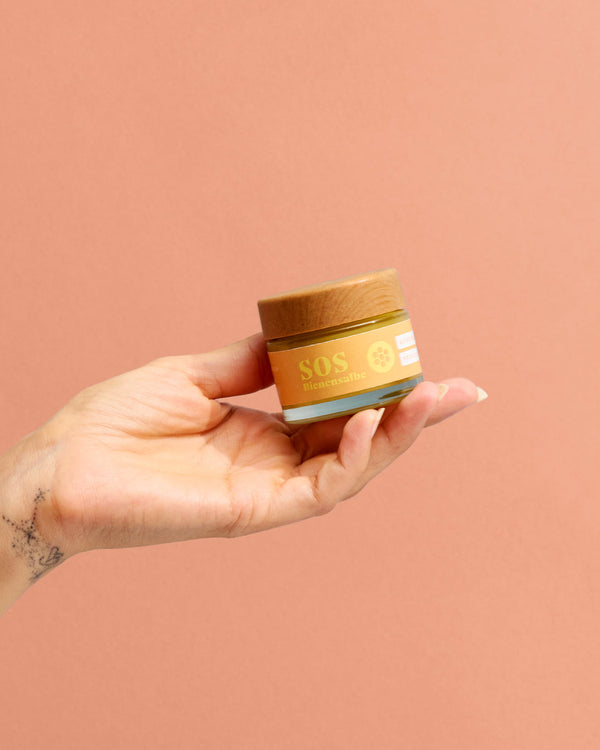
Many people know calendula salve from their grandmother's kitchen: flowers steeped in hot lard, strained and poured into jars. In the pharmacy, next to it, there are tubes with calendula that feel more like a hand cream, and tins of bee salve. To compare them you need to ask two questions: how was the calendula processed, and what is it in?
Calendula: the plant and what it contains
Calendula, or pot marigold (Calendula officinalis), belongs to the daisy family (Asteraceae, formerly Compositae) (EMA 2018). Cosmetics mainly use the flowers. For calendula ingredients in cosmetics, a safety assessment lists, among others, phenolic acids, flavonoids, tannins, coumarins, sterols, mono-, sesqui- and triterpenes, tocopherols and resins (Andersen et al. 2010). In fat-soluble extracts of the flower heads, triterpene diol esters dominate, mainly faradiol esters. They are most abundant in the outer ray florets, about ten times lower in the inner disc florets and present only in traces in the leaves (Zitterl-Eglseer et al. 2001). So which parts of the flower and which variety were processed changes what ends up in the salve.
Calendula extract: oil, alcohol or fat
The EU monograph on calendula flowers as a herbal drug shows how different the extract can be. It lists comminuted flowers, liquid extracts and tinctures made with alcohol-water mixtures, a liquid extract at a ratio of 1:10 in a fatty vegetable oil such as olive oil, and extracts at 1:5 to 1:25 in hardened vegetable fat or petroleum jelly (EMA 2018).
| Preparation | Extraction solvent according to the EMA monograph | How it usually appears in the INCI list |
|---|---|---|
| Comminuted flowers | None | Calendula Officinalis Flower |
| Tincture or liquid extract | Ethanol 40–90 % | Calendula Officinalis Flower Extract, plus Alcohol |
| Oil extract (macerate) | Fatty vegetable oil, e.g. olive oil, 1:10 | Calendula Officinalis Flower Extract, plus the oil |
| Extract in solid fat | Hardened vegetable fat or petroleum jelly, 1:5 to 1:25 | Calendula Officinalis Flower Extract, plus the fats |
INCI names describe the plant part, not the process: according to the EU database, "Calendula Officinalis Flower Extract" is an extract obtained from the flowers, "Calendula Officinalis Flower Oil" an oil derived from the flowers and "Calendula Officinalis Flower" the flower material itself (CosIng). The name does not tell you what was used for the extraction.
The base decides: what else is in calendula salves
On 29 October 2026 we looked at four ingredient lists and package leaflets of calendula products sold by online pharmacies. Apart from the plant, they had little in common:
| Base | Ingredients according to the list | Water | Classification |
|---|---|---|---|
| Lard with wax | Lard (Adeps Suillus), beeswax, calendula extract, sunflower oil, tocopherol, beta-carotene | No | Classic fatty salve, sold as a "balm" |
| Petroleum jelly and paraffin | Calendula mother tincture, water, emulsifying cetostearyl alcohol, liquid paraffin, white petroleum jelly, octyldodecanol, benzyl alcohol | Yes | Medicinal product with an authorisation number |
| Lanolin and sesame oil | Calendula mother tincture, sesame oil, water, lanolin, ethanol, yellow wax, lanolin alcohols | Yes | Medicinal product (authorised in Switzerland) |
| Emulsion | Water, cetearyl alcohol, propylene glycol, emulsifiers, isopropyl alcohol, witch hazel and calendula extract, alcohol, potassium sorbate | Yes, listed first | A cream by structure, despite "salve" in the name |
The base determines how a product feels and how strongly it seals the skin. Petroleum jelly and paraffin form a dense film, lanolin can bind water, lard and plant oils bring fatty acids, and a water-based cream absorbs faster but needs emulsifiers and preservatives. The differences are explained in Petroleum jelly or beeswax salve: the difference, Lanolin or beeswax: what is the difference? and Balm, salve, cream, butter: what is the difference? How a film of fat slows evaporation is covered in Occlusion and TEWL: how a wax film protects the skin.
Calendula salve or bee salve: the comparison
| Feature | Calendula salve (typical) | Our bee salve (according to INCI) |
|---|---|---|
| Ingredient behind the name | Extract of calendula flowers | Beeswax, plus propolis |
| Base | Lard, petroleum jelly, paraffin, lanolin, plant oil or emulsion | Olive, almond and castor oil with beeswax |
| Water | Depends on the product | No |
| Resin | Usually no | Larch resin |
| Scent | Often none, sometimes with perfume | Essential oils of mandarin, rosemary and fir |
| What to watch for with allergies | Daisy family, lanolin, fragrances | Propolis, larch resin, fragrance components such as limonene and linalool |
| Legal status | Cosmetic or medicinal product | Cosmetic |
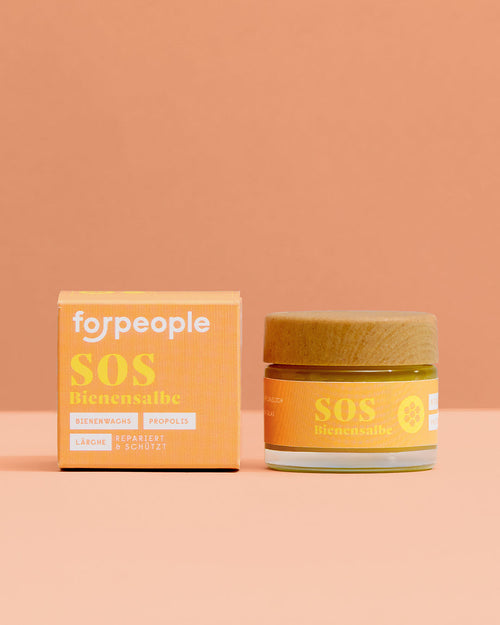
According to its ingredient list, our Beeswax Salve – Larch & Mandarin in a Glass Jar contains no calendula. According to the product page it is intended for dry, rough areas on hands, heels and elbows, and as a thin layer for dry lips. Exactly what is in it and how it differs from bee venom and propolis salves is covered in Bee venom salve, propolis salve, bee salve: what's in each.
Calendula and wounds: what the EMA says and what cosmetics may claim
The European Medicines Agency has not established a "well-established" medicinal use for calendula flowers, only a traditional one: herbal medicinal products with calendula can be registered as traditional medicines for minor skin inflammations such as sunburn and as an aid for minor wounds, exclusively on the basis of long-standing use (EMA 2018). In Germany such a product must say exactly that on the pack and carries a "Reg.-Nr." (Section 10(4a), German Medicinal Products Act). Other calendula salves are homeopathic or anthroposophic medicines with their own authorisation.
Cosmetics are different: they may clean, protect and keep the skin in good condition, but not treat wounds (Regulation (EC) No 1223/2009, Art. 2), and claims must not suggest functions a product does not have (Art. 20). A cosmetic calendula salve cares for dry skin like any other fatty salve. Whether a salve is a cosmetic or a medicinal product can be seen from "Zul.-Nr." or "Reg.-Nr." on German packs.
Daisy family allergy: who should be careful with calendula
In a study in Innsbruck, 443 dermatology patients were tested one after another. 2.0 percent reacted to calendula, 1.1 percent to arnica and 4.1 percent to the standard mix for the daisy family. Only four of the nine calendula reactions also showed up with the daisy family mix; the standard mix therefore does not reliably detect a calendula allergy. The same people often also reacted to nickel, balsam of Peru, fragrances, propolis or colophony (Reider et al. 2001). The most important allergens of the daisy family are sesquiterpene lactones; for most species, calendula included, the evidence rests on individual cases, and how often already sensitised people react to products containing these plants is largely unknown (Paulsen 2002).
The cosmetic safety assessment found no irritating or sensitising effect in animal or clinical tests and considers calendula ingredients safe at the usual concentrations (Andersen et al. 2010). The EMA monograph, on the other hand, mentions reported skin sensitisation of unknown frequency and rules out use in people hypersensitive to the daisy family (EMA 2018); the same contraindication appears in the package leaflets we read. Well-known members of the daisy family besides calendula and arnica include chamomile and echinacea. How to try a new product carefully is explained in Trying new skincare: how do I test it on a small area?
Calendula in our products
According to the ingredient lists, calendula is in our bar soaps, not in the bee salve. For the Aloe Vera Soap – Lavender and our other aloe vera soaps, "Calendula Officinalis Flower" appears in the list, meaning calendula flowers. The Aloe Vera Soap - Lemongrass lists "Calendula Officinalis Flower Extract", called calendula oil in the plain-language list. Soaps are intended for washing hands, face and body and are rinsed off. If you react to the daisy family, you will find calendula in their ingredient lists; more about the soaps is in Curd soap, olive soap, Aleppo, glycerine soap: soap types compared.
When to seek medical advice
Salves from the drugstore are skincare, not wound care. Have a doctor look at deep, heavily bleeding or dirty wounds, bites, burns with blisters or larger than the palm of your hand, and wounds that have not closed after a few days. If redness spreads, the area becomes warm or produces pus, or you develop a fever, see a doctor the same day. If you have diabetes or circulatory problems, even small injuries on your feet belong in the hands of a doctor or podiatrist. If your skin turns red, itches or forms blisters after using a salve, stop using it and have it checked by a dermatologist; more in Reacted to a cosmetic: what to do, who to report it to, can you return it?
Frequently asked questions
What is the difference between calendula salve and bee salve?
Calendula salve contains an extract of calendula flowers in any kind of base, from lard to cream. Bee salve is a salve made of beeswax and oils, often with propolis or resin. Neither name is protected; the ingredient list tells you what is inside.
Calendula salve or udder balm: which suits cracked hands?
Classic udder balm is made of petroleum jelly and paraffins and leaves a dense film. A calendula salve based on petroleum jelly is similar; one based on lard or oil brings fatty acids, and a cream absorbs faster. More in What is udder balm? What it is made of and what it is good for.
Calendula salve or zinc ointment?
Zinc ointment is usually a medicinal product with 10 percent zinc oxide in a base of white petroleum jelly, lanolin alcohols and cetostearyl alcohol. It is intended for different purposes from a calendula salve used for skincare. If you have a skin problem, ask at a pharmacy or doctor's practice which one fits.
Calendula salve or petroleum jelly?
Pure petroleum jelly seals the skin strongly and contains nothing else. Many calendula salves contain petroleum jelly themselves, plus the plant extract and often water and emulsifiers.
Calendula salve or dexpanthenol ointment?
Dexpanthenol is a different active ingredient, a precursor of pantothenic acid. Ointments with it are sold as medicinal products and as cosmetics. It has nothing to do with calendula; the products can only be compared by their composition.
Can I make calendula salve myself?
Yes, traditionally the flowers are steeped in oil or fat and firmed with wax. How the ratio of wax to oil determines firmness and how long homemade products keep is explained in Making solid cream: how much wax to oil? and Homemade cream: how long does it keep, and how can it keep longer?
Can I use calendula salve if I am allergic to the daisy family?
The EMA rules out calendula medicines in people hypersensitive to the daisy family. If you have a known allergy to arnica, chamomile or other members of this family, talk to your dermatologist before use.
At forpeople
We do not sell a calendula salve. Our salve is the bee salve; according to the ingredient lists, calendula is in our bar soaps:
- Beeswax Salve – Larch & Mandarin in a Glass Jar, 50 g, €12.90: olive, almond and castor oil, beeswax, larch resin, propolis, essential oils; water-free, for dry, rough areas and thinly for the lips.
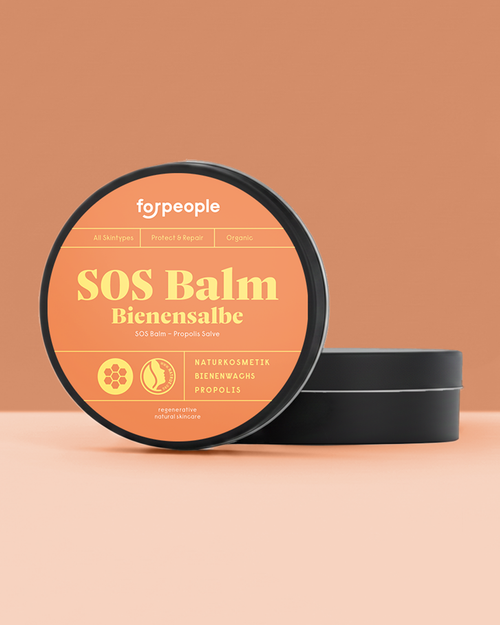
- Bee Salve Larch & Mandarin in a Tin, 150 g, €34.90: the same formula in the large metal tin.
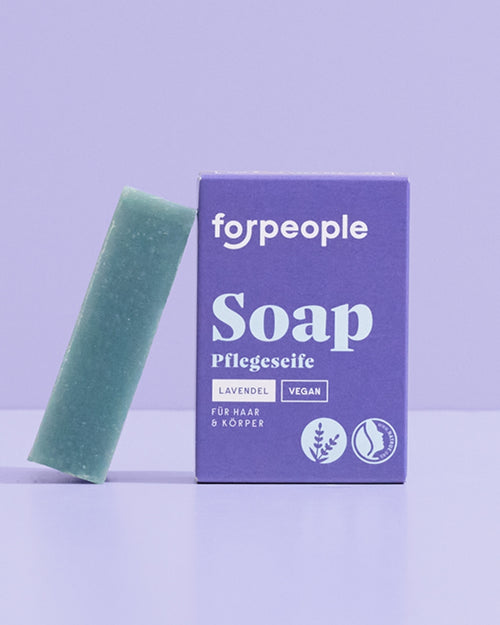
- Aloe Vera Soap – Lavender, 75 g, €8.90: soap made from olive, coconut and other oils with calendula flowers, aloe vera and lavender and lavandin oil.
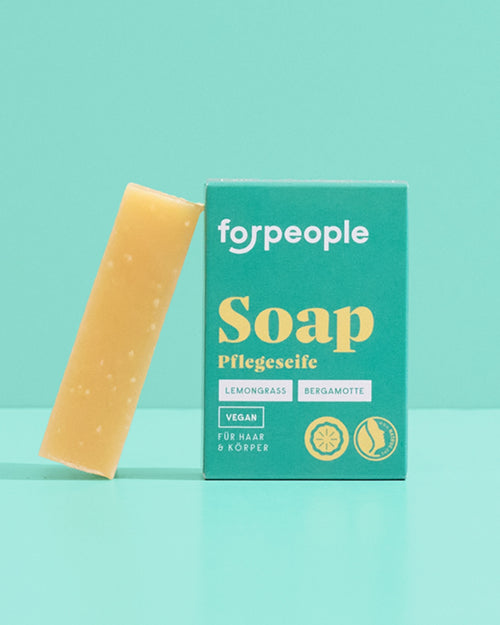
- Aloe Vera Soap - Lemongrass, 75 g, €8.90: with aloe vera juice, calendula extract and lemongrass and bergamot oil.
More on this: Urea or water-free cream? Rough heels and dry hands · Colophony allergy, propolis, beeswax: symptoms and advice · How to read an INCI list
From the blog: Bee salve with beeswax and propolis for dry skin
Sources
- European Medicines Agency, Committee on Herbal Medicinal Products (2018): European Union herbal monograph on Calendula officinalis L., flos, Revision 1 (EMA/HMPC/437450/2017). ema.europa.eu
- Andersen FA, Bergfeld WF, Belsito DV, Hill RA, Klaassen CD, Liebler DC et al. (2010): Final report of the Cosmetic Ingredient Review Expert Panel amended safety assessment of Calendula officinalis-derived cosmetic ingredients. International Journal of Toxicology 29(6 Suppl): 221S–243S. https://doi.org/10.1177/1091581810384883
- Reider N, Komericki P, Hausen BM, Fritsch P, Aberer W (2001): The seamy side of natural medicines: contact sensitization to arnica (Arnica montana L.) and marigold (Calendula officinalis L.). Contact Dermatitis 45(5): 269–272. https://doi.org/10.1034/j.1600-0536.2001.450503.x
- Paulsen E (2002): Contact sensitization from Compositae-containing herbal remedies and cosmetics. Contact Dermatitis 47(4): 189–198. https://doi.org/10.1034/j.1600-0536.2002.470401.x
- Zitterl-Eglseer K, Reznicek G, Jurenitsch J, Novak J, Zitterl W, Franz C (2001): Morphogenetic variability of faradiol monoesters in marigold, Calendula officinalis L. Phytochemical Analysis 12(3): 199–201. https://doi.org/10.1002/pca.582
- Regulation (EC) No 1223/2009 of the European Parliament and of the Council of 30 November 2009 on cosmetic products, Articles 2 and 20. eur-lex.europa.eu
- German Medicinal Products Act (Arzneimittelgesetz – AMG), Section 10 Labelling, subsections 1 and 4a. gesetze-im-internet.de
- European Commission: CosIng database, entries Calendula Officinalis Flower, Calendula Officinalis Flower Extract, Calendula Officinalis Flower Oil (accessed 29 October 2026). ec.europa.eu/growth/tools-databases/cosing