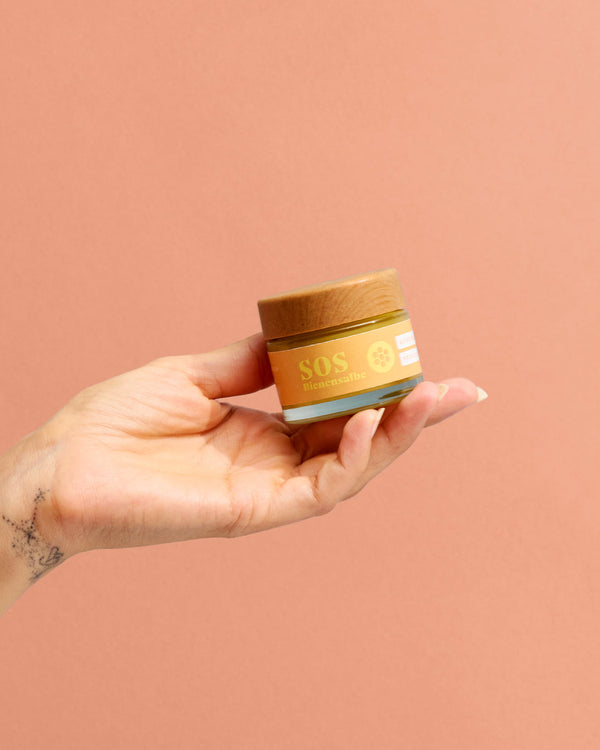
On pharmacy shelves and in online shops the three names often sit side by side, and almost every pack shows a bee or a honeycomb. Search for "bee venom salve" and you quickly end up with a bee salve, and vice versa. Yet the products differ in exactly the ingredient that gives them their name, and so in what people with allergies need to look out for.
Three salves, three different bee products
| Bee venom salve | Propolis salve | Bee salve | |
|---|---|---|---|
| Ingredient behind the name | Bee venom (apitoxin) | Propolis (bee glue) | Beeswax, often with propolis or resin |
| Where it comes from | The worker bee's venom gland, released when she stings | Plant resins that bees collect and mix with wax | The wax glands of worker bees |
| Name in the INCI list | Bee Venom (some labels say "Apitoxin") | Propolis Extract, Propolis Wax or Propolis Cera | Cera Alba, plus propolis or resin depending on the formula |
| Typical companions | Camphor, menthol, essential oils, sometimes chilli extract or arnica | Plant oils, wax, sometimes resins | Plant oils, sometimes resin and essential oils |
| What to watch for | Insect venom allergy | Contact allergy to propolis and related substances | Propolis or resin allergy, if included |
None of the three names is defined in law. For cosmetics, the only reliable guide to what is inside is the ingredient list, headed "Ingredients" and sorted in descending order of weight; ingredients below 1 percent may follow in any order (Regulation (EC) No 1223/2009, Art. 19). How to read the list is explained in How to read an INCI list. How salve, balm and cream differ is covered in Balm, salve, cream, butter: what is the difference?
Bee venom: what apitoxin is made of
Bee venom is produced in the venom gland of worker bees. Fresh venom is about 88 percent water; the rest is a mixture of peptides, enzymes and small molecules (Gajski et al. 2024). The table shows the main components of dried venom.
| Component | Share of dried venom | What it is |
|---|---|---|
| Melittin | 40–50 % | Peptide made of 26 amino acids, the main component |
| Phospholipase A2 | 10–12 % | Enzyme that splits building blocks of cell membranes |
| Hyaluronidase | 1–3 % | Enzyme that breaks down hyaluronic acid in tissue |
| Apamin | 1–3 % | Peptide |
| MCD peptide | 1–2 % | Peptide that makes mast cells release histamine |
| Histamine | 0.5–2 % | Biogenic amine |
Figures from Gajski et al. 2024; the composition varies with region and season of collection. To collect venom, a device made of glass plates and wires carrying a weak current of 18 to 22 volts is placed in front of the hive entrance. The irritated bees release their venom onto the glass, from which it is scraped off once dry. Dried bee venom is a light grey to yellowish powder (Gajski et al. 2024).
In the European Commission's ingredient database the substance is called "Bee Venom" and is described as the venom of the honeybee, consisting chiefly of melittin (CosIng). "Apitoxin" does not appear in the EU glossary of ingredient names, but you will find it on some labels.
What is in a bee venom salve
On 29 October 2026 we looked at ingredient lists and product information for bee venom salves sold by online pharmacies. The pattern was similar: a base of lanolin, plant oils, beeswax and water with an emulsifier, plus camphor, menthol and essential oils such as rosemary, eucalyptus, peppermint, thyme or juniper; other salves listed chilli extract, arnica or devil's claw. In one list the bee venom came right at the end, even after fragrance components such as linalool and geraniol. Under the labelling rule, that points to a share below 1 percent. None of the pages gave an exact amount.
What you feel when you apply such a salve, such as coolness or warmth, is familiar from menthol, camphor and chilli extract. How much the bee venom contributes cannot be read from the list. There is also a physical limit: melittin has a molecular mass of around 2,850 daltons (Gajski et al. 2024). For substances to pass through the intact outer layer of the skin, a rule of thumb is below 500 daltons; larger molecules hardly get through (Bos and Meinardi 2000). A systematic review of bee venom therapy also notes that the large molecules of the venom penetrate the skin poorly from a salve (Jang and Kim 2020).
"For arthritis" and "for muscle pain": what such promises mean
Many searches for bee venom salve are about joints, back and muscles. Under EU law, however, cosmetic products are intended to clean, perfume, change the appearance of, protect, keep in good condition or correct body odour (Regulation (EC) No 1223/2009, Art. 2). Treating joint or muscle complaints is not one of these purposes, and claims must not suggest functions a product does not have (Art. 20). In Germany, a medicinal product carries an authorisation number "Zul.-Nr." or a registration number "Reg.-Nr." on the pack (Section 10, German Medicinal Products Act). The bee venom salves we looked at showed no such number and were sold as cosmetics or skincare.
On the evidence: a systematic review found twelve randomised trials of bee venom therapy. Most used injections or bee venom acupuncture, two used ultrasound gel and only one used an ointment; for that ointment study on the jaw muscles, the authors describe no clear effect. The most common side effects reported were skin reactions such as itching and swelling (Jang and Kim 2020). So there is no reliable evidence for commercial bee venom salves and joint conditions. Persistent joint or back pain needs to be checked by a doctor.
Bee venom and insect venom allergy
According to the German guideline on bee and wasp venom allergy, about 3 percent of people in Europe report a whole-body allergic reaction after a sting. In German-speaking countries, insect stings are the most common cause of severe allergic reactions (anaphylaxis) in adults. Antibodies to bee or wasp venom can be found in around 23 percent of adults without them necessarily having any symptoms (Ruëff et al. 2023). Among the major allergens of bee venom the guideline lists phospholipase A2 (Api m 1), hyaluronidase (Api m 2) and acid phosphatase (Api m 3); melittin is also described as an allergen (Api m 4).
A review of reported side effects of bee products found cases of anaphylaxis and deaths after therapeutic use of bee venom; overall, allergic reactions were the most common side effect, especially in people prone to allergies (Rocha Filho et al. 2026). How high the risk is with a salve on intact skin has not been studied systematically. If you have a known bee venom allergy, carry an emergency kit or are currently having desensitisation treatment, do not use products containing bee venom without first talking to your allergist.
Propolis: the bee glue of the hive
Propolis is not a venom but a building material: bees collect resins from buds and bark, mix them with wax and use them to seal gaps in the hive. A review gives a typical composition of about 50 percent resin, 30 percent wax, 10 percent essential oils, 5 percent pollen and 5 percent other substances. European propolis mostly comes from poplars and contains mainly flavonoids as well as phenolic acids and their esters (Silva-Carvalho et al. 2015).
In the INCI list you will find propolis as Propolis Extract, Propolis Wax or Propolis Cera; all three names are in the EU glossary (CosIng, Glossary 2019/701). Statements about effects against germs or inflammation mostly come from laboratory tests with extracts and cannot be transferred to a cosmetic salve; as a cosmetic, a propolis salve cares for the skin. Propolis can cause a contact allergy. A recent analysis concludes that propolis is found in only a few cosmetics, which are rarely the trigger; many positive test reactions are probably cross-reactions in people with a fragrance allergy (de Groot and Rustemeyer 2026). Symptoms, cross-allergies and the allergy test are explained in Colophony allergy, propolis, beeswax: symptoms and advice; the ingredient itself is introduced in Propolis salve – bee resin.
Bee salve: what is in ours
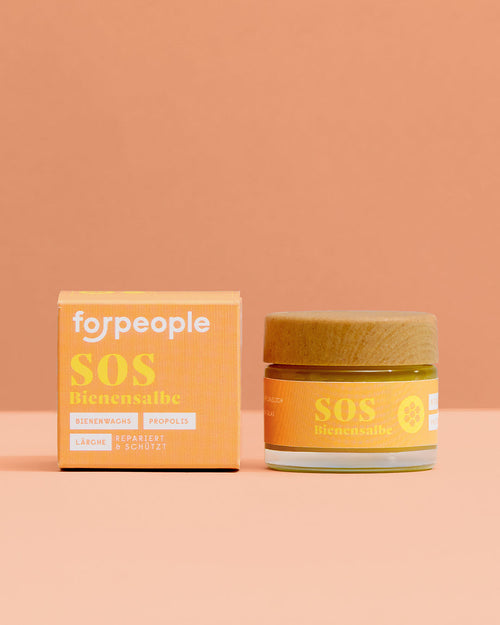
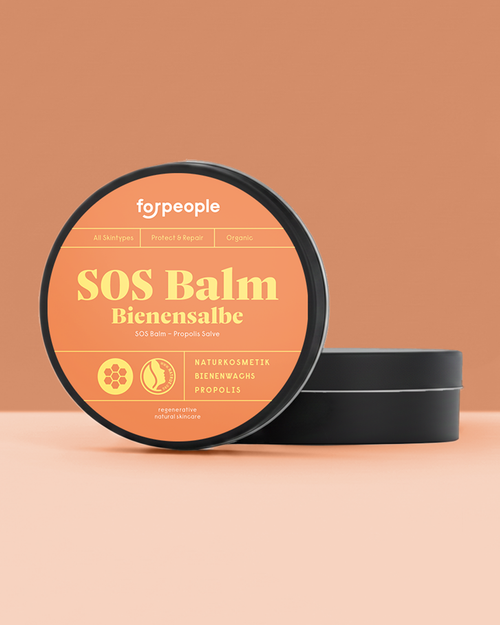
According to its ingredient list, our Beeswax Salve – Larch & Mandarin in a Glass Jar contains olive oil, almond oil, castor oil, beeswax, larch resin (Terebinthina Laricina), propolis (Propolis Cera) and essential oils of mandarin peel, rosemary and fir; limonene, pinene, terpinene, linalool and terpinolene are listed as components of these oils. It contains no bee venom, no honey and no water. According to the product page it is intended for dry, rough areas on hands, heels and elbows, and as a thin layer for dry lips; it is a cosmetic care product, not a medicinal product. The same formula is available as Bee Salve Larch & Mandarin in a Tin.
If you react to propolis, colophony or certain fragrances, these are the ingredients to watch. For hands, we have two formulas without propolis and resin:
| Product | Bee products according to INCI | Resin | Essential oils | Intended for (according to product page) |
|---|---|---|---|---|
| Bee salve – Larch & Mandarin | Beeswax, propolis | Larch resin | Mandarin, rosemary, fir | Hands, heels, elbows, lips |
| Solid Hand Cream – Beeswax | Beeswax | No | No | Dry, rough hands |
| Solid Hand Cream – Bergamot | None (candelilla wax) | No | Lemon, bergamot | Dry hands |
| Typical bee venom salve from retail | Bee venom, often beeswax | Rarely | Usually several, plus camphor and menthol | According to sellers, massage and rubbing in |
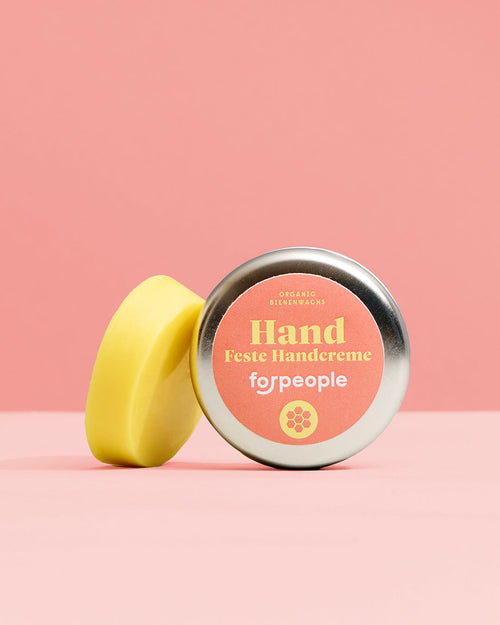
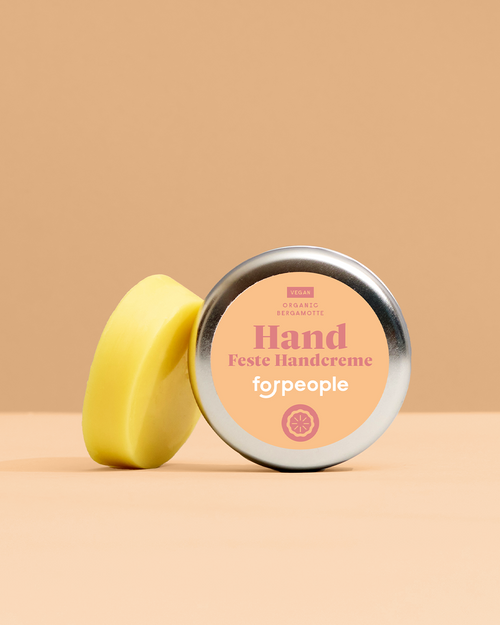
According to its INCI, the Solid Hand Cream - Beeswax consists of beeswax, olive and sunflower oil and extracts of St John's wort and aloe vera. The Solid Vegan Hand Cream - Bergamot contains no bee products and uses candelilla wax; it contains lemon and bergamot oil. What larch resin does in a salve is explained in Larch resin salve and resin salve: what's in them and how they differ; on fragrances see Essential oils and fragrance allergens.
When to seek medical advice
Call the emergency number (112 in Europe) if, after a sting or after applying a product, you develop shortness of breath, swelling of the face or throat, dizziness or hives all over the body. If you have a known insect venom allergy, carry an emergency kit or are having desensitisation treatment, talk to your allergist before using bee venom products. If the skin where you applied a product turns red, itches or forms blisters, often only one to three days later, stop using it and have it checked by a dermatologist; what you can do then is described in Reacted to a cosmetic: what to do, who to report it to, can you return it? Joint, muscle or back pain that persists, comes with swelling or warmth, or follows an accident belongs in a doctor's hands, not under a salve.
Frequently asked questions
Does bee salve contain bee venom?
Not automatically. "Bee salve" is not a defined term and usually means a salve made with beeswax. Only the ingredient list tells you whether bee venom is included: it appears as "Bee Venom". Our bee salve contains no bee venom, but it does contain propolis.
What is the difference between propolis and bee venom?
Propolis is a resin mixture that bees collect from plants and use as building material in the hive. Bee venom is a secretion of the venom gland, made up mainly of the peptide melittin and enzymes such as phospholipase A2. Both can cause allergies, but in different ways: propolis usually a contact allergy of the skin, bee venom an allergy that can affect the whole body after a sting.
Can I buy bee venom salve in a pharmacy?
Yes, online pharmacies sell bee venom salves. The products we looked at were presented as cosmetics; in Germany you can recognise a medicinal product by "Zul.-Nr." or "Reg.-Nr." on the pack.
What side effects can bee venom salve have?
In studies of bee venom therapy, skin reactions such as itching and swelling were the most common. In people with bee venom allergy, severe allergic reactions have also been described after therapeutic use of bee venom. Companion ingredients such as essential oils or lanolin can cause reactions too.
Can I use bee venom salve if I am allergic to wasp venom?
Bee and wasp venom have different compositions, but some proteins are similar, and many people have antibodies to both. Only an allergist can judge whether this matters for you. Ask before using it.
Does bee venom salve help with arthritis?
Such a claim must not be made for a cosmetic, and there are no reliable studies on commercial bee venom salves for arthritis. Joint complaints need to be checked by a doctor.
Can I use your bee salve if I am allergic to propolis?
Our bee salve contains propolis and larch resin. If you have a known propolis or colophony allergy, talk to your dermatologist first. Our Solid Hand Cream - Beeswax and Solid Vegan Hand Cream - Bergamot contain neither propolis nor resin.
At forpeople
We do not sell a bee venom salve. Our salve from the hive is the bee salve with beeswax and propolis:
- Beeswax Salve – Larch & Mandarin in a Glass Jar, 50 g, €12.90: olive, almond and castor oil, beeswax, larch resin, propolis, essential oils of mandarin, rosemary and fir; for dry, rough areas and thinly for the lips.
- Bee Salve Larch & Mandarin in a Tin, 150 g, €34.90: the same formula in the large metal tin.
- Solid Hand Cream - Beeswax, 30 g, €9.90: beeswax and plant oils, without propolis, resin or essential oils.
- Solid Vegan Hand Cream - Bergamot, 30 g, €9.90: vegan with candelilla wax, no bee products; with lemon and bergamot oil.
Try new skincare on a small area first: Trying new skincare: how do I test it on a small area?
More on this: Is beeswax good for the skin? Uses and limits · Why does beeswax smell of honey, and why does the scent change? · Petroleum jelly or beeswax salve: the difference · INCI names explained: our ingredients translated
From the blog: Bee salve with beeswax and propolis for dry skin · Bee-friendly beekeeping
Sources
- Gajski G, Leonova E, Sjakste N (2024): Bee Venom: Composition and Anticancer Properties. Toxins 16(3): 117. https://doi.org/10.3390/toxins16030117
- Jang S, Kim KH (2020): Clinical Effectiveness and Adverse Events of Bee Venom Therapy: A Systematic Review of Randomized Controlled Trials. Toxins 12(9): 558. https://doi.org/10.3390/toxins12090558
- Ruëff F, Bauer A, Becker S, Brehler R, Brockow K, Chaker AM et al. (2023): Diagnosis and treatment of Hymenoptera venom allergy: S2k Guideline of the German Society of Allergology and Clinical Immunology (DGAKI) et al. Allergologie select 7: 154–190. https://doi.org/10.5414/ALX02430E
- Rocha Filho LKA, Silva GI, Silva MS (2026): Pharmacovigilance and toxicological risks associated with apitherapeutic products: a systematic overview. Archives of Toxicology 100(2): 425–436. https://doi.org/10.1007/s00204-025-04218-6
- Bos JD, Meinardi MM (2000): The 500 Dalton rule for the skin penetration of chemical compounds and drugs. Experimental Dermatology 9(3): 165–169. https://doi.org/10.1034/j.1600-0625.2000.009003165.x
- Silva-Carvalho R, Baltazar F, Almeida-Aguiar C (2015): Propolis: A Complex Natural Product with a Plethora of Biological Activities That Can Be Explored for Drug Development. Evidence-Based Complementary and Alternative Medicine 2015: 206439. https://doi.org/10.1155/2015/206439
- de Groot A, Rustemeyer T (2026): Contact Allergy to Propolis: Update 2013–2025. Dermatitis 37(4): 563–588. https://doi.org/10.1177/17103568251392243
- Regulation (EC) No 1223/2009 of the European Parliament and of the Council of 30 November 2009 on cosmetic products, Articles 2, 19 and 20. eur-lex.europa.eu
- German Medicinal Products Act (Arzneimittelgesetz – AMG), Section 10 Labelling. gesetze-im-internet.de
- European Commission: CosIng database, entries Bee Venom, Propolis Extract, Propolis Wax (accessed 29 October 2026), and Commission Decision (EU) 2019/701 establishing a glossary of common ingredient names. ec.europa.eu/growth/tools-databases/cosing